
Table of Contents
Table of Contents
Kafka incidents rarely start as a total platform outage. They usually begin inside a smaller boundary: one broker loses disk performance, one availability zone has a network problem, one rack accumulates too many hot partitions, or one connector starts retrying badly enough to turn a local failure into a cluster-wide symptom. The hard part is not naming these boundaries after the postmortem. The hard part is proving, before the incident, that each boundary fails in the way your architecture assumes it will.
That is the real search intent behind failure domain testing kafka. Teams need a practical way to answer a production question: if this part of the streaming platform fails, do users see a controlled degradation, a delayed recovery, data loss, or a surprise bill? The answer depends on Kafka semantics, storage placement, replication, cloud networking, client behavior, and the operational runbook around all of it.
1Why Failure Domains Matter More Than Availability Claims
Availability numbers are useful, but they flatten the shape of failure. A Kafka platform can be highly available at the service level and still expose customers to visible errors when one boundary behaves differently from the design model. A broker restart is not the same as an availability-zone impairment. A network partition is not the same as object-storage throttling. A consumer lag spike is not the same as committed-offset loss. Each case exercises a different contract.
Failure-domain testing puts those contracts under pressure one at a time. The test is not only "does the cluster stay up?" A good test asks which producers receive retriable errors, whether leader election converges, whether in-sync replicas remain healthy, whether consumers resume at the expected offsets, and whether the recovery path creates new traffic that competes with foreground workload. Kafka's own documentation explains the core mechanisms behind distribution, replication, consumer groups, and protocol behavior, but production systems turn those mechanisms into cloud-specific trade-offs.
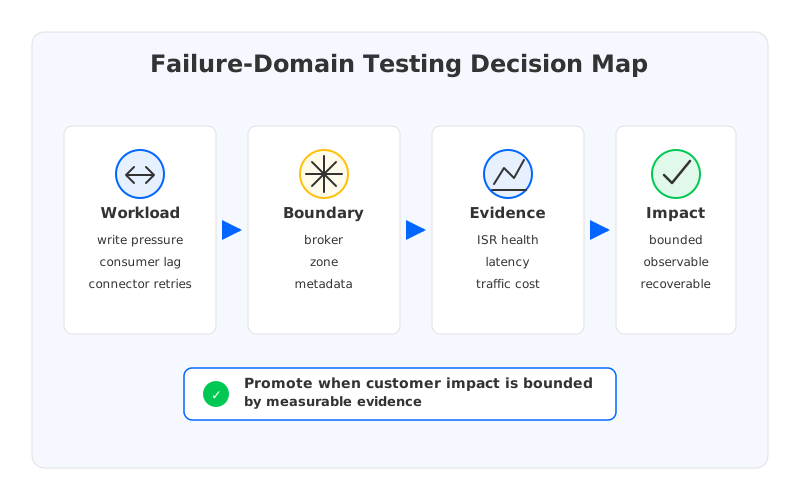
The most useful tests start with a map. Draw the boundaries that can fail independently, then attach each boundary to an observable customer outcome. A broker-local disk failure should not become a customer-visible data-loss event. A single-zone network impairment should not create uncontrolled cross-zone traffic. A controller failover should not leave operators guessing whether metadata has stabilized. When the boundary is clear, the test can be specific enough to matter.
2The Production Constraint Behind the Problem
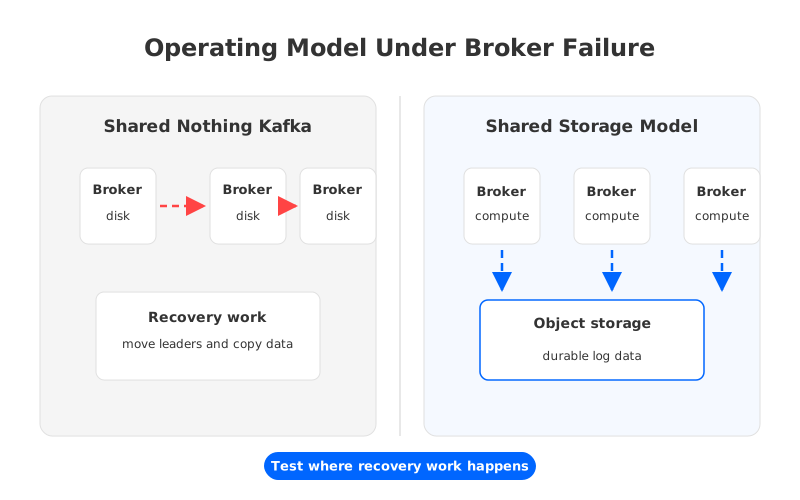
Traditional Kafka deployments often combine compute and durable storage inside each broker. That shared-nothing model made sense for distributed systems built around local disks: partitions live on brokers, replicas are spread across brokers, and recovery means moving leadership or copying data until the cluster returns to its target replication state. The model is robust, battle-tested, and familiar. It also means the failure domain of a broker includes both the process and the data placed on that broker.
In cloud environments, this coupling changes the cost and recovery profile. When a broker is replaced, its data placement has to be reconciled. When a partition is under-replicated, the cluster may need to copy bytes across zones. When capacity is added, rebalancing can consume network and disk throughput that the application also needs. Tiered storage can reduce how much cold data remains on broker disks, but the hot path still needs careful testing because local broker state and active replicas remain part of the operational picture.
Failure-domain testing is where this architecture becomes concrete. It reveals whether the team has enough spare broker capacity, enough network headroom, enough controller stability, and enough runbook discipline to survive the boundary being tested. The test also reveals hidden ownership gaps. SRE owns the cluster. Data engineering owns consumers and connectors. Security owns network controls. Finance sees the cross-zone bill. If the test stops at broker health, it misses the actual production system.
3A Practical Failure-Domain Test Matrix
The matrix below is intentionally neutral. It applies whether you run open-source Apache Kafka, a managed Kafka service, or a Kafka-compatible cloud-native platform. The goal is to separate the failure being injected from the outcome being measured.
| Failure domain | What to inject | What to measure | Production risk if untested |
|---|---|---|---|
| Broker process | Restart, kill, or isolate one broker | Leader election time, producer errors, ISR movement | A routine restart causes application-facing write failures |
| Broker storage | Saturate or detach local disk where applicable | Append latency, under-replicated partitions, recovery traffic | Local storage issues become cluster-wide instability |
| Availability zone | Block traffic to one zone or drain nodes | Client failover, cross-zone traffic, controller stability | A zone problem becomes a customer incident or cost spike |
| Metadata plane | Force controller failover in a controlled window | Topic metadata convergence, admin operation behavior | Operators cannot distinguish recovery from stuck metadata |
| Consumer group | Kill consumers during rebalance and offset commits | Lag recovery, duplicate processing, offset correctness | Downstream systems see stale or duplicated events |
| Connector path | Pause source or sink systems | Backpressure, retry behavior, DLQ policy, freshness | Integration failures spread back into the streaming layer |
The table is not a one-time certification exercise. It is a release and operations habit. Every meaningful platform change should be mapped back to at least one row: broker version upgrade, instance-family change, storage-class change, network-policy change, client-library upgrade, connector migration, security policy update, or disaster-recovery redesign.
4How to Design Tests That Do Not Lie
A failure-domain test can pass while the system remains unsafe. That usually happens when the test is too small, too clean, or measured against the wrong outcome. Killing an idle broker in a staging cluster proves very little if the production risk is broker loss during a write-heavy window with active consumer lag and connector retries. The test has to preserve the pressure that makes the failure dangerous.
Start by choosing one customer-facing invariant for each scenario. For example, "acks=all producers continue with bounded retriable errors," "committed consumer offsets remain usable after recovery," or "critical topics do not lose their target durability posture." Then define the platform signals that prove or disprove that invariant. Broker liveness alone is weak evidence. ISR state, request latency, controller events, consumer lag, error-code distribution, and cloud-network metrics are stronger evidence because they connect the failure to Kafka behavior and user impact.
Good test design also keeps rollback visible. If you cannot explain how to stop the test and return to a known-good state, you are rehearsing confusion. The runbook should include pre-checks, blast-radius limits, abort criteria, owner handoff, and post-test reconciliation.
5Architecture Options And Trade-Offs
There are several ways to reduce the customer impact of Kafka failure domains. None is magic, and each shifts responsibility somewhere else.
The first option is disciplined operation of a traditional Kafka architecture. This means correct replication factors, rack awareness, conservative broker sizing, tested rolling upgrades, client timeout tuning, and enough spare capacity to absorb leader movement and replica catch-up. It works, but it asks the team to reserve capacity for the worst day, not the average day.
The second option is a managed Kafka service. Managed operations can reduce toil around provisioning, upgrades, monitoring, and common failure recovery. The trade-off is boundary visibility. Teams still need to test client behavior, consumer recovery, connector backpressure, networking, data governance, and disaster-recovery assumptions. A managed control plane does not remove the need to understand what happens when a workload boundary fails.
The third option is a Kafka-compatible architecture that separates compute from storage more aggressively. The design question changes from "how fast can brokers copy data after failure?" to "how much durable data is tied to the broker that failed?" If brokers are closer to stateless compute and durable log data is backed by shared storage, broker replacement and scaling can become less dependent on moving local replica data around. The trade-off is that the storage layer, write-ahead log design, metadata coordination, and cloud network path must be tested as first-class parts of the system.
6Evaluation Checklist For Platform Teams
A useful checklist should make weak assumptions uncomfortable. If every row receives a confident "yes" without evidence, the checklist is probably too vague.
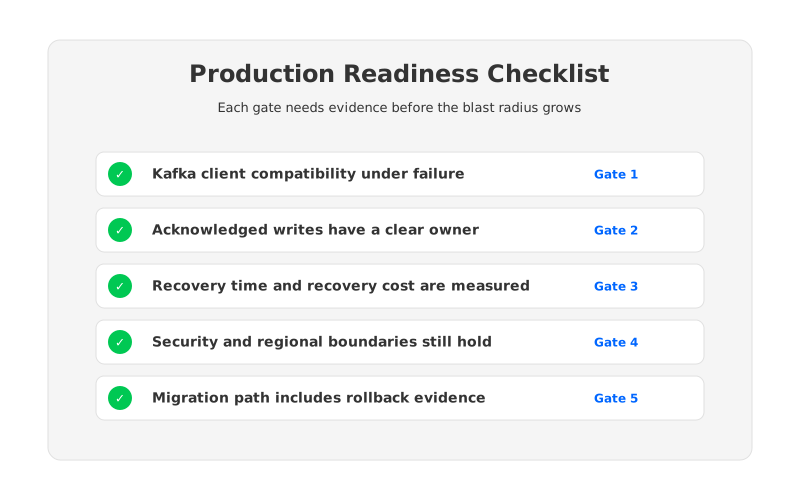
- Compatibility: Can existing Kafka clients, protocol expectations, authentication patterns, and operational tooling keep working during the failure scenario being tested?
- Durability: Which component owns the acknowledged write at each point in the failure, and what independent evidence proves that ownership?
- Recovery time: How long does the system take to restore the target replication, leadership, or service posture under real workload pressure?
- Recovery cost: Does recovery create cross-zone traffic, disk pressure, object-storage requests, or compute spikes that finance or SRE will see later?
- Operational boundary: Which team owns the decision to continue, abort, roll back, or fail over?
- Governance: Do encryption, private networking, identity, audit, and regional-control requirements still hold during degraded operation?
- Migration risk: Can the team test the new path, replay or mirror traffic, and roll back without turning a planned migration into an availability event?
The point is not to make the checklist long. The point is to force a crisp answer for every boundary that can hurt customers.
7How AutoMQ Changes The Operating Model
Once a team has done the neutral evaluation, AutoMQ becomes relevant as an architectural option rather than a product interruption. AutoMQ is a Kafka-compatible streaming system that keeps the Kafka protocol surface while moving the storage architecture toward shared object storage and stateless broker operation. Its documentation describes shared storage, WAL choices, Kafka compatibility, and eliminating inter-zone traffic in supported cloud deployments.
That shift matters for failure-domain testing because it changes what a broker failure means. In a traditional deployment, broker loss can imply process loss plus local durable-state recovery plus replica movement. In a shared-storage model, the broker is designed to be less stateful, so replacement and scaling can focus more on compute capacity and metadata correctness than on copying the broker's local data footprint. The failure-domain test still has to be real: producers, consumers, controllers, WAL, object storage, and network paths all need evidence. But the operating model being tested is different.
The most important distinction is where recovery work happens. If durable log data is no longer primarily stranded on a failed broker's local disk, then failover, replacement, and elasticity can avoid a class of expensive data movement. If the architecture can also avoid cross-AZ traffic for the write path under the right deployment model, the test matrix gains a new cost dimension: not only did the platform recover, but it recovered without turning the cloud network bill into a surprise incident artifact.
AutoMQ should still be evaluated with the same discipline as any other platform. Test Kafka client compatibility, broker loss during write pressure, zone impairment, WAL behavior under degraded paths, object-storage permissions, migration, and rollback. The benefit of a cloud-native Kafka-compatible design is not that it eliminates failure domains. It can make the boundaries cleaner and the recovery work less tied to broker-local storage, which is what platform teams need to verify before customers are involved.
8A Readiness Sequence That Works In Practice
The safest teams do not begin with a full regional disaster simulation. They build confidence from small, observable tests and then expand the blast radius. Start with broker process failure under representative workload. Add storage pressure or broker drain behavior where relevant. Move to availability-zone impairment only after client routing, quotas, observability, and abort criteria are proven.
Each step should produce an artifact that future operators can use: a runbook update, a dashboard panel, an alert threshold, a client-configuration recommendation, or a migration gate. The cluster may behave correctly while the organization still fails to decide quickly. A good readiness sequence trains both.
The final gate is customer impact. Define the smallest customer-visible symptom that would cause escalation: write latency, stale reads, delayed downstream updates, failed admin operations, or unexpected duplicate processing. Then prove the test either avoids that symptom or exposes it within an agreed error budget. Anything else is infrastructure theater.
9Conclusion
Failure-domain testing for Kafka is not about breaking things for drama. It is about discovering whether your architecture, clients, cloud network, storage model, and operating process agree on where failure is allowed to stop. The useful question is not "can Kafka survive failure?" Kafka can be engineered to survive many failures. The useful question is "which boundary fails next, and what does the customer see?"
If you are evaluating a Kafka-compatible architecture for lower operational risk, cleaner failover, or cloud-native recovery economics, use the matrix above as a buying and testing tool. For teams considering shared-storage Kafka-compatible infrastructure, AutoMQ's architecture documentation is a good next step, and you can contact the AutoMQ team through the verified product page: discuss your Kafka failure-domain testing plan.
10References
- Apache Kafka Documentation
- Apache Kafka Distribution and Replication Implementation Notes
- Apache Kafka Tiered Storage Documentation
- AutoMQ Architecture Overview
- AutoMQ WAL Storage Documentation
- AutoMQ and Apache Kafka Differences
- AutoMQ Zero Cross-AZ Traffic Documentation
- AutoMQ Migration Documentation
- Amazon S3 FAQs
- Amazon EC2 On-Demand Pricing
11FAQ
11.1What is a Kafka failure domain?
A Kafka failure domain is a boundary where one fault should remain contained, such as a broker, disk volume, availability zone, metadata controller, consumer group, connector path, network segment, or cloud account boundary. The useful definition is operational: if this boundary fails, what should continue, what may degrade, and what must never happen?
11.2How often should teams run Kafka failure-domain tests?
Run small tests after meaningful platform changes and larger tests on a scheduled readiness cycle. Broker restart, rolling upgrade, client-library change, storage-policy change, network-policy update, connector migration, and disaster-recovery redesign are all good triggers. The schedule matters less than tying tests to real changes in risk.
11.3Is chaos engineering the same as failure-domain testing?
Chaos engineering is a broader practice. Failure-domain testing is narrower and more architecture-driven. It starts with a named boundary, defines the expected Kafka and customer outcomes, injects a controlled fault, and records whether the boundary contained the failure.
11.4Does shared storage remove the need for Kafka failure testing?
No. Shared storage can change the recovery model by reducing dependence on broker-local data movement, but it introduces its own boundaries around WAL, object storage, permissions, metadata, and network behavior. The right conclusion is not fewer tests. It is better-targeted tests.
11.5What should be measured during a Kafka zone-failure test?
Measure producer error rates, produce latency, leader election, ISR health, consumer lag, committed offsets, controller stability, cloud-network traffic, connector backpressure, and application-level freshness. A zone test that only checks broker process health misses the outcomes customers actually feel.


