
Table of Contents
Table of Contents
A team searching for mongodb event ingestion kafka is usually past the tutorial stage. The question is no longer whether MongoDB changes can be streamed into Kafka. The harder question is what happens when the source connector restarts during a burst, a broker loses leadership, a downstream consumer falls behind, or a platform migration overlaps with a replay. At that point, MongoDB event ingestion is not a connector task. It is a recovery design.
MongoDB change streams and Kafka Connect give teams a familiar path for moving document changes into Kafka topics. That path works when the failure surface is small: one source, stable topics, predictable throughput, and a downstream service that tolerates duplicates. Production turns the same path into a compound system. Source offsets, Kafka offsets, connector task state, topic retention, consumer group progress, schema handling, dead-letter routing, and broker recovery all become part of one story.
The useful framing is therefore blunt: a reliable MongoDB-to-Kafka pipeline is measured by how it behaves after interruption. Throughput matters, but recovery behavior decides whether the platform is trusted by payment systems, search indexes, analytics pipelines, fraud models, and operational dashboards.
1Why teams search for mongodb event ingestion kafka
Most teams arrive at this search from one of three situations: building a CDC path from MongoDB, replacing batch exports with event-driven ingestion, or making MongoDB changes follow the same governance, replay, and consumer group model as other Kafka events. These situations look similar in an architecture diagram, but they fail in different ways.
MongoDB source ingestion has a source-side clock, a connector-side execution model, and a Kafka-side durability model. If the connector stops, the source position and Kafka write position must still make sense together. If Kafka is overloaded, source capture may observe changes while writes slow down. If downstream consumers pause, Kafka retention and replay capacity become the safety margin. A checklist that stops at "connector exists" is too thin for production.
The first design pass should name the failure modes rather than the products:
- Source interruption. The MongoDB deployment, credentials, network path, or change stream position becomes unavailable, and the connector needs a known resume behavior.
- Connector task failure. Kafka Connect workers restart, rebalance tasks, retry writes, or route failed records, and the team must understand which operations are idempotent.
- Kafka-side recovery. Brokers, partitions, retention, and consumer group offsets decide whether a delayed pipeline can catch up without data loss or uncontrolled cost.
- Downstream replay. Search, warehouse, lakehouse, and service consumers may need to rebuild state from Kafka rather than from MongoDB directly.
That last point is where many ingestion projects change shape. Kafka is not only a buffer between MongoDB and consumers. It becomes the replay contract for every team that depends on those changes.
2The production constraint behind the problem
Traditional Kafka is strong because it makes ordered partition logs explicit. Producers write records to topic partitions, consumers track offsets, and consumer groups divide partition ownership across members. The Kafka model gives teams a durable abstraction for fan-out and recovery, but broker implementation still matters. In the classic Shared Nothing architecture, each broker owns local storage, and partition replicas are copied across brokers for availability.
For MongoDB event ingestion, that local-storage design turns recovery pressure into capacity pressure. A burst of source changes creates producer load. A connector restart can replay records. A downstream outage increases retention pressure. A broker failure triggers leadership movement and replica catch-up. These are separate events in an incident timeline, but they often hit the same bottleneck: broker-local disk, network replication, and partition movement.
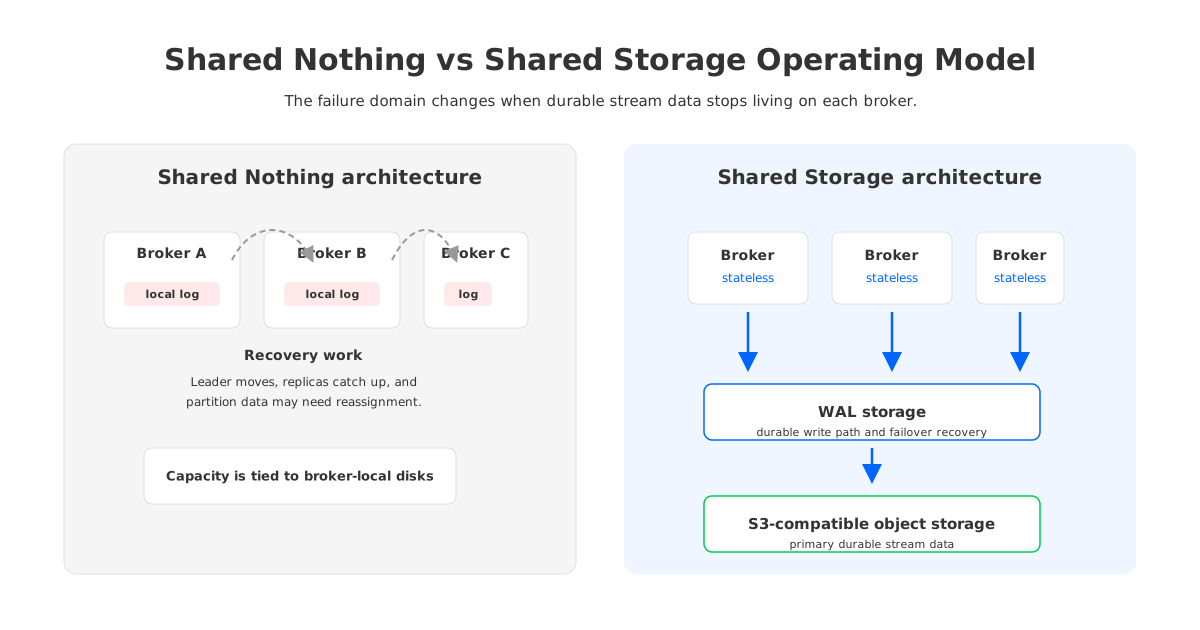
Tiered Storage can help with older data by moving historical segments to object storage, and it is a reasonable option for many Kafka deployments. The limitation is architectural: the hot path and partition ownership still depend on broker-local storage. If the production problem is only long-term retention, Tiered Storage may be enough. If the problem is elastic recovery under failure, the team has to evaluate the hot path, broker replacement, and data movement model as well.
This is especially visible during catch-up. A delayed MongoDB connector or consumer does not politely wait for the cluster to be idle. It competes with live writes, background replication, compaction, controller operations, and other tenants. In a small cluster, this may be acceptable. In a shared platform, the recovery workload can be larger than the steady-state workload that capacity planning was based on.
3Architecture options and trade-offs
There are several credible architectures for MongoDB event ingestion into Kafka. A self-managed Kafka Connect cluster gives teams control over connector plugins, worker placement, secrets, transforms, error handling, and upgrades. A managed Kafka or managed connector service reduces worker operations, but recovery and network behavior depend on the provider boundary. A CDC platform can abstract source capture, yet Kafka retention, replay, and downstream ownership remain architectural decisions.
The comparison becomes clearer when each option is evaluated against the same questions:
| Evaluation axis | What to verify | Why it matters during failure |
|---|---|---|
| Connector semantics | Resume behavior, task offsets, retries, dead-letter handling, and converter compatibility | Determines whether restarts produce gaps, duplicates, or malformed records |
| Kafka compatibility | Producer, consumer, Connect, transactions, ACLs, and client version support | Reduces migration risk for existing tools and stream applications |
| Storage model | Broker-local disk, Tiered Storage, or Shared Storage architecture | Defines how much data moves when brokers fail or scale |
| Cost model | Compute, storage, cross-AZ paths, PrivateLink or peering, and connector workers | Recovery traffic can be more expensive than steady-state traffic |
| Governance | Topic naming, schema strategy, ACLs, audit, and ownership | Prevents a CDC pipeline from becoming an unowned data firehose |
| Recovery objective | Acceptable duplication, replay window, lag, and cutover time | Converts vague reliability goals into testable conditions |
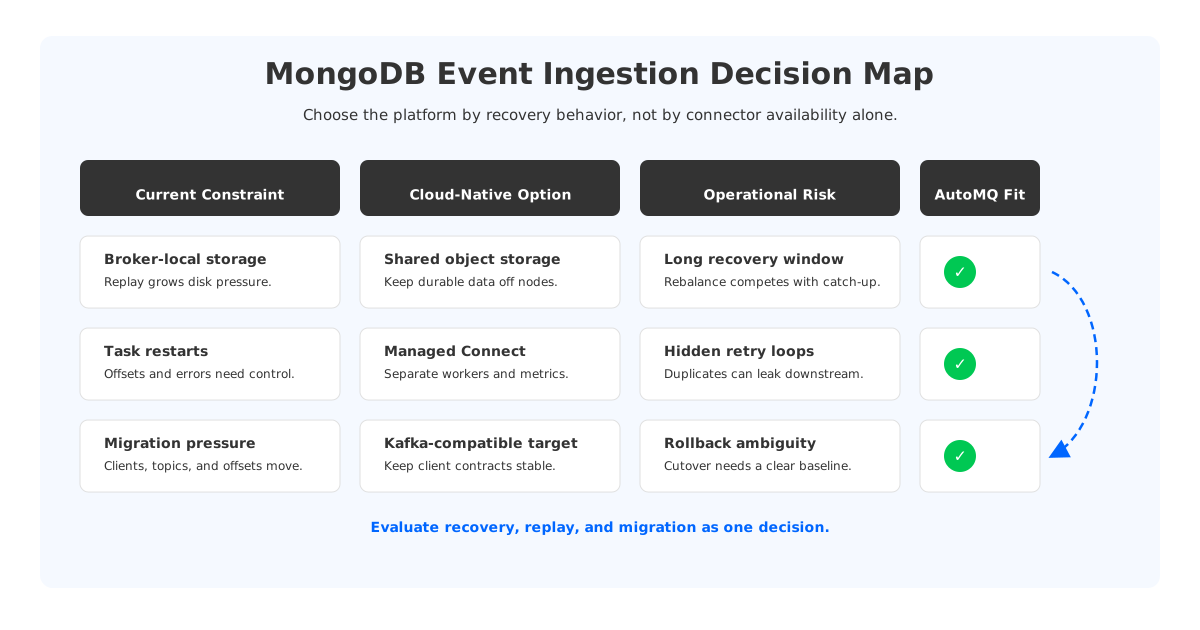
The decision map is useful because it separates connector choice from platform architecture. A strong connector running on an under-sized Kafka cluster is still fragile. A highly elastic Kafka platform with poor source offset discipline is also fragile. The production answer has to connect both halves.
For many platform teams, the most important boundary is rollback. If a MongoDB ingestion path is feeding a search index, a rollback may mean pausing consumers and rebuilding from Kafka. If it feeds an operational service, rollback may mean switching readers back to the previous topic or source path. If it feeds a lakehouse, rollback may mean replaying a bounded time window into a corrected table. Each path has a different tolerance for duplicate records, late records, and schema changes.
4Evaluation checklist for platform teams
Before choosing a platform, write the readiness checklist as if an incident review will read it later. Every owner, offset, network path, and recovery action should be named. If a line cannot be assigned to a team, the system is not ready.
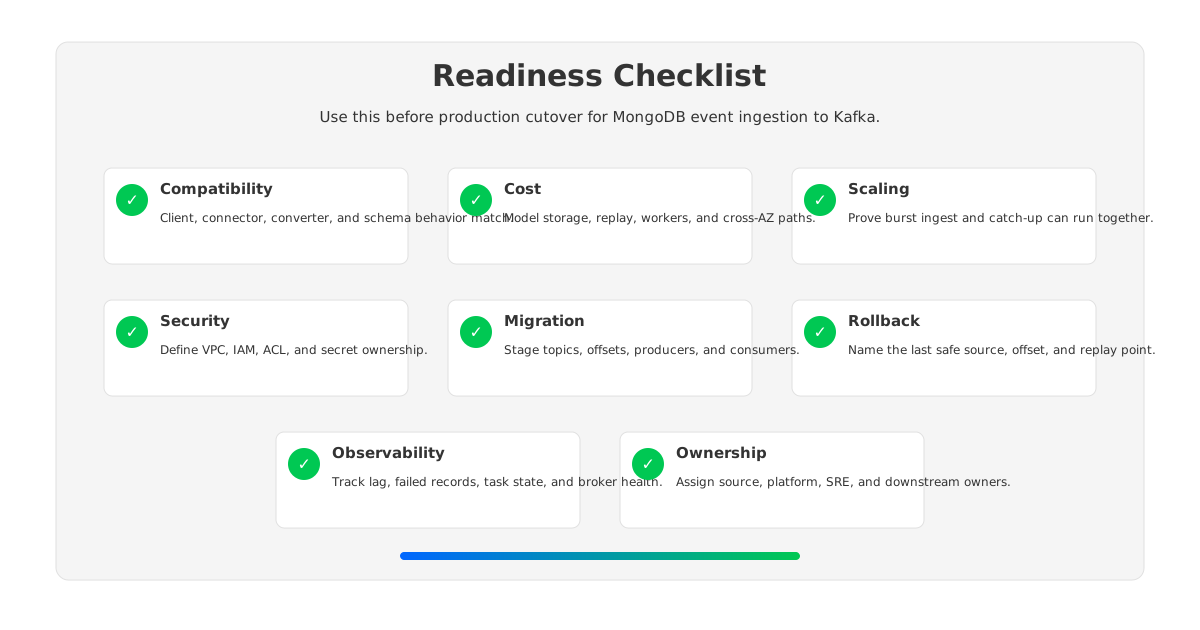
Start with compatibility. Existing Kafka clients, Kafka Connect plugins, stream processors, and monitoring tools should not require a rewrite as a side effect of moving MongoDB ingestion. Apache Kafka's consumer group and offset model is often the operational contract that downstream teams already understand. Preserving that contract matters more than choosing a fashionable platform label.
Then size for recovery, not average traffic. A MongoDB source connector that normally writes a modest stream may need to catch up after maintenance, worker restart, or downstream outage. That path consumes broker resources, object storage reads if historical data is involved, connector CPU, and network bandwidth. Test with live writes plus replay, because that exposes weak capacity assumptions.
Security deserves the same practical treatment. The team should document where credentials live, which network path connects MongoDB to workers, which ACLs allow topic writes, how secrets rotate, and whether data leaves the customer's account or VPC boundary. These details are not paperwork. They decide how quickly SRE and security teams can respond when a connector starts failing authentication or a downstream consumer reads from the wrong topic.
Observability closes the loop. A production ingestion path needs metrics for connector task state, failed records, source lag if available, Kafka consumer lag, broker health, request errors, and end-to-end delay. Logs should separate source permission, serialization, Kafka authorization, and broker-side capacity problems. Without that distinction, every incident becomes a generic "Kafka is slow" ticket.
5How AutoMQ changes the operating model
After those neutral checks, a different platform category becomes relevant: Kafka-compatible streaming with Shared Storage architecture. AutoMQ fits that category. It keeps Kafka protocol and ecosystem compatibility while replacing Kafka's broker-local log storage with S3Stream, WAL storage, S3-compatible object storage, and stateless brokers.
That architecture changes the failure conversation for MongoDB event ingestion. In a traditional broker-local model, broker replacement and scaling are tied to local partition data. In AutoMQ's Shared Storage architecture, durable stream data lives in shared object storage, while brokers focus on Kafka protocol handling, leadership, caching, and request processing. WAL storage provides the durable write path and recovery buffer before data is uploaded to object storage.
The practical effect is not that connectors stop failing. Connectors still need correct configuration, error handling, source permissions, and monitoring. The effect is that the Kafka layer has a different recovery shape. Broker failure does not require the same broker-local data movement model. Scaling and traffic balancing are less constrained by local disk ownership. Long replay windows align more naturally with object-storage-backed retention.
AutoMQ BYOC is also relevant when MongoDB event ingestion has strict data-boundary requirements. In BYOC deployment, the control plane and data plane run in the customer's cloud account or VPC boundary, and the Kafka workload uses customer-owned cloud resources. For teams moving operational database events, that boundary can be as important as throughput, because data integration pipelines often carry sensitive operational records.
Managed Connector support adds another layer for teams that do not want to operate Kafka Connect workers themselves. AutoMQ managed Kafka Connect lets users create connector tasks through the AutoMQ Console or Terraform, with worker execution handled by the control plane and support for metrics integration. That does not remove the need to test MongoDB connector semantics, but it reduces the amount of worker lifecycle machinery the platform team has to own.
Migration is the final reason to evaluate the architecture rather than the connector alone. AutoMQ Kafka Linking is designed for Kafka-to-AutoMQ migration paths with byte-to-byte replication, consumer progress synchronization, and producer proxy support in documented scenarios. For a MongoDB ingestion estate, that matters when the team wants to keep existing clients and topic contracts stable while changing the Kafka storage and operations layer underneath.
6A practical recovery model
A healthy recovery plan for MongoDB event ingestion has three layers. The source layer defines how the connector resumes from MongoDB and what happens when the source position is invalid. The connector layer defines retry, dead-letter, transform, converter, and task restart behavior. The Kafka layer defines retention, offset tracking, broker recovery, migration, and replay capacity.
Those layers should be tested together. A useful drill is to pause the connector, produce a burst of MongoDB changes, restart the connector, kill a Kafka broker or worker during catch-up, and measure whether downstream consumers recover within the agreed window. The point is not to create a dramatic chaos test. The point is to prove that the platform can absorb the failure pattern that production will eventually create.
The outcome should be a decision record, not a vague architecture preference:
- Which MongoDB collections and topics are in scope?
- Which fields define idempotency for downstream consumers?
- How long must Kafka retain data for replay?
- Which metrics page proves the connector is healthy?
- Which team owns rollback when the source, connector, Kafka layer, or sink fails?
- Which platform constraint forces a redesign: local storage, network cost, security boundary, migration risk, or worker operations?
If the answers point mostly to connector configuration, improve the connector estate first. If the answers point to broker-local storage, replay cost, and slow recovery under scaling, the Kafka platform architecture deserves a deeper review. That is the moment to compare a traditional Shared Nothing deployment, Tiered Storage, and a Kafka-compatible Shared Storage architecture on the same operational test.
7Closing checklist
MongoDB event ingestion looks like a source connector problem until the first recovery event. Then it becomes a platform problem. The teams that handle it well do not treat Kafka as a passive pipe; they treat offsets, retention, storage architecture, connector workers, and rollback ownership as one system.
If your team is evaluating MongoDB ingestion into Kafka and wants to keep Kafka compatibility while reducing broker-local storage and recovery pressure, review the AutoMQ architecture documentation or start a BYOC evaluation through AutoMQ Cloud.
8FAQ
8.1Is MongoDB event ingestion into Kafka the same as CDC?
It is usually part of a CDC design, but the production scope is larger than capture. Teams must also define Kafka topic contracts, offsets, retries, dead-letter handling, schema strategy, retention, replay, observability, and downstream ownership.
8.2Does Kafka guarantee exactly-once ingestion from MongoDB?
Kafka supports idempotent producers and transactions, but end-to-end behavior depends on the source connector, write pattern, sink behavior, and consumer idempotency. For MongoDB ingestion, design downstream consumers to tolerate retries unless the full connector-to-sink path has been tested for stricter guarantees.
8.3When is Shared Storage architecture useful for MongoDB ingestion?
It is useful when replay windows, burst catch-up, broker replacement, scaling, and storage cost dominate the operational problem. If the main issue is a single connector misconfiguration, fix that before changing the Kafka platform.
8.4Can AutoMQ replace Kafka Connect?
No. AutoMQ is the Kafka-compatible streaming platform underneath connectors and clients. Kafka Connect, managed connector tasks, CDC tools, stream processors, and custom consumers still perform integration logic. AutoMQ changes the broker storage and recovery model.
8.5What should be tested before cutover?
Test source interruption, connector restart, malformed records, broker failure, consumer lag, replay from retention, credential rotation, and rollback. The test is credible only when live writes and catch-up traffic run at the same time.
9References
- Apache Kafka documentation: https://kafka.apache.org/documentation/
- Apache Kafka Connect documentation: https://kafka.apache.org/documentation/#connect
- MongoDB Kafka Connector source connector documentation: https://www.mongodb.com/docs/kafka-connector/current/source-connector/
- AutoMQ Kafka compatibility documentation: https://docs.automq.com/automq/what-is-automq/compatibility-with-apache-kafka?utm_source=blog&utm_medium=reference&utm_campaign=failure-handling-recovery-mongodb-event-ingestion-kafka
- AutoMQ Shared Storage architecture documentation: https://docs.automq.com/automq/architecture/overview?utm_source=blog&utm_medium=reference&utm_campaign=failure-handling-recovery-mongodb-event-ingestion-kafka
- AutoMQ WAL storage documentation: https://docs.automq.com/automq/architecture/s3stream-shared-streaming-storage/wal-storage?utm_source=blog&utm_medium=reference&utm_campaign=failure-handling-recovery-mongodb-event-ingestion-kafka
- AutoMQ managed Kafka Connect documentation: https://docs.automq.com/automq-cloud/kafka-connect/overview?utm_source=blog&utm_medium=reference&utm_campaign=failure-handling-recovery-mongodb-event-ingestion-kafka
- AutoMQ Kafka Linking documentation: https://docs.automq.com/automq-cloud/migrate-to-automq/overview?utm_source=blog&utm_medium=reference&utm_campaign=failure-handling-recovery-mongodb-event-ingestion-kafka
- AWS EC2 data transfer pricing reference: https://aws.amazon.com/ec2/pricing/on-demand/


