
Table of Contents
Table of Contents
Teams usually search for object storage sink pipeline kafka when a connector has stopped being a convenience feature and has become part of the recovery plan. The sink may write audit logs to S3, land CDC records for a lakehouse, or archive operational events for replay. When it fails, the question is rarely "how do we restart the connector?" The harder question is whether Kafka, the connector runtime, object storage, and the consuming teams can agree on the same recovery boundary.
That boundary is easy to underestimate. Kafka tracks records by topic, partition, and offset. Kafka Connect tracks connector task state and offsets. Object storage exposes files, prefixes, metadata, permissions, and eventual downstream readers. A production-grade design has to connect those three worlds without pretending that a successful write to a bucket means the pipeline is fully recovered.
1Why teams search for object storage sink pipeline kafka
An object storage sink pipeline usually starts as a practical answer to a common data integration problem: Kafka is the real-time buffer, and object storage is the durable landing zone. The pattern is attractive because it separates ingestion from analytics, keeps replay available, and gives downstream teams a storage interface they already know how to query or govern. The moment the pipeline becomes business-critical, the design pressure shifts from throughput to failure handling.
The failure modes are not exotic. A sink task can crash after reading records but before flushing files. A bucket permission can change while the Kafka side remains healthy. A schema change can create unreadable output. A network path can fail between connector workers and the storage endpoint. A consumer group rebalance can move partitions while a task is closing files. Each case asks a different recovery question, so a single "restart failed tasks" runbook is too thin.
For platform teams, the operating target is stricter: recover without data loss, control duplicates, preserve replay, and avoid turning a connector incident into a Kafka cluster incident. That is why the keyword matters. The team is not looking for a generic sink connector tutorial. It is trying to decide what architecture can keep the object storage sink boring when production is not.
2The production constraint behind the problem
The object storage sink is downstream from Kafka, but its reliability is still shaped by the Kafka cluster behind it. In traditional Kafka, the broker owns local log segments, replication, leader movement, and storage capacity. That Shared Nothing architecture is proven and familiar, yet it also means recovery and scaling depend on broker-local data placement. When a cluster is under pressure, the sink pipeline inherits the blast radius.
Consider a backlog recovery after several connector tasks were paused. The sink needs to read historical records quickly enough to catch up, while producers continue writing and other consumers continue serving applications. On a broker-local storage model, that recovery competes with local disk I/O, page cache behavior, network replication, and partition leadership. If the cluster also needs rebalancing or broker replacement, the same local data is involved in several operational workflows at once.
Object storage does not remove these constraints by itself. A sink connector can write to S3, but Kafka may still keep durable log ownership tied to brokers. Tiered Storage can move older segments to object storage, which helps retention economics, yet the hot write path and broker-local serving responsibility remain separate concerns. A team needs to distinguish "Kafka writes files to object storage later" from "Kafka durability and recovery are designed around shared storage."
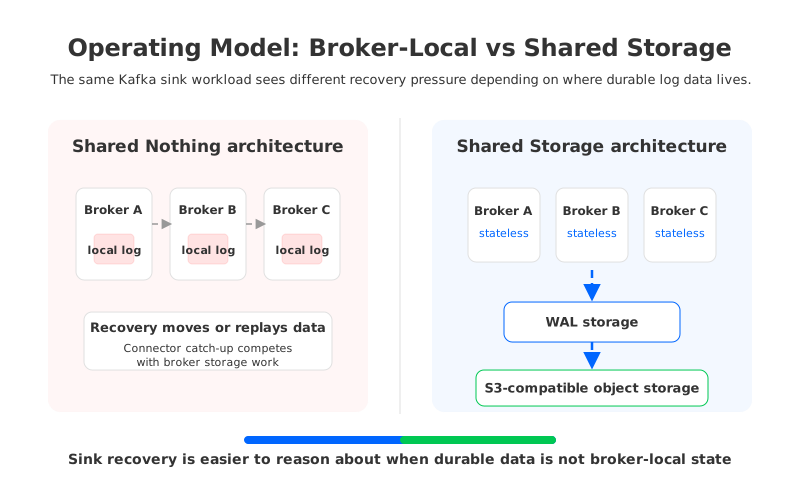
The core issue is alignment. Sink recovery wants a stable replay source, predictable offset behavior, enough catch-up bandwidth, and a storage endpoint that is governed independently. Kafka recovery wants broker health, leader availability, metadata correctness, and enough capacity for the workload. Object storage recovery wants idempotent file naming, durable object writes, access control, and lifecycle policies. A design fails when those concerns are optimized separately and tested together only during an incident.
3Architecture options and trade-offs
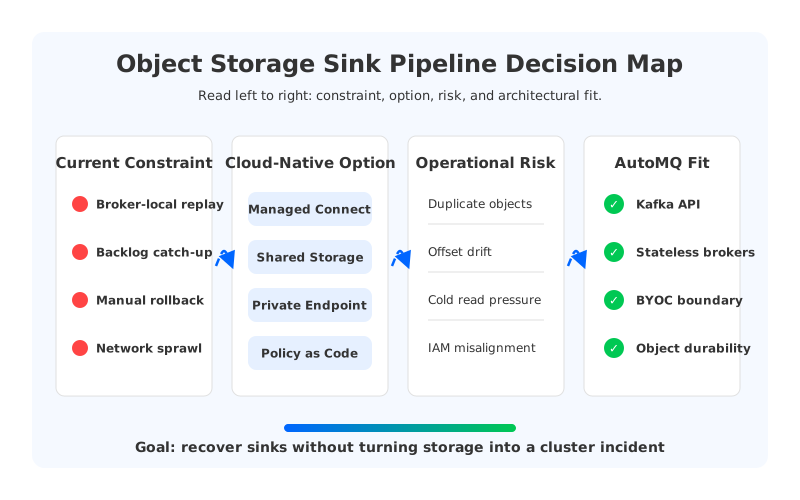
A neutral evaluation should start with what must be preserved. If applications depend on Kafka clients, consumer groups, transactions, schema workflows, and existing observability, then a replacement that breaks the Kafka contract creates application migration work. If the real problem is recovery pressure around storage and scaling, the platform decision should focus on the operating model underneath Kafka rather than the API surface alone.
| Option | What it preserves | What it changes | Recovery trade-off |
|---|---|---|---|
| Traditional Kafka with object storage sink | Existing Kafka operations and connector patterns | Adds a downstream sink path to object storage | Familiar, but broker-local storage still controls replay pressure and cluster recovery behavior |
| Kafka with Tiered Storage | Kafka API and long-retention access | Moves older segments to remote storage while retaining a local hot path | Useful for retention, but not a full answer to broker replacement, hot backlog recovery, or connector worker isolation |
| Kafka-compatible Shared Storage architecture | Kafka protocol, clients, offsets, and ecosystem behavior | Moves durable log storage away from broker-local disks | Changes the recovery model by reducing dependence on broker-local data movement, while adding object storage, WAL, cache, and metadata checks |
| Managed connector layer in a customer-controlled network | Connector lifecycle, worker isolation, and operational controls | Moves deployment and scaling from custom scripts to a control plane | Reduces connector operations, but still requires tests for permissions, schemas, retries, and rollback |
This table is not a ranking. The right choice depends on which failure mode costs the team the most. A stable cluster with small sink volumes may need better connector runbooks and stricter object naming rules. A high-throughput platform with frequent rebalancing, long retention, and multiple sink pipelines may need a deeper storage architecture change. The evaluation should make that distinction before any vendor or product name enters the conversation.
4Evaluation checklist for platform teams
The fastest way to expose weak assumptions is to write the recovery contract before choosing the platform. For an object storage sink, the contract should cover Kafka semantics, connector behavior, object storage layout, governance, and rollback. These areas are linked, but they should be tested separately so a failure in one layer does not hide inside a passing end-to-end demo.
Use this checklist as a readiness review:
- Kafka compatibility. Test the exact client versions, producer settings, consumer groups, offsets, transactions, Admin APIs, schema workflows, and Kafka Connect paths your applications use. Protocol compatibility is necessary, but workload compatibility is what protects migration risk.
- Connector recovery. Define what happens when a task crashes during file rotation, flush, retry, rebalance, or schema error handling. The expected behavior should name the duplicate policy and replay procedure, not only the restart command.
- Object storage contract. Standardize bucket ownership, prefix layout, object naming, encryption, access control, lifecycle policies, and downstream reader expectations. A connector can be healthy while creating objects that analytics teams cannot trust.
- Backlog and catch-up. Measure whether the platform can recover from a paused sink without starving producers or other consumers. This test should include cold reads, hot reads, and connector worker scaling.
- Network and security boundaries. Confirm whether traffic stays inside the intended VPC, account, region, and private endpoint path. Public egress and cross-zone paths can become both cost and compliance issues.
- Observability. Track connector task status, Kafka consumer lag, failed records, object write errors, flush latency, object count growth, and storage-side access denials in one incident view.
- Rollback. Decide whether rollback means pausing connectors, rewinding offsets, deleting partial objects, switching consumer groups, or restoring a previous schema. A rollback plan that starts with "inspect the bucket manually" is not a production plan.
The checklist has a useful side effect: it separates product convenience from architecture. A managed connector service can reduce deployment work, but it cannot compensate for vague idempotency rules. A shared-storage Kafka layer can reduce broker-local recovery pressure, but it still needs a tested WAL path, metadata health, cache behavior, and object storage permissions. Good platform decisions make these responsibilities explicit.
5How AutoMQ changes the operating model
After that evaluation, AutoMQ becomes relevant as a Kafka-compatible streaming platform that changes the storage layer under the Kafka contract. AutoMQ keeps the Kafka protocol and ecosystem compatibility while using Shared Storage architecture: durable stream data is stored in S3-compatible object storage, and brokers are designed as stateless compute nodes rather than owners of local persistent logs. For object storage sink pipelines, that changes where recovery pressure lands.
The important shift is that replay and broker lifecycle are less entangled with broker-local data movement. AutoMQ Brokers handle Kafka protocol processing, leadership, cache, and scheduling, while S3Stream writes through WAL storage and persists data to object storage. A broker replacement or scale event is therefore closer to a compute ownership change than a large local log migration. That matters when sink pipelines are catching up after a pause, because the platform team can reason about connector recovery separately from broker disk evacuation.
AutoMQ BYOC also changes the operational boundary for data integration teams. The control plane and data plane run inside the customer's cloud account or VPC, and AutoMQ managed Kafka Connect deploys connector workers in that environment. For object storage sinks, this model keeps access to buckets, IAM roles, private endpoints, and regional policies under the customer's cloud boundary. The practical benefit is not magic failure avoidance. It is a smaller set of cross-team handoffs when a connector worker, Kafka instance, and object storage bucket must be investigated together.
There is still engineering work to do. Teams should test connector plugins, flush behavior, object naming rules, schema compatibility, offset recovery, and downstream readers against their own workloads. They should also observe WAL storage, object storage request behavior, cache efficiency, and metadata health. The difference is that the Kafka storage architecture no longer forces every scaling or recovery event to revolve around broker-local durable data.
6Recovery scorecard before production
The final gate should be a scorecard, not a slide that says the architecture looks scalable. Score each item as pass, partial, or fail, and assign an owner. A partial result is useful because it tells the team which part of the recovery contract remains a manual process.
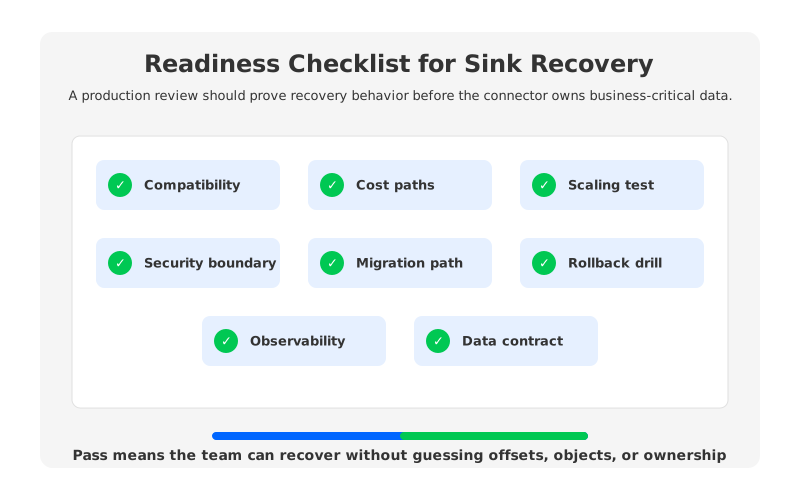
| Area | Pass condition | Owner |
|---|---|---|
| Offset recovery | The team can replay from a known Kafka offset or consumer group state without guessing which objects are complete | Data integration |
| Duplicate control | The object naming and downstream merge policy can tolerate connector retries and partial task failure | Lake platform |
| Cluster recovery | Broker replacement, scaling, or leadership movement does not block sink catch-up under tested load | Platform engineering |
| Security boundary | Connector workers access object storage through approved roles, network paths, and encryption policies | Security and cloud platform |
| Observability | Kafka lag, connector status, object write errors, and storage access failures appear in one incident workflow | SRE |
| Rollback | The team has a rehearsed rollback path for bad schema, bad objects, and failed migration steps | Application and platform teams |
Back at the original search query, the goal is not to find a connector that can write files to a bucket. The goal is to build a Kafka-backed object storage sink pipeline whose failure behavior is boring enough to operate. If your evaluation shows that broker-local storage is part of the recovery pressure, test a Kafka-compatible Shared Storage architecture alongside connector-level fixes. To evaluate AutoMQ in your own cloud boundary, start with AutoMQ Cloud and use the checklist above as the first PoC script.
7FAQ
7.1Is an object storage sink pipeline the same as Kafka Tiered Storage?
No. A sink pipeline writes Kafka records into object storage for downstream use, often through Kafka Connect or a custom consumer. Tiered Storage is a Kafka broker feature for moving older log segments to remote storage while preserving Kafka read semantics. They can coexist, but they solve different problems.
7.2What should be tested first when recovering a failed sink connector?
Start with offsets and object completeness. Confirm the last committed connector position, identify which objects were fully written, and decide whether replay will create duplicates. After that, test worker restart, schema handling, and downstream reader behavior.
7.3Does Shared Storage architecture remove the need for connector idempotency?
No. Shared Storage architecture can reduce broker-local recovery pressure, but connector idempotency remains part of the sink contract. File naming, commit markers, merge policies, and replay procedures still need explicit design.
7.4When does AutoMQ fit this use case?
AutoMQ fits when the team wants to keep Kafka compatibility while reducing the operational coupling between broker compute, durable storage, scaling, and recovery. It is especially worth testing when sink catch-up, broker replacement, storage growth, or cross-zone data movement regularly appears in incident reviews.


