
Table of Contents
Table of Contents
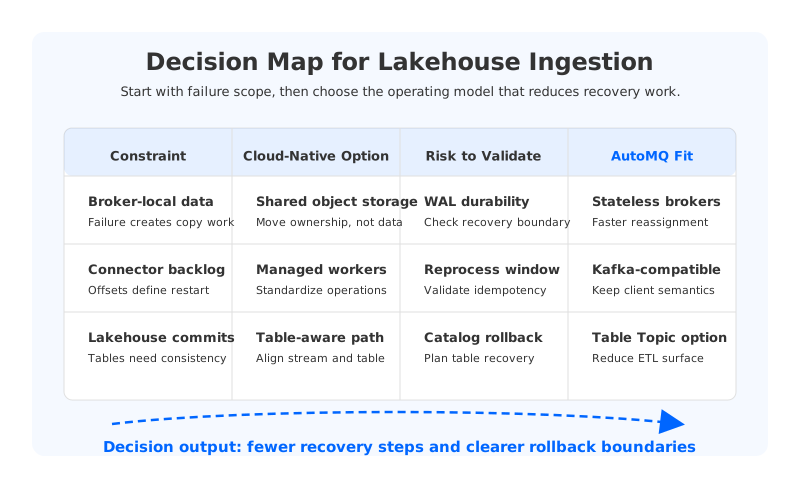
Teams searching for streaming ingestion lakehouse kafka are usually not asking a generic architecture question. They already have producers, topics, connectors, consumer groups, schemas, table formats, and dashboards in motion. The pressure appears when the lakehouse ingestion path becomes part of the production recovery plan: a connector restarts, a broker fails, a consumer group falls behind, a table commit is incomplete, or a migration window closes before the backlog is drained.
Kafka remains a strong foundation because it gives teams a durable event log, ordered partitions, offsets, consumer groups, and a mature ecosystem around Kafka Connect and stream processing. The hard part is whether the operating model around Kafka lets a platform team recover ingestion without guessing which layer owns the failure.
That distinction matters for a lakehouse. A failed ingestion pipeline is not only a messaging incident; it can become a table consistency problem, a catalog problem, a duplicate-write problem, and a governance problem. The right platform decision starts with failure handling because failure handling exposes the real architecture.
1Why Teams Search for streaming ingestion lakehouse kafka
The search usually starts after a team has outgrown batch-only ingestion. Analytics wants fresher data. Fraud detection wants events closer to real time. Machine learning teams want features written into a lakehouse without waiting for hourly jobs. Data engineering wants table management, while application teams still want Kafka APIs and operational patterns.
That creates a layered system. Producers write to Kafka topics. Kafka Connect, CDC tools, Flink jobs, or custom consumers transform and land data. The lakehouse layer handles files, snapshots, compaction, schemas, and catalog metadata. Each layer has its own recovery mechanism, and those mechanisms do not automatically compose.
The visible symptoms are familiar:
- A connector task restarts successfully, but the downstream table contains duplicates because the sink behavior is not idempotent.
- A consumer group commits offsets ahead of a failed lakehouse write, so replay requires manual offset correction.
- A broker replacement triggers partition movement, and the ingestion backlog grows while the lakehouse team is trying to keep table maintenance on schedule.
- A migration copies topic data but does not preserve the exact offset semantics required by downstream jobs.
- A security review approves Kafka access but delays the project because object storage, catalog, connector workers, and network boundaries are documented separately.
None of these failures are exotic. They happen because streaming ingestion into a lakehouse is an end-to-end contract, while most operational runbooks are written one component at a time.
2The Production Constraint Behind the Problem
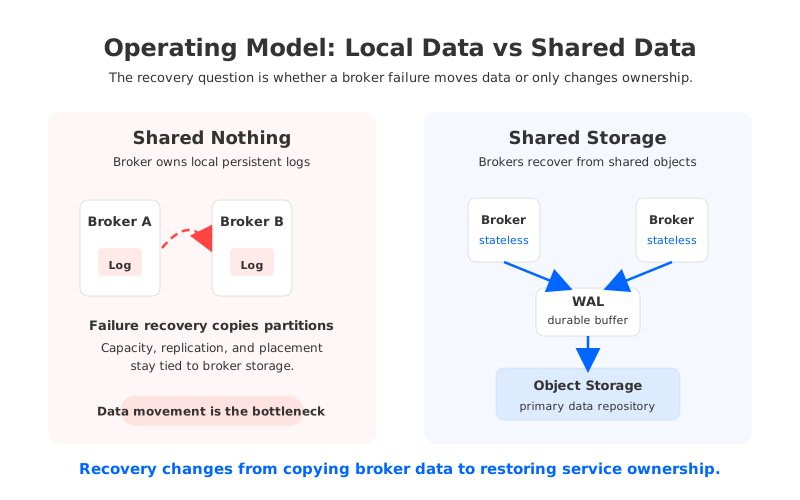
Traditional Kafka uses a Shared Nothing architecture. Each broker owns local log storage, and Kafka relies on replication between brokers to keep partition data available. That design is understandable: Kafka was built as a distributed commit log before cloud object storage became the default durable storage layer for analytics platforms. In a fixed cluster with carefully sized disks, broker-local storage gives direct control over hot data and predictable behavior.
The same design becomes harder to operate when lakehouse ingestion grows in three directions at once. Retention increases because teams want replay and backfill. Partition counts increase because more domains publish events. Read fan-out increases because one topic may serve operational consumers, enrichment jobs, audit pipelines, and lakehouse sinks. Local broker storage then becomes part of every capacity and recovery decision.
When a broker fails or a cluster needs to scale, recovery work often includes moving partition data or restoring local storage balance. Tiered Storage can reduce historical data on broker disks, but it does not fully remove the coupling between brokers and recent data in the primary storage layer. For ingestion teams, the question is what must move before the pipeline is healthy again.
That question is where lakehouse recovery gets practical. If a connector lags during broker recovery, the table may not receive files on schedule. If a consumer restart replays a window, the sink must handle duplicates. If failover changes leader placement and network paths, cost and latency can change under pressure.
3Architecture Options and Trade-Offs
A production ingestion design should compare operating models before comparing product names. The useful categories are not "Kafka or not Kafka." They are the places where failure state lives, who can observe it, and how much data must be moved during recovery.
| Option | Where it fits | Recovery strength | Trade-off to test |
|---|---|---|---|
| Self-managed Kafka with local disks | Teams that need direct infrastructure control and already have Kafka expertise | Full control over brokers, disks, topics, and upgrade timing | Broker replacement, rebalancing time, disk sizing, and operator workload remain yours |
| Managed Kafka service | Teams that want less cluster administration | Provider handles many broker operations | Check data plane boundary, service limits, networking, connector placement, and migration path |
| Kafka plus lakehouse sink tools | Teams standardizing on Kafka Connect, CDC, Flink, or custom consumers | Mature ecosystem and clear offset model | Exactly how offsets align with table commits must be tested under failure |
| Kafka-compatible shared-storage platform | Teams that want Kafka APIs with less broker-local storage coupling | Broker recovery and scaling can avoid large local data movement | Test latency profile, WAL behavior, object storage dependency, and compatibility edge cases |
| Direct table ingestion feature | Teams that want to reduce the number of ETL components | Fewer moving parts between stream and table | Validate supported catalogs, table formats, schema evolution, and rollback behavior |
This table is not a ranking. A CDC-heavy workload has different failure modes than clickstream ingestion, and append-only audit records behave differently from keyed updates. The common mistake is evaluating only steady-state throughput. A platform that looks efficient during normal ingestion may still be expensive if every broker failure creates data movement, every table incident requires manual offset repair, or every migration needs a high-risk cutover.
4Evaluation Checklist for Platform Teams
The evaluation should start with a failure matrix. Pick a representative topic, connector, downstream table, and consumer group. Then rehearse incidents that matter: broker loss, connector restart, object storage slowdown, catalog unavailability, schema incompatibility, consumer lag spike, and rollback after a bad deployment.
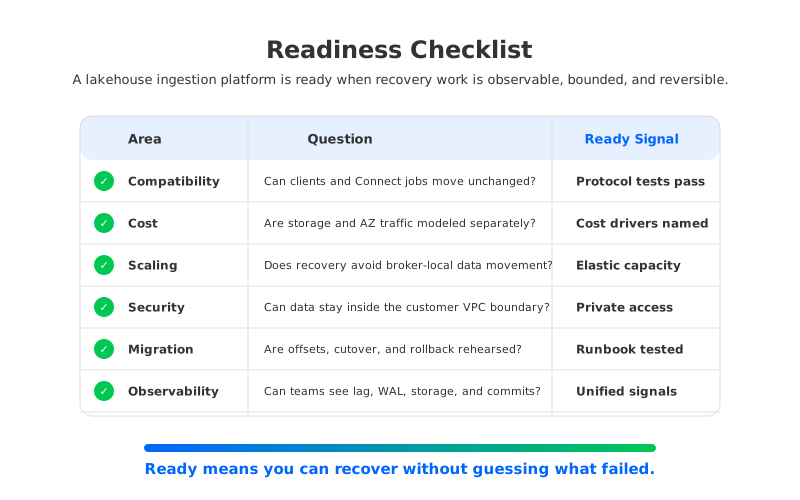
The checklist below turns that exercise into a platform decision rather than a generic benchmark:
- Compatibility: Verify the Kafka client versions, producer settings, idempotent producer behavior, transactions if used, consumer group behavior, ACLs, schemas, and Kafka Connect plugins. "Kafka-compatible" should mean the applications you run can pass their own tests, not only that the protocol is familiar.
- Offset and commit alignment: Define when a lakehouse write is considered durable and when the consumer offset is committed. If the offset moves before the table commit is durable, your rollback plan must explain how replay works.
- Cost surface: Separate compute, broker storage, object storage, cross-AZ data transfer, PrivateLink or endpoint charges, connector worker cost, catalog operations, and table maintenance. A single monthly number hides the levers that matter during growth.
- Scaling behavior: Measure how the platform behaves when partitions, producers, and sinks scale independently. The important question is whether scaling adds capacity or triggers data movement that competes with ingestion.
- Security boundary: Document where brokers, connector workers, object storage, catalog services, credentials, logs, and metrics live. BYOC and private-cloud requirements often fail late because these boundaries were described at a marketing level rather than an implementation level.
- Recovery and rollback: Rehearse replay, connector restart, sink idempotency, consumer group reset, table snapshot rollback, and cluster migration. The runbook should name the owner for each step.
- Observability: Track broker health, request latency, consumer lag, connector task state, WAL or storage behavior if applicable, object storage errors, table commit latency, and catalog availability in the same incident view.
This is also where platform and data teams should agree on ownership. Kafka operators own topics and brokers. Data engineering owns table correctness. Security owns access paths. FinOps owns cost attribution. A lakehouse ingestion platform crosses all four boundaries, so the recovery plan must name decision owners.
5How AutoMQ Changes the Operating Model
Once the evaluation framework is clear, AutoMQ becomes relevant as a Kafka-compatible shared-storage approach. AutoMQ keeps Kafka protocol compatibility while replacing broker-local log storage with S3Stream, a storage layer built around WAL, object storage, and data caching. Brokers become stateless for persistent data, and durable records live in shared object storage rather than a specific broker disk.
For lakehouse ingestion, that changes the failure model in three ways. Broker replacement and scaling are less dependent on copying local partition data. Object-storage-backed durability gives the data platform a storage boundary closer to the lakehouse itself. Because AutoMQ remains Kafka-compatible, existing clients, Kafka Connect jobs, stream processors, and observability tools can be evaluated with less rewrite risk.
The WAL layer deserves attention in any test. In AutoMQ, WAL absorbs the low-latency persistence path before data is uploaded to object storage. Production evaluations should test the WAL type that matches the deployment model, including write acknowledgment, upload path, cache behavior, and recovery before data reaches the primary object storage layer.
AutoMQ BYOC is relevant when lakehouse ingestion must stay inside a customer-controlled cloud boundary. In BYOC deployments, the control plane and data plane run in the customer's cloud environment, and managed Kafka Connect workers can be deployed inside the customer's VPC. That matters for CDC and lakehouse pipelines that need private access to databases, object storage, catalogs, and security tooling.
For teams trying to reduce the ETL surface, AutoMQ Table Topic is another evaluation path. It is designed to write streaming data into Apache Iceberg tables and can reduce separate ingestion components in supported scenarios. It is useful when the workload fits supported table, catalog, and schema requirements and when removing a connector or ETL layer improves recovery.
The migration story needs the same discipline as the architecture review. AutoMQ's Kafka compatibility can reduce application change, and Kafka Linking is available for supported migration paths. A production migration still needs source-cluster validation, authentication checks, topic mapping, offset handling, consumer cutover, and rollback rehearsal.
6A Practical Recovery Runbook
A strong runbook starts with the record lifecycle. A producer writes a record. The platform persists and serves it. A connector or consumer reads it. A sink writes files or table commits. A catalog records table state. If any step fails, the runbook should say which state is authoritative.
Use this sequence for a production drill:
- Stop one connector task while producers continue writing. Confirm whether lag grows, whether offsets are committed, and how the task resumes.
- Restart a broker or remove capacity from the cluster. Measure whether ingestion recovery waits on data movement, cache warm-up, leadership changes, or downstream sink throughput.
- Inject a table commit failure. Confirm whether the sink retries safely, whether duplicates appear, and whether table rollback can restore a consistent snapshot.
- Reset a consumer group in a controlled environment. Confirm who approves replay, how much data is replayed, and how duplicate writes are prevented.
- Simulate a migration cutover. Confirm producer routing, consumer offsets, schema behavior, connector state, and rollback timing.
The output should be a short scorecard: pass, partial, or fail. A partial result is valuable because it shows where the platform boundary is unclear. If connector recovery passes but table rollback is manual, that is a data-platform gap. If broker replacement passes but cost spikes across Availability Zones, that is a network and architecture gap.
7Conclusion
The phrase streaming ingestion lakehouse kafka sounds like a search keyword, but the production problem is concrete: can your team recover the ingestion path without losing track of offsets, table commits, storage state, and ownership? Traditional Kafka, managed Kafka, shared-storage Kafka-compatible platforms, and direct table ingestion features can all be valid when failure behavior matches governance, cost, and recovery requirements.
Start with the recovery drills, not the feature checklist. If broker-local data movement, connector operations, lakehouse commit consistency, or BYOC network boundaries are the pressure points, evaluate an architecture that changes those constraints directly. To test AutoMQ in that context, start with the docs and a workload-specific proof of concept through AutoMQ Cloud.
8FAQ
8.1Is Kafka still a good choice for lakehouse ingestion?
Yes, when the team needs durable event streams, replay, consumer groups, and a mature connector ecosystem. The key is to align Kafka offsets with downstream table commits and to test recovery under real failure conditions.
8.2What is the main failure risk in streaming ingestion for a lakehouse?
The main risk is inconsistent state across layers. A consumer may commit an offset while a table write fails, or a connector may replay data into a sink that is not idempotent. Recovery planning must cover both Kafka state and table state.
8.3Does Tiered Storage solve Kafka recovery problems?
Tiered Storage can reduce the amount of historical data kept on broker disks, but it does not fully remove broker-local storage from the operational model. Teams should test whether scaling, broker replacement, and recent-data recovery still depend on local data movement.
8.4Where does AutoMQ fit in a lakehouse ingestion architecture?
AutoMQ fits when teams want Kafka compatibility with a Shared Storage architecture, stateless brokers, object-storage-backed durability, and customer-controlled deployment options. It should be evaluated with the same compatibility, latency, recovery, and rollback tests as any production streaming platform.
8.5Should teams use Kafka Connect, Flink, or a direct table ingestion feature?
It depends on transformation needs. Kafka Connect is strong for standardized source and sink movement. Flink is useful when the pipeline needs stateful processing. Direct table ingestion can reduce operational surface when the workload fits supported table and catalog requirements.
9References
- Apache Kafka documentation: Consumer groups, offsets, transactions, KRaft, Tiered Storage, and Kafka Connect
- AutoMQ documentation: Compatibility with Apache Kafka
- AutoMQ documentation: Shared Storage architecture overview
- AutoMQ documentation: WAL storage
- AutoMQ documentation: Managed Kafka Connect in AutoMQ BYOC
- AutoMQ documentation: Table Topic overview


