
Table of Contents
Table of Contents
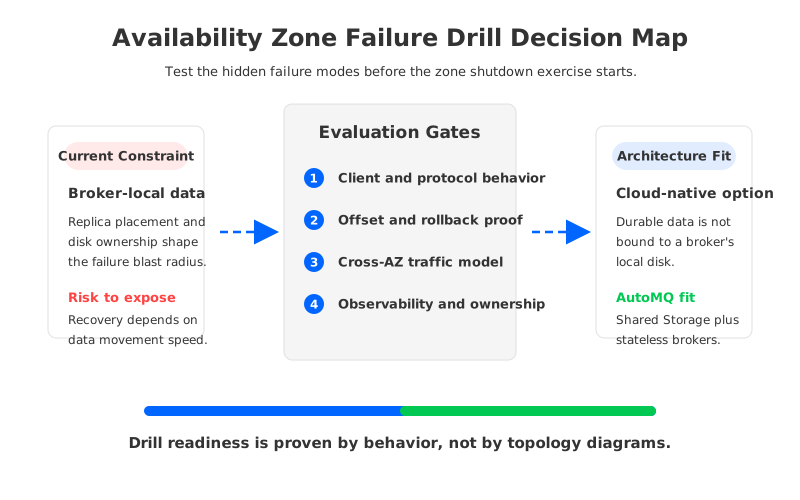
Someone searching for availability zone failure drill kafka is probably past the whiteboard stage. The cluster already runs across Availability Zones (AZs), a reliability review is approaching, and the platform team needs to prove that a planned zone impairment will not turn into a business incident. The visible question is whether Kafka keeps serving traffic when one zone disappears. The harder question is whether the surrounding operating model can survive: clients, offsets, broker storage, network paths, failback, observability, and rollback.
That distinction matters because a zone drill is a poor place to discover failure modes for the first time. Traditional Apache Kafka can tolerate broker failures when replication, quorum, capacity, and clients are configured correctly. But a production drill does not test Kafka in isolation. It tests choices around broker-local storage, partition leadership, cross-zone traffic, retained data, metadata, migration tooling, and team ownership.
The useful version of an AZ failure drill is a staged validation program. Before any zone is intentionally impaired, the team should know which symptoms are acceptable, which metrics define failure, and which recovery path is safe under pressure.
1Why teams search for availability zone failure drill kafka
The search usually starts with a deadline, not curiosity. A financial services team may need evidence for an operational resilience review. A SaaS platform team may have promised multi-zone durability. A data platform group may be moving from self-managed Kafka to a Kafka-compatible platform and wants a migration readiness checklist that includes failure behavior, not only throughput tests.
What they share is a need to convert architecture claims into operational evidence. A diagram with three brokers in three zones is a topology statement. It does not prove that producers reconnect, consumer groups rebalance on time, lag remains recoverable, offset reset tooling is safe, or traffic does not silently move across zones during the event.
The first pass at readiness should separate three layers of failure:
- Service continuity: Producers, consumers, admin clients, Kafka Connect workers, and stream processors keep making progress within agreed service-level objectives.
- Data correctness: Offsets, transactions, idempotent producer behavior, retention, and replay windows remain consistent with the workload's recovery model.
- Operating control: The team can observe the incident, stop the drill, fail back, or roll forward without guessing which system owns the next action.
If those layers are not separated, the drill produces ambiguous results. A consumer lag spike might be acceptable if the recovery budget allows it. The same spike is a failure if it breaks a fraud scoring pipeline, delays alert ingestion, or causes a downstream processor to replay from the wrong offset.
2The production constraint behind the problem
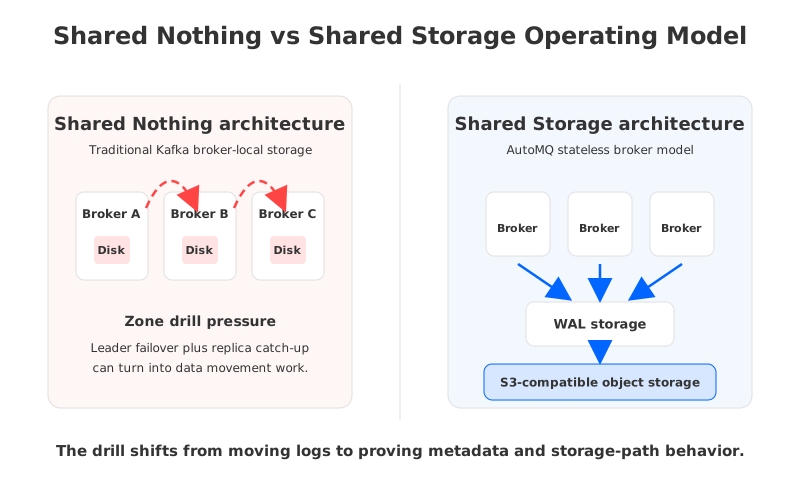
Traditional Kafka follows a Shared Nothing architecture. Brokers own partition replicas on local or attached storage, leaders serve reads and writes, and followers replicate from leaders through the in-sync replica (ISR) mechanism. This model is durable and well understood, but storage ownership and compute placement are tied together. When a zone is impaired, the cluster is not only moving traffic away from unavailable brokers; it is also dealing with replica availability, leader movement, catch-up behavior, and remaining capacity.
This is why a test that starts by turning off a whole zone can hide preparation gaps. The dramatic failure may pass while smaller failure modes remain untested. A broker restart might wait on local log recovery. A partition reassignment might collide with a retention-heavy topic. A consumer might fetch from a remote zone because rack awareness is incomplete. A migration link might copy data but miss assumptions around consumer progress.
The cloud cost model adds another constraint. In multi-zone deployments, data movement across zones may be billed depending on provider, region, and service path. AWS, Google Cloud, and Azure publish network pricing rules that teams should check against their topology rather than assume all in-region movement is free. For Kafka, the relevant traffic includes replication, consumer reads, rebalances, backfills, monitoring, and migration flows.
The practical implication is useful: design the AZ drill from failure modes backward. Ask what hidden coupling would make the drill inconclusive, then test that coupling while the system is healthy, observable, and reversible.
3Architecture options and trade-offs
The first option is to keep the current Kafka architecture and improve the runbook. This can be right when workload growth is predictable, retention is bounded, reassignment tooling is mature, and the organization accepts broker-local storage and replica traffic. The drill plan should then focus on rack-aware placement, client bootstrap diversity, controlled throttles, alert thresholds, capacity buffers, and failback rehearsal.
The second option is Tiered Storage. Apache Kafka's Tiered Storage separates hot local data from historical data in remote storage, which can help retention economics and long replay windows. It does not make brokers stateless, because the active write and serving path still depends on broker-local primary storage. For an AZ drill, the team still has to validate leader movement, local storage health, replica catch-up, and workloads that consume near the tail.
The third option is a Kafka-compatible Shared Storage architecture. Durable data moves out of broker-local disks into shared object storage, while brokers keep Kafka-facing compute responsibilities. Broker replacement becomes less about restoring local logs and more about restoring metadata ownership, cache warmth, client routing, and storage-path health. Testing still matters, but the test target changes.
A fair evaluation compares these options against the same workload.
| Evaluation area | What to test before the drill | Why it matters |
|---|---|---|
| Kafka compatibility | Producer retries, consumer groups, transactions if used, admin APIs, Kafka Connect, and monitoring clients | Compatibility is proven by the estate you run, not by one sample producer |
| Storage recovery | Broker restart, lost node replacement, retained-log access, and catch-up reads | Zone drills often expose storage coupling before they expose compute limits |
| Network path | Producer locality, consumer locality, replication traffic, private endpoints, and monitoring export | Cross-zone movement can affect both latency and cost |
| Elasticity | Scale-out, scale-in, partition movement, and cache warmup under load | A surviving cluster still fails if it lacks headroom |
| Migration and rollback | Data sync, offset consistency, dual-run validation, cutover, and failback | Migration risk is a reliability risk when drills happen during platform change |
| Governance | IAM, audit logs, encryption, deployment boundary, and operational ownership | The recovery path must fit the organization's control model |
A log ingestion cluster, a payments event stream, and a feature store pipeline can all use Kafka, but they should not share the same pass/fail criteria. Define the recovery window, acceptable lag, duplicate handling, and rollback point for each critical topic group.
4Evaluation checklist for platform teams
The checklist should begin with clients because clients decide whether a zone failure becomes visible to applications. Validate that producers use multiple bootstrap servers and have retry, timeout, idempotence, and acknowledgment settings that match the durability target. Validate that consumers survive group rebalances without unsafe offset resets. If Kafka Connect or stream processors are in the path, test their restart behavior and task placement as separate systems.
Next, test the metadata and control path. Kafka deployments that use KRaft depend on the metadata quorum for cluster coordination. Confirm where quorum voters run, what happens when a voter is isolated, and how long controller transitions take under load. Metadata health should be a first-class part of the drill.
Then test storage behavior before the zone exercise. Replace a broker. Fill a broker close to its operational threshold in a controlled environment. Reassign a topic with a long retention window. Run a catch-up consumer from an older offset. The goal is to know whether recovery is dominated by data movement, metadata changes, client behavior, or downstream capacity.
Cost and capacity deserve their own gate. Model the drill with normal write traffic, expected read fanout, retained bytes, and one zone removed. A cluster that passes technically but consumes all remaining headroom has borrowed capacity from the next incident. Check network pricing for the selected region and data path, especially with cross-zone replication, private endpoints, or cross-zone consumers.
The last gate is rollback. Every drill plan should name the point where the team stops, rolls forward, and restores the original topology. During migration projects, a target cluster that looks healthy under normal traffic may still be risky if the team cannot prove offset consistency, producer cutover behavior, and consumer resume behavior before the drill.
5How AutoMQ changes the operating model
After that neutral evaluation, the role of AutoMQ becomes easier to reason about. AutoMQ is a Kafka-compatible streaming platform that keeps Kafka protocol and ecosystem compatibility while replacing broker-local log storage with a Shared Storage architecture based on S3Stream, WAL storage, and S3-compatible object storage. Brokers still speak Kafka, but durable data is no longer owned by a broker's local disk.
That design changes what an availability zone failure drill is meant to prove. In a traditional Shared Nothing architecture, broker failure is tightly connected to local replica availability and data movement. In AutoMQ, stateless brokers reduce recovery work tied to local persistent storage. The drill shifts toward metadata ownership, client routing, WAL and object storage health, cache behavior, and deployment boundaries.
This does not make the checklist shorter; it makes it more precise. A platform team evaluating AutoMQ should still test the same producers, consumers, topic settings, security settings, and observability stack used in production. Several painful tests change shape:
- Broker replacement: The team validates broker replacement and traffic rebalance when durable data is in shared storage.
- Partition movement: The team measures reassignment and Self-Balancing without treating every movement as bulk data copy.
- Cross-AZ traffic: The team checks whether zone-aware design and S3-based routing reduce broker-to-broker replica traffic and client cross-zone paths under documented constraints.
- Migration readiness: The team validates Kafka Linking, including byte-level copy, offset consistency, producer cutover, and consumer progress synchronization.
- Rollback design: The team keeps a clear cutover point for producers and consumers instead of using the AZ drill as the first full-system cutover.
Deployment ownership also matters. AutoMQ BYOC runs in the customer's cloud account and VPC, while AutoMQ Software is for private data center environments. Reliability drills may include IAM, private networking, audit evidence, cloud limits, and incident response roles. A storage model that violates the organization's control boundary is not production-ready for that organization.
6A readiness scorecard before the zone shutdown
Use a scorecard close to the drill date. It should be strict enough to delay the drill when evidence is missing. A weak scorecard says "multi-AZ enabled." A useful scorecard says which client group, topic group, storage path, migration path, and rollback point has been tested.
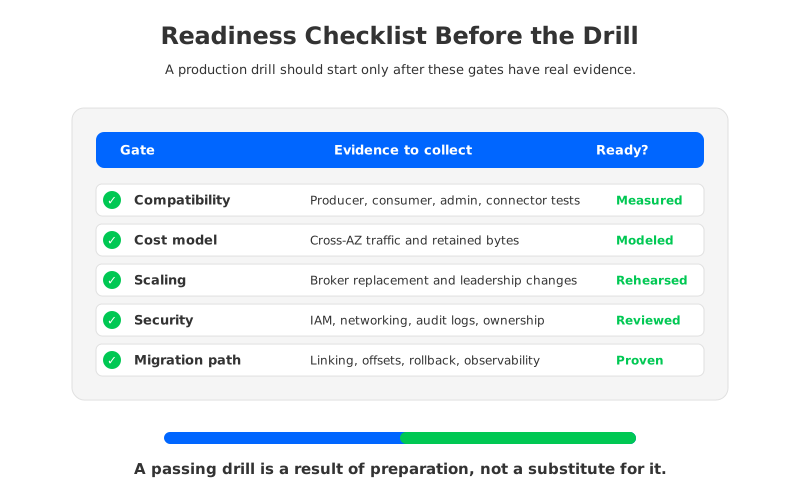
| Gate | Pass condition | Drill should wait if |
|---|---|---|
| Compatibility | Critical clients, connectors, and admin workflows have passed production-shaped tests | The proof is limited to a synthetic producer and consumer |
| Recovery | Broker replacement, leader changes, catch-up reads, and metadata transitions are measured | Recovery depends on assumptions about data movement or cache behavior |
| Cost and capacity | Remaining zones have modeled headroom and known network cost exposure | The team cannot explain traffic movement during the drill |
| Migration | Data sync, offsets, producer cutover, consumer resume, and rollback are rehearsed | The migration path is treated as separate from reliability |
| Governance | IAM, audit logs, private networking, and ownership are reviewed | The recovery path requires privileges or services not approved for production |
| Observability | Dashboards and alerts identify the failing layer within minutes | The team has to infer root cause from application symptoms |
The right outcome is not a perfect drill. The right outcome is a drill whose results can be interpreted. If lag rises, the team knows whether it was expected. If a client stalls, the team knows which timeout or metadata path failed. If a cost alarm fires, the team knows whether traffic moved through a known fallback path or a misconfiguration.
When the original search is availability zone failure drill kafka, the next useful action is to test the architecture before testing the disaster. Build the scorecard, run the smaller failure modes, and choose the streaming model whose trade-offs remain visible under pressure. For teams evaluating Kafka-compatible shared storage with customer-controlled deployment boundaries, start an AutoMQ BYOC architecture review with the same checklist.
7FAQ
7.1What is the first failure mode to test before a Kafka availability zone drill?
Start with client behavior. Producers, consumers, Kafka Connect workers, and stream processors decide whether a zone impairment becomes visible to applications. Validate bootstrap diversity, retries, timeouts, idempotent producer settings, consumer group rebalances, and offset handling first.
7.2Does Tiered Storage make Kafka brokers stateless?
No. Tiered Storage can move older log segments to remote storage, but the active write and serving path still depends on broker-local primary storage. Broker replacement, leader movement, and local storage health remain part of an AZ drill.
7.3How does Shared Storage architecture change an AZ failure drill?
Shared Storage architecture moves durable data out of broker-local disks and into shared object storage. The drill becomes less about restoring local logs and more about validating metadata ownership, storage-path health, client routing, and cache behavior.
7.4Should migration testing be part of an availability zone drill plan?
Yes, if the team is changing platforms, regions, or deployment models. A migration can fail operationally even when data sync works. Offset consistency, producer cutover, consumer resume behavior, observability, and rollback must be tested first.


