
Table of Contents
Table of Contents
Someone searching for cluster decommission planning kafka is usually trying to answer a dangerous question: can the old cluster be removed without making it part of the recovery plan? The migration may already look successful. Producers are sending to the target, consumers are catching up, and dashboards are green enough for a steering meeting. Yet the source cluster still exists because the final shutdown turns a reversible migration into an architectural commitment.
That is the right instinct. A Kafka cluster is not only a set of brokers; it is also offset history, access-control boundary, incident replay source, connector anchor, and operational memory. Decommissioning removes that anchor. The useful question is not "when can we delete it?" but "which failures have we proven we can survive without it?" Treat cluster decommission planning as a reliability exercise, not an administrative closeout.
1Why Teams Search for cluster decommission planning kafka
Cluster decommission work often starts after a broader migration or consolidation project. A team may be moving from self-managed Kafka to a managed service, splitting a large cluster by business domain, replacing hardware, changing cloud regions, or adopting a Kafka-compatible architecture with a different storage model. In every case, the source cluster becomes expensive to keep and risky to remove: finance sees duplicate infrastructure, SREs see rollback dependency, and application teams see protection if the target behaves differently under load.
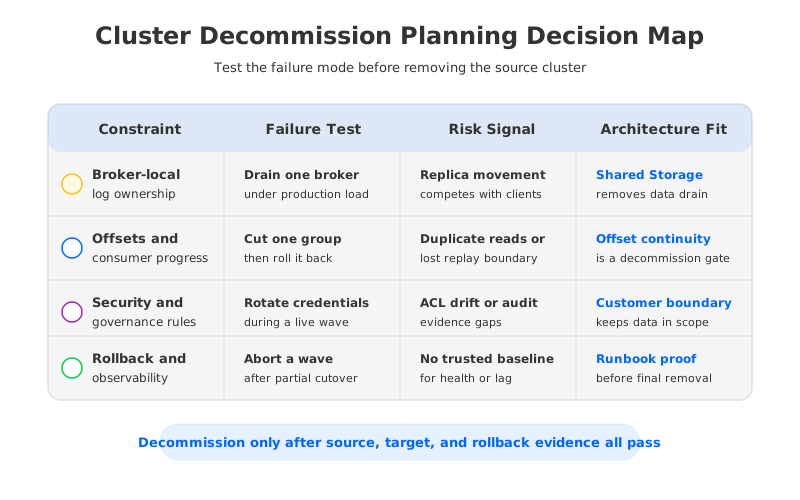
That tension comes from the way Kafka is used in production. Consumer offsets define where applications resume. Topic retention defines replay windows. Transactions and idempotent producers shape write semantics. Kafka Connect workers can carry connector offsets and task state that inventory reviews miss. KRaft metadata, ACLs, quotas, certificates, and monitoring rules form a control surface around the data. A plan that checks topic byte counts while ignoring runtime state will miss the parts that break user workflows.
The search phrase also signals a timing problem. Teams look for guidance when the migration is late enough to have real traffic on the target, but early enough that the old cluster can still absorb a rollback. That window should be used for failure drills, not for debating preferences. If a rollback, broker loss, credential rotation, consumer lag spike, or connector restart has not been tested during the overlap period, the source cluster is still doing unmeasured work.
2The Production Constraint Behind the Problem
Traditional Kafka uses a Shared Nothing architecture: each broker owns local or attached log data, and reliability comes from replication across brokers. That design is well understood, but it ties infrastructure lifecycle to replica placement. Removing a broker is not equivalent to deleting compute capacity. The partitions and replicas on that broker must be moved, throttled, and verified before the broker is gone.
The same coupling appears during cluster-level decommissioning. If the source cluster remains the trusted place for historical replay, offset comparison, connector recovery, or operational audit evidence, then it still owns part of the production state. The target may be handling live traffic, but the old cluster is still carrying the risk of unknown behavior. That is why many teams keep source clusters alive longer than planned. They are not being indecisive; they are compensating for missing evidence.
The failure modes worth testing are specific:
- Broker or node loss during the overlap period. A migration that works only while every source and target broker is healthy has not proven the decommission boundary.
- Consumer cutover with rollback. A consumer group should be able to move to the target, detect an issue, and return to a known safe position without guesswork.
- Connector restart or task rebalance. Kafka Connect pipelines may expose offset, schema, authentication, and task-assignment assumptions that ordinary producer and consumer tests do not cover.
- Access-control drift. ACLs, certificates, service accounts, and network paths must be validated under rotation, not only copied from an inventory spreadsheet.
- Observability loss. The team needs dashboards that prove target health without relying on source-cluster metrics as the baseline.
These tests break the tidy narrative that "traffic has moved, so the source is done." In a production Kafka migration, decommission readiness means the source cluster is no longer required to explain, recover, or prove platform state.
3Architecture Options and Trade-Offs
There are three common architecture paths when a team prepares for decommission. The first is to stay within a broker-local storage model and improve the runbook: better partition reassignment planning, disciplined throttling, clearer owner approvals, and a longer overlap window. This can be reasonable when workloads are stable and the migration target does not change the application contract. Its weakness is that data movement remains in the critical path for scaling, recovery, and broker retirement.
The second path is to use Tiered Storage. Apache Kafka's Tiered Storage separates older log segments from the local hot set by placing remote log data in object storage while retaining recent data on broker storage. That can reduce local storage pressure for long-retention workloads, and it can make historical reads less dependent on large broker disks. It does not remove the need to reason about the local hot tier, replica placement, and reassignment behavior. For decommission planning, the key question is not whether some data is remote; it is whether the source cluster still owns state that must be drained before infrastructure can disappear.
The third path is a Shared Storage architecture, where durable stream data is stored in shared object storage and brokers become stateless compute nodes. This changes the failure model. Broker replacement, scale-in, and decommission no longer have to wait for broker-local durable log data to move away first. The team still has to test client compatibility, offsets, security rules, and rollback behavior, but the operating model shifts from "move the data before removing compute" to "prove ownership, routing, and recovery before removing a dependency."
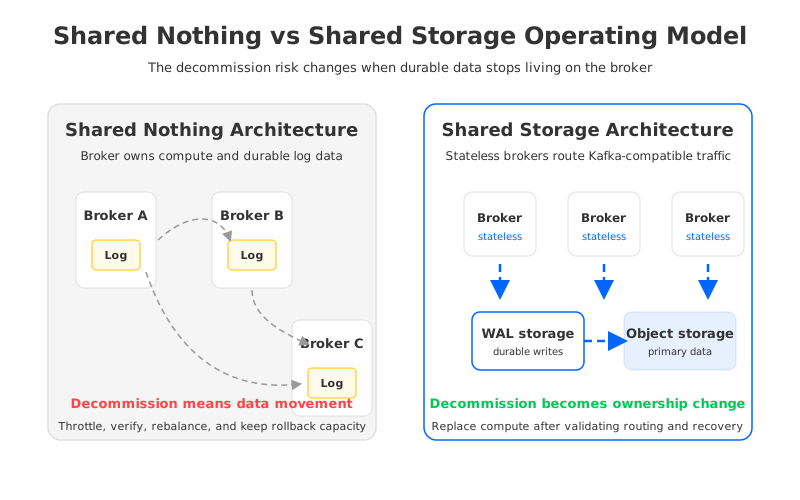
The trade-off is not only technical elegance. Shared storage moves more responsibility to object storage, WAL design, metadata management, and cache behavior. A serious evaluation should ask how writes are made durable, how cold reads behave, how object storage failures surface, how metadata is recovered, and how the platform preserves Kafka semantics. Low-latency transactional streams, log ingestion, CDC pipelines, and analytics fan-out stress the system differently.
4Evaluation Checklist for Platform Teams
A decommission plan should be scored against evidence, not optimism. Each gate below maps to a failure that can be rehearsed while the source cluster still exists. Require every weak gate to have an owner and a date before final shutdown.
| Gate | What to prove before decommission | Common failure signal |
|---|---|---|
| Compatibility | Clients, admin tools, transactions, idempotent producers, and Connect workloads run against the target. | A workload requires special handling that was not in the inventory. |
| Offsets | Consumer groups resume from the expected position after cutover and after rollback. | Lag graphs look normal, but an application reprocesses or skips a boundary. |
| Cost | The overlap period is budgeted for compute, storage, network, support, and operational coverage. | The team is pressured to remove the source before reliability gates pass. |
| Scaling | The target survives scale-out, scale-in, broker loss, and hotspot mitigation without source dependency. | Capacity planning assumes the source can absorb emergency traffic. |
| Security | ACLs, certificates, service accounts, network routes, and audit logs are validated under change. | Access works in steady state but fails during rotation or incident response. |
| Rollback | A failed wave can be stopped, routed back, and explained from recorded evidence. | Rollback depends on manual offset reconstruction or tribal memory. |
| Observability | Target dashboards prove health, lag, errors, and storage behavior without source metrics. | Operators compare against the old cluster because target signals are incomplete. |
Attach the checklist to a runbook with named owners. Application teams own service validation. Platform teams own cluster health, capacity, and security mappings. Data teams own connector and downstream correctness. Finance or procurement owns the cost overlap decision. Without those boundaries, everyone can agree in principle while nobody can approve the last step.
The most useful drill is a partial cutover followed by an intentional abort. Move a small but representative workload, let it produce and consume long enough to create real offsets, inject a target-side issue, and roll it back. If the team cannot explain where the application resumes, which records may duplicate, which alerts prove recovery, and who has authority to stop the wave, the source cluster is still part of the reliability design.
5How AutoMQ Changes the Operating Model
After the neutral evaluation, architecture becomes the practical question: which target state reduces the number of failure modes that require human coordination? AutoMQ is a Kafka-compatible cloud-native streaming platform that keeps Kafka protocol semantics while replacing broker-local log storage with a Shared Storage architecture. Stateless brokers process Kafka traffic, WAL storage provides durable write buffering, and object storage holds the primary stream data.
This matters because it changes what must be proven before compute can be removed. In traditional Kafka, broker retirement forces teams to reason about local replicas, reassignment traffic, disk capacity, and throttling windows. In AutoMQ's architecture, durable data is not tied to the broker's local disk. Decommission testing can focus on client behavior, metadata ownership, offset continuity, routing, object storage health, and rollback boundaries.
AutoMQ's migration story also matters at the final shutdown stage. AutoMQ Open Source recommends MirrorMaker2 for migrations from Apache Kafka or other Kafka distributions. AutoMQ commercial editions provide Kafka Linking for smoother migrations where byte-level message synchronization and offset consistency are required. The operational takeaway is simple: choose the migration mechanism based on the failure mode you need to control. If duplicate processing is acceptable for a logging workload, a simpler path may be enough. If application correctness depends on exact replay boundaries, offset consistency becomes a decommission gate rather than a nice-to-have feature.
The deployment boundary also matters. AutoMQ BYOC runs the control plane and data plane inside the customer's cloud account and Virtual Private Cloud, while AutoMQ Software is intended for customer-managed private environments. For regulated teams, audit logs, network routes, object storage buckets, identity permissions, and operational evidence remain inside the customer's environment. That does not remove governance work, but it makes the ownership boundary explicit.
AutoMQ should still be tested like any production platform. Validate Kafka client behavior, Connect integrations, producer retries, consumer groups, quotas, metrics, and object storage operations under failure. Test scale-in and broker replacement, and confirm how the selected WAL type fits latency and durability requirements. Stateless brokers and shared storage reduce durable data movement tied to infrastructure lifecycle; they do not remove the need for disciplined cutover evidence.
6A Readiness Scorecard for the Final Shutdown
The last decommission meeting should not ask whether everyone feels comfortable. It should ask whether the scorecard has enough evidence to make the old cluster irrelevant to recovery. Use a blunt scale: 0 untested, 1 lab-tested, 2 production-like traffic, and 3 controlled production wave with rollback evidence.
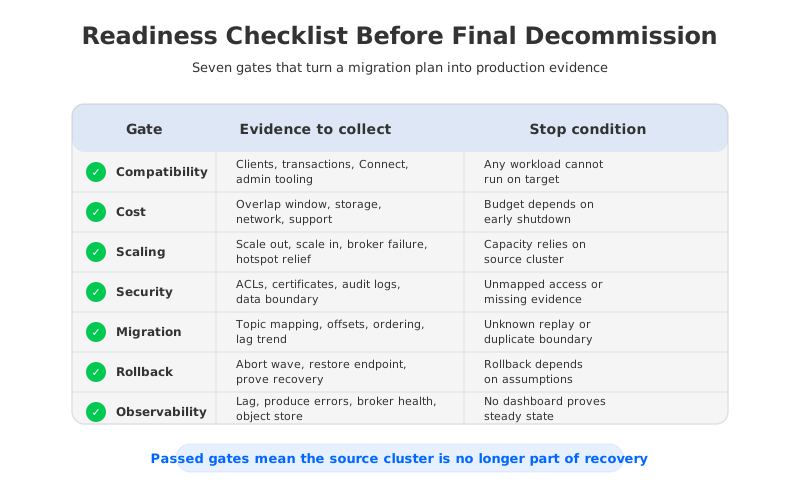
Use the scorecard to separate closure work from risk work. Archive topic mappings, migration configs, offset decisions, dashboard links, security changes, and rollback results. Keep the source cluster until required replay and audit windows are covered, but do not let undefined fear become an indefinite bill. When evidence says the source is no longer needed for compatibility, recovery, governance, or observability, decommissioning becomes a controlled infrastructure action.
The opening question was whether the old Kafka cluster can be removed without becoming part of the recovery plan. That answer comes from drills, not promises. If your team is evaluating a Kafka-compatible shared-storage target for a decommission-heavy migration, the next useful step is to test the operating model with your own offsets, retention windows, and rollback rules. You can start an AutoMQ BYOC evaluation here: try AutoMQ in your own cloud.
7FAQ
7.1When is a Kafka source cluster safe to decommission?
A source cluster is safe to decommission when it is no longer required for rollback, replay, offset verification, audit evidence, or emergency capacity. The team should have evidence from controlled production-like drills.
7.2Is broker decommissioning the same as cluster decommissioning?
No. Broker decommissioning removes a broker from a running cluster, usually after moving partitions away from it. Cluster decommissioning retires an entire source environment after migration or consolidation, so it also includes application cutover, offsets, governance, and rollback boundaries.
7.3Does Tiered Storage remove decommission risk?
Tiered Storage can reduce pressure on broker-local storage for long-retention workloads, but it does not automatically make brokers stateless. Platform teams still need to test the local hot tier, replica placement, consumer offsets, and rollback behavior before final shutdown.
7.4How does Shared Storage architecture help decommission planning?
Shared Storage architecture stores durable stream data in shared object storage instead of broker-local disks. That reduces the need to move durable log data before removing compute, so decommission testing can focus on compatibility, routing, metadata, object storage health, and rollback evidence.
7.5What should be tested first in a Kafka migration readiness checklist?
Start with the workloads that are hardest to roll back: transactional producers, stateful consumers, high-fan-out consumer groups, CDC connectors, and services with strict replay boundaries. These workloads reveal whether offset handling and rollback procedures are real or assumed.
8References
- Apache Kafka Documentation
- Apache Kafka basic operations
- Apache Kafka KRaft operations
- Apache Kafka Connect documentation
- Apache Kafka Tiered Storage operations
- AutoMQ architecture overview
- AutoMQ compatibility with Apache Kafka
- AutoMQ WAL storage
- AutoMQ migration overview
- AutoMQ inter-zone traffic overview


