
Table of Contents
Table of Contents
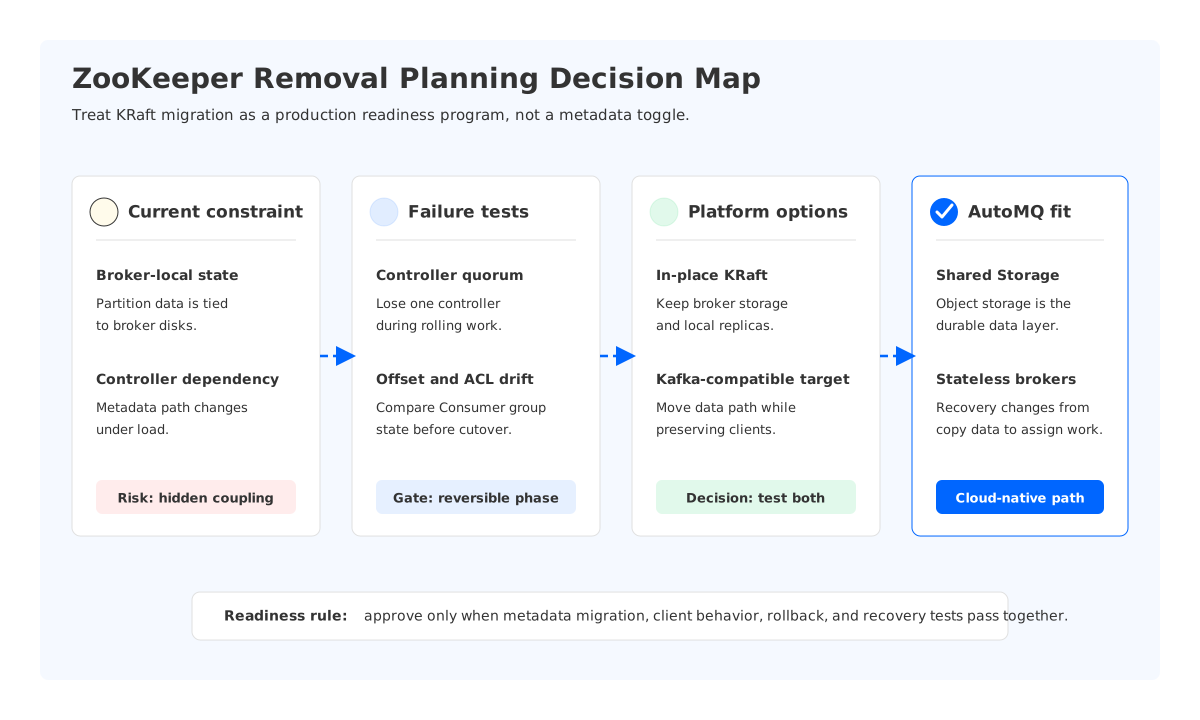
Teams usually search for zookeeper removal planning kafka after the direction is already clear. They know ZooKeeper is leaving the critical path for Kafka metadata. They know KRaft is the replacement direction in Apache Kafka. What is less clear is whether their production system is ready for the failure modes that appear when metadata, broker storage, client behavior, and rollback windows all move at once.
The dangerous version of the project is not the one that fails in a staging cluster. That failure is useful. The dangerous version is the migration that passes a clean happy-path checklist, reaches a final commitment point, and then exposes a broker-local storage issue, an offset mapping surprise, or a controller quorum weakness under real traffic. ZooKeeper removal planning should start with that uncomfortable possibility.
The practical question is not "Can we run without ZooKeeper?" A better question is: "Which assumptions must break in testing before we trust this plan in production?"
1Why Teams Search for zookeeper removal planning kafka
ZooKeeper removal is often framed as a control-plane upgrade. In older Kafka deployments, ZooKeeper stores cluster metadata and coordinates controller activity. In KRaft mode, Kafka stores metadata in a Raft-based controller quorum. Apache Kafka 3.9 documents the ZooKeeper-to-KRaft migration path as a phased process, while Apache Kafka 4.0 points teams back to 3.9 as the last bridge release for that migration path. That detail matters because planning is tied to version boundaries, not only architecture preference.
The search intent behind zookeeper removal planning kafka usually comes from four pressures:
- Version pressure. The team wants to avoid being trapped on an old Kafka line because metadata migration was postponed.
- Operational pressure. ZooKeeper adds another quorum to patch, observe, secure, back up, and explain during incidents.
- Platform pressure. The organization is consolidating Kafka operations into Kubernetes, Terraform, or a cloud platform model where separate coordination services create lifecycle drift.
- Migration pressure. The team is evaluating a Kafka-compatible target and wants to know whether the KRaft decision should be bundled with broader platform modernization.
Those pressures are legitimate, but they can push teams into the wrong unit of analysis. ZooKeeper is only one source of state. Kafka also has partition logs, Consumer group offsets, ACLs, quotas, transactional state, client behavior, connector configuration, monitoring assumptions, and runbook habits. Removing one coordination service does not automatically make the rest of the system easier to move.
2The Production Constraint Behind the Problem
Traditional Kafka was built around a Shared Nothing architecture. Each broker owns local storage for the partitions assigned to it. Durability comes from replication across brokers, and availability depends on leader/follower coordination, ISR (In-Sync Replicas), and enough spare capacity to survive failures. KRaft changes how metadata is coordinated, but it does not by itself remove the operational weight of broker-local data.
That distinction is the root of many failed plans. A team may successfully move controller metadata to KRaft and still carry the same storage behavior during broker replacement, cluster scaling, hot partition recovery, and cross-Availability Zone traffic. If a broker fails, the cluster still has to deal with partitions, replicas, leadership, catch-up work, and local disk placement. If the team scales out, it still has to rebalance data. If the team scales in, it still needs to drain partitions without damaging availability.
This is why ZooKeeper removal planning should test production constraints in groups rather than as isolated checks. Metadata migration, broker recovery, client continuity, and rollback are connected. A controller quorum test that ignores disk pressure tells you too little. A disk replacement test that ignores Consumer group progress also tells you too little.
The more useful failure map looks like this:
| Failure mode | What to test | Why it matters |
|---|---|---|
| Controller quorum loss | Stop one controller during rolling maintenance and observe metadata availability | KRaft depends on a majority of controllers staying available |
| Broker replacement | Remove a broker under write and read traffic, then measure leadership movement and recovery work | Storage architecture determines whether recovery is a metadata operation or a data movement operation |
| Offset continuity | Compare Consumer group progress before and after migration or cutover | A small offset mismatch can become duplicate processing or missed data |
| ACL and quota behavior | Replay representative admin and client operations | Security and governance regressions often appear outside the data path |
| Rollback boundary | Rehearse every rollback phase before finalization | Some migration phases are reversible, and some are not |
The table is not exhaustive. Its value is the habit it creates: every success criterion must connect to a production behavior the team can observe.
3Architecture Options and Trade-Offs
There are two common paths after the team accepts that ZooKeeper removal is not enough.
The first path is an in-place Kafka modernization. The team upgrades through a supported bridge release, runs the ZooKeeper-to-KRaft migration, validates the controller quorum, and keeps the existing broker storage model. Fewer moving parts change at once, which is useful when the existing cluster is well understood and the main risk is staying on an aging metadata architecture.
The trade-off is equally clear. In-place KRaft migration does not remove the storage mechanics that make Kafka operationally heavy in the cloud. Broker-local logs still influence scaling speed. Replication traffic still exists between brokers. Tiered Storage can reduce the amount of historical data retained on expensive local or block storage, but it keeps a local primary storage layer for the active log. That means it improves part of the cost and retention story without turning brokers into replaceable compute.
The second path is to treat ZooKeeper removal planning as a broader Kafka-compatible platform evaluation. Instead of asking only whether the current cluster can migrate to KRaft, the team asks whether the next platform should preserve Kafka APIs while changing the storage and operating model. This path carries more evaluation work upfront, but it addresses the question metadata migration does not answer: what should happen when brokers are scaled, replaced, drained, or isolated?
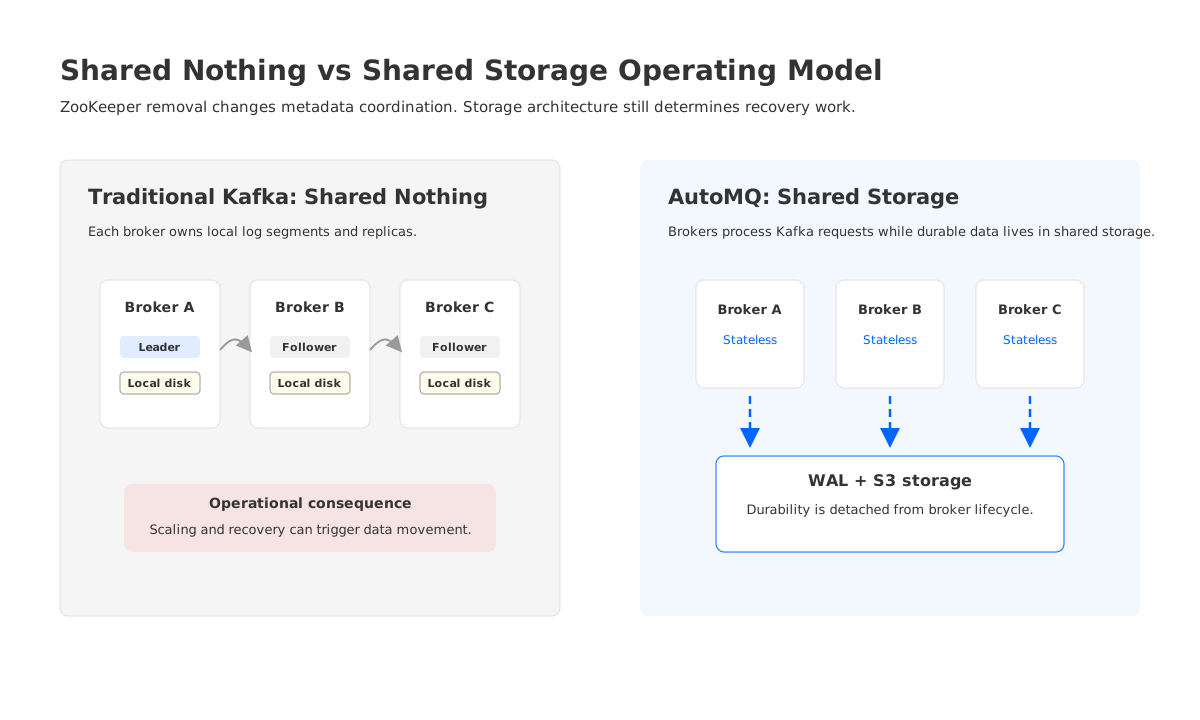
The comparison is not about old versus shiny. It is about where durable state lives. In Shared Nothing architecture, the broker is both compute and storage owner. In Shared Storage architecture, durable data is placed in a shared storage layer and brokers become closer to stateless compute nodes. That shift changes the failure test. You stop asking only, "Can the controller elect a leader?" and start asking, "How much data must move when the compute layer changes?"
4Evaluation Checklist for Platform Teams
A strong Kafka migration checklist separates compatibility from operations. Compatibility asks whether applications, clients, tools, and ecosystem components still work. Operations asks whether the platform behaves better when something breaks. Both are needed, and they fail in different ways.
Start with compatibility because it protects the business interface. Apache Kafka clients rely on stable semantics around topics, partitions, offsets, producer acknowledgments, Consumer group coordination, transactions, ACLs, and quotas. Test the messy clients too: old producers, long-running consumers, Kafka Connect workers, schema tooling, monitoring jobs, and admin scripts are where hidden dependencies live.
Then move to cost and elasticity. A cloud-native Kafka plan should explain provisioned disk, replication traffic, cross-Availability Zone movement, and capacity buffers together. Kafka cost is shaped by how much data is copied, how much capacity waits idle for failure scenarios, and how long rebalancing consumes network and disk bandwidth.
The third layer is governance. KRaft, managed Kubernetes, IAM, VPC routing, object storage policies, private endpoints, audit logs, and support access all change operational responsibility. A platform team should be able to answer who can change cluster state, where customer data is stored, and which control path can affect the data plane.
Finally, test rollback as a first-class feature. Apache Kafka's ZooKeeper-to-KRaft migration documentation makes the finalization boundary explicit: after finalization, reverting to ZooKeeper mode is no longer possible. That does not make the migration unsafe. It means the rehearsal must prove that the team knows exactly where the stop line is before crossing it.
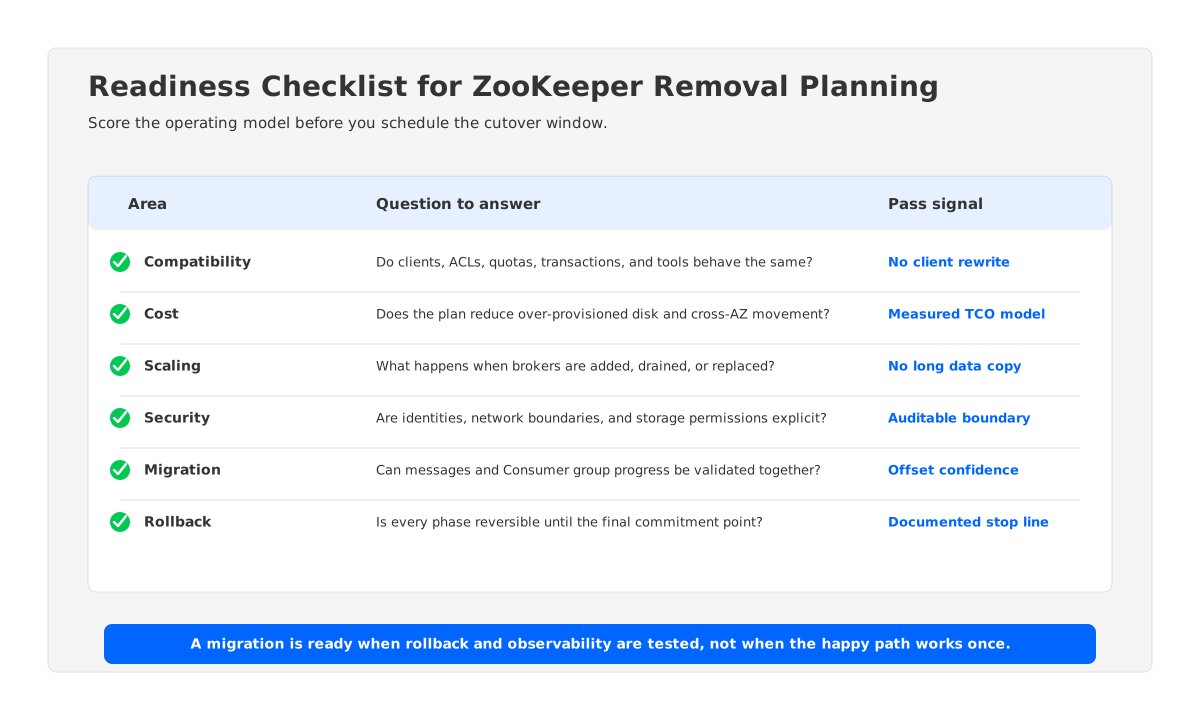
Use this checklist as a release gate, not as a document template:
- Compatibility: client SDKs, Kafka Connect, admin tools, ACLs, quotas, transactions, and Consumer group behavior are tested against production-like workloads.
- Cost model: storage, compute, network, and operational labor are modeled together, with assumptions written down.
- Scaling behavior: adding, draining, and replacing brokers are tested under read and write traffic.
- Security boundary: control plane, data plane, network, identity, and object storage permissions are reviewed together.
- Migration method: message data and Consumer group progress are validated in the same run.
- Rollback plan: every reversible phase has an owner, a command path, and a measured time budget.
- Observability: controller quorum, broker health, consumer lag, replication or synchronization backlog, request latency, and storage errors are visible during the test.
The score is not a percentage. A single red item in rollback or observability should stop the project, even when every compatibility test passes.
5How AutoMQ Changes the Operating Model
After the neutral evaluation is complete, AutoMQ becomes relevant as an architectural option rather than a slogan. AutoMQ is a Kafka-compatible, cloud-native streaming platform that keeps Kafka protocol and API compatibility while replacing Kafka's broker-local storage layer with a Shared Storage architecture built on S3-compatible object storage and S3Stream.
That architecture changes the shape of the tests above. In AutoMQ, brokers are stateless brokers from the perspective of durable Kafka data. The WAL (Write-Ahead Log) layer handles low-latency durability, and S3 storage acts as the primary data storage layer. Because persistent data is not tied to a specific broker's local disk, broker replacement and scaling are no longer dominated by copying partition data between machines.
This does not remove the need for testing. It changes what a good test should prove. You still validate Kafka compatibility, client behavior, Consumer group offsets, ACLs, metrics, and application restart procedures. You also validate the object storage permissions, WAL storage choice, VPC boundaries, and observability path. The difference is that compute-layer change no longer has to be treated as a large storage migration every time a broker is added or removed.
For teams using ZooKeeper removal planning as part of a broader migration, AutoMQ's Kafka Linking capability is relevant because migration risk often concentrates around offsets and rollback. Kafka Linking is designed for byte-level message synchronization and offset consistency, which helps prove that consumers can continue from the expected position after cutover. For less complex cases, open source migration paths such as MirrorMaker2 may be sufficient, but offset remapping and duplicate processing risk still need explicit tests.
The BYOC (Bring Your Own Cloud) deployment model also matters for governance. In AutoMQ BYOC, the control plane and data plane run inside the customer's cloud account and VPC. Security reviewers can inspect cloud resources, network paths, IAM permissions, object storage buckets, and operational access inside a customer-controlled environment.
The practical benefit is not that ZooKeeper disappears. KRaft already moves Kafka in that direction. The benefit is that the operating model can be redesigned around replaceable brokers, shared durable storage, and cloud-native lifecycle management. For platform teams, that is a different migration question: not "How do we remove one dependency?" but "Which stateful responsibilities should the next Kafka-compatible platform still ask brokers to carry?"
6Put Ownership on the Failure Modes
"We tested KRaft" is too vague to operate. "We killed one controller, drained one broker, replayed ACL changes, validated consumer offsets, and rehearsed rollback before finalization" is a plan an SRE team can trust. ZooKeeper removal planning begins as a metadata project, but production will judge it as a reliability project. If your current Kafka estate is healthy and the main issue is version posture, an in-place KRaft migration may be the cleanest route. If the pain is broader, local storage, slow scaling, cross-AZ movement, or repeated capacity planning, use the migration window to evaluate a Kafka-compatible Shared Storage architecture as well.
For teams that want to test that second path, start with the same failure modes in this article and run them against AutoMQ in your own environment. The fastest useful next step is to try the Kafka-compatible API and broker lifecycle behavior yourself through the AutoMQ project on GitHub: get started with AutoMQ.
7FAQ
7.1Is ZooKeeper removal the same as migrating to KRaft?
In Apache Kafka, ZooKeeper removal means moving cluster metadata management to KRaft. The project still needs version planning, controller quorum validation, client testing, rollback rehearsal, and operational readiness checks.
7.2Does KRaft make Kafka brokers stateless?
No. KRaft changes metadata coordination. Traditional Kafka brokers still own local partition data unless the platform uses a different storage architecture. Stateless brokers require separating durable storage from broker-local disks.
7.3Should ZooKeeper removal be bundled with a platform migration?
It depends on the source of pain. If the main issue is Kafka version posture, an in-place KRaft migration can be cleaner. If the main issues are scaling speed, broker replacement, storage cost, or cross-Availability Zone traffic, it is worth evaluating a Kafka-compatible Shared Storage architecture in parallel.
7.4What is the highest-risk part of the migration?
Rollback and offset continuity deserve special attention. A project can pass basic produce and consume tests while still failing when consumers resume at unexpected positions or when the team crosses an irreversible finalization boundary without enough observation time.
7.5Where does AutoMQ fit in ZooKeeper removal planning?
AutoMQ fits when the team wants Kafka-compatible APIs with a different operating model. Its Shared Storage architecture and stateless brokers change broker recovery and scaling behavior, while Kafka compatibility keeps existing clients and ecosystem tools in scope for migration testing.


