
Table of Contents
Table of Contents
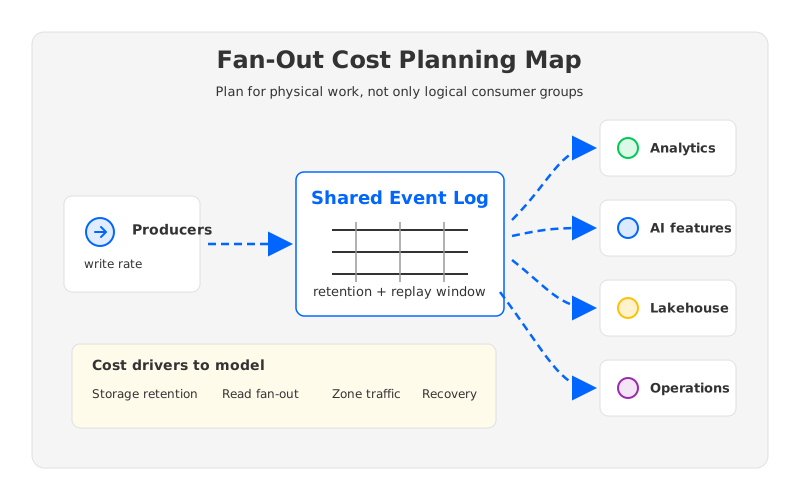
A Kafka platform rarely becomes expensive because one producer writes too much data. The cost curve usually bends when the same data becomes useful to many teams at once: fraud analytics, operational dashboards, lakehouse ingestion, feature pipelines, and AI agents that need fresh event context. Each added consumer sounds harmless because the data already exists, but the cluster still has to serve another read path, absorb another lag spike, and keep another team inside the same governance boundary.
That is the practical problem behind fan out cost planning kafka. The search query is not about consumer groups in isolation. It is about the moment when a streaming platform stops being a transport layer for one application and becomes shared infrastructure for analytics and AI. At that point, the bill is shaped by storage layout, network topology, broker recovery, client behavior, and ownership across business units.
1Why fan-out gets expensive before it looks broken
Kafka's consumer model is intentionally flexible. Multiple consumer groups can read the same topic independently, maintain their own offsets, and replay historical data when needed. That design is why Kafka works as a shared event backbone: one durable log can serve different applications without forcing them into the same processing schedule. The operational catch is that logical independence does not mean physical independence. Brokers still serve the bytes, disks still retain the log, and cloud networks still account for where those bytes move.
The first consumer group usually feels inexpensive because it rides on capacity that already exists. The fourth or fifth consumer group is different. A BI pipeline may scan older data in large batches, a stream processor may keep a steady low-latency read pattern, and an AI feature pipeline may replay a wider window after a model refresh. None of these workloads is wrong, but they pull the platform in different directions. Capacity planning that only measures producer throughput misses the read amplification created by fan-out.
For planning, separate four cost drivers instead of treating "Kafka cost" as one bucket:
- Storage retention decides how much historical data remains available for replays, backfills, late analytics, and model-feature regeneration. Longer retention is valuable, but it changes disk or object-storage sizing.
- Read fan-out determines how many independent consumers read the same event stream. This is the multiplier most teams undercount because it arrives team by team.
- Network placement decides whether reads and replication stay inside an availability zone, cross zones, or traverse private connectivity boundaries.
- Operational recovery determines how much spare capacity and data movement you need when brokers fail, partitions rebalance, or consumers fall behind.
These drivers interact. A customer-facing application may require low-latency reads, while a lakehouse sink wants durable bulk export. If both read the same topic across zones, the platform team pays for the same logical event multiple times through different infrastructure paths. If the cluster also uses broker-local disks, recovery adds another variable: data placement is tied to the machines that own the partitions.
2The cloud cost drivers behind read fan-out
Cloud cost planning starts with a simple equation: write volume multiplied by retention is not the whole system. A more useful planning model is:
effective_streaming_load =
  producer_write_rate
  + replication_or_durability_traffic
  + sum(consumer_group_read_rate)
  + replay_and_catch_up_bursts
The exact price depends on provider, region, instance type, storage class, and network path, so the formula should not be turned into a universal benchmark. It is still useful because it exposes where hidden multipliers enter. AWS, for example, publishes separate pricing pages for EC2 data transfer and S3 storage/request dimensions; a production estimate must use the current region-specific pricing pages rather than a stale spreadsheet. The important architectural point is stable even when prices change: every additional consumer group creates physical work somewhere.
The cost profile changes again when analytics and AI consumers appear. These consumers often have burstier access patterns than service-to-service consumers. A dashboard refresh may create hourly load, while an embedding pipeline may replay several days after a schema change. If the Kafka platform has no budget for catch-up reads, these jobs compete with steady consumers for CPU, network, page cache, and disk I/O.
| Planning Question | Why It Matters | Evidence to Collect |
|---|---|---|
| How many independent consumer groups read each high-volume topic? | Fan-out multiplies read traffic and operational ownership. | Consumer group inventory, offsets, owners, and service tier. |
| Which consumers replay history? | Catch-up reads can dominate short windows when average traffic looks moderate. | Lag history, backfill jobs, batch schedules, retention policy. |
| Where do consumers run? | Zone and VPC placement can change data-transfer cost and latency. | Client rack or zone labels, subnet map, private connectivity path. |
| Which topics feed AI or analytics systems? | These consumers often need longer retention and larger replay windows. | Lakehouse sinks, feature jobs, model-monitoring pipelines. |
The table forces a useful shift: fan-out cost planning is a shared-infrastructure governance exercise, not a broker-sizing exercise alone. The platform team needs enough technical data to model traffic and enough organizational data to decide which consumers deserve isolation, quota, or a separate tier.
3Storage, network, and compute trade-offs
Traditional Kafka couples compute and storage at the broker. The broker handles client requests and owns local log segments for its partitions. This shared-nothing model gives Kafka predictable performance and clear ownership of replicas. In cloud environments, the same model also means storage placement, broker lifecycle, and partition movement are closely linked. When the cluster grows, shrinks, recovers, or rebalances, data movement becomes part of the operational plan.
Tiered storage changes part of that equation by moving older log segments to remote storage while keeping hot data local. It can reduce pressure on broker disks and make longer retention more practical. It does not make brokers stateless, and it does not remove the need to reason about hot reads, local storage, replica placement, or the latency path for consumers that need fresh data. For fan-out planning, tiered storage is a helpful tool, but it is not the same as designing the primary streaming storage layer around shared storage.
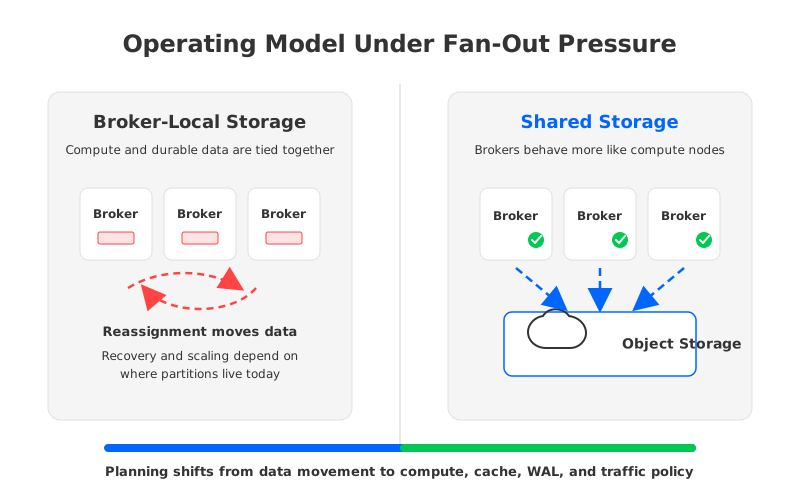
A useful architecture review should compare the operating model, not only the feature list:
- In a broker-local model, scaling often means adding brokers and then moving partition data until placement catches up with capacity. The more data each broker owns, the more important reassignment and recovery planning become.
- In a tiered model, older data can be served from remote storage, but hot data and active broker responsibilities still need careful sizing. Analytics consumers may still hit the hot tier when they replay near-term history.
- In a shared-storage model, brokers can be treated more like compute nodes because durable stream data is stored outside the broker lifecycle. That changes how teams think about elasticity, recovery, and workload isolation.
This is where AutoMQ enters the evaluation in a technical, not promotional, way. AutoMQ is a Kafka-compatible streaming system that uses a shared-storage architecture: brokers keep Kafka protocol compatibility while stream data is backed by cloud object storage through its storage layer and WAL design. For fan-out planning, compute and storage can be reasoned about separately. If the read side grows, the platform team can evaluate broker compute, cache behavior, and object-storage economics without treating every broker as a fixed bundle of CPU, network, and local durable storage.
The architecture also changes the failure conversation. When broker-local storage is the durability boundary, replacing a failed broker and restoring balanced placement can involve significant data movement. When durable data lives in shared storage, broker replacement can focus more on restoring compute capacity and metadata ownership. Capacity planning still matters, but the hard questions move to cache sizing, WAL choice, object-storage throughput, inter-zone traffic control, and consumer isolation policy.
4A practical evaluation checklist for platform and FinOps teams
The fastest way to find fan-out risk is to inventory consumers by topic and service tier. Do not begin with instance types. Begin with who reads the data, why they read it, and what happens when they fall behind. Kafka gives each consumer group independent offsets, which is exactly what analytics and AI teams need. The platform plan has to decide how much independence the infrastructure can support before costs or incidents spill across teams.
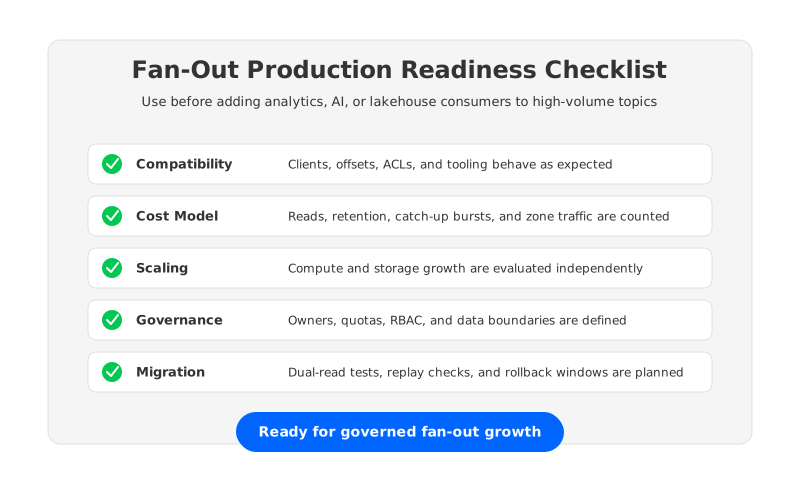
Use this checklist before increasing retention, adding another analytics sink, or approving another AI feature pipeline:
- Map consumer ownership. Every consumer group reading a high-volume topic should have an owner, service tier, expected read rate, replay behavior, and contact path.
- Classify read patterns. Separate steady reads from scheduled batch reads, ad hoc analytics, lakehouse ingestion, and model refresh jobs.
- Model zone placement. Identify whether clients, brokers, and storage paths stay in-zone or cross zone boundaries. Zone-aware routing can be as important as broker count.
- Budget catch-up reads. Measure how often consumers replay historical data and how quickly they try to catch up. Average throughput hides these bursts.
- Set isolation controls. Use quotas, separate clusters, topic-level ownership, or workload tiers where one consumer class can harm another.
- Define migration and rollback paths. Keep client compatibility, offset behavior, security, and rollback windows explicit.
This list is intentionally operational. A cost model that cannot be enforced by platform policy will drift. A governance policy that ignores physical traffic will become theater. Fan-out planning needs both: a cost model that understands the infrastructure and a platform model that understands the teams using it.
5How AutoMQ changes the operating model
AutoMQ's strongest fit is not "Kafka, but with a lower bill" as a slogan. The stronger argument is architectural: fan-out-heavy workloads expose the cost of coupling broker compute with durable storage. AutoMQ keeps the Kafka-facing programming model while moving the storage foundation toward cloud object storage and stateless brokers.
In a practical design review, the AutoMQ path should be evaluated across four dimensions:
| Dimension | What to Verify | Why It Helps Fan-Out Planning |
|---|---|---|
| Kafka compatibility | Client protocol, consumer groups, offsets, ACLs, and operational tooling expectations. | Migration risk stays bounded when consumers do not need application rewrites. |
| Shared storage behavior | WAL choice, object-storage path, cache strategy, and recovery model. | Storage durability is separated from broker lifecycle, which changes scaling and recovery planning. |
| Inter-zone traffic controls | Zone-aware client and broker configuration for read locality. | Fan-out reads are less likely to create uncontrolled cross-zone transfer. |
| Observability and governance | Metrics for consumer lag, read throughput, storage, network, and ownership. | FinOps teams can connect cost drivers to teams and workloads. |
The evaluation should stay honest about trade-offs. Object storage has different latency and request economics from local disks. A shared-storage architecture needs a WAL path and cache strategy that protect the hot write and read path. AI and analytics workloads may still need workload separation if they run replay jobs during business-critical windows. The benefit is not that architecture removes all planning; the benefit is that planning aligns with cloud primitives that can be scaled, governed, and priced directly.
That distinction matters when teams compare migration options. Replacing a Kafka cluster without changing the operating model may reduce one cost line while preserving the same fan-out bottlenecks. Changing the operating model can reduce broker-local overprovisioning, make broker replacement less data-heavy, and create a clearer path for elastic analytics and AI reads. The right answer depends on workload shape, compliance boundaries, and team maturity.
6Migration notes for analytics and AI consumers
Fan-out migrations fail when the platform team only tests producer throughput. Consumers are where the hidden state lives. Offsets, group membership behavior, schemas, ACLs, client library versions, sink connectors, and replay assumptions all have to be checked before a production switch. Analytics and AI consumers also need backfill tests because these teams often validate a platform by reading historical data at high speed.
A cautious migration plan usually stages the work in this order. First, inventory topics and consumer groups by business owner. Next, validate client compatibility and security configuration outside production. Then run mirrored or dual-read validation for representative consumers, including one steady service consumer and one bursty analytics or AI consumer. Finally, define rollback based on offsets and data correctness, not only cluster health.
The last point is easy to miss. A streaming platform can look healthy while a downstream model-feature job silently reads a different window than expected. Fan-out planning should define correctness checks for each consumer class: event counts, ordering assumptions, lag thresholds, schema compatibility, and replay completeness.
7References
- Apache Kafka documentation: consumers and consumer groups
- Apache Kafka documentation: consumer configuration
- Apache Kafka documentation: tiered storage
- AWS EC2 On-Demand pricing and data transfer notes
- AWS S3 pricing
- AutoMQ architecture overview
- AutoMQ S3Stream shared storage overview
- AutoMQ inter-zone traffic documentation
8FAQ
8.1What does fan-out mean in Kafka cost planning?
Fan-out means the same topic is read by multiple independent consumer groups. Each group can maintain its own offsets and read schedule, but the infrastructure still has to serve the bytes. Cost planning should count producer writes, durability traffic, steady reads, and replay bursts.
8.2Is tiered storage enough for analytics and AI consumers?
Tiered storage can help by moving older log segments to remote storage. It does not automatically remove hot-read pressure, broker compute limits, or operational planning for active partitions. Teams should compare it with a broader shared-storage operating model when read fan-out is a major cost driver.
8.3How should teams estimate cross-zone traffic risk?
Map where producers, brokers, consumers, and storage paths run. Then identify which consumer groups read high-volume topics across availability zones or private network boundaries. Provider pricing pages should be checked because network pricing is region- and path-dependent.
8.4When should AutoMQ be considered?
AutoMQ is worth evaluating when a Kafka-compatible platform needs cloud-native elasticity, independent compute and storage planning, object-storage-backed durability, and better control over inter-zone traffic. It is especially relevant when read fan-out grows faster than producer write volume.
8.5What is the next step after this checklist?
Return to the topic that creates the most uncomfortable cost or recovery question and model it with real consumer groups, not averages. If you want to evaluate the shared-storage path with your current retention, fan-out, and zone-placement data in hand, start from AutoMQ Cloud.


