
Table of Contents
Table of Contents
A team searching for real time feature pipeline kafka is usually past the whiteboard stage. The model already depends on signals that change during the day: account status, product clicks, payment events, device posture, inventory, support activity, or fraud labels. Batch refreshes still have a place, but the production question has shifted from "can we compute features?" to "can we keep the serving path fresh without turning Kafka operations into the bottleneck?"
That question is harder than it first sounds. Kafka can provide ordered, replayable event streams, consumer groups, offsets, transactions, and a broad connector ecosystem. A feature store can manage feature definitions, online serving, offline consistency, and discovery. The pressure sits between those two systems: the event feed has to absorb bursts, retain enough history for replay, keep downstream writers current, and remain governable when model teams ask for more signals. The practical thesis is simple: a real-time feature pipeline succeeds when the streaming backbone is evaluated as an operating model, not only as a message bus.
1Why Teams Search for real time feature pipeline kafka
Feature freshness becomes visible when predictions start depending on state that changes faster than the training cycle. A recommendation model may need the last few minutes of clicks. A risk model may need the most recent failed-login pattern. A support agent may need customer lifecycle events that were not in last night's warehouse snapshot. In each case, stale features are not an abstract data quality issue; they change the decision that an application makes.
Kafka often enters the design because it gives teams a durable event contract. Producers publish domain events once, and multiple consumers can build online features, offline training tables, monitoring views, and audit trails from the same stream. Apache Kafka's documentation describes the core mechanics behind this pattern: consumers coordinate through Consumer groups, track progress with offsets, and can use transactions when applications need atomic writes across partitions. Those primitives are valuable, but they do not define the full platform boundary.
The missing boundary is ownership. Feature teams care about definitions, transformations, and model impact. Platform teams care about partitions, retention, broker health, storage growth, network topology, security, and recovery. Data engineering often owns connectors and stream processors. When a feature feed falls behind, the incident cuts across all three groups, which is why "use Kafka" is not enough architecture.
For a production feature feed, the streaming layer has to answer six questions before the model team can trust it:
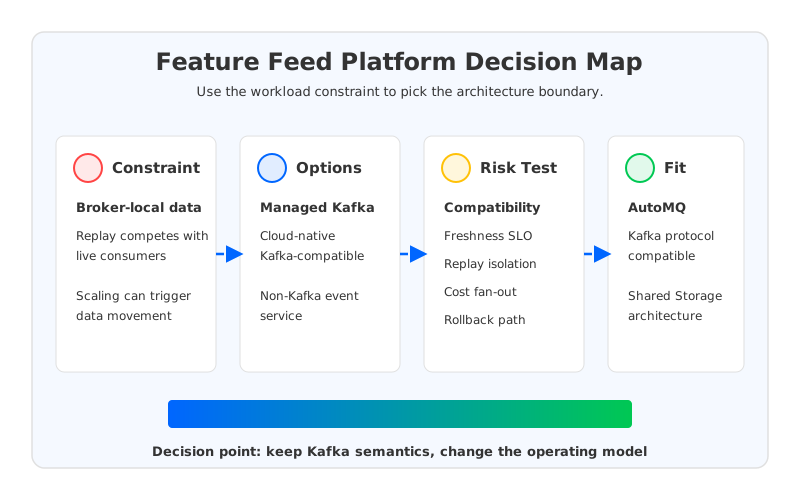
Those questions turn a keyword search into a platform evaluation. The right answer may be Kafka with careful operations, a managed Kafka service, a Kafka-compatible cloud-native platform, or a narrower streaming service if the team does not need Kafka semantics. The mistake is to select the transport before naming the operational constraint.
2The Production Constraint Behind the Problem
Traditional Kafka was designed around a Shared Nothing architecture. Each broker owns local log storage, and replication between leader and follower replicas gives the cluster durability and availability. This model is mature, widely understood, and still a strong fit for many workloads. It also makes storage a broker-local concern, which becomes important when feature pipelines start behaving like a shared data product rather than a single application queue.
Feature feeds put pressure on broker-local storage in three ways. First, retention grows because teams want replay for backfills, audits, and offline training alignment. Second, read fan-out grows because the same topic may feed online serving, batch materialization, monitoring, and experiment analysis. Third, elasticity becomes uneven because traffic spikes do not always match the disk and partition layout that existed when the cluster was sized.
That combination turns routine ML operations into Kafka operations. A backfill may require enough broker I/O headroom to serve historical reads without hurting tailing consumers. A scale-out event may trigger partition movement because adding brokers does not automatically move stored data. A cross-Availability Zone deployment may replicate data between brokers before downstream systems ever read it. None of these behaviors are wrong; they are the consequences of making the broker both the compute node and the durable storage owner.
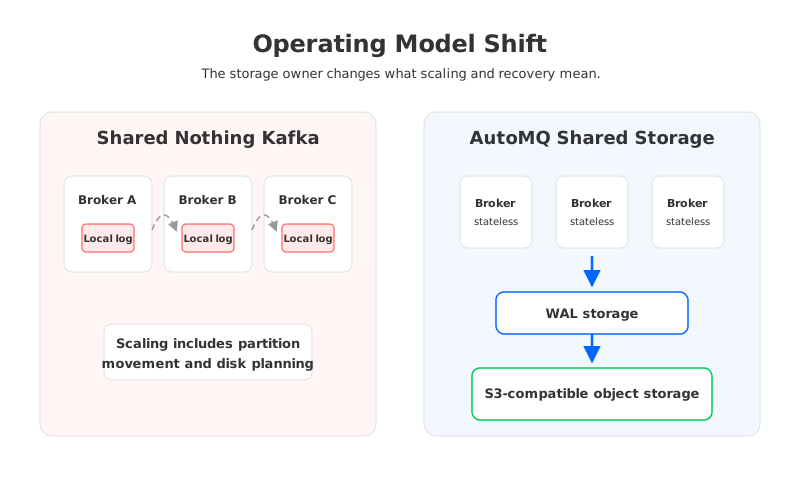
Tiered Storage changes part of this picture by moving older log segments to remote storage while recent data stays on broker-local disks. That can help retention economics and long reads, and Apache Kafka documents Tiered Storage as a way to store older log segments remotely. It does not make brokers stateless. The local storage path, leader ownership, and operational relationship between partitions and brokers still matter for scaling and recovery.
Feature pipelines expose that difference quickly. If the team only needs longer retention, Tiered Storage may be the right improvement. If the team needs to scale broker compute without moving durable data, isolate replay from local disk pressure, and keep storage independent from broker replacement, the architecture question moves beyond tiering. The platform starts to need a separation between Kafka-facing compute and durable stream storage.
3Architecture Options and Trade-Offs
A useful evaluation starts with the feature feed contract, not the vendor category. The contract says what the stream must preserve for the ML system: event order where it matters, replay range, schema evolution, consumer isolation, security boundaries, and recovery behavior. Once those are named, the platform options become easier to compare.
| Option | Where it fits | Trade-off to test |
|---|---|---|
| Self-managed Kafka | Teams with deep Kafka operations skill and infrastructure control | You own broker sizing, upgrades, storage growth, partition balancing, and incident response. |
| Managed Kafka | Teams that want Kafka semantics with less infrastructure work | You still need to model retention, network topology, read fan-out, quotas, and migration behavior. |
| Kafka-compatible cloud-native streaming | Teams constrained by broker-local storage, elastic scaling, or deployment boundaries | Compatibility, tooling behavior, and migration runbooks need practical validation. |
| Non-Kafka event service | Workloads with simpler semantics or cloud-specific integration needs | You may trade Kafka ecosystem compatibility for a narrower operational surface. |
The table is intentionally neutral. Kafka compatibility has real value when a feature platform already uses Kafka clients, Kafka Connect, Kafka Streams, Flink connectors, Schema Registry-compatible tooling, or existing observability dashboards. A narrower event service may be attractive for a single cloud-native application, but it can force different client libraries, semantics, and migration work when the feature platform expands.
The sharper decision is whether the streaming backbone should be stateful at the broker layer. In a broker-local model, compute, storage, and partition placement are tightly linked. That can be acceptable when traffic is stable and the team is comfortable with operations. In a shared-storage model, durable data lives in object storage or another shared storage layer, and brokers focus more on protocol handling, caching, leadership, and scheduling. The trade-off is not "broker-local versus shared-storage" as a slogan. It is whether the operating model should bind feature freshness to broker-local disk behavior.
There is also a governance trade-off. Real-time feature feeds need lineage and access control, but the streaming platform should not pretend to be the feature store. Feast, for example, documents Kafka as a streaming source for feature ingestion, which reflects a common pattern: Kafka or Kafka-compatible streams deliver fresh events, while the feature store owns definitions and serving behavior. Keeping that boundary clean prevents a platform team from burying ML semantics inside broker configuration.
4Evaluation Checklist for Platform Teams
After the architecture options are clear, the practical work is a readiness review. A good checklist forces the team to say what must be true before a feature pipeline becomes a production dependency. It also stops a common failure mode: debating broker technology while leaving rollback, schema ownership, and observability vague.
Use this scorecard before picking or changing the streaming backbone:
| Dimension | Production question | Evidence to collect |
|---|---|---|
| Compatibility | Will existing producers, consumers, connectors, and admin tooling behave as expected? | Client tests, connector tests, offset reset tests, transactional producer tests, and ACL checks. |
| Freshness | Can the team measure event age across source, stream, processor, feature store, and serving API? | Per-stage age histograms, lag metrics, write latency, and alert thresholds tied to model impact. |
| Replay | Can historical reads run while tailing consumers stay healthy? | Backfill test under live write traffic, consumer lag behavior, and recovery time after interruption. |
| Cost | Which line item grows with writes, reads, retention, zones, and private connectivity? | Workload-based model for storage, broker compute, network transfer, connector runtime, and operations. |
| Security | Where do records, credentials, metadata, logs, and metrics live? | VPC design, IAM policy review, encryption settings, audit logs, and data boundary documentation. |
| Migration | Can traffic move in phases with rollback? | Dual-write or mirroring plan, offset consistency checks, cutover criteria, and failure rehearsal. |
| Observability | Who sees the same incident view across ML, data, and platform teams? | Shared dashboards for freshness, lag, broker health, connector status, processor errors, and feature-store writes. |
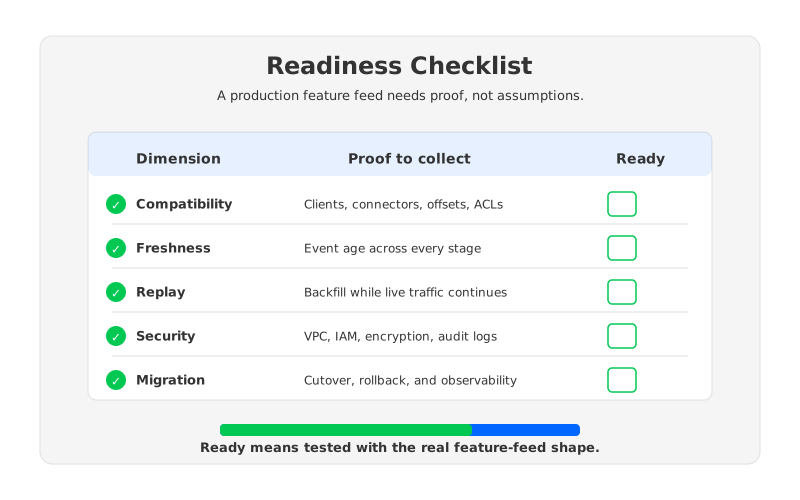
The scorecard should be run with a real workload shape, not a generic benchmark. A low-volume feature feed with strict freshness may stress tail latency and retries. A high-fan-out personalization feed may stress read throughput and network cost. A regulated risk feature may stress lineage, retention, and replay auditability. Those are different bottlenecks, and the platform decision should preserve that difference.
5How AutoMQ Changes the Operating Model
Once the neutral evaluation points to broker-local storage as the constraint, AutoMQ becomes relevant as a Kafka-compatible, cloud-native streaming platform built around Shared Storage architecture. It preserves Kafka protocol semantics for clients and ecosystem tools while moving durable stream data out of broker-local disks and into S3-compatible object storage through S3Stream and WAL (Write-Ahead Log) storage.
The architectural change is straightforward to describe but important operationally. AutoMQ Brokers are stateless brokers: they handle Kafka-facing compute, caching, leadership, and scheduling, while durable data is stored in shared object storage. The write path uses WAL storage for durable acknowledgment and recovery, then organizes data into object storage for long-term retention and reads. That means replacing or scaling brokers does not require the same kind of broker-local data movement that a Shared Nothing architecture implies.
For feature feeds, this changes the failure and scaling conversation. A platform team can evaluate broker capacity more like compute capacity, while storage grows independently with retention and replay requirements. Read fan-out and backfill still need capacity planning; no storage architecture makes those disappear. But the team is no longer forced to treat every storage-growth or replay question as a broker-disk placement problem.
AutoMQ's deployment model also matters for AI data infrastructure. AutoMQ BYOC runs the control plane and data plane inside the customer's cloud account and VPC, while AutoMQ Software targets customer-managed private environments. For teams handling sensitive feature signals, the data boundary is part of the architecture. The question is not only "does it stream fast enough?" but also "who controls the network, credentials, storage, logs, and operational metadata?"
AutoMQ does not replace stream processors, feature stores, model serving, or schema governance. It fits beneath them as the Kafka-compatible streaming backbone. That distinction keeps the evaluation honest. If the bottleneck is feature transformation logic, fix the processor. If the bottleneck is online feature serving, fix the feature store. If the bottleneck is the operating model of Kafka storage, scaling, retention, and recovery, a Shared Storage architecture is worth testing.
6FAQ
6.1Is a real-time feature pipeline the same as a feature store?
No. A real-time feature pipeline moves events, transforms them, and writes feature values into serving or training systems. A feature store manages feature definitions, discovery, online serving, offline consistency, and often lineage. Kafka or Kafka-compatible streams commonly sit upstream of the feature store.
6.2Does Kafka guarantee feature freshness?
Kafka provides durable, ordered streams and consumer progress tracking through offsets, but feature freshness depends on every stage: source capture, broker health, stream processing, feature-store writes, and serving visibility. A useful freshness SLO measures business event age across the whole path, not only Kafka consumer lag.
6.3When should a team consider a Kafka-compatible platform instead of changing the feature store?
Consider the streaming backbone when replay, retention, broker scaling, storage growth, or migration risk is the limiting factor. If the feature definitions, serving latency, or model logic are the limiting factor, changing the streaming platform will not solve the core problem.
6.4How should teams test migration risk?
Start with client and connector compatibility, then test offset behavior, transactional producers if used, ACLs, schema flows, replay under live writes, and rollback. The migration plan should prove that feature consumers can resume from known positions and that stale or duplicate writes are handled by the downstream systems.
7Closing Checklist
The search for real time feature pipeline kafka starts with fresh ML signals, but it ends with a platform boundary. The event feed must be replayable, governable, observable, and elastic enough that model teams can move without waiting for broker operations to catch up. If broker-local storage is the part holding that boundary in place, test a Kafka-compatible Shared Storage architecture with your own feature-feed workload. For a hands-on starting point, try AutoMQ on GitHub.


