
Table of Contents
Table of Contents
Financial services teams do not search for financial services event controls kafka because they want another generic streaming overview. They search for it when a real-time platform has crossed a threshold: fraud decisions depend on event freshness, payment limits need consistent ordering, trading systems need replayable audit trails, and security teams want evidence that a policy change did not silently break the pipeline. Kafka is often already in the middle of that system, but the control question is larger than Kafka configuration.
The hard part is that risk platforms combine two kinds of pressure that do not naturally fit together. The application side wants low-latency event flow, burst handling, and rapid product change. The governance side wants retention, replay, access control, region boundaries, audit evidence, and predictable failure behavior. Treating those requirements as separate workstreams is where many Kafka programs start to drift. A platform can pass a throughput test and still fail as a control surface.
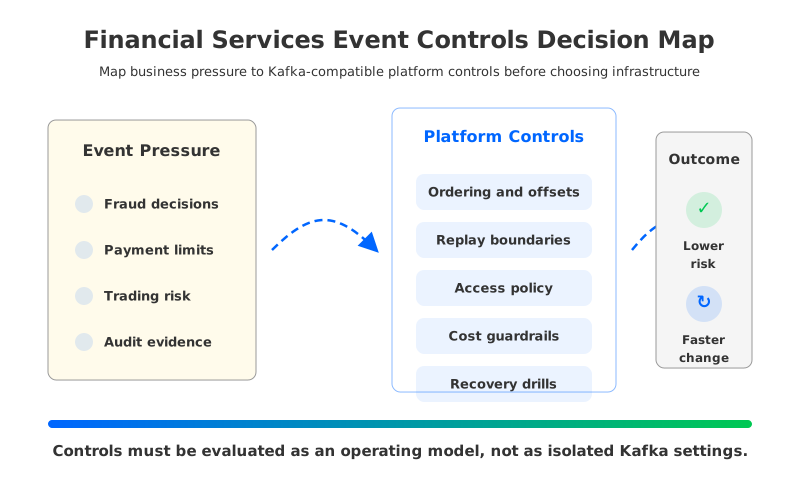
The better starting point is to define event controls as production properties. A control is not only an ACL, a retention value, or a runbook entry. It is the combination of a technical mechanism, an owner, a signal, and a recovery path. That framing changes how platform teams evaluate Kafka-compatible infrastructure, because the question becomes: can this architecture keep the control intact when traffic, cost, teams, and failure modes change?
1Why Financial Services Event Controls Need Kafka Discipline
Kafka became common in financial services because it gives teams a durable event log, ordered partitions, consumer groups, offset tracking, and a large ecosystem of clients and connectors. Those primitives are useful for fraud scoring, transaction monitoring, customer activity streams, treasury workflows, market-data distribution, and security event collection. They let different applications consume the same event history without forcing every consumer into the same synchronous call path.
The same primitives create control obligations. Partitioning choices affect which events can be ordered together. Offset commits affect replay and recovery. Producer idempotence and transactions affect duplicate handling in specific write paths. Consumer lag affects how quickly a risk model sees an event. Retention affects how far an investigation can go back without relying on a separate archive.
For a regulated platform team, the control surface usually falls into six areas:
- Correctness controls define how ordering, duplicate handling, schema evolution, and consumer progress are managed across services.
- Access controls determine who can produce, consume, administer topics, change retention, or read audit-sensitive event streams.
- Recovery controls specify how teams replay, fail over, roll back, and prove that a recovery action preserved business semantics.
- Cost controls prevent long retention, bursty reads, reassignment, and cross-zone traffic from becoming unexplained spend.
- Change controls cover topic creation, connector changes, client upgrades, policy changes, and deployment boundaries.
- Evidence controls turn platform telemetry into material that security, risk, audit, and application owners can all understand.
This is where a Kafka platform starts to look less like middleware and more like shared financial infrastructure. Fraud teams think in model features and decision windows. SRE teams think in broker load, controller health, and consumer lag. Compliance teams think in retention, region, and access evidence. The event platform has to translate between those languages without losing the operational truth.
2The Production Constraint Behind the Problem
Traditional Kafka is a shared-nothing system: brokers serve protocol traffic and own local log data for the partitions assigned to them. That design is proven and widely understood, but it makes storage ownership part of the control model. When a broker is added, removed, overloaded, or replaced, the platform does not only move compute responsibility. It also has to account for partition leadership, replica placement, log movement, disk capacity, and the network work created by those changes.
That matters for financial services because risk traffic is rarely flat. Payment activity can spike around market volatility, batch settlement windows, incident investigations, promotional events, or fraud campaigns. A cluster sized only for average traffic will disappoint application teams. A cluster sized for every peak will disappoint finance teams. In a broker-local storage model, the gap between average and peak is also a data-placement problem.
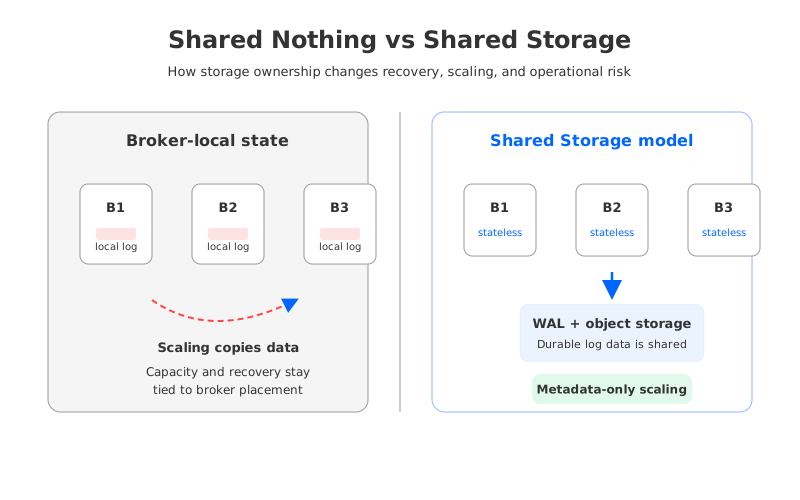
The control failure often shows up indirectly. A team adds brokers to create headroom, then discovers that reassignment creates background traffic during a sensitive period. A team increases retention for investigation needs, then finds that disk pressure has changed the risk profile of unrelated topics. A team prepares a recovery drill, then discovers that the key question is not "can we restart the broker?" but "which broker owns the durable data we need?"
There is no magic setting that removes these trade-offs. Kafka operators can use quotas, Cruise Control-style planning, careful partition design, tiered storage, and disciplined runbooks. Those tools are valuable. The deeper point is that the architecture determines where operational coupling lives. If compute, durable storage, and recovery state are tightly bound to brokers, every control has to be reviewed through that coupling.
3Architecture Options and Trade-Offs
The right architecture depends on the control boundary, not the brand name on the platform. Financial services teams usually evaluate several deployment models: self-managed Kafka on VMs or Kubernetes, a cloud provider managed Kafka service, a vendor SaaS service, a BYOC-style managed platform, or Kafka-compatible software that runs inside a customer-controlled environment. Each option can work, but each moves responsibility to a different place.
| Evaluation area | What to verify | Why it matters for event controls |
|---|---|---|
| Protocol compatibility | Clients, serializers, security mechanisms, admin tooling, and connector behavior | Risk systems often have long-lived clients that cannot be replaced during every platform change |
| Storage ownership | Whether durable log data is broker-local, tiered, or placed in shared storage | Storage ownership defines scaling, recovery, reassignment, and cost behavior |
| Deployment boundary | SaaS, BYOC, self-managed software, VPC placement, and private networking | Financial data controls often depend on where data and metadata reside |
| Operational automation | Provisioning, balancing, upgrades, rollback, observability, and incident tooling | Controls fail when the platform depends on undocumented operator memory |
| Cost model | Compute, storage, network, retention, burst reads, reassignment, and support | A control that is too expensive to exercise will eventually be bypassed |
| Evidence model | Logs, metrics, audit records, policy history, and owner mapping | Governance teams need traceable evidence, not only dashboards |
The storage row deserves extra attention. Tiered storage can reduce pressure from long retention by moving older data to remote storage, but it does not automatically make brokers stateless. Brokers can still own active partitions and local hot data. Shared storage or diskless designs go further: durable log data is placed behind a shared storage layer, while brokers become closer to stateless compute nodes.
For a real-time risk platform, the architecture choice should be tested against uncomfortable scenarios. What happens if fraud reads surge during a payment incident? What happens if an investigation needs a deep replay while normal traffic continues? What happens if a broker pool has to scale down after a burst? The answer should be more concrete than "the service is managed."
4Evaluation Checklist for Platform Teams
A useful checklist keeps business controls and infrastructure controls in the same review. Start with compatibility, because financial services platforms tend to have many existing producers, consumers, frameworks, and operational tools. A Kafka-compatible platform should preserve topic semantics, partition ordering expectations, offset behavior, client security, connector paths, and admin operations. Compatibility is a migration test plan, not a slogan.
Then examine cost and elasticity together. Elasticity that depends on moving large amounts of broker-local data may not be elastic at the moment the business needs it. A cost model that ignores cross-zone traffic, reassignment, retention, catch-up reads, and migration overlap will understate the real control cost. Financial services teams need cost behavior they can explain before an incident makes it visible.
Governance is the next filter. The platform should make it clear where event data lives, where metadata lives, who can access it, how private networking is configured, and which operations require administrator access. This is especially important when teams compare SaaS, BYOC, and self-managed deployments. The word "managed" says little about whether the data plane is inside the customer's account or how control-plane outages affect operations.
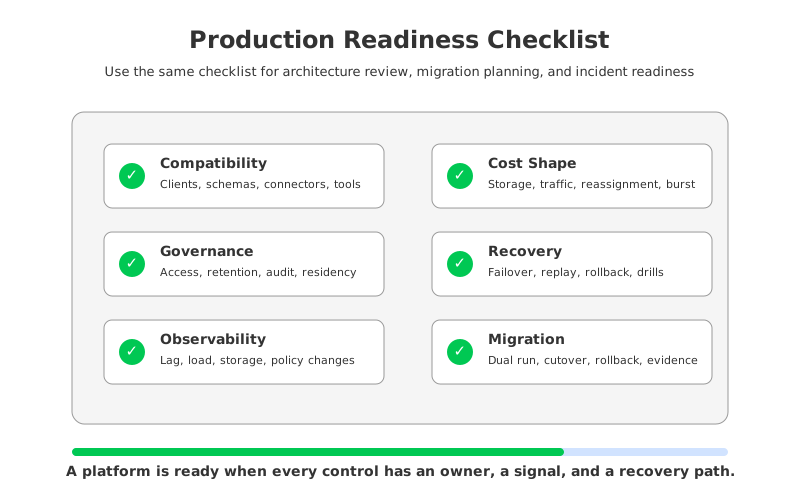
Recovery deserves its own rehearsal. A replay plan is different from a failover plan, and both are different from a rollback plan after a bad schema or producer change. For each critical event stream, platform teams should know the consumer groups involved, the offset boundaries that matter, the retention window available, and the evidence that proves the recovery did not create a larger business error.
The final filter is team boundary. Kafka platforms often fail quietly when ownership is split across application teams, data engineering, SRE, security, and procurement. A strong event-control program assigns every critical control to a service owner and a platform owner. One understands business semantics; the other understands the infrastructure mechanism.
5How AutoMQ Changes the Operating Model
Once the evaluation reaches storage ownership, AutoMQ becomes relevant as a Kafka-compatible cloud-native streaming platform built around Shared Storage architecture. It keeps the Kafka protocol surface while moving the durable storage center of gravity away from broker-local disks. In AutoMQ's architecture, brokers handle Kafka protocol processing and related compute work, while S3Stream, WAL storage, and object storage form the durable storage layer.
That design matters because many event controls become easier to reason about when broker compute is not the long-term owner of durable log data. Scaling a broker pool is closer to changing compute capacity than relocating the core event history. Recovery planning can focus on making shared durable data available through healthy compute rather than preserving a specific broker and its local disk. Cost analysis can separate compute, WAL storage, object storage, requests, and network paths.
AutoMQ does not remove the need for design work. Teams still have to validate latency targets, partitioning, client behavior, security configuration, observability, migration paths, and rollback plans. The point is that Shared Storage changes the default shape of the work. A control review can ask whether the architecture supports independent compute and storage scaling and whether elastic change still turns into a data-movement project.
For financial services teams, the deployment boundary is as important as the storage model. AutoMQ BYOC is designed for customer-controlled cloud environments, which lets teams evaluate managed operations while keeping the data plane within their cloud boundary. AutoMQ Software is relevant when a team needs a vendor-supported Kafka-compatible platform in a self-managed or private environment.
The practical way to evaluate AutoMQ is the same way you evaluate any event-control platform: run the checklist. Test existing clients and connectors. Model retention and replay. Review WAL placement and object storage paths. Exercise failover and rollback. Confirm which evidence security teams need from metrics, logs, topic changes, and access history.
6Migration and Rollback Planning
Financial services migration planning should assume that the riskiest cutover is not the first message written to the target platform. It is the moment when teams have to prove that event semantics, consumer progress, alerting, and rollback options are still intact. A strong plan starts with low-risk topics, validates compatibility, then expands toward streams with stronger business consequences.
The migration plan should treat dual running as evidence collection, not only traffic copying. During a parallel phase, the team can compare lag, throughput, error rates, consumer progress, schema behavior, and operational alerts. It can also test how quickly operators can answer control questions: which consumer is behind, which topic changed, which replay boundary is safe, and which rollback path is still available.
Rollback should be designed before cutover. A rollback plan needs clear producer routing, consumer offset strategy, schema compatibility rules, connector behavior, and owner approval. If the platform team cannot explain where the rollback boundary is, the business team will not trust the migration, even if the benchmark numbers look attractive.
7Turning the Checklist Into Operating Practice
The event-control program should end with a small number of artifacts that survive beyond the architecture review. One artifact is a workload register: critical topics, producers, consumers, owners, retention, replay needs, and recovery expectations. Another is a control matrix that maps each platform mechanism to business risk. A third is an incident drill record that proves the platform can recover, replay, and explain.
That last point is easy to underestimate. In a real incident, the platform team is not only restoring traffic. It is answering questions from fraud, payments, compliance, and executives at the same time. A good Kafka-compatible platform gives operators enough signal to answer those questions without improvising. A good architecture gives the team enough flexibility to fix the problem without creating a larger one.
Financial services event controls are not a one-time Kafka tuning exercise. They are the operating contract between real-time business decisions and the infrastructure that carries them. If that contract is becoming harder to keep as traffic, retention, and governance pressure grow, use the checklist above to review the architecture before the next peak makes the decision for you. To compare this operating model with a Kafka-compatible Shared Storage deployment, start with AutoMQ BYOC.
8References
- Apache Kafka Documentation
- Apache Kafka Consumer Groups
- Apache Kafka Message Delivery Semantics and Transactions
- Apache Kafka Connect
- Apache Kafka KRaft
- Apache Kafka Tiered Storage
- AutoMQ Shared Storage Architecture
- AutoMQ WAL Storage
- AutoMQ Stateless Broker
9FAQ
9.1What are event controls in a Kafka-based financial services platform?
Event controls are the technical and operational mechanisms that keep real-time event streams correct, governed, recoverable, and explainable. In Kafka environments, they include partitioning, ordering, offset management, retention, ACLs, producer settings, consumer group behavior, observability, replay procedures, and recovery runbooks.
9.2Is Kafka enough for real-time risk platforms?
Kafka provides important primitives for durable event streaming, but the platform still needs a control model around them. Financial services teams should evaluate compatibility, storage ownership, deployment boundary, cost behavior, governance evidence, and recovery practice before treating any Kafka-compatible system as production-ready for risk workloads.
9.3How is tiered storage different from Shared Storage architecture?
Tiered storage usually moves older log segments to remote storage while brokers still own active partition state and local hot data. Shared Storage architecture places durable log data behind a shared storage layer, making brokers closer to stateless compute. That difference affects scaling, reassignment, recovery, and cost modeling.
9.4Where does AutoMQ fit in a financial services Kafka architecture?
AutoMQ fits when a team wants Kafka compatibility but needs a cloud-native operating model with shared storage, more independent compute and storage scaling, and customer-controlled deployment options. It should be evaluated through the same production checklist as any critical event platform: client behavior, latency, security, observability, migration, rollback, and governance evidence.


