
Table of Contents
Table of Contents
Teams rarely search for fips readiness kafka because they are curious about cryptography in the abstract. They search because a production system is moving closer to regulated data, a federal customer is asking hard questions, an internal security team is tightening procurement review, or a cloud migration has turned an old Kafka cluster into part of a larger compliance boundary. The streaming platform may still be doing familiar work: ingesting events, feeding data products, supporting CDC, and connecting services. The review around it has changed.
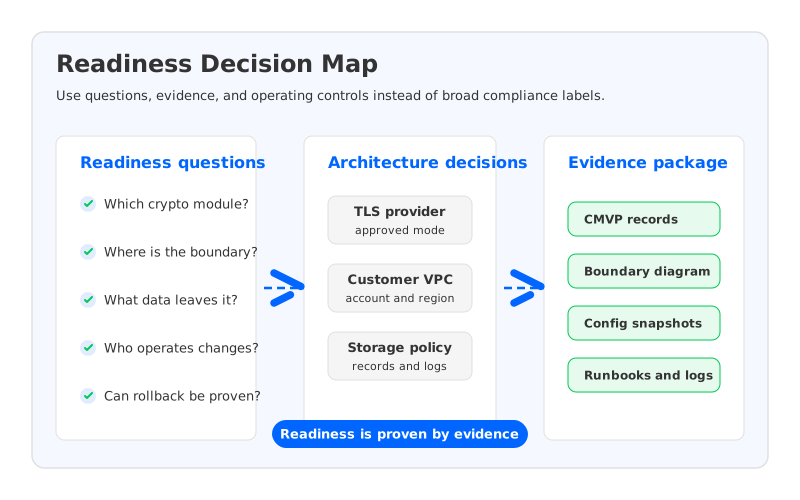
That shift matters because Kafka-compatible streaming is not a single binary or a single network port. A production deployment includes brokers, clients, TLS libraries, storage, key management, observability, connector workers, and automation that can change the environment at runtime. FIPS readiness has to ask where cryptography is performed, which modules are validated, which deployment boundary is under customer control, and what evidence an auditor can inspect.
The useful question is not "Is Kafka FIPS compliant?" It is "Can this streaming architecture be operated with the evidence, boundaries, and controls required by a FIPS-oriented environment?" That framing avoids unsupported certification claims and gives platform teams a practical way to compare Kafka-compatible systems.
1Why Teams Search for fips readiness kafka
FIPS usually enters the Kafka conversation through procurement, not through a broker tuning exercise. A buyer may need to satisfy a public-sector requirement, support FedRAMP-aligned controls, or prove that cryptographic functions use validated modules. The National Institute of Standards and Technology runs the Cryptographic Module Validation Program, and the relevant validation target is the cryptographic module and its approved mode of operation, not a vague platform slogan. For streaming teams, that means the review has to follow the actual paths where secrets, plaintext, ciphertext, and keys move.
Kafka adds friction because it sits in the middle of many systems. Producers may use different TLS stacks from consumers, stream processors, and service meshes. Kafka Connect workers introduce source and sink connectors with their own clients and credentials. Observability tools scrape metrics and collect logs. Each integration can expand the compliance review if the boundary is not explicit.
The first readiness question is therefore about scope: which parts of the streaming system are in the FIPS-relevant boundary? A narrow scope may cover client-to-broker TLS and broker storage encryption. A broader scope may include connector traffic, Kubernetes secrets, object storage access, monitoring exports, CI/CD automation, and administrative access. The wrong answer is the one nobody can defend.
2The Production Constraint Behind the Problem
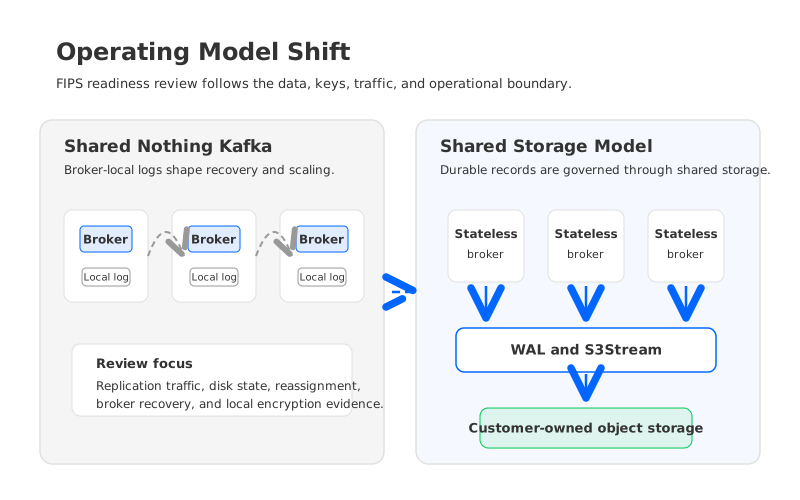
Traditional Kafka was designed around broker-local logs. Each broker owns local partition data, and replication across brokers provides durability. This model is coherent and widely used. It also turns a compliance review into a topology review because data placement, broker identity, disk encryption, replication traffic, and failure recovery are tightly coupled.
In a multi-AZ cloud deployment, that coupling shows up quickly. Replication traffic crosses failure domains, partition reassignment moves data when capacity changes, and broker replacement has to consider local disk state. If the cluster uses tiered storage, the hot log and remote tier introduce another boundary to inspect. Connector workers can also pull source and sink credentials into the same operational review.
Security teams tend to ask simple questions that reveal this complexity:
- Which TLS implementation terminates each connection, and is the module validated for the required FIPS standard?
- Where are keys generated, stored, rotated, and revoked?
- Which storage layer holds durable Kafka records, and who controls that layer?
- What traffic crosses AZ, region, account, VPC, or on-premises boundaries?
- Which automation can create, delete, scale, or reconfigure broker resources?
- What logs and metrics leave the customer-controlled environment?
These are operating-model questions. A platform can support encryption and still fail a readiness review if the team cannot explain the cryptographic boundary, the deployment boundary, and the evidence chain.
3Architecture Options and Trade-Offs
The safest evaluation starts from architecture, then moves to product details. A self-managed Apache Kafka cluster gives the platform team direct control over OS images, JVM settings, TLS providers, disk encryption, key stores, network policy, and audit evidence. That control can be valuable in a strict environment. It also means the team owns patching, broker replacement, capacity planning, replication cost, client compatibility testing, connector hardening, and incident response.
A managed Kafka service changes the burden. The provider may operate brokers, patch infrastructure, and integrate with cloud-native identity and key management. The buyer then has to inspect the provider's artifacts and shared responsibility model. The review shifts from "Can our team configure this correctly?" to "Which parts does the provider operate, which parts remain ours, and does the documented boundary match our audit boundary?"
Kafka-compatible cloud-native platforms add a third pattern. They keep the Kafka protocol surface while changing how storage, scaling, and deployment boundaries work. This is where careful language matters. A Kafka-compatible platform should not be accepted because it claims a general compliance label. It should be evaluated because its architecture may make evidence collection, data residency, capacity isolation, and customer-controlled deployment boundaries easier to reason about.
| Evaluation area | What to ask | Why it matters for FIPS readiness |
|---|---|---|
| Cryptographic module | Which module performs TLS, storage encryption, and signing? | FIPS validation applies to specific cryptographic modules and modes. |
| Deployment boundary | Which account, VPC, region, and cluster owns the workload? | The boundary determines who can inspect, restrict, and evidence the environment. |
| Data path | Where do records, metadata, logs, and metrics flow? | Hidden exports or cross-boundary paths can expand audit scope. |
| Operations | Who patches, rotates keys, changes configs, and scales capacity? | Readiness depends on repeatable controls, not initial setup alone. |
| Migration | How are clients, offsets, ACLs, connectors, and rollback handled? | A clean target architecture still needs a defensible cutover path. |
The table is intentionally phrased as questions. In FIPS-oriented environments, each answer should be backed by documentation, configuration, validation records, diagrams, and runbooks.
4Evaluation Checklist for Platform Teams
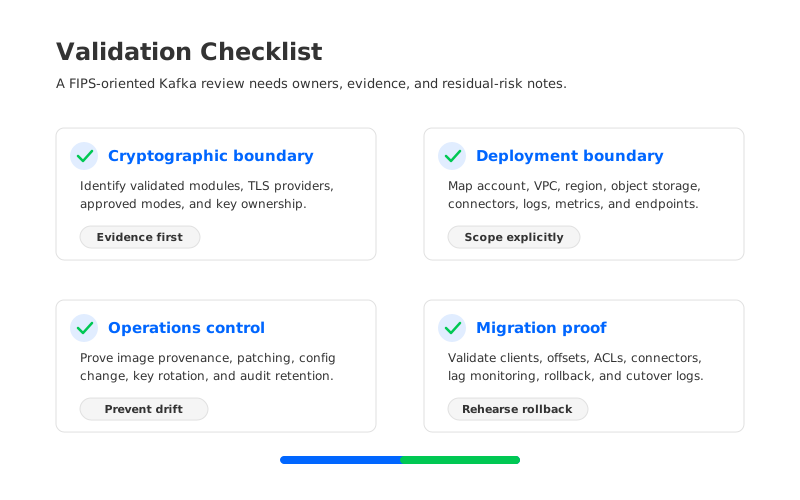
Start with cryptography, but do not stop there. The cryptographic review should identify every place the platform depends on TLS, signing, encryption at rest, or key derivation. For each place, list the implementation, version, configuration, validation status, and approved mode requirements. Kafka's protocol compatibility does not imply a uniform crypto stack across every producer and consumer.
The next layer is data placement. Kafka records may live in local broker logs, cloud block storage, object storage, connector buffers, sink systems, backup buckets, or dead-letter topics. Metadata may live in KRaft quorum storage. Credentials may live in Kubernetes secrets, cloud secret managers, environment variables, or connector configuration. Readiness depends on proving that each location is inside the intended governance boundary.
Network paths deserve the same treatment. Client-to-broker traffic is the obvious path, but a Kafka deployment also has replication, controller communication, cloud API calls, object storage access, monitoring exports, connector egress, and administrative access. If a team says "private VPC," the reviewer will still ask whether traffic uses private endpoints, NAT gateways, peering, or cross-region routing.
Operational controls turn the design into a system that can survive production change. A cluster that is FIPS-ready on Monday can drift by Friday if automation rolls out an unapproved image, changes a TLS provider, adds a connector, or ships logs to another destination. That is why the checklist must include change control, image provenance, version pinning, key rotation, incident response, rollback procedures, and evidence retention.
5How AutoMQ Changes the Operating Model
Once the review is framed around boundaries and evidence, storage architecture becomes more than a performance topic. AutoMQ is a Kafka-compatible cloud-native streaming platform that separates compute from storage. It keeps the Kafka protocol and ecosystem surface while moving durable stream storage into shared object storage through its S3Stream architecture. Brokers become largely stateless compute nodes, while WAL storage and object storage handle durability.
That architectural change does not by itself create a FIPS certification claim, and it should not be described that way. Its relevance is operational. In a customer-controlled deployment, the platform team can reason about where the data plane runs, which object storage bucket holds durable records, which cloud account owns the resources, and which identity policies govern access. Those are the boundaries that security and compliance teams need to inspect.
The shared-storage model also changes failure and scaling behavior. In traditional Kafka, adding or replacing brokers often means moving partition data between local disks. That movement affects recovery planning, capacity windows, and cross-AZ traffic. With stateless brokers and shared storage, the operational focus shifts toward metadata, leadership, cache warm-up, WAL recovery, and object storage access. The data is no longer tied to a specific broker's local disk in the same way.
For FIPS readiness, the practical AutoMQ questions should look like this:
- Which AutoMQ deployment model is being used: open source self-managed, BYOC, or software in a private environment?
- Which WAL type is selected, and which storage service or device is inside the deployment boundary?
- Which TLS, key management, OS image, container image, and cloud endpoint choices are controlled by the customer?
- Which metrics, logs, and control-plane metadata leave the data plane, if any, and under what policy?
- Which official AutoMQ documents and customer-side configurations support the readiness evidence package?
This is also where AutoMQ's BYOC model matters. In BYOC, the control plane and data plane run in the customer's cloud environment, and customer message data stays in customer-owned infrastructure. That boundary can help organizations align streaming operations with their own VPC, IAM, object storage, logging, and network controls. The correct claim is not "AutoMQ is FIPS certified." The correct question is whether the deployment can use the cryptographic modules, endpoints, and controls your program requires.
AutoMQ's zero cross-AZ traffic design is another operating-model detail worth evaluating. FIPS readiness is not a cost program, but cost and compliance interact in production. If a design requires heavy cross-AZ replication, teams may be tempted to reduce redundancy, delay scaling, or defer maintenance to control spend. A design that reduces unnecessary cross-zone traffic gives platform teams more room to keep security controls and availability goals aligned.
6Migration and Readiness Scorecard
Migration is where many compliance plans become vague. A team may design a clean target state and still fail review because the transition path touches unmanaged clients, stale ACLs, connector secrets, consumer offsets, or rollback data. Kafka-compatible migration has to preserve application semantics while tightening the compliance boundary.
A readiness scorecard should be boring enough to use in a design review. Each line needs an owner, evidence, status, and residual risk. The point is to prevent hidden assumptions from becoming late-stage blockers.
| Readiness question | Evidence to collect | Owner |
|---|---|---|
| Are required cryptographic modules identified and validated? | CMVP records, OS/runtime docs, TLS configuration, approved-mode notes | Security architecture |
| Is the deployment boundary explicit? | VPC/account/region diagram, data path diagram, IAM policy summary | Platform engineering |
| Are storage locations governed? | Object storage policy, block storage encryption config, key rotation runbook | Cloud infrastructure |
| Are Kafka semantics preserved? | Client compatibility tests, producer/consumer tests, transaction and offset validation | Data platform |
| Is the migration reversible? | Cutover plan, rollback plan, lag monitoring, dual-write or mirror strategy where applicable | SRE / migration lead |
| Is evidence retained after change? | Audit log location, config snapshots, change tickets, incident records | Compliance operations |
The scorecard also protects the team from overclaiming. If one area is not ready, mark it as not ready and describe the path to closure. Reviewers trust systems that expose their boundaries more than systems that blur them.
For teams evaluating Kafka-compatible shared storage, the next useful step is to inspect the deployment model rather than skim a feature list. AutoMQ's architecture and BYOC documentation are a good starting point: review the AutoMQ deployment boundary and shared-storage architecture.
7References
- NIST Cryptographic Module Validation Program: FIPS 140-3 standards and validated module search
- AWS General Reference: service endpoints and Amazon S3 endpoints, useful when checking FIPS endpoint availability and private network routing
- Apache Kafka documentation: Kafka documentation and KRaft operations
- AutoMQ documentation: shared storage architecture, WAL storage, BYOC environment overview, and zero cross-AZ traffic
8FAQ
8.1Is Apache Kafka itself FIPS certified?
Treat that as the wrong level of abstraction. FIPS validation applies to cryptographic modules and approved modes, while a Kafka deployment includes clients, brokers, operating systems, TLS libraries, storage services, connectors, and automation. A Kafka environment can support FIPS-oriented requirements only when those components and boundaries are explicitly reviewed.
8.2What is the most important first question for FIPS readiness?
Ask where cryptography happens and which module performs it. That includes client TLS, broker TLS, storage encryption, signing, key management integrations, administrative access, and connector traffic. After that, map the deployment boundary and evidence chain.
8.3Does BYOC automatically make a Kafka-compatible platform FIPS ready?
No. BYOC can give customers more control over the cloud account, VPC, storage, IAM, endpoints, and logs, but readiness still depends on validated cryptographic modules, approved configurations, documented boundaries, and operational evidence from the actual deployment.
8.4Why does storage architecture matter for a compliance review?
Storage architecture determines where durable records live, who controls the storage service, how broker replacement works, and what data movement happens during scaling or recovery. Those details affect both technical risk and the evidence a platform team must provide.
8.5How should teams compare AutoMQ with traditional Kafka for FIPS-oriented environments?
Compare the deployed operating model, not a generic product label. For traditional Kafka, inspect broker-local storage, replication traffic, disk encryption, and reassignment operations. For AutoMQ, inspect shared object storage, WAL choice, stateless broker operations, BYOC boundaries, cloud endpoints, and customer-controlled evidence. In both cases, require proof at the component and deployment level.


