
Table of Contents
Table of Contents
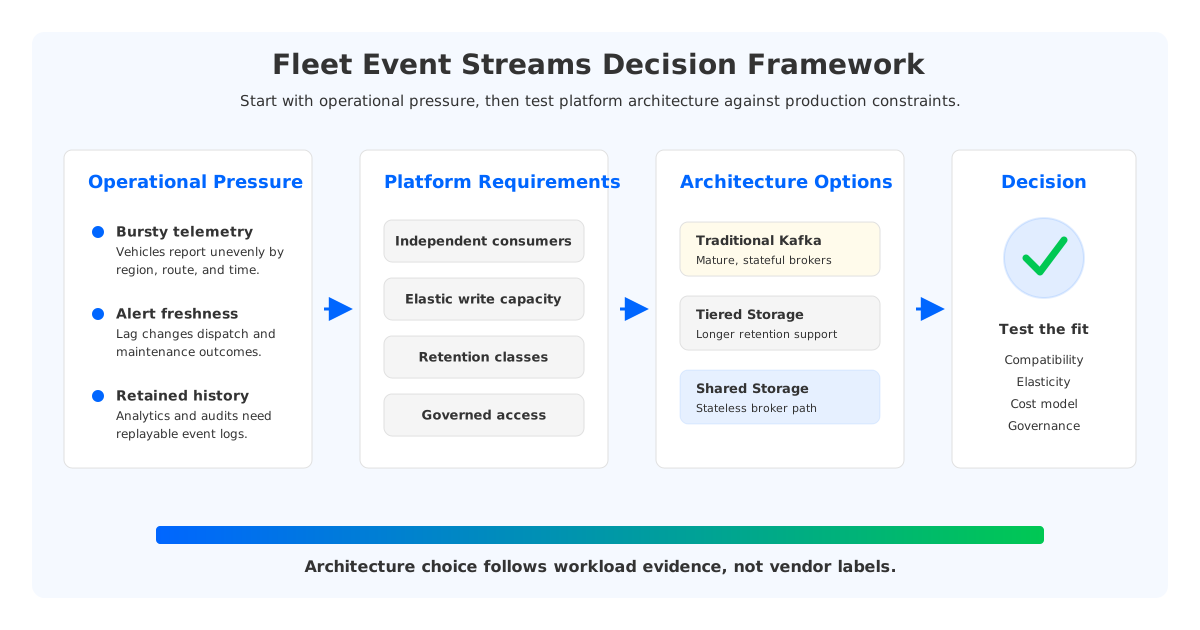
Fleet operations teams rarely search for event streams because they want another messaging diagram. They search because vehicle telemetry, location updates, maintenance signals, driver events, partner integrations, and customer-facing notifications have stopped fitting into batch jobs and point-to-point APIs. A fleet platform may need to detect a refrigeration fault, reroute a delivery, flag a safety event, update an ETA, and retain the same event history for analytics and compliance. The hard question is whether the streaming platform stays predictable when the fleet grows, message rates swing by geography and time of day, and downstream consumers multiply.
That pressure changes the design center. Fleet telemetry is not one stream; it is a portfolio of streams with different latency, retention, governance, and replay requirements. GPS pings may be high-volume and short-lived for live tracking, while diagnostic trouble codes, service records, and driver-safety events may need stronger retention and audit controls. Alerts must be fast enough to matter, but analytics teams also need historical context. Platform teams therefore need an architecture that separates hot operational decisions from retained event history without forcing every workload into the most expensive operating mode.
1Why Fleet Operations Event Streams Matter
Fleet data makes streaming infrastructure visible to the business. A late financial report may be annoying; a late fleet alert can mean a spoiled shipment, missed delivery window, unsafe driving pattern, or stranded vehicle. The value of fleet data also increases when it is joined with route plans, inventory, weather, service history, payment status, warehouse capacity, and customer notification workflows.
Most fleet platforms eventually converge on the same broad event categories:
- Telemetry events: position, speed, heading, battery, fuel, temperature, device status, and sensor readings.
- Operational events: job assignment, pickup, drop-off, route change, driver check-in, and exception handling.
- Alert events: geofence violations, temperature excursions, harsh braking, maintenance thresholds, and device failures.
- Decision events: dispatch recommendations, ETA changes, escalation decisions, and automation outcomes.
- Audit events: who changed a route, acknowledged an alert, overrode a policy, or exported data.
Kafka-compatible streaming is attractive because these categories can share a common event log while still using separate topics, schemas, retention policies, and consumer groups. Apache Kafka's consumer group and offset model is especially useful here: multiple applications can process the same stream independently, commit their own positions, and replay when needed. That is a better fit than a single queue where one consumer's progress destroys another team's ability to learn from the same event.
The architectural risk is that the event log becomes the hidden dependency behind every operational decision. Once dispatch, maintenance, customer notifications, analytics, and machine learning pipelines depend on it, the platform is production infrastructure, not only ingestion.
2The Production Constraints Behind the Search
Fleet operations workloads stress streaming platforms in uneven ways. They are often bursty by region, sensitive to stale data, and expensive to retain if every event is copied across multiple local disks. They also attract more consumers over time. A telemetry topic that begins with a live map may later feed predictive maintenance, fraud analysis, driver coaching, billing reconciliation, SLA reporting, and AI feature pipelines.
Three constraints deserve early attention.
First, the write path must tolerate bursty ingestion without making capacity planning a weekly ritual. Traffic peaks during commute windows, weather events, delivery cutoffs, holiday periods, and regional incidents. If brokers are stateful and tied to local disks, adding capacity can require partition movement and storage rebalancing, not only more compute.
Second, retention must be designed as a product requirement. Some events are useful for seconds; others are useful for months. If all retained data is treated as broker-local hot data, teams may choose between short retention and high infrastructure cost. Tiered storage can move older log segments to remote storage, but the broker still has local storage responsibilities.
Third, governance must be part of the streaming design. Fleet data may reveal customer locations, driver behavior, asset utilization, and operational performance. Topic naming, schema evolution, access control, encryption, audit logging, and data residency are not finishing touches. They determine whether the platform can be shared across teams without turning into an uncontrolled data exhaust pipe.
These constraints are why "fleet operations event streams best practices" should lead to an operating model, not only an event schema.
3Architecture Patterns Teams Usually Compare
The common options are not mutually exclusive, but each moves complexity to a different place.
| Pattern | Where It Fits | Main Tradeoff |
|---|---|---|
| Point-to-point APIs | Low-volume integrations and request/response workflows | Coupling grows quickly as consumers multiply |
| Cloud ingestion services | Device telemetry, logs, and cloud-native analytics pipelines | Kafka behavior and ecosystem compatibility may be limited |
| Traditional Kafka | Shared event backbone with mature clients and stream processing | Stateful brokers, local storage, and replication drive operational cost |
| Kafka with tiered storage | Longer retention with less pressure on local broker disks | Hot path and broker lifecycle remain stateful |
| Shared-storage Kafka-compatible platform | Elastic streaming where compute and storage scale separately | Requires validation of compatibility, latency profile, and migration path |
Traditional Kafka remains a strong baseline because its ecosystem is mature. Producers, consumers, Kafka Connect, stream processors, schema registries, monitoring tools, and operational practices are widely understood. Apache Kafka also documents the semantics that matter for fleet systems: topics, partitions, offsets, consumer groups, transactions, KRaft metadata management, and tiered storage.
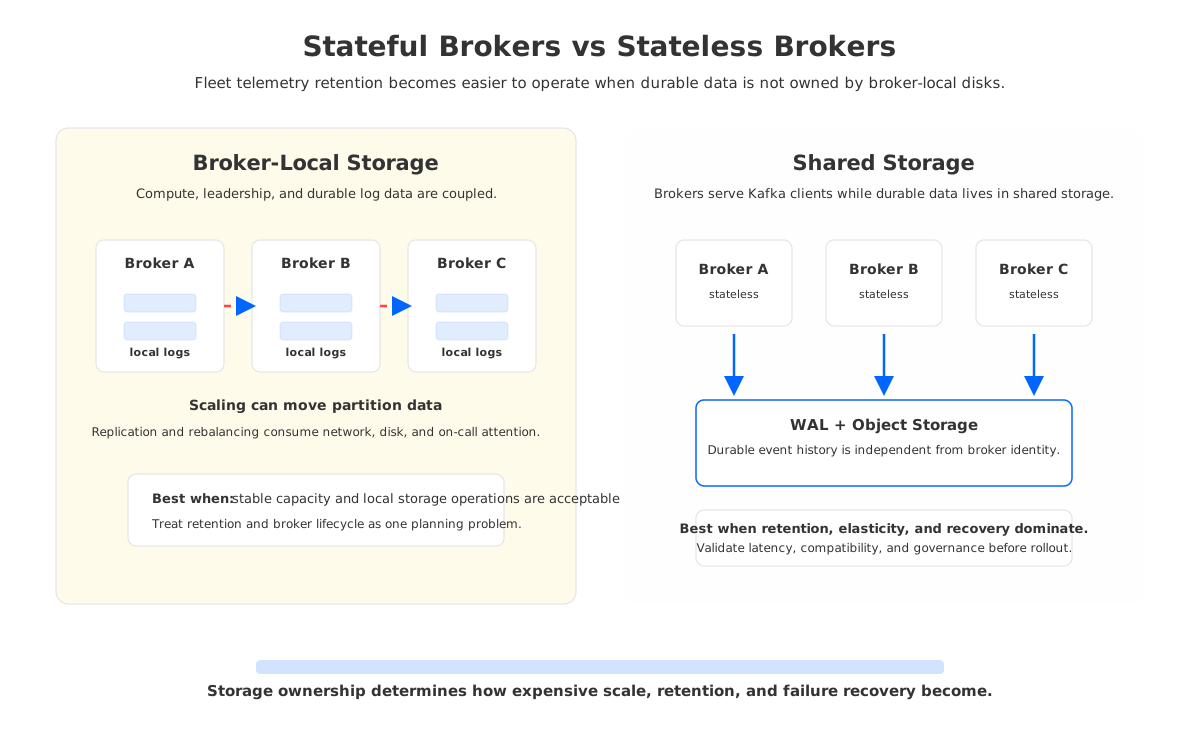
The challenge is the shared-nothing storage model behind classic Kafka operations. Each broker owns local log data. Replication protects availability, but it also multiplies storage and network traffic. Scaling can trigger partition reassignment and data movement. Retention increases disk requirements. Broker replacement is not the same as replacing a stateless service instance because persistent log data and leadership responsibilities are attached to the cluster topology.
For a fleet platform, this matters most when the business wants both low-latency decisions and long event history. If every additional day of telemetry retention forces more replicated broker storage, teams may shorten retention, split clusters, or route history into a separate data lake before consumers are ready. Those workarounds are valid, but they should be deliberate.
4Design The Event Model Before Sizing The Cluster
Sizing a streaming platform before clarifying event semantics is a common mistake. Fleet operations is full of events that look similar at ingestion time but have different downstream meaning. A raw location ping, a normalized vehicle-position update, a geofence breach, and a dispatch decision should not be collapsed into one generic topic because they carry different ownership, retention, and correctness requirements.
A practical event model starts with four decisions:
- Partitioning: Choose keys that preserve the ordering the business actually needs, such as vehicle ID, asset ID, driver ID, route ID, or job ID. Avoid keys that overload a single partition during regional peaks.
- Retention classes: Separate short-lived tracking events from durable operational records and audit events. Retention is a cost and governance decision, not only a Kafka topic setting.
- Schema ownership: Assign owners for telemetry, alert, decision, and audit schemas. Fleet platforms age poorly when every producer invents its own payload shape.
- Consumer isolation: Use independent consumer groups for dispatch, alerting, analytics, and ML feature pipelines so one workload does not control another workload's progress.
The result is usually a layered event topology. Raw device events land first. Normalization services validate and enrich them. Alerting services react to thresholds or patterns. Decision services publish recommended or executed actions. Analytics and lakehouse sinks consume durable streams for historical analysis. This makes replay safer because downstream teams can restart from offsets without asking the ingestion path to resend data.
It also exposes platform requirements. Raw telemetry may prioritize ingestion throughput and low storage cost. Alerting may prioritize end-to-end latency and predictable consumer lag. Audit streams may prioritize retention, access control, and immutable history. A single streaming platform can support all of these, but not if it is evaluated by one average latency number.
5Evaluation Checklist For Platform Teams
Before choosing a fleet operations event streaming platform, test it against the operating conditions that will exist after the first successful launch. Pilot projects often prove only that producers can write and consumers can read. Production asks harder questions.
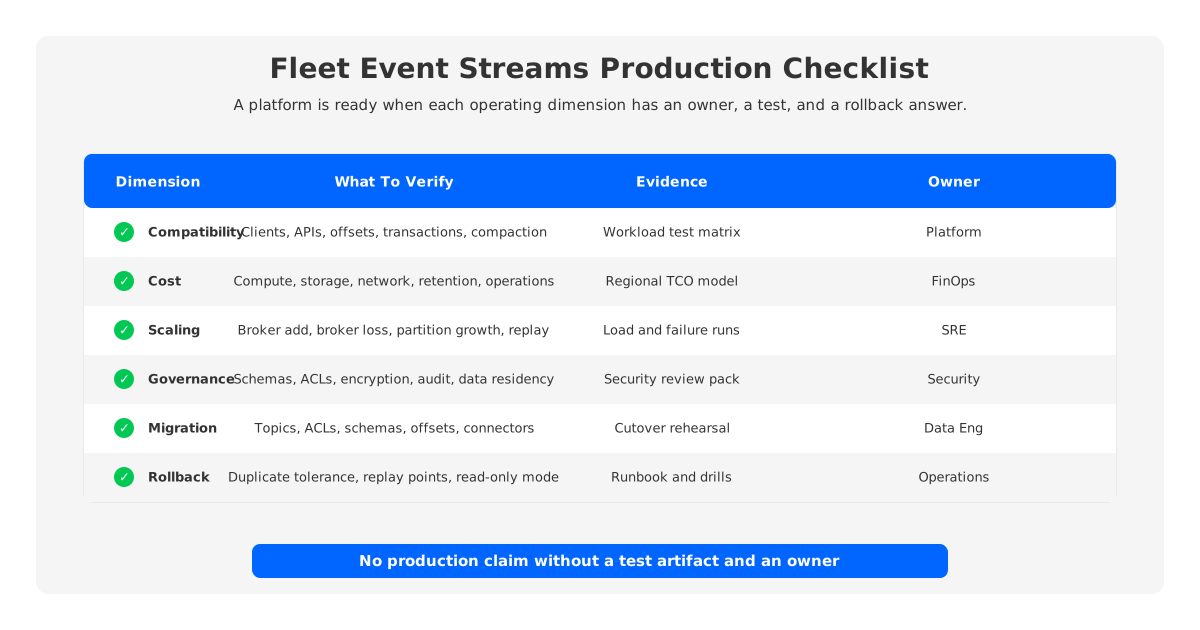
Start with compatibility. If the organization already uses Kafka clients, Kafka Connect, Flink, Kafka Streams, or established observability tools, verify the exact protocol features and administrative APIs in use. Idempotent producers, transactions, compaction, cooperative rebalancing, headers, large messages, ACLs, and offset behavior should be tested explicitly.
Then test elasticity and failure behavior. Add brokers, remove brokers, fail a broker, expand retention, increase partitions, and replay consumers while ingestion continues. Watch what moves: metadata, leadership, local data, remote data, network traffic, or operational responsibility.
Cost modeling should include more than broker instance prices. For Kafka-style systems, the durable cost picture includes compute, local disks, remote storage, replication traffic, cross-zone or cross-region networking, private connectivity, observability, backups, and operational labor. Cloud provider pricing pages change by region and over time, so publishable cost models should be based on current official pricing at the time of procurement. The important architectural lesson is stable: storage placement and data movement often dominate the long-term bill.
Governance deserves the same rigor. Fleet operations teams should define topic ownership, schema compatibility rules, producer authentication, consumer authorization, encryption boundaries, audit retention, and deletion policies. If the platform spans cloud accounts, VPCs, regions, or vendors, the security review should map where data, metadata, credentials, and operational access reside.
Finally, evaluate migration and rollback before the platform becomes critical. A credible plan covers topic configuration, ACLs, schemas, offsets, connector state, stream-processing checkpoints, monitoring, alert thresholds, and rollback windows. For fleet systems, specify which operational decisions can tolerate duplicate events, delayed processing, or temporary read-only behavior.
6Where Shared Storage Changes The Operating Model
The architectural turning point is storage ownership. In a shared-nothing Kafka cluster, broker compute and durable log storage are tightly coupled. In a shared-storage model, brokers handle Kafka protocol work while durable stream data lives in shared storage, often with a write-ahead log layer on the hot path. That changes scaling and recovery from "move data between brokers" toward "change which brokers serve which partitions."
This is where AutoMQ can enter the evaluation without changing the decision framework. AutoMQ is a Kafka-compatible, cloud-native streaming platform built around shared storage and stateless brokers. Its public documentation describes compatibility with Apache Kafka clients and an architecture where data is stored in S3-compatible object storage, with WAL options used for the immediate durable write path before data is flushed to object storage. In BYOC deployments, the data plane runs in the customer's cloud account, which can matter for fleet teams with strict data-boundary requirements.
For fleet operations event streams, the practical value is not that every workload suddenly needs a new platform. Shared storage changes several tradeoffs:
- Scaling compute does not require the same amount of partition data movement as a broker-local storage model.
- Retained event history can use object storage economics instead of treating all history as replicated local disk.
- Broker replacement and rebalancing can become less storage-bound because persistent data is not owned by a single broker instance.
- Teams can evaluate Kafka-compatible APIs while changing the underlying storage and elasticity model.
Those benefits still require validation. A fleet alerting path should test the chosen WAL mode, producer acknowledgments, consumer lag, and failure behavior under realistic load. A historical telemetry workload should test replay throughput, object storage request patterns, and downstream sink behavior. A governed enterprise deployment should verify IAM, network boundaries, audit logging, and operational responsibilities.
The point is not to replace architecture review with a product checkbox. It is to add a credible option when traditional Kafka operations become constrained by local disks, replication traffic, and manual capacity planning.
7A Decision Table For Fleet Event Stream Architecture
Use the following table as a first-pass decision aid, then refine it with workload-specific tests.
| If Your Main Pressure Is... | Optimize Existing Kafka | Re-Platform To Shared Storage | Split Workloads |
|---|---|---|---|
| A small number of operational topics | Strong fit | Usually premature | Rarely needed |
| Growing telemetry retention cost | Partial fit with tiering and retention tuning | Strong fit if replay and governance validate | Useful for lakehouse history |
| Frequent capacity changes by region or season | Limited by broker state and data movement | Strong fit if elasticity tests pass | Useful for isolated regions |
| Strict Kafka ecosystem compatibility | Strong baseline | Validate client, admin, and connector behavior | Depends on integration boundary |
| Complex governance and data residency | Depends on deployment model | Strong fit when data plane stays in your account | Useful for sensitive domains |
| Migration risk dominates | Safer short term | Viable with staged replication and rollback | Useful for gradual adoption |
This table avoids a universal answer. Fleet operations platforms often combine device ingestion at the edge, Kafka-compatible streams, stream processors, object storage or lakehouse tables, and APIs for current state. The winning design keeps these responsibilities visible.
8References
- Apache Kafka Documentation
- Apache Kafka Consumer Position
- Apache Kafka KRaft
- Apache Kafka Tiered Storage
- AWS IoT FleetWise
- Amazon S3 User Guide
- OpenTelemetry Collector Documentation
- AutoMQ Documentation: Overview
9FAQ
9.1What are fleet operations event streams?
Fleet operations event streams are ordered streams of telemetry, updates, alerts, decisions, and audit records from vehicles, assets, dispatch systems, and downstream applications. They let multiple teams consume the same operational history without point-to-point integrations.
9.2Is Kafka a good fit for fleet telemetry?
Kafka is often a good fit when multiple consumers need independent access to the same event history, especially for alerting, analytics, stream processing, and replay. The design still needs careful topic modeling, partitioning, retention classes, governance, and cost evaluation.
9.3How should fleet teams choose partition keys?
Choose keys based on the ordering boundary the business needs. Vehicle ID, asset ID, driver ID, route ID, and job ID are common candidates. Test for hot partitions during regional peaks because a key that is semantically clean can still concentrate too much traffic.
9.4When should a fleet platform evaluate shared-storage Kafka?
Evaluate shared-storage Kafka-compatible platforms when broker-local storage, retention cost, partition movement, or capacity planning are limiting the operating model. The strongest fit is usually retained, high-volume telemetry combined with elastic compute needs and a desire to preserve Kafka APIs.
9.5Where does AutoMQ fit in this architecture?
AutoMQ fits as a Kafka-compatible shared-storage option for teams that want to keep Kafka clients and ecosystem tools while changing the storage and elasticity model. Fleet teams should validate compatibility, latency, migration, governance, and failure behavior before standardizing.


