
Table of Contents
Table of Contents
Fleet telemetry sounds narrow until the fleet becomes large enough to behave like its own distributed system. A delivery network, industrial equipment fleet, payment terminal estate, gaming device population, or connected vehicle program does not send one clean stream of events. It sends bursts, gaps, retries, firmware-specific payloads, late arrivals, and location-dependent traffic patterns. The moment those signals feed operational dashboards, fraud models, maintenance workflows, or customer-facing features, the streaming layer stops being a message pipe and becomes production infrastructure.
That is why teams search for fleet telemetry streams kafka. They are usually not asking whether Kafka can ingest events; Kafka already has a deep ecosystem around producers, topics, partitions, consumer groups, offsets, stream processing, and connectors. The harder question is whether a Kafka-compatible platform can absorb edge variability while remaining governable, elastic, and cost-effective in the cloud.
1Why Fleet Telemetry Stresses Kafka Architecture
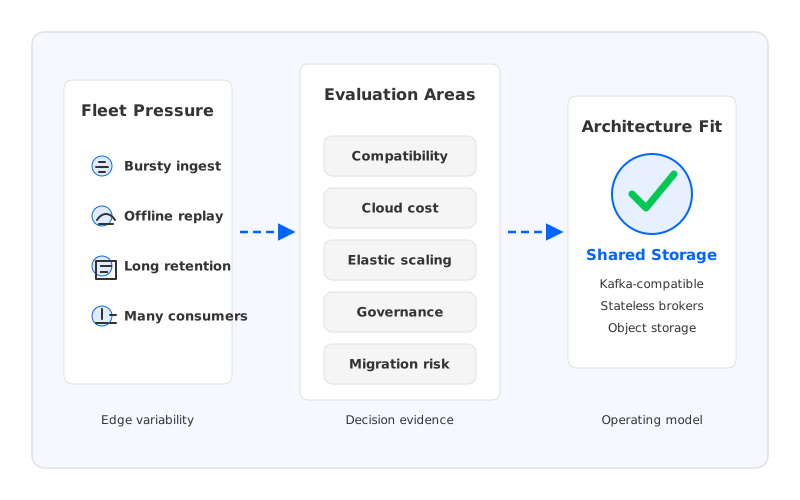
Fleet telemetry workloads combine three patterns that are individually manageable and painful together. First, event arrival is uneven. A fleet wakes up around shift changes, weather events, service windows, network restoration, or regional business hours. Second, the data has multiple consumers with different expectations: low-latency operations, batch analytics, anomaly detection, replay, and compliance export all want the same topic history for different reasons. Third, the edge side is messy. Devices lose connectivity, buffer locally, change payload shape across firmware versions, and occasionally resend data after a long offline period.
Traditional Kafka can handle these patterns, but the operational burden appears where the platform meets cloud economics. More partitions improve parallelism and isolate hot streams, yet they increase metadata, placement, and reassignment work. Longer retention supports replay and model backfill, yet it increases storage pressure. More replicas improve availability, yet they also introduce data movement across brokers and multi-AZ network paths.
The production constraint is not only throughput. It is the combination of ingestion, retention, fan-out, and operational change. A platform team may size for the morning traffic peak, then discover that the expensive part of the system is catch-up reads after a regional outage or broker replacement during maintenance.
2The Edge-to-Cloud Shape of the Problem
An edge-to-cloud telemetry platform usually has several layers before an event reaches business logic. The device or gateway collects measurements. A regional ingress layer authenticates traffic and normalizes payloads. A streaming platform keeps durable ordered history. Downstream processors route data to operational databases, warehouses, lakehouse tables, alerting systems, and ML feature pipelines. The streaming layer is where backpressure, retention, and replay meet.
For platform teams, this creates a decision map with four questions:
- Where should buffering happen when devices are offline or cloud ingress is unavailable? Edge buffering protects connectivity gaps, but the cloud stream still needs to absorb delayed batches without destabilizing normal consumers.
- How much history should remain queryable for replay? Short retention may satisfy live dashboards, while maintenance analytics and fraud investigations often need longer lookback windows.
- Which teams are allowed to change schemas, topics, ACLs, and connector routes? Telemetry platforms become shared infrastructure quickly, so governance cannot be bolted on after the first dozen producers.
- What happens when the fleet doubles or changes geography? Scaling should not require weeks of broker-local data movement or manual partition placement work.
These are not application-only questions. They shape the Kafka architecture itself. A cluster that looks healthy at steady state may still be a poor fit if it cannot scale storage independently from compute, if adding brokers triggers large data movement, or if replay traffic breaks service-level objectives.
3Architecture Options and Trade-Offs
There are three common ways to design fleet telemetry streams around Kafka-compatible infrastructure. The first is a conventional self-managed Kafka cluster with broker-local storage. This gives teams full control and mature ecosystem compatibility, but the broker owns both compute and persistent data. Capacity planning therefore couples CPU, memory, disk, partition placement, and replication. When traffic shifts, the team often has to rebalance partitions and move data before new capacity is fully useful.
The second option is managed Kafka. This reduces some operational responsibilities, especially around cluster provisioning and patching, but it does not automatically remove the architecture-level coupling between brokers and storage. Teams still need to understand retention cost, partition count, network topology, connector operations, quota policy, and consumer behavior. Managed service boundaries can help, but they can also hide details that matter during incident response or migration planning.
The third option is a Kafka-compatible shared storage architecture. In this model, the Kafka protocol and ecosystem remain familiar, but persistent log data is moved away from broker-local disks into shared storage. Brokers become closer to stateless compute nodes, while durable data is maintained by a storage layer backed by object storage and an accelerated write path. This does not make capacity planning disappear; it changes which variables are coupled.
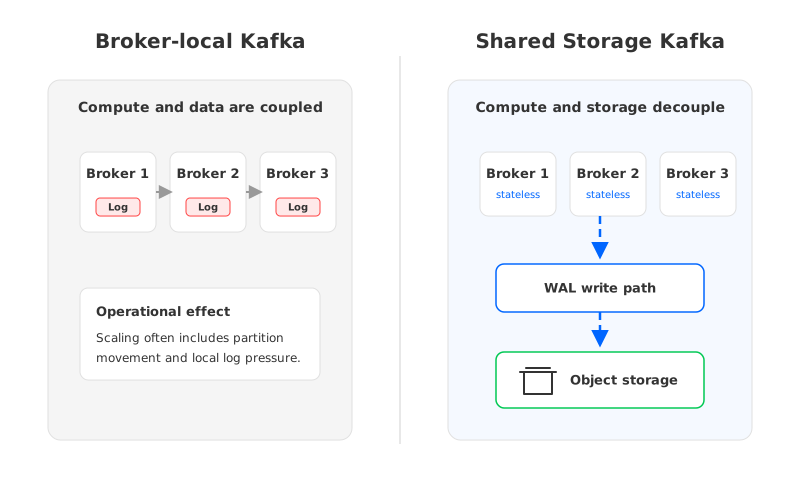
The distinction matters for fleet telemetry because the fleet does not wait for infrastructure maintenance windows. A burst from devices, a firmware rollback, or a replay request from the analytics team can arrive while the platform team is already replacing nodes. If scaling compute requires copying broker-local data, the platform is slowest exactly when it needs to be flexible.
| Decision area | Broker-local Kafka model | Shared storage Kafka-compatible model |
|---|---|---|
| Compute scaling | Add brokers, then rebalance partition data before capacity is fully useful. | Add broker capacity and shift ownership or traffic with less broker-local data movement. |
| Retention planning | Longer retention increases broker disk pressure and replacement cost. | Durable history is primarily held in object storage, with the write path optimized separately. |
| Failure recovery | Recovery often depends on replica placement and local log state. | Recovery can rely more on shared durable storage plus metadata and leadership changes. |
| Fleet burst handling | Burst handling is tied to pre-provisioned broker and disk capacity. | Compute can be adjusted more directly while storage capacity follows object storage economics. |
| Operational boundary | Deep cluster operations remain a platform-team responsibility. | The boundary shifts toward storage policy, WAL choice, metadata, and traffic governance. |
This table is not a universal verdict. Broker-local Kafka can be a strong choice for teams with stable workload shape, deep Kafka operations experience, and clear cost expectations. Shared storage becomes more interesting when the fleet is volatile, retention is long, replays are common, or cloud infrastructure cost is under active review.
4A Practical Evaluation Checklist
The safest way to evaluate a fleet telemetry streaming platform is to test the whole lifecycle, not only the ingest path. A short benchmark will miss expensive parts of a real deployment: schema drift, regional retries, consumer lag recovery, broker replacement, topic growth, and cloud networking. The platform should be judged by how it behaves when normal traffic and operational change happen at the same time.
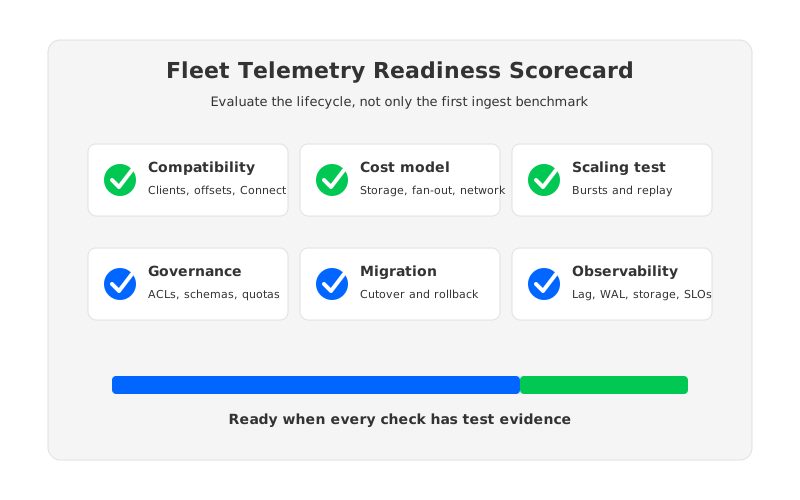
Start with compatibility. Existing producers, consumers, stream processors, and connectors should keep using Kafka APIs and semantics without surprising rewrites. Consumer groups, offset commits, transactional producers, idempotent writes, and Kafka Connect integrations are not optional details when the telemetry stream feeds operations. A small incompatibility can be tolerable in a greenfield prototype and expensive in a migration from an established Kafka estate.
Then evaluate cost as a shape, not as a single monthly number. Fleet telemetry cost comes from ingress, retained bytes, read fan-out, catch-up reads, cross-zone or cross-region networking, connector compute, and operational labor. A platform that looks cost-effective at low retention may become unattractive when replay and long history are introduced. Conversely, a platform with a stronger storage model may justify itself only when retention and burst tolerance are part of the test.
Governance deserves the same attention as throughput. Device fleets create many producer identities, topic families, schema versions, and downstream consumers. The platform needs a clear model for authentication, ACLs, quotas, schema enforcement, topic creation, connector ownership, audit logs, and data residency. Without that model, the Kafka cluster becomes a shared write target that everyone depends on and nobody can safely change.
Migration risk should be tested explicitly. A credible plan includes dual-write or mirror patterns where appropriate, consumer offset strategy, rollback criteria, schema compatibility checks, DNS or bootstrap endpoint changes, and a way to freeze nonessential producer changes during cutover. The highest-risk migrations are not the ones with the most data; they are the ones where no one can explain which consumers are allowed to lag, replay, or pause.
5How AutoMQ Changes the Operating Model
Once the evaluation framework is clear, AutoMQ fits into a specific architectural category: it is a Kafka-compatible cloud-native streaming platform that moves Kafka's storage layer to shared object storage while keeping the Kafka protocol and upper-layer ecosystem familiar. Its architecture uses S3Stream to replace broker-local log storage, with a write-ahead log layer for durable low-latency writes and object storage as the primary long-term storage layer. The result is a system where brokers can be treated more like stateless compute nodes than durable data owners.
That change is relevant to fleet telemetry because it attacks the coupling that makes cloud Kafka operations hard. In a shared nothing model, every broker replacement, scale event, and partition reassignment has to respect where the local log data lives. In AutoMQ's shared storage architecture, durable data is held in shared storage, while brokers handle protocol processing, caching, leadership, and scheduling. Reassignment becomes more about metadata and traffic ownership than copying retained topic history from one broker to another.
This is also why AutoMQ's deployment boundary matters for technical buyers. In BYOC-style deployments, the data plane runs in the customer's cloud account, and telemetry data remains within customer-controlled infrastructure. That does not eliminate the need for IAM, networking, encryption, observability, and operational process. It gives the architecture team a different boundary to evaluate: Kafka compatibility and cloud-native storage inside the same environment where the fleet data already lives.
For edge-to-cloud platforms, the most practical AutoMQ evaluation is not "can it replace Kafka?" but "which operational constraints change if Kafka-compatible brokers no longer own all persistent data locally?" That question leads to concrete tests:
- Scale broker compute during a simulated regional telemetry burst and measure how quickly capacity becomes useful.
- Run catch-up consumers against retained telemetry while live device traffic continues, then compare tail latency and recovery behavior.
- Replace or remove broker nodes during retention-heavy operation and observe whether recovery work looks like metadata movement or bulk data movement.
- Validate connector, schema, ACL, and client behavior with the same Kafka tools used in the existing estate.
- Model cloud network paths, especially availability-zone placement and private connectivity, before assuming the cost impact.
The trade-off is that shared storage introduces its own design surface. Teams need to understand WAL choices, object storage behavior, cache policy, metadata scale, and cloud provider limits. The architecture should be tested against the fleet's real burst patterns, not against a generic streaming demo.
6Building a Migration and Readiness Scorecard
A useful scorecard turns architectural preferences into decision evidence. Give each area a simple rating such as green, yellow, or red, then attach a test or source of evidence. The goal is not to create a procurement spreadsheet with false precision. The goal is to expose weak assumptions before the platform becomes the default ingestion layer for every device team.
For fleet telemetry streams, the scorecard should include:
- Workload envelope: peak ingest rate, average ingest rate, maximum offline replay batch, expected retention, partition strategy, and consumer fan-out.
- Compatibility surface: producer libraries, consumer groups, stream processors, Kafka Connect connectors, schema registry behavior, transactions, and idempotent producer usage.
- Operations: broker replacement, partition reassignment, scaling time, consumer lag recovery, alert routing, and maintenance process.
- Governance: device identity, topic ownership, ACL model, quota policy, data residency, encryption, auditability, and schema lifecycle.
- Cost model: storage, compute, private networking, cross-zone transfer, connector infrastructure, observability, and engineering time.
This scorecard prevents a common failure mode: optimizing only the first successful ingest path. A fleet telemetry platform is successful when the second, third, and fourth teams can reuse it without creating a new operational exception each time. That is where Kafka-compatible infrastructure earns its keep, and it is also where storage architecture becomes a business decision rather than an implementation detail.
Fleet telemetry starts at the edge, but the platform risk usually lands in the cloud. If your team is evaluating Kafka-compatible streaming for high-volume telemetry, start by mapping your workload envelope and then test the operating model behind the broker. AutoMQ's shared storage architecture is one option worth evaluating when retained history, elastic compute, customer-controlled deployment, and cloud cost discipline all matter. The next useful step is to review the AutoMQ shared storage architecture and compare it against your own fleet telemetry scorecard.
7References
- Apache Kafka 4.3 documentation
- Apache Kafka Streams documentation
- AutoMQ architecture overview
- AutoMQ S3Stream shared streaming storage
- AutoMQ WAL storage
- AWS IoT Greengrass stream manager component
8FAQ
8.1Is Kafka a good fit for fleet telemetry streams?
Kafka is often a good fit when the platform needs durable ordered event history, multiple independent consumers, replay, and a mature integration ecosystem. The harder question is whether the chosen Kafka-compatible infrastructure can handle bursty edge traffic, long retention, governance, and cloud operations without excessive manual work.
8.2How should teams choose partition strategy for fleet telemetry?
Partition strategy should reflect ordering requirements, expected device cardinality, hot-key risk, consumer parallelism, and future replay needs. Many teams start with a device, tenant, region, or fleet segment key, then test whether that key creates hot partitions during realistic burst scenarios.
8.3What makes shared storage relevant to telemetry workloads?
Shared storage separates durable retained data from broker-local disks. For telemetry workloads with bursts, long retention, and replay-heavy consumers, this can reduce the amount of broker-local data movement required during scaling, replacement, and reassignment.
8.4Does AutoMQ remove the need for Kafka operations expertise?
No. AutoMQ changes the operating model, but teams still need Kafka knowledge around topics, clients, consumer groups, schemas, ACLs, quotas, connectors, and observability. The main difference is that storage and compute are less tightly coupled than in broker-local Kafka deployments.
8.5What should be tested before migrating fleet telemetry streams?
Test client compatibility, peak ingest, offline replay, catch-up reads, broker replacement, consumer lag recovery, connector behavior, schema evolution, network placement, rollback, and cost under realistic retention. A migration plan is weak if it only proves that producers can write new events.


