
Table of Contents
Table of Contents
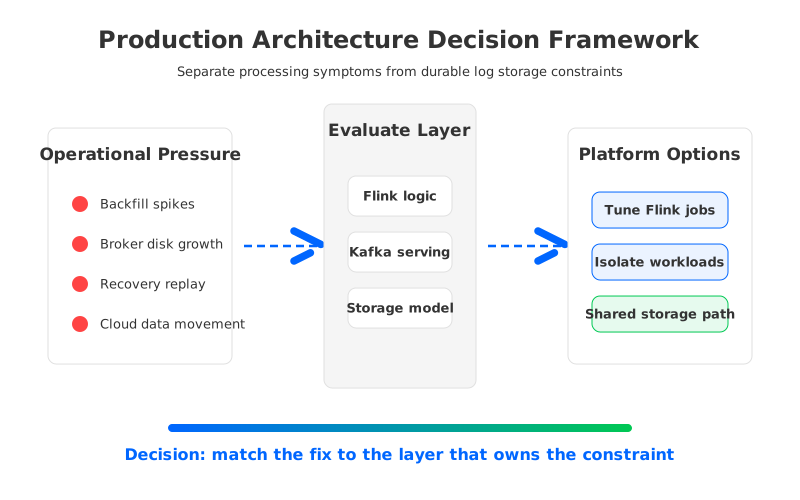
Searches for flink kafka production architecture usually come from a team that has already moved past the whiteboard. Events landed in Kafka, Flink jobs enriched or aggregated them, and downstream systems received fresh data. Then production pressure arrived. Backfills became expensive. Consumer lag looked like an application issue until it exposed a broker capacity problem. A Flink checkpoint failure looked isolated until recovery replayed enough Kafka data to disturb the rest of the platform.
The hard part is not deciding whether Kafka and Flink belong together. Kafka provides a durable event log with consumer groups, offsets, retention, and a protocol ecosystem that teams already depend on. Flink provides stateful stream processing: event-time semantics, checkpoints, keyed state, and operators that transform events into business-ready streams. If Kafka is treated as both the integration backbone and an infinitely elastic storage layer, Flink inherits operational risk from the log.
That boundary matters even more for real-time AI data pipelines. Retrieval, feature freshness, fraud scoring, and recommendation updates all depend on data that is fresh enough to act on and durable enough to replay.
1Why the Boundary Gets Blurry
In a clean mental model, Kafka stores ordered facts and Flink computes derived facts. Kafka owns append, replay, retention, and fan-out. Flink owns joins, windows, stateful transformations, timers, and exactly-once processing patterns. Production adds responsibilities that do not fit neatly into either box. Retention determines how much history Flink can recover. Checkpoints determine how quickly Flink can resume work. Ownership adds another wrinkle: platform teams often operate Kafka, while data teams own Flink jobs.
2What Kafka Should Own
Kafka should own the durable, replayable event history and the coordination semantics around reading that history. The Apache Kafka design centers on a distributed commit log: producers append records to partitions, consumers read by offset, and consumer groups coordinate work across members. Those primitives decouple writers from readers. A Flink job can fail, scale, or be redeployed without forcing producers to know anything about its internal state.
That does not mean Kafka should own every historical data use case. Once retention stretches from operational replay into analytical history, storage architecture starts to matter more than the Kafka API alone. Traditional broker-local storage ties data placement to broker placement. Partitions have leaders and replicas, and the cluster moves partition data when capacity changes or recovery requires rebalancing. This model is proven, but it makes storage elasticity a broker operation.
Kafka's production responsibilities are strongest when they are framed as contracts:
- Ordering and replay contract. Kafka should preserve partition order, expose offsets, and provide enough retention for Flink recovery, application replay, and controlled reprocessing.
- Isolation contract. A heavy Flink backfill should not starve unrelated consumers or producers. Isolation may require quotas, workload-aware topic design, separate clusters, or a storage architecture that absorbs replay differently.
- Durability contract. The log must survive broker failure without forcing the processing layer to reinterpret data loss, offset gaps, or partial recovery.
- Compatibility contract. Existing producers, consumers, schemas, connectors, and operations tooling should not be broken by infrastructure changes underneath the Kafka API.
These contracts let architects ask whether the platform can keep its promises when traffic spikes, a Flink job replays history, or a broker fails.
3What Flink Should Own
Flink should own computation over streams, including stateful transformations that would be awkward or fragile inside Kafka clients. Windowed aggregations, temporal joins, fraud rules, feature derivation, sessionization, and enrichment pipelines belong in a stream processor because they need event-time handling, operator state, checkpointing, and recovery. Kafka delivers the input history; Flink turns that history into continuously updated facts.
The temptation is to push more storage responsibility into Flink because Flink has state. That is usually a category error. Flink state is processing state, not a replacement for the source log. A keyed aggregate may contain the latest balance, count, session, or feature value, but it is not the ordered record history that produced it. When auditors, model teams, or downstream applications need replay, they need a reliable log or a governed table representation.
This distinction affects AI infrastructure in a practical way. A feature pipeline may use Flink to maintain near-real-time features, but the team still needs to answer where raw events live and whether a new model can recompute features from the same input. Flink makes the derived stream fresh. Kafka makes the input history reusable.
| Responsibility | Kafka/log layer | Flink/processing layer |
|---|---|---|
| Durable event history | Primary owner | Reads and replays from it |
| Event-time windows and joins | Provides ordered input by partition | Primary owner |
| Consumer offsets and group coordination | Primary owner | Uses source offsets during execution |
| Application state | Stores source records, not derived state | Primary owner through keyed state and checkpoints |
| Reprocessing | Supplies retained records | Executes revised logic over those records |
| Downstream materialization | Often feeds sinks and connectors | Computes and writes derived outputs |
Most production incidents happen when one row quietly migrates to the wrong side. If Flink becomes the only place where critical business state exists, recovery depends on checkpoint health and job semantics. If Kafka becomes the place for every historical query, brokers become an expensive substitute for a lakehouse or OLAP system. The boundary is healthy when each layer can fail, recover, and scale according to its purpose.
4The Broker-Local Storage Trap
The classic Kafka architecture is shared-nothing: brokers own local storage, partitions live on broker disks, and replication copies data between brokers. This still works well for many workloads. The issue is that production cloud environments magnify the cost of tying compute and storage together.
When a broker fills up, the platform team adds capacity and moves partitions. When throughput rises, the team may add brokers even if the real bottleneck is disk, not CPU. When a Flink backfill reads old data at high speed, the same brokers still serve live writes, replication, and other consumers. Locality becomes an operational coupling point.
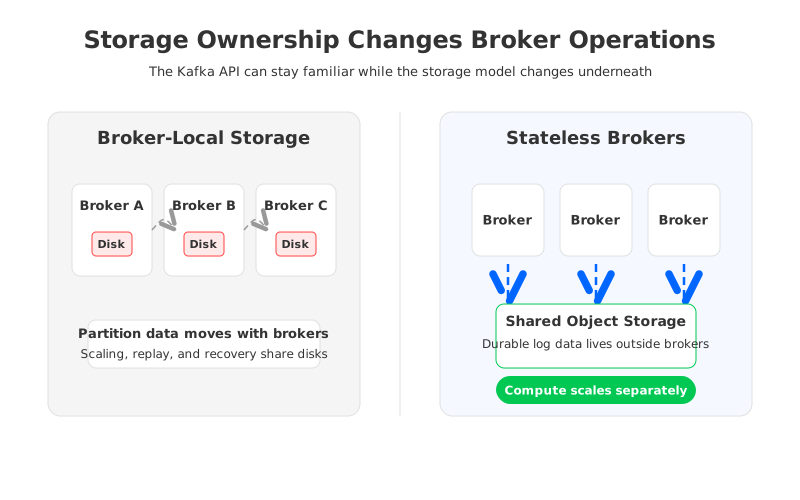
Tiered storage helps by moving older segments to remote storage, and Kafka's own tiered storage work reflects the same pressure: local broker disks should not be the only place where retained history lives. But tiering is not the same as making brokers stateless. The hot path, metadata behavior, cache design, failure recovery, and operating model still determine whether storage elasticity is independent from broker lifecycle.
This is where a neutral architecture evaluation becomes useful. Before choosing a product or rewriting a platform, ask what kind of pressure dominates your Kafka and Flink deployment:
- If the main issue is job logic, optimize Flink first: state size, checkpoint interval, parallelism, backpressure, serialization, and sink behavior.
- If the main issue is cluster utilization, examine Kafka partitioning, producer batching, consumer fetch patterns, quotas, and topic retention.
- If the main issue is storage growth and broker recovery, evaluate whether broker-local storage is the root constraint.
- If the main issue is cloud cost, separate the bill into compute, storage, cross-zone traffic, private connectivity, and operational overhead instead of treating Kafka as one line item.
The answer may still be "keep the current Kafka architecture and tune it." A good framework should sometimes tell you not to migrate.
5A Production Evaluation Checklist
The best platform reviews are concrete. They ask what happens during a real event.
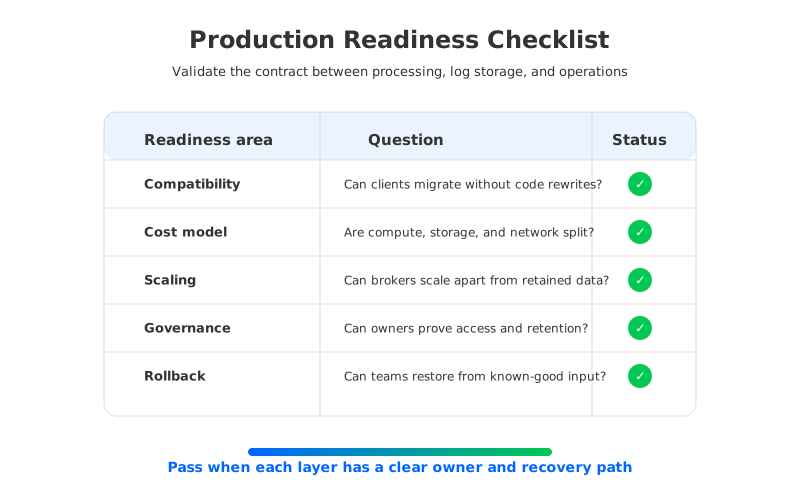
Start with recovery. Pick a critical Flink job and model what happens after a failed deployment, a bad transformation, or a checkpoint restore. How much Kafka history must be replayed? Which topics and partitions carry the load? Does the replay compete with live traffic? If the answer depends on an operator manually watching several dashboards, the architecture is carrying human coordination as part of its reliability model.
Then test elasticity. Increase producer traffic, increase consumer fan-out, and run a controlled backfill. Watch whether Kafka needs more CPU, more disk, or more network first. A healthy architecture lets each tier scale for the resource it actually consumes. A weak one forces the team to add brokers because disks are full, or slow Flink jobs because Kafka cannot safely serve replay.
Finally, test governance and migration. Schema evolution, topic ownership, access control, network boundaries, and rollback procedures become more important as real-time data feeds more systems. The architecture should make it possible to prove where data lived, who could read it, and how a bad derived stream can be rolled back to known-good input.
6Where Cloud-Native Kafka Changes the Operating Model
Once the evaluation points to broker-local storage as the constraint, the next question is not "which faster broker should replace Kafka?" Most teams cannot casually abandon Kafka semantics. They have producers, consumers, connectors, governance, and runbooks built around the Kafka protocol. The more realistic question is whether the storage layer can change while the Kafka-facing contract remains familiar.
AutoMQ fits that category: a Kafka-compatible, cloud-native streaming system that separates broker compute from shared storage. The important idea is not that every Flink job suddenly becomes simpler. Durable log storage no longer has to be tied one-to-one to broker-local disks. Brokers can act more like stateless compute in front of shared object storage, with a write-ahead log layer for the write path.
That changes the operating model in several ways that matter for Flink-heavy environments. Scaling broker compute is less entangled with retained data volume. Recovery does not need to treat every broker as the physical home of the data it once served. Object storage durability and capacity can carry more of the long-term log responsibility, while Kafka-compatible APIs preserve the application surface. For teams that run in their own cloud accounts, deployment boundaries also matter: data-plane control, network locality, and compliance reviews are part of the architecture decision.
AutoMQ's zero cross-AZ traffic design is another example of why the storage model affects production trade-offs. In traditional replicated Kafka deployments, multi-AZ durability often implies replication traffic across zones. A shared-storage design can change where durability is provided and how brokers interact with zones. The exact economics still depend on region, workload, cloud provider pricing, and deployment choices, so the useful claim is architectural: the cost model changes because data movement responsibilities move to different layers.
For Flink, the benefit is indirect but meaningful. Flink still needs good job design, state management, checkpoint hygiene, and sink behavior. AutoMQ does not remove those responsibilities. It reduces the chance that a processing problem becomes a broker storage crisis, or that a storage recovery event turns into a processing outage.
7Decision Table for Platform Teams
The architecture choice should follow the pressure pattern. A team with five small Flink jobs and short Kafka retention does not need the same answer as a team feeding AI features, operational analytics, and dozens of downstream consumers from the same log.
| Situation | Better first move | Why |
|---|---|---|
| Flink checkpoints are slow, but Kafka has stable disk, CPU, and network usage | Tune Flink job design | The processing layer is the visible bottleneck, so start with state, parallelism, and checkpoint configuration. |
| Kafka brokers are disk-bound because retention keeps growing | Revisit log storage architecture | The platform is using broker-local disks as the long-term history layer. |
| Backfills disturb live producers or unrelated consumers | Add workload isolation, then evaluate storage decoupling | Isolation may solve the immediate issue, but repeated replay pressure points to a deeper storage/log serving problem. |
| AI feature pipelines require both fresh derived data and replayable raw events | Define a strict log-versus-processing contract | Flink should compute features; Kafka-compatible storage should preserve reusable input history. |
| Migration risk is dominated by application compatibility | Prefer Kafka-compatible options and staged migration | Protocol and client compatibility reduce the number of moving parts during platform change. |
| Cloud cost is rising with unclear drivers | Split cost by compute, storage, network, and operations | Architecture decisions are easier when the bill maps to system responsibilities. |
The point is to stop asking either layer to hide the other layer's design constraints. Kafka should be a durable, replayable, governable log. Flink should be a stateful computation engine over that log. Cloud-native Kafka architectures, including AutoMQ, are worth evaluating when the log contract is still right but broker-local storage has become the limiting assumption.
If your team is reviewing a production Flink and Kafka platform, start by mapping top incidents and costs to this boundary. The patterns will usually be obvious: processing state, log storage, replay behavior, or cloud data movement. From there, compare the current Kafka design with a shared-storage Kafka-compatible model and test it against your own recovery and backfill scenarios. AutoMQ's documentation is a practical next step when that evaluation points toward decoupling Kafka compute from durable storage.
8References
- Apache Kafka Design Documentation
- Apache Flink Stateful Stream Processing
- AutoMQ Architecture Overview
- AutoMQ WAL Storage Documentation
- AutoMQ Zero Cross-AZ Traffic Overview
- AWS S3 Pricing
9FAQ
9.1Is Kafka a stream processor or a storage system?
Kafka is best treated as a durable event log and streaming integration layer. It can support lightweight transformations through ecosystem tools, but production stateful processing usually belongs in a processor such as Flink, where event-time handling, keyed state, checkpoints, and operator recovery are first-class concerns.
9.2Should Flink replace Kafka for stateful applications?
No. Flink state is processing state, not the same as a replayable source log. A production architecture usually needs both: Kafka-compatible storage for durable input history and Flink for continuous computation over that history.
9.3When does broker-local Kafka storage become a problem?
It becomes a problem when retained data volume, backfills, broker recovery, or cloud data movement dominate operational work. If teams scale brokers mainly because disks are full, or if Flink replay routinely disturbs live Kafka workloads, the storage model deserves review.
9.4Does tiered storage make Kafka brokers stateless?
Not by itself. Tiered storage can reduce dependence on local disks for older segments, but the broker lifecycle, hot path, cache behavior, and recovery model still matter. Stateless broker architectures go further by separating durable log storage from broker-local data ownership.
9.5Where does AutoMQ fit in a Flink Kafka production architecture?
AutoMQ fits where teams want to keep Kafka-compatible APIs while changing the storage operating model. It separates broker compute from shared storage, uses a WAL layer for the write path, and is designed for cloud-native deployment patterns where storage elasticity, replay behavior, and cross-zone traffic are part of the platform decision.


