
Table of Contents
Table of Contents
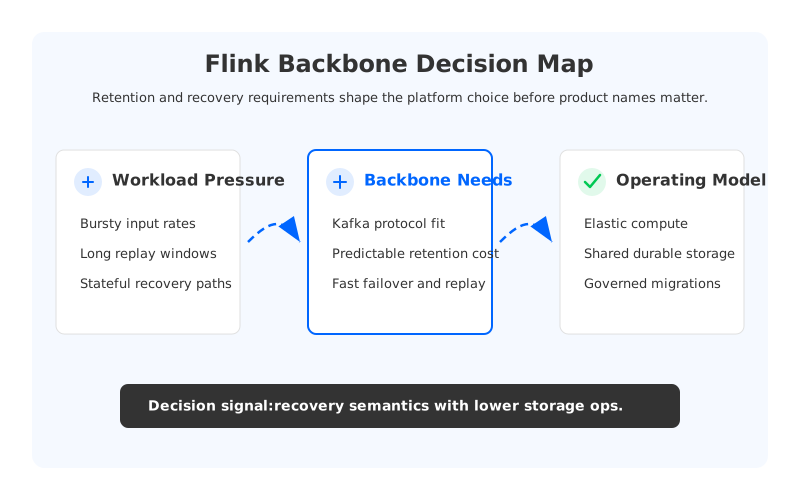
When a team searches for flink application backbone kafka, the question is rarely about a toy pipeline. It usually means a Flink job has become part of the production control path: fraud scoring, inventory updates, customer state, observability enrichment, settlement, routing, or model-feature generation. The job may be written in Flink, but its operating envelope is determined by the event backbone behind it. If that backbone cannot retain history and support controlled recovery, the stateful application inherits those limits.
Kafka became the default backbone for this class of work because it gives Flink a durable, ordered, replayable stream with consumer offsets and broad ecosystem support. Flink can checkpoint operator state, restore from a checkpoint, and resume consumption from the corresponding Kafka offsets. That combination is powerful, but it also creates a dependency that teams often understate: recovery is only as good as the retained log, the offset discipline, and the operational behavior of the Kafka-compatible platform under stress.
The practical question is not "Can Kafka feed Flink?" That answer is already yes for many production teams. The harder question is whether the Kafka-compatible layer can remain boring when the Flink application is no longer boring. Retention grows from hours to days, replay becomes routine backfill, cross-zone traffic appears on the cloud bill, and broker scaling intersects with recovery objectives.
1Why Teams Search for flink application backbone kafka
Flink applications become demanding Kafka consumers because they combine low-latency processing with durable state. A stateless enrichment service can often tolerate a short retry window or a cache miss. A stateful Flink pipeline has a different relationship with history: it needs to reconstruct internal state, align checkpoints with source positions, and sometimes replay a bounded section of the log after a bug fix, rollback, or downstream outage.
That is why the search phrase tends to appear near architectural decision points. A team might be replacing a batch job with continuous processing. Another team might be moving from a single Kafka cluster to a multi-tenant streaming platform. A platform group might be standardizing how Flink jobs access CDC topics, telemetry topics, and product-event topics without creating a custom exception for every application.
The common pressure shows up in four places:
- Retention becomes a recovery control, not only a compliance setting. Short retention can make a Flink restore technically successful but operationally useless if the required offsets have already expired.
- Replay cost becomes visible. Backfills, catch-up reads, and incident recovery read older data at high volume, which can disturb broker disks, network links, and cache behavior.
- Scaling is tied to state movement. If adding brokers triggers long data movement, the platform may not be elastic enough for workloads whose traffic changes faster than the cluster can rebalance.
- Governance moves closer to the stream. Teams need access control, encryption, auditability, and deployment boundaries that match the criticality of the application.
These are not exotic requirements. They are the normal consequences of letting a streaming job sit between user activity and business state. The event backbone has become part of the application architecture.
2The Production Constraint Behind the Problem
A stateful Flink application has two durable memories. Flink owns operator state through checkpoints and savepoints. Kafka owns the event history and consumer positions that let the job continue reading from a known point. Recovery works when those two memories stay compatible. If the Flink checkpoint refers to source offsets that no longer exist, or if the Kafka cluster is too degraded to serve the replay quickly, the recovery plan becomes a negotiation with production reality.
Apache Flink's checkpointing model is designed to make state recovery deterministic, while Apache Kafka's consumer group and offset model makes stream position explicit. That boundary is useful because it keeps the stream backbone and processing engine independently operable. It also means platform teams must test the boundary as a system, not as two separate products. A successful checkpoint drill that ignores Kafka retention is incomplete; a Kafka retention policy that ignores Flink restore time is also incomplete.
Traditional Kafka deployments usually store partition replicas on broker-local disks. This shared-nothing model made sense for Kafka's original operating environment: brokers were durable storage nodes, replication happened between brokers, and capacity planning meant provisioning enough disk, network, and CPU per broker. In the cloud, the same model turns several application-level concerns into infrastructure side effects.
Broker-local storage affects Flink backbones in concrete ways. Reassigning partitions can move large amounts of data between brokers. Longer retention increases disk pressure even when the compute requirement is unchanged. Multi-AZ durability can create cross-zone replication traffic. A catch-up consumer can compete with hot reads for local disk and page cache. None of these behaviors are wrong; they are the direct consequences of coupling compute and durable log storage inside the broker.
3Architecture Options and Trade-Offs
Teams usually evaluate three architecture patterns for a Flink application backbone. The first is a self-managed Kafka cluster on instances or Kubernetes. It gives maximum control and predictable Kafka semantics, but the team owns broker sizing, storage expansion, partition reassignment, failure handling, security hardening, and upgrade choreography.
The second pattern is a managed Kafka service. It reduces undifferentiated operations and can be the fastest path to a standard Kafka API. The trade-off is that operational knobs, network topology, storage behavior, and cost controls are shaped by the service boundary. For Flink-heavy platforms, the key question is whether the service exposes enough control over retention, replay, client configuration, network placement, and observability to meet application-level recovery objectives.
The third pattern is a Kafka-compatible platform that changes the storage architecture while preserving Kafka-facing behavior. Instead of treating each broker as the durable home for a subset of partitions, the platform keeps durable stream data in shared cloud storage and lets brokers operate closer to stateless compute. The reader should be skeptical here in a healthy way: compatibility, latency, durability, and operational maturity must be verified, not assumed.
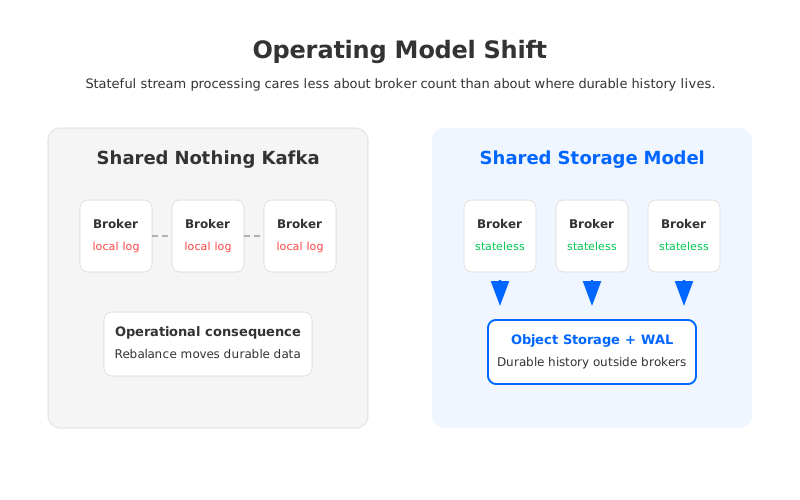
The architecture choice is easier to reason about when the trade-offs are separated:
| Evaluation axis | Broker-local Kafka model | Shared storage Kafka-compatible model |
|---|---|---|
| Retention growth | Increases broker disk footprint and capacity planning pressure | Moves long-lived history toward object storage economics |
| Broker scaling | Often involves partition reassignment and data movement | Can reduce the amount of durable data tied to broker membership |
| Replay behavior | Older reads may contend with local broker resources | Depends on cache and object-storage read path design |
| Compatibility | Native Kafka behavior when using Apache Kafka | Must be validated against Kafka APIs, clients, and Flink connectors |
| Operations | Familiar model with mature tooling | Different failure modes and observability questions |
No row in this table says one model is universally correct. A low-retention, steady-throughput Flink job may run perfectly on a conventional Kafka cluster for years. The pain appears when retention, replay, elasticity, and cloud networking all become first-class requirements at the same time.
4Evaluation Checklist for Platform Teams
The right evaluation starts with workload behavior, not vendor claims. A platform team should describe the Flink application in terms of source topics, retention windows, checkpoint interval, maximum tolerated restore time, expected replay volume, peak ingress, consumer fan-out, and deployment topology. Those inputs determine whether the backbone is mostly a low-latency buffer, a durable recovery log, a multi-tenant integration layer, or all three.
From there, the checklist becomes more concrete:
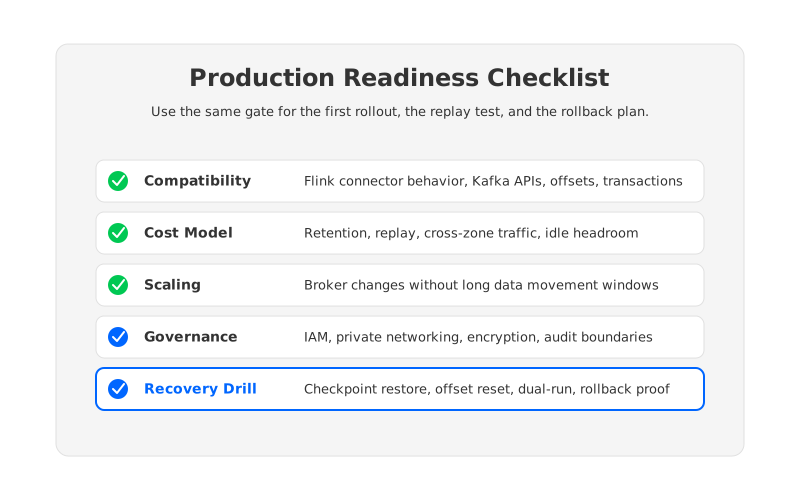
- Kafka and Flink compatibility. Validate the exact Flink Kafka connector version, authentication mode, transaction usage if applicable, offset reset behavior, consumer group operations, and administrative APIs needed by your tooling.
- Retention and restore math. Define the longest acceptable incident window, then verify that topic retention, checkpoint retention, and operational restore procedures cover it with margin.
- Replay isolation. Test whether a large catch-up read affects tail latency for live consumers and producers. Recovery that damages the live system is not a recovery plan.
- Network topology. Map producer, broker, Flink TaskManager, object storage, and sink locations by zone or region. Cross-zone traffic is often invisible in design diagrams and very visible in bills.
- Governance boundaries. Confirm IAM, ACLs, encryption in transit and at rest, private connectivity, audit logs, and ownership boundaries for platform and application teams.
- Migration and rollback. Plan dual-running, offset translation, consumer cutover, producer cutover, and rollback before the first production topic moves.
The most useful proof is a recovery drill. Break a staging pipeline in a way that resembles a production incident: stop consumers, let lag accumulate, deploy a bad transformation, restore from a checkpoint, replay from retained Kafka offsets, and measure how long the platform takes to become boring again. A paper design cannot answer that question.
5How AutoMQ Changes the Operating Model
Once the evaluation framework is in place, AutoMQ becomes relevant as an example of the third architecture pattern: a Kafka-compatible streaming platform that separates broker compute from durable stream storage. AutoMQ keeps Kafka protocol and client compatibility as the application-facing contract, while its Shared Storage architecture moves the durable log layer toward object storage and uses WAL storage for low-latency persistence. The point is not to make Flink developers learn another stream API; the point is to change what the platform team has to operate behind that API.
This matters for Flink application backbones because most of the hard questions above are storage questions in disguise. If durable history is tied to broker-local disks, retention growth, scaling, partition reassignment, and recovery reads all put pressure on the same broker fleet. If durable history is held in shared storage and brokers are closer to stateless compute, the platform has more room to scale compute and storage independently.
For a Flink team, the practical impact is operational rather than cosmetic. Longer retention can be evaluated against object-storage-backed economics instead of only broker disk size. Broker replacement and scaling can be considered separately from moving all retained partition data. Catch-up reads and recovery paths can be tested as part of the storage read path, not as a surprise load on a small set of local disks. Cross-zone traffic can also be addressed explicitly through AutoMQ's inter-zone traffic elimination guidance, which is important when Flink workers, producers, and brokers span availability zones.
AutoMQ also fits deployment models where the data boundary matters. Many stateful Flink workloads process regulated, tenant-sensitive, or business-critical events. A bring-your-own-cloud or private deployment model can let the organization keep data-plane resources in its own cloud account or Kubernetes environment while still adopting a Kafka-compatible operating model. That does not remove the need for security review, but it gives architects a clearer place to draw IAM, network, encryption, and audit boundaries.
The product should still be tested like infrastructure. Run the same Flink connector suite, producer and consumer configs, failover drills, replay tests, ACL checks, and observability checks you would run against any Kafka-compatible backbone. Compatibility claims are useful only when they survive your application behavior.
6A Migration Readiness Scorecard
A migration from an existing Kafka backbone to a Kafka-compatible shared storage model should be staged around evidence. The safest scorecard is small enough to run, but strict enough to stop a risky rollout.
| Gate | Pass condition | Evidence to collect |
|---|---|---|
| Connector fit | Flink jobs run with the existing Kafka connector and security settings | Integration test logs, client configs, admin API checks |
| Retention safety | Required restore offsets remain available for the defined incident window | Topic configs, checkpoint configs, restore drill results |
| Replay behavior | Backfill and catch-up reads do not violate live latency budgets | Producer latency, consumer lag, broker metrics |
| Cost visibility | Storage, compute, and network drivers are separated and forecastable | Cloud bill model, traffic metrics, retention assumptions |
| Rollback | Producers and consumers can return to the previous path without data loss | Dual-run plan, offset plan, rollback runbook |
| Ownership | Platform and application teams know who operates each failure mode | On-call runbook, alert routing, access model |
Run the scorecard on one representative pipeline before it becomes a platform standard. Pick a job with real state, lag risk, governance requirements, and enough business importance to expose the uncomfortable parts of the design.
To explore whether that model fits your Flink backbone, review the docs or request a technical walkthrough through the verified AutoMQ demo page: https://www.automq.com/demo?utm_source=blog&utm_medium=cta&utm_campaign=rpb-0141.
7References
- Apache Kafka Documentation for consumer groups, offsets, transactions, KRaft, topic configuration, Kafka Connect, and client behavior.
- Apache Flink Checkpoints for Flink's checkpoint-based state recovery model.
- AutoMQ Shared Storage Architecture for the separation of broker compute and durable stream storage.
- AutoMQ S3Stream Shared Streaming Storage and WAL Storage for storage-layer design details.
- AutoMQ Kafka Compatibility for Kafka protocol and client compatibility guidance.
- AutoMQ Inter-Zone Traffic Overview for cross-zone traffic considerations.
- AutoMQ Flink Integration for using AutoMQ with Flink.
- AWS S3 Storage Classes for cloud object storage durability and storage-class context.
8FAQ
8.1Is Kafka still the right backbone for Flink applications?
Kafka remains a strong fit when the application needs durable ordered streams, explicit offsets, replay, and a broad connector ecosystem. For stateful Flink workloads, evaluate retention, recovery, replay isolation, and scaling behavior before standardizing on a platform.
8.2How long should Kafka retention be for a stateful Flink pipeline?
Retention should exceed the longest realistic recovery and backfill window, with margin for incident response and approval time. Align Kafka topic retention, Flink checkpoint retention, and rollback procedures as one recovery policy.
8.3Does Flink checkpointing remove the need for Kafka retention?
No. Flink checkpoints capture processing state and source positions, but the source data must still be available when the job resumes from those positions. If Kafka has deleted the required offsets, the checkpoint cannot recreate the missing event history by itself.
8.4What should teams test before migrating a Flink backbone?
Test connector compatibility, authentication, ACLs, offset behavior, transaction usage if present, checkpoint restore, large replay, live-tail latency during replay, metrics, alerting, and rollback. The migration is ready when those tests produce operational evidence, not when a proof-of-concept can send and receive a few records.
8.5Where does AutoMQ fit in this decision?
AutoMQ fits when a team wants Kafka-compatible behavior with a cloud-native shared storage operating model. It is especially relevant when long retention, elastic scaling, cross-zone traffic control, and customer-controlled deployment boundaries are important.


