
Table of Contents
Table of Contents
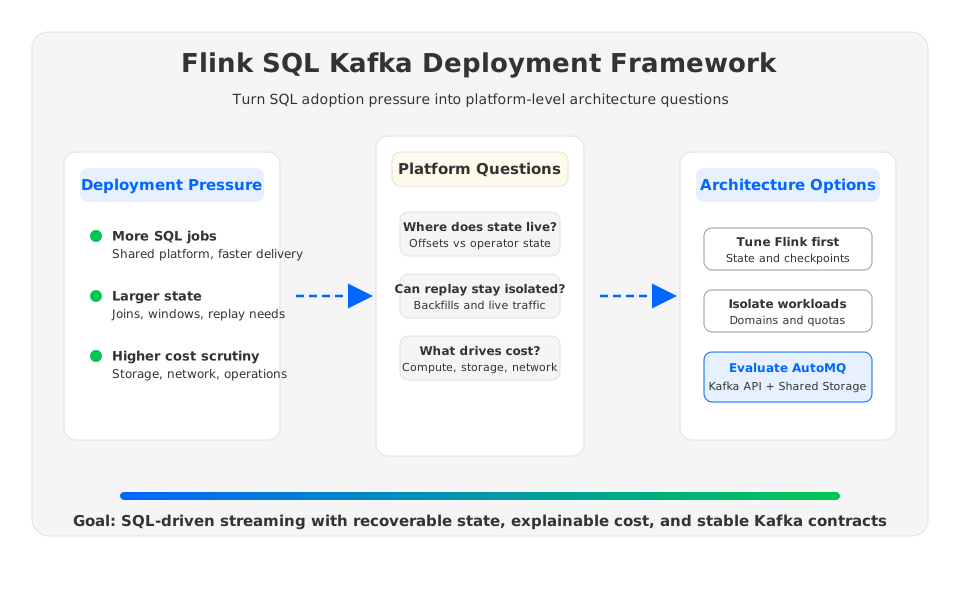
Searches for flink sql kafka deployment rarely come from curiosity. They usually come from a team with Kafka topics, SQL-fluent data engineers, and pressure to move more logic into streaming without turning every pipeline into a custom Java job. Flink SQL looks like the right interface: declarative, familiar, and powerful enough for joins, windows, enrichment, and continuous materialization. The real question is what happens after the first job works.
Production forces a different conversation. A SQL query becomes a long-running service. A table definition becomes an operational contract. A Kafka topic becomes both input history and recovery source. A serious architecture review should begin with boundaries: state, replay, Kafka guarantees, and what changes when the backbone moves from broker-local disks to cloud-native Shared Storage architecture.
1Why Flink SQL Changes the Kafka Conversation
Kafka teams tend to be comfortable with application-owned consumers. A service joins a consumer group, reads by offset, commits progress, and writes results somewhere else. Flink SQL changes the ownership model because processing logic becomes part of a shared data platform. A single query can combine topics, maintain keyed state, emit changelog streams, and serve downstream systems that do not know which operator graph produced the result.
The benefit is real. Flink's Table and SQL APIs let teams express streaming transformations using tables, connectors, watermarks, and continuous queries rather than hand-rolled consumer loops. The Kafka SQL connector maps Kafka topics into Flink tables, which makes it natural to treat event streams as queryable inputs and outputs. For organizations with many analysts and data engineers, that can shrink the gap between "we need this signal in real time" and "a production job is running."
The cost of that abstraction is that the platform has to supply the missing operational detail. SQL hides consumer polling and serialization from the author, but the job still depends on Kafka offsets, checkpoints, topic retention, consumer group behavior, and sink semantics. A deployment review must make those dependencies visible again before they become incident tickets.
Several production questions are worth asking before the first critical Flink SQL job goes live:
- Who owns the job lifecycle? SQL makes the logic approachable, but the job still needs versioning, deployment, rollback, state compatibility checks, and controlled restarts.
- How much Kafka history is recoverable? Retention must cover checkpoint restore, replay, backfill, and bad-query recovery, not just normal consumer lag.
- How isolated is replay traffic? A large historical read from Flink can compete with live producers, ordinary consumers, and internal broker replication.
- What does the cost model reward? A platform that charges or scales primarily by broker disk, cross-zone traffic, or over-provisioned compute will behave differently from one that separates compute from durable log storage.
2The State Boundary: Kafka Offsets Are Not Flink State
The easiest mistake is to treat Kafka offsets and Flink state as two names for the same reliability mechanism. They are related, but they solve different problems. Kafka offsets identify where a consumer is in a partitioned log. Flink state records the intermediate data needed to continue a computation: keyed aggregates, join buffers, timers, window contents, and operator metadata. A production Flink SQL job needs both to recover correctly.
Consider an enrichment query that reads orders and customer updates from Kafka, joins them, and writes enriched orders to another topic. Kafka stores the ordered input records. Flink stores the state needed to join records that arrive at different times. If the job fails, recovery restores Flink state from a checkpoint and resumes Kafka reads from offsets consistent with that checkpoint. If retention is too short, the job may not have the source history it needs after delayed recovery.
This boundary becomes sharper with SQL because a small query change can alter state shape. Adding a join, changing a window, or switching aggregation keys may require a savepoint, state migration, or fresh backfill. Teams that treat Flink SQL as "just queries" often discover this when a schema or job update turns into a state compatibility issue.
Separate responsibilities cleanly:
| Production concern | Kafka responsibility | Flink SQL responsibility |
|---|---|---|
| Source history | Retain ordered records in topics | Read from consistent offsets |
| Processing progress | Provide offsets and consumer group mechanics | Bind offsets to checkpoints |
| Derived state | Provide replayable input, not operator state | Maintain keyed state, joins, windows, and timers |
| Recovery | Preserve enough history for restart and replay | Restore checkpoints or savepoints and resume work |
| Backfill | Serve historical records without destabilizing live traffic | Execute revised SQL over retained input |
3Deployment Patterns Teams Usually Compare
Flink SQL deployments usually fall into three patterns. A shared Flink cluster reading from a shared Kafka cluster is efficient for early adoption, but one heavy replay can pressure Kafka, task managers, checkpoints, and sinks at the same time. Domain-isolated Flink deployments over a central Kafka backbone give teams more release control, but they still depend on mature topic ownership, schema governance, and retention planning. Workload-specific stacks for AI features, fraud detection, or operational analytics are easier to reason about during incidents, but they multiply infrastructure and governance work.
The right answer depends on pressure, not fashion. Low-volume metrics can live in a shared environment. A feature pipeline that must replay days of history needs stronger isolation. A compliance-sensitive stream may need a separate network boundary even if throughput is modest.
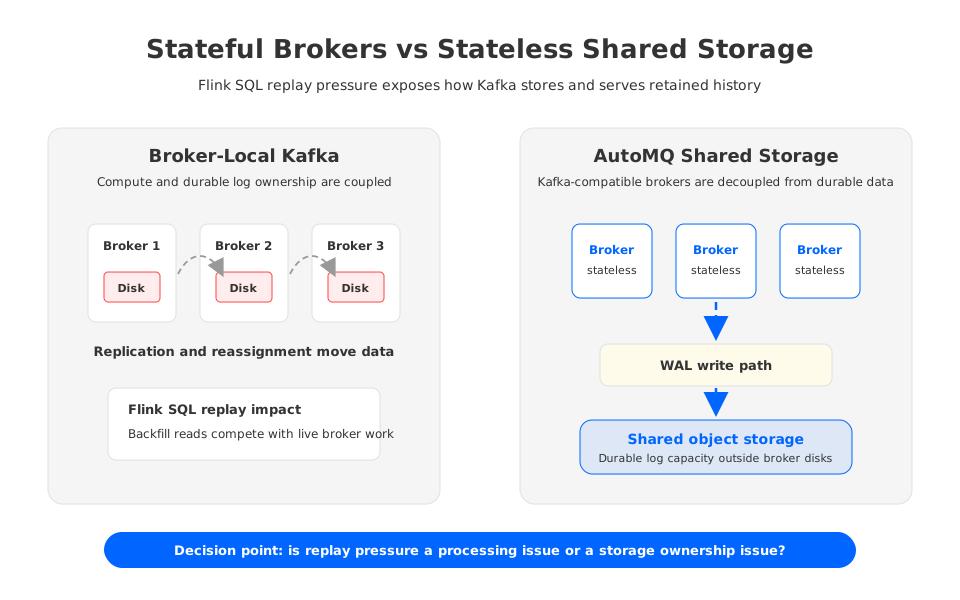
Kafka's storage model affects all three patterns. In traditional shared-nothing Kafka, brokers own local disks, partitions live on those brokers, and replication moves data between brokers for durability. That model is proven, but it couples retained data volume to broker lifecycle. If Flink SQL adoption increases retained history, replay, and fan-out, the cluster may scale for storage and network movement rather than producer CPU.
Tiered storage can reduce pressure from older data by moving segments to remote storage. It does not automatically make brokers stateless. The hot path, recovery path, cache behavior, and partition ownership model still decide how much operational work remains attached to broker-local data. For Flink SQL users, the practical question is whether Kafka can serve recovery and backfill as a normal workload, not as a special event.
4Cost Questions That Matter More Than Price Lists
Teams searching for "how to reduce Kafka cost" often want a number. The better first step is to split the cost into mechanisms. A Flink SQL deployment can increase Kafka costs indirectly even when the SQL jobs run on separate compute: more retained history, more replay, more fan-out, more derived topics, and stricter recovery targets.
The bill usually hides distinct drivers:
- Broker compute. CPU and memory are needed for producers, consumers, request handling, compression, replication, and cache behavior.
- Durable log storage. Retention turns Kafka from a short-lived buffer into a recoverable history layer. Broker-local disks, network-attached volumes, and object storage all have different cost curves.
- Cross-zone and network traffic. Multi-AZ Kafka deployments can create replication and client traffic across availability zones. Cloud providers price network movement differently by region and path, so this must be modeled against current provider pricing.
- Operational labor. Partition reassignment, capacity planning, failed broker recovery, quota tuning, and incident response are not line items in the cloud bill, but they are real platform cost.
This is why benchmark-style claims are less useful than workload modeling. Model the writes, reads, retention period, replay frequency, fan-out, zones, and sink behavior that Flink SQL jobs will create. A credible cost review keeps reliability and rollback in the same spreadsheet as infrastructure spend.
5Evaluation Checklist for Production Flink SQL
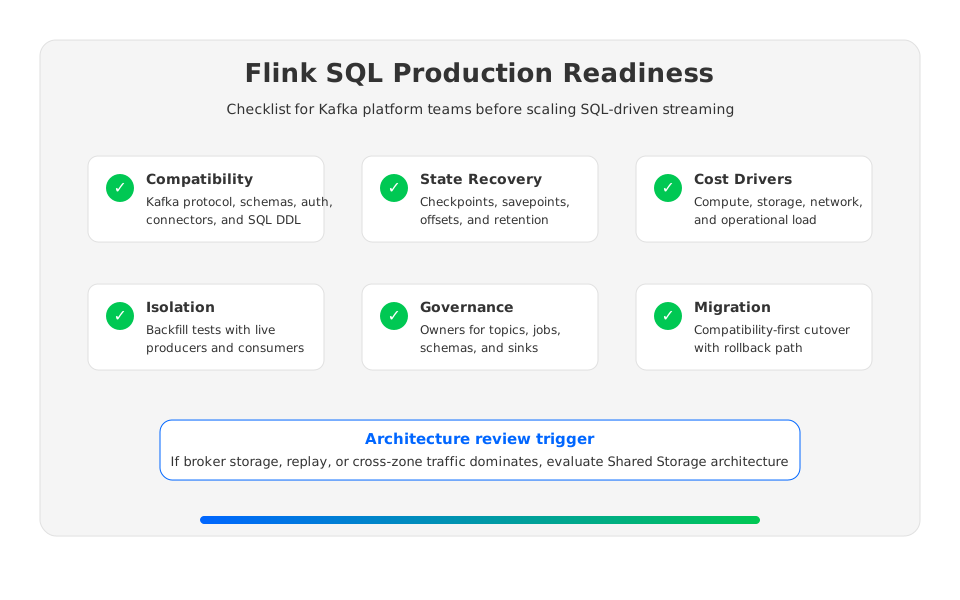
Start with compatibility. Flink SQL jobs depend on topics, serialization formats, schemas, authentication, authorization, and connector behavior. The safest platform changes preserve Kafka-facing contracts first, then change the lower layers deliberately. If a storage migration also forces application rewrites, the project risk becomes much larger.
Move next to recovery. Pick one critical SQL job and simulate three events: a failed deployment, a bad-query rollback, and a delayed checkpoint restore. For each event, identify the Kafka history required, Flink state required, replay load, and downstream cleanup. If the answer is a chain of manual guesses, the deployment is not production-ready yet.
Then test isolation. Run a controlled backfill while live traffic continues. Watch broker CPU, disk, network, request latency, consumer lag, Flink backpressure, checkpoint duration, and sink throughput. The goal is not to create a dramatic stress test. The goal is to learn whether replay is an ordinary platform behavior or an exceptional event.
Finally, review governance. SQL makes streaming logic easier to create, which also means the platform can accumulate long-running jobs faster than the operating model matures. Teams need owners for topics, schemas, jobs, state changes, sink contracts, access policies, and retention changes.
6Where AutoMQ Changes the Operating Model
If the review shows that SQL authoring, Flink state management, and job deployment are the main constraints, start there. Tune Flink, standardize job templates, improve savepoint discipline, and make schema evolution boring. A storage architecture change will not fix a poorly governed processing layer.
But if the repeated pain is Kafka storage growth, broker recovery, replay cost, and cross-zone data movement, the Kafka layer deserves a deeper look. The goal is not to abandon Kafka semantics. For most teams, the producer and consumer ecosystem is precisely what they want to keep. The goal is to change the storage operating model underneath a Kafka-compatible API.
AutoMQ is designed for that category of problem. It is a Kafka-compatible, cloud-native streaming system that separates broker compute from Shared Storage architecture. Brokers become closer to stateless compute, while durable data is stored in object storage with a WAL layer on the write path. For teams deploying in their own cloud environment, AutoMQ BYOC keeps the data plane inside the customer's cloud boundary.
This architecture changes the Flink SQL discussion in three ways. First, retained Kafka history is less tightly coupled to broker-local disk capacity. Second, scaling broker compute is less likely to imply moving large amounts of partition data between brokers. Third, replay and recovery can be evaluated as storage and network behaviors of a Shared Storage architecture rather than as a broker-local disk crisis.
AutoMQ's zero cross-AZ traffic design is relevant when teams operate multi-AZ Kafka-style deployments in the cloud. Traditional replicated Kafka architectures often pay for durability with cross-zone replication traffic. A Shared Storage architecture changes where durability is provided and how data moves across zones. The exact savings depend on workload, region, provider pricing, and deployment design, so the responsible evaluation is to model your own traffic rather than borrow a generic percentage.
AutoMQ is not a replacement for Flink SQL, and it does not remove the need for checkpointing, state compatibility, or job governance. It becomes interesting after a neutral review shows that Kafka's broker-local storage model is making Flink SQL harder or more expensive to operate than it needs to be.
7A Practical Decision Table
A good platform decision should produce a next action, not an architectural mood.
| Symptom | First place to investigate | Why it matters |
|---|---|---|
| SQL jobs fail during upgrades or query changes | Flink state and deployment lifecycle | The issue is likely savepoints, state schema compatibility, release discipline, or rollback planning. |
| Recovery requires more Kafka history than retention allows | Kafka retention and storage economics | The log contract does not match the recovery contract. |
| Backfills disturb unrelated consumers or producers | Workload isolation and log-serving capacity | Replay is competing with live traffic and should be treated as a first-class workload. |
| Kafka scales mostly because disks fill up | Storage architecture | Broker-local storage may be forcing compute scaling for a storage problem. |
| Cloud networking dominates the Kafka bill | Zone placement and data movement model | Cross-zone replication, client paths, and private connectivity can outweigh expected compute costs. |
| Teams hesitate to migrate because clients and connectors are entrenched | Kafka compatibility | Keeping the Kafka API stable reduces application rewrite scope. |
The healthiest Flink SQL Kafka deployment is the one whose failure modes are boring. A bad query can be rolled back. A job can recover from a checkpoint. Kafka can serve replay without endangering live traffic. If your review points to query lifecycle and state, improve Flink operations first. If it points to Kafka storage, replay, and data movement, compare your current architecture with a Kafka-compatible Shared Storage architecture such as AutoMQ and test it against real recovery scenarios.
8References
- Apache Flink Kafka SQL Connector
- Apache Flink Stateful Stream Processing
- Apache Kafka Documentation
- AutoMQ Architecture Overview
- AutoMQ WAL Storage
- AutoMQ Zero Cross-AZ Traffic Overview
- AWS EC2 On-Demand Pricing: Data Transfer Notes
- AWS S3 Pricing
- AWS PrivateLink Documentation
9FAQ
9.1Is Flink SQL enough for production Kafka stream processing?
Flink SQL can be production-ready, but SQL syntax is only one layer. The deployment still needs state management, checkpointing, savepoint discipline, Kafka retention planning, schema governance, access control, monitoring, and rollback procedures.
9.2How should Kafka retention be sized for Flink SQL jobs?
Retention should cover more than normal consumer lag. It should cover checkpoint restore time, delayed recovery, controlled backfills, bad deployment rollback, and the maximum period during which a job may need to replay source records.
9.3Do Flink checkpoints replace Kafka offsets?
No. Flink checkpoints coordinate processing state with source progress, including Kafka offsets, but they do not replace the Kafka log. Kafka still provides the ordered source history that a Flink job reads during normal execution and replay.
9.4When does Kafka cost optimization become an architecture problem?
It becomes an architecture problem when cost is driven by broker-local storage growth, cross-zone replication, replay traffic, over-provisioned brokers, or operational work that tuning cannot remove. At that point, the team should evaluate whether compute and storage are too tightly coupled.
9.5Where does AutoMQ fit in a Flink SQL Kafka deployment?
AutoMQ fits when teams want to keep Kafka-compatible APIs while changing the storage operating model. It separates broker compute from Shared Storage architecture, uses a WAL layer for the write path, and helps teams evaluate replay, retention, and cross-zone traffic differently.


