
Table of Contents
Table of Contents
Teams search for flink sql production pipeline kafka when the prototype has already worked. The Flink SQL statement can read from a Kafka topic, the sink can write to another topic or table, and the demo dashboard updates in seconds. The problem starts when that query becomes part of production. At that point the platform team has to explain where offsets live, how checkpoints recover, what happens during Kafka maintenance, how long data must be retained for replay, and who pays for the infrastructure that keeps the pipeline alive.
The hard part is that Flink SQL makes stream processing easier to express, but it does not make the streaming substrate disappear. A production pipeline still depends on Kafka-compatible semantics: ordered partitions, consumer groups, offsets, transactions where needed, retention, access control, and operational recovery. The useful architecture question is not "Can Flink SQL connect to Kafka?" It is "Can the Kafka-compatible platform keep up with Flink's production expectations without turning every scale event, replay, or failover into a storage operation?"
1Why teams search for flink sql production pipeline kafka
Flink SQL appeals to teams because it lets analysts and data engineers describe continuous logic with a familiar relational shape. A pipeline can enrich clickstream events, materialize CDC changes, route invalid records, or feed an operational feature table without forcing every transformation into a custom Java or Scala application. Kafka sits naturally in that design because it gives Flink a durable, partitioned, replayable source and sink.
That combination creates a specific kind of pressure. Flink jobs are long-running and stateful. They use checkpoints to recover processing state, and their Kafka sources track progress through offsets. If a job fails, the team expects the job to restart from a known checkpoint and resume reading the right Kafka positions. If a downstream sink falls behind, the team expects Kafka retention to preserve enough history for catch-up. If a schema change breaks a query, the team expects replay to rebuild the derived output after the fix.
Those expectations are reasonable. They are also infrastructure requirements, not query syntax requirements. A production Flink SQL pipeline needs Kafka to behave like a durable operating boundary between producers, processors, and consumers. When Kafka is deployed as a traditional broker-local storage system, that boundary is shaped by disks, replicas, partition placement, network paths, and capacity planning.
2The production constraint behind the problem
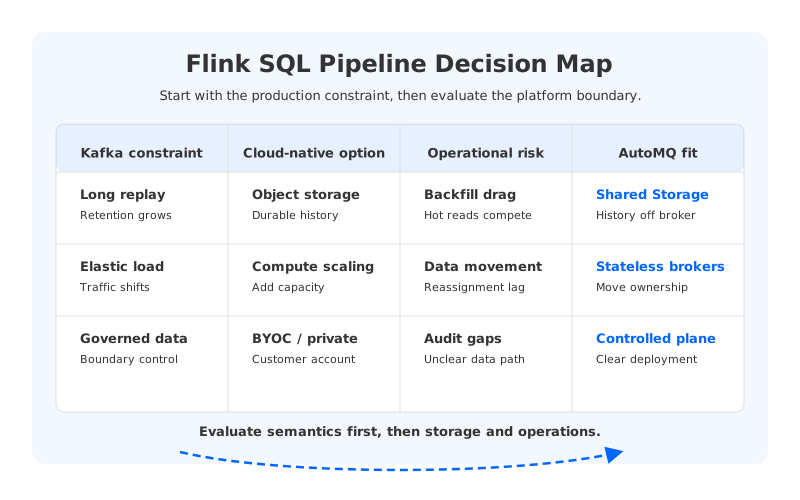
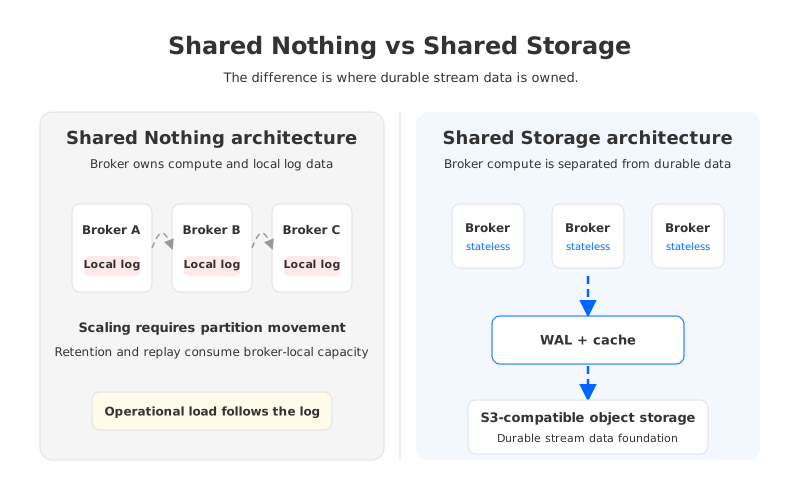
Traditional Apache Kafka uses a Shared Nothing architecture. Each broker owns local log segments for the partitions assigned to it, and replication keeps copies on other brokers for durability. This design is robust and well understood, but it makes storage ownership central to operations. A broker is not merely compute capacity; it is also a storage owner.
That coupling shows up in Flink SQL production work in four common ways:
- Retention becomes capacity planning. Long replay windows help Flink recover, backfill, and rebuild outputs, but broker-local retention consumes disk or cloud volume capacity on specific brokers.
- Scaling becomes data movement. Adding brokers can help throughput, but the cluster must rebalance partition data before the added capacity fully helps.
- Failure recovery becomes placement-sensitive. Broker replacement, leader movement, and ISR health affect how quickly the streaming layer returns to a stable state.
- Multi-AZ design becomes a network bill and a failure-domain decision. Replicating records across Availability Zones improves resilience, but it also creates traffic paths that platform and FinOps teams must model with cloud pricing pages.
For a Flink job, these details often appear as symptoms: checkpoint recovery takes longer than planned, consumer lag grows during Kafka maintenance, backfill throughput competes with fresh reads, or the team delays retention changes because disk expansion requires a cluster operation. The SQL is not the bottleneck. The storage model behind the Kafka-compatible layer is.
3Architecture options and trade-offs
The right answer depends on the pipeline's risk profile. A small Flink SQL job that enriches low-volume telemetry can run well on a conventional Kafka cluster. A high-throughput CDC pipeline with strict replay, table-format sinks, multi-team consumption, and aggressive elasticity requirements needs a broader evaluation.
The most useful comparison is not a vendor list. It is a set of architecture categories:
| Option | What stays familiar | What changes | Watch carefully |
|---|---|---|---|
| Self-managed Kafka | Kafka protocol, full operational control, mature ecosystem | Team owns broker sizing, disks, upgrades, and balancing | Operational load, storage growth, cross-AZ traffic, incident response |
| Managed Kafka service | Kafka experience with less infrastructure ownership | Provider controls many lifecycle details | Cost dimensions, networking model, compatibility boundaries, migration exit path |
| Kafka plus Tiered Storage | Local Kafka log remains primary for hot data; older data can move remote | Retention economics may improve for historical data | Local broker state still matters for writes, leaders, and hot reads |
| Kafka-compatible Shared Storage architecture | Kafka-facing contract remains; durable storage moves away from broker-local disks | Brokers become closer to stateless compute | Compatibility validation, WAL design, object storage behavior, deployment boundary |
Tiered Storage deserves a careful note because teams often overgeneralize it. Apache Kafka's Tiered Storage moves older log segments to remote storage while retaining the broker-local log as the active write path. That can help with longer retention, but it is not the same as making broker compute stateless. The operational question for Flink SQL is whether the platform only reduces historical storage pressure or also changes how scaling, failover, and reassignment work.
Shared Storage architecture is a different design point. Instead of making object storage a cold extension of a broker-owned log, the platform treats shared object storage as the durable stream storage foundation and uses a WAL (Write-Ahead Log) plus cache to support the write and read paths. That distinction matters when Flink pipelines need replayable history and elastic compute at the same time.
4Evaluation checklist for platform teams
A production checklist should start with the Flink/Kafka contract before it looks at cloud bills. If the platform cannot preserve the application's semantic assumptions, a lower infrastructure cost does not help. The first review should include consumer group behavior, offset continuity, transactional writes if the pipeline uses them, authentication, ACLs, schema handling, and connector compatibility.
After that, evaluate the operating model:
- Compatibility. Confirm Kafka client compatibility for the Flink version, Kafka connector settings, serializers, security protocol, and any transaction or idempotent producer settings used by sinks.
- Recovery. Test restart from checkpoints, topic replay after retention changes, job cancellation and redeployment, and sink recovery after partial failure.
- Scaling. Measure what happens when Flink parallelism increases, Kafka partitions change, broker capacity changes, and backfill reads run beside fresh reads.
- Governance. Map where data lives, which identities can access it, which logs and metrics leave the environment, and how audits prove those boundaries.
- Cost. Model compute, storage, object storage requests, broker-local volumes, cross-AZ traffic, private connectivity, observability, and human operations.
- Migration. Validate offset preservation, dual-write avoidance, consumer switchover, rollback, and how long source and target platforms must run together.
This list keeps the review grounded. It prevents a common mistake: choosing a streaming platform because one dimension looks attractive while the actual production risk sits somewhere else. A Flink SQL pipeline usually fails at the boundary between systems, not inside the SELECT clause.
5How AutoMQ changes the operating model
After the neutral checklist is explicit, AutoMQ becomes relevant as a Kafka-compatible Shared Storage architecture option. AutoMQ keeps the Kafka protocol and ecosystem surface while replacing broker-local durable log ownership with S3Stream, WAL storage, data caching, and S3-compatible object storage. In practical terms, the broker's job shifts toward Kafka request handling, leadership, routing, cache, and scheduling, while durable stream data is stored through shared object storage.
That shift changes the operational question for Flink SQL teams. Instead of asking how much local broker storage must be moved when capacity changes, the team can ask how quickly ownership, leadership, and traffic can move when compute changes. Instead of treating long retention as broker disk pressure, the team can evaluate object-storage-backed durability and catch-up read behavior. Instead of planning every broker replacement as a storage recovery event, the team can test a stateless broker model against their recovery objectives.
AutoMQ's WAL layer is important in this story because object storage by itself is not a low-latency append log. The WAL provides a durable write buffer and recovery path, while data is uploaded to object storage. AutoMQ Open Source uses S3 WAL, while AutoMQ commercial editions can use other WAL storage options such as Regional EBS WAL or NFS WAL depending on deployment needs. A production evaluation should specify the WAL type, because latency, fault domain, and operational requirements differ.
For governance, AutoMQ BYOC and AutoMQ Software matter because many Flink SQL pipelines process regulated operational data. In AutoMQ BYOC, the control plane and data plane run in the customer's cloud environment, and the data path is designed around customer-controlled cloud resources. In AutoMQ Software, the deployment target is a private data center or customer-controlled environment. That does not remove the need for security review, but it gives platform teams a concrete boundary to evaluate.
The fit is strongest when the Kafka-compatible layer is expected to serve more than one stream processing job. A Flink SQL pipeline may start as an enrichment query, then grow into CDC fan-out, online features, replayable audit streams, and lakehouse writes. AutoMQ's Table Topic feature is relevant in that direction because it can write topic data into Apache Iceberg tables, but it should be evaluated as part of the data architecture rather than as a replacement for Flink's processing logic. Flink still owns transformations; the streaming platform owns the durable, replayable data path.
6A readiness scorecard before migration
A migration from a traditional Kafka cluster to a Kafka-compatible Shared Storage architecture platform should be treated as an application continuity project. The risky part is not creating a replacement cluster. The risky part is preserving producer behavior, consumer offsets, Flink checkpoint assumptions, security controls, and rollback options while traffic moves.
Use this scorecard before the first production cutover:
| Readiness area | Green signal | Red signal |
|---|---|---|
| Kafka compatibility | Flink jobs pass restart, replay, and sink tests against the target | Tests only cover produce and consume smoke checks |
| Offset continuity | Consumer group positions and Flink checkpoint recovery are validated together | Offset migration is assumed from topic copy alone |
| Cost model | Compute, storage, network, object storage, and operations are modeled separately | The review uses a single blended price without workload assumptions |
| Security boundary | VPC, IAM, keys, buckets, logs, metrics, and operator access are documented | The team cannot explain which data leaves the environment |
| Rollback | Producers, consumers, and Flink jobs have a defined fallback path | Rollback depends on manual topic surgery during an incident |
| Observability | Lag, checkpoint health, broker health, WAL, cache, and object storage metrics are visible | The target only exposes generic cluster status |
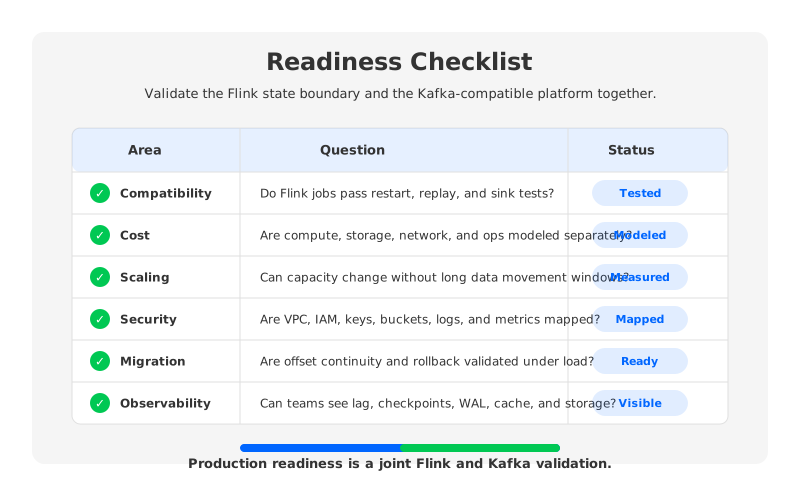
The scorecard is deliberately stricter than a feature comparison. Production Flink SQL pipelines bind together stream processing state and Kafka progress. If those two are validated separately, the test can look successful while the real recovery path remains unproven.
7FAQ
7.1Is Flink SQL enough to make a Kafka pipeline production-ready?
No. Flink SQL makes the processing logic easier to write and operate, but production readiness also depends on Kafka-compatible semantics, checkpoint recovery, offset handling, retention, security, observability, and migration discipline.
7.2Should every Flink SQL pipeline move to Shared Storage architecture?
No. Conventional Kafka can be a good fit for stable workloads with predictable retention, limited replay needs, and mature operations. Shared Storage architecture becomes more relevant when elastic capacity, long retention, backfill, multi-AZ cost, and broker recovery are recurring constraints.
7.3How should teams test Kafka compatibility for Flink SQL?
Run the exact Flink version, Kafka connector configuration, security protocol, serializers, transactional settings, and checkpoint strategy used in production. Then test failure and recovery, not only steady-state reads and writes.
7.4Where does AutoMQ fit with Flink?
AutoMQ fits at the Kafka-compatible streaming platform layer. Flink owns SQL processing and stateful computation. AutoMQ provides Kafka-compatible topics, offsets, retention, replay, and a Shared Storage architecture for the durable streaming foundation.
If your Flink SQL pipelines are starting to expose storage, scaling, or migration constraints in the Kafka layer, test the workload against a Shared Storage architecture design before the next capacity cycle. Start with AutoMQ BYOC and validate the scorecard with your own Flink jobs, topics, and recovery paths.
8References
- Apache Kafka documentation
- Apache Flink Kafka SQL connector documentation
- AutoMQ compatibility with Apache Kafka
- AutoMQ architecture overview
- AutoMQ WAL storage documentation
- AutoMQ stateless broker documentation
- AutoMQ continuous Self-Balancing documentation
- AutoMQ eliminate inter-zone traffic overview
- AutoMQ Table Topic configuration
- AutoMQ Kafka Linking overview


