
Table of Contents
Table of Contents
Teams usually search for follower fetch economics kafka after a bill, a latency graph, or an availability review makes the same point: the read path is not free. Kafka already gives operators strong tools for replication, consumer groups, and rack-aware placement, but cloud infrastructure changes the accounting around those tools. A consumer that reads from a leader in another Availability Zone may be technically correct and still economically awkward. A follower fetch policy may reduce network distance and cross-zone traffic, but it also introduces a new dependency on replica health, rack metadata, and failover behavior.
That is why follower fetch should be treated as an operating model question, not a toggle. The hard part is not understanding that local reads are attractive. The hard part is proving that local reads remain attractive when leaders move, replicas lag, brokers restart, consumers rebalance, and the finance team asks why data transfer still grew after the optimization.
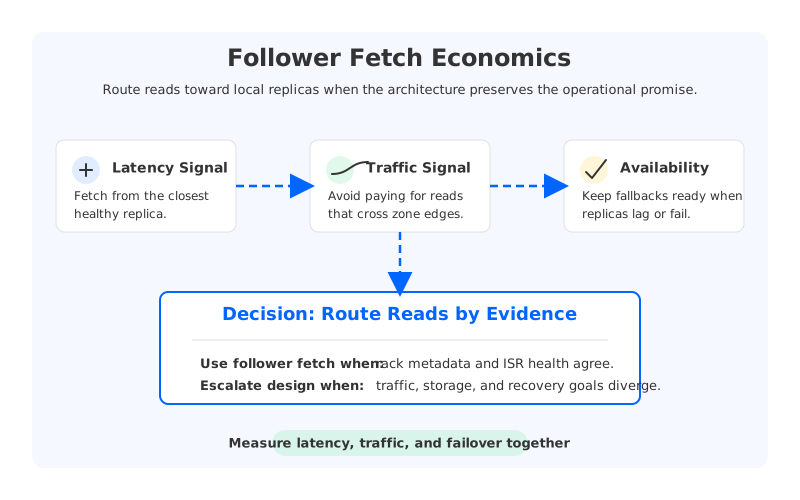
The decision map above captures the practical framing. Latency, traffic, and availability are not independent signals. If the cluster optimizes for the nearest replica while ignoring ISR health, it can make steady-state reads look good and failure behavior worse. If it optimizes for availability while ignoring traffic placement, it may send consumers back across zones and erase the savings. Platform teams need to measure all three signals together.
1Why Teams Search for follower fetch economics kafka
Kafka's default read path is leader-centric. Producers write to the leader partition, followers replicate from that leader, and consumers typically fetch from the leader as well. This model is simple to reason about because the leader is the serialization point for the partition, but it can be inefficient in a multi-zone cloud deployment. When a consumer runs in Zone A and the partition leader runs in Zone B, every fetch crosses the zone boundary even if a synchronized replica exists nearby.
Apache Kafka added the foundation for fetching from the closest replica through KIP-392, and current Kafka configuration includes client rack metadata such as client.rack. In practical terms, the cluster needs to know where clients and replicas live, and the broker needs a replica selection policy that can route fetches toward a suitable replica. The idea is straightforward: let consumers read from a replica that is closer to them when doing so preserves correctness and availability assumptions.
The economic motivation is cloud-specific. In many cloud environments, data transfer across availability boundaries has a separate cost line from compute and storage. AWS, for example, documents regional data transfer considerations for EC2, and cloud architects routinely treat cross-AZ movement as a billable design surface rather than background noise. The exact price depends on region, service, and traffic direction, so it must be verified against the current provider page before a business case is published.
Follower fetch becomes interesting when the read fan-out is large enough that consumer traffic rivals or exceeds producer traffic. A platform with many analytics jobs, fraud detection services, personalization systems, and replay-heavy workloads can multiply the same bytes across several consumer groups. At that point, the placement of consumers relative to leaders and followers becomes a material part of Kafka economics.
2The Production Constraint Behind the Problem
The obvious version of the problem sounds like a network bill. The real version is a control-plane and storage-coupling problem. Traditional Kafka stores partition data on broker-local disks. A broker is not only a compute process that serves protocol requests; it is also the owner of local log segments, replica state, page cache behavior, and recovery work. When capacity moves, data moves with it. When a broker fails, recovery work is tied to the placement and replication state of stored data.
Follower fetch addresses one slice of this model: it can reduce read-path distance for consumers. It does not remove the fact that brokers still carry local storage responsibilities. That distinction matters because teams often discover several cost surfaces at once:
- Consumer reads may cross zones when clients and leaders are not co-located.
- Replica traffic may cross zones by design, especially when replication spans failure domains.
- Rebalancing and broker replacement can copy stored data across the network.
- Over-provisioning may persist because storage growth and broker compute are coupled.
Those surfaces should not be collapsed into a single "Kafka traffic cost" number. Follower fetch can help with consumer read placement, but it cannot automatically fix storage movement, recovery duration, or compute/storage coupling. If the business case does not separate these components, the team may over-credit follower fetch when traffic drops or blame it unfairly when a different traffic source dominates the bill.
3Architecture Options and Trade-Offs
There are two architectural questions hiding behind follower fetch economics. The first is whether the current Kafka deployment can safely route consumers toward local replicas. The second is whether the broader platform architecture still fits the cloud operating model when traffic, storage, and recovery are measured together.
In a shared-nothing Kafka deployment, the follower fetch decision sits inside a stateful broker layout. The cluster can use rack awareness to distribute replicas and can use client metadata to make smarter fetch choices, but the storage layer remains attached to broker placement. That can be a perfectly reasonable design for stable clusters with predictable workloads. It becomes harder when the team expects frequent scaling, long retention, fast broker replacement, or strict cost attribution by zone and workload.
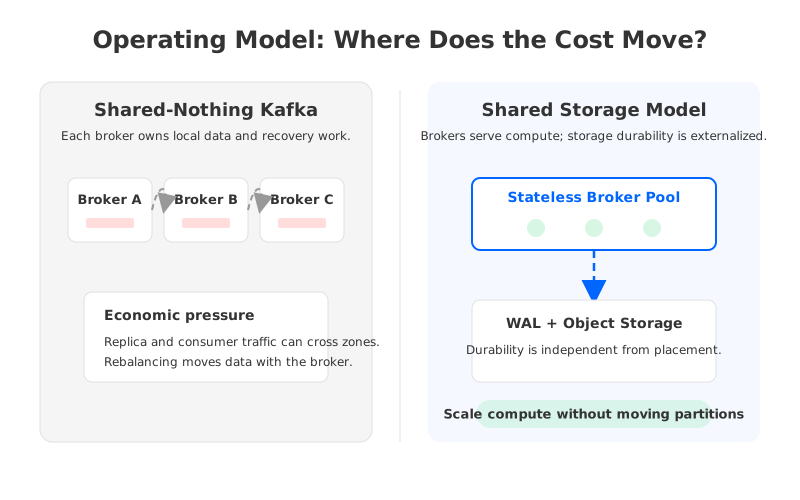
Shared storage changes the shape of the trade-off. AutoMQ is a Kafka-compatible cloud-native streaming system that separates broker compute from durable storage on object storage. Its brokers are designed to be stateless from the storage ownership perspective, while a WAL and object storage handle durability. This does not make locality irrelevant. It changes what locality is expected to solve. Instead of using follower fetch to compensate for every consequence of broker-local data, the platform can treat read placement, storage durability, and compute scaling as separate concerns.
That separation is especially important for teams that are trying to reduce cross-zone traffic without weakening availability. AutoMQ documents a zero cross-AZ traffic design for specific deployment models, where the architecture is built to reduce inter-zone data movement rather than treating it as a side effect of replica placement. The strategic difference is subtle but important: follower fetch asks "which replica should this consumer read from?" A shared-storage operating model asks "why should storage ownership force this traffic pattern in the first place?"
The answer is not that every Kafka workload should be redesigned immediately. Some clusters are small, stable, and cost-insensitive enough that follower fetch plus good rack metadata is sufficient. Other clusters have read-heavy fan-out, long retention, frequent scaling, or strict cloud cost governance. Those teams need a wider evaluation frame.
| Evaluation area | Follower fetch focus | Broader architecture question |
|---|---|---|
| Latency | Can consumers read from nearby replicas? | Are hot reads, cache behavior, and failover paths predictable? |
| Traffic cost | Does read traffic avoid unnecessary zone crossings? | Are replication, recovery, and storage movement also controlled? |
| Availability | Are selected followers in-sync and healthy? | Can the platform recover without large broker-local data movement? |
| Scaling | Does routing survive rebalances and leader changes? | Can compute scale independently from retained data volume? |
| Governance | Can teams attribute traffic by app, topic, and zone? | Can deployment boundaries match security and ownership requirements? |
The table is intentionally blunt. Follower fetch is useful, but it is not a replacement for architecture review. It should be one line in the platform economics model, not the entire model.
4Evaluation Checklist for Platform Teams
The strongest follower fetch projects start with measurement, not configuration. Before changing production routing, capture current consumer placement, leader placement, cross-zone traffic, ISR health, consumer lag, and failure behavior. A clean steady-state benchmark is helpful, but it can be misleading if it ignores leader election, rolling restarts, and consumer group rebalances.
The readiness checklist should cover both Kafka mechanics and organizational ownership:
- Confirm that client rack metadata is populated consistently across applications, deployment platforms, and regions. Missing or stale metadata can make routing behavior hard to explain.
- Validate broker-side replica selection behavior in a staging environment that mirrors production zone layout. The test should include leader movement and follower lag, not only a healthy steady state.
- Separate cost accounting for consumer fetches, replication, rebalancing, object storage, and private connectivity. A single blended network number hides the cause of change.
- Define rollback triggers before rollout. Remote fetch ratio, consumer lag, ISR shrinkage, request latency, and zone-level errors should have clear thresholds.
- Assign owners for application changes. Platform teams can expose the capability, but client deployment metadata often belongs to service teams.
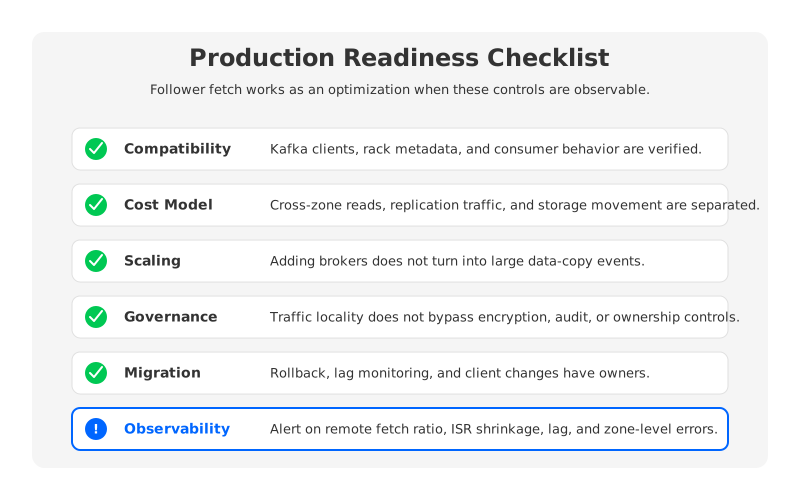
A practical scorecard can be simple. Rate each workload from 1 to 5 on read fan-out, cross-zone sensitivity, availability criticality, metadata hygiene, and migration complexity. High read fan-out with poor metadata hygiene is not a quick win; it is a cleanup project. High read fan-out with clean metadata and strong observability is a good candidate for follower fetch evaluation. High read fan-out plus long retention and frequent broker scaling may point to a deeper storage architecture review.
5How AutoMQ Changes the Operating Model
AutoMQ should enter the conversation after the team has separated the signals. If the only problem is that consumers read from remote leaders, Kafka follower fetch may be the right first step. If the pattern is broader, with cross-zone traffic, broker-local storage movement, slow scaling, and difficult cost attribution reinforcing one another, the platform is probably paying for architectural coupling rather than one missing configuration.
AutoMQ's design keeps the Kafka protocol surface while moving durable storage responsibilities out of the broker-local disk model. Stateless brokers can be added, removed, or replaced without treating retained partition data as something that must follow a specific machine. Object storage provides the durable data layer, while the WAL absorbs the latency-sensitive write path. For operators, the important result is not a slogan about storage separation; it is a cleaner failure and scaling model.
That model affects follower fetch economics in three ways. First, it narrows the problem: local read routing becomes a latency and traffic optimization, not a workaround for every cost created by stateful brokers. Second, it makes capacity planning less entangled because compute can be scaled with less dependence on retained data volume. Third, it gives governance teams a more explicit boundary for cost and data ownership, especially in BYOC or customer-controlled deployment models where cloud accounts, network paths, and storage policies matter.
There are still engineering details to validate. Kafka compatibility must match the client features your applications rely on. WAL choices, object storage behavior, and network topology need to be reviewed against your latency and durability requirements. Security teams still need to evaluate encryption, IAM boundaries, audit logging, and private connectivity. The point is not that shared storage removes hard decisions. It makes the decisions more explicit.
6A Migration-Safe Way to Evaluate the Change
The safest path is to avoid turning follower fetch into a one-shot production experiment. Start with a representative topic and a small set of consumer groups whose owners can change deployment metadata quickly. Measure baseline fetch latency, cross-zone bytes, consumer lag, and error rates for at least one normal traffic cycle. Then enable the routing change in a controlled environment, compare the same signals, and run a planned failure drill.
For architecture evaluation, run a separate exercise. Pick a workload where read fan-out, retention, and scaling pressure are all visible. Model the current shared-nothing costs across compute, disk, replication traffic, consumer fetch traffic, and operational labor. Then model the same workload under a shared-storage Kafka-compatible design such as AutoMQ, using official cloud pricing pages and product documentation for every assumption. Do not mix the two exercises. One tells you whether follower fetch is working; the other tells you whether the platform architecture is still the right fit.
This separation also helps procurement and finance stakeholders. A follower fetch rollout should have a narrow success metric: lower unnecessary remote reads without degraded lag or availability. A platform migration business case should include a wider set of metrics: compute utilization, storage retention cost, cross-zone traffic, recovery time, operational toil, compatibility risk, and rollback plan. When those are treated as different decisions, the organization can move faster without pretending that a configuration change and an architecture change carry the same risk.
If your main concern is inter-zone traffic in Kafka-compatible streaming, review AutoMQ's documentation on eliminating inter-zone traffic. It is the most relevant next step for turning the economics framework into a concrete architecture review.
7References
- Apache Kafka documentation
- KIP-392: Allow consumers to fetch from closest replica
- AWS EC2 On-Demand Pricing
- AutoMQ Documentation: Eliminate Inter-Zone Traffic
8FAQ
8.1Is follower fetch the same as rack awareness?
No. Rack awareness is the placement and metadata foundation that helps Kafka understand failure domains and locality. Follower fetch uses locality information to route consumer reads toward a suitable replica. In production, the two are connected, but they are not the same control.
8.2Does follower fetch always reduce Kafka cost?
No. It can reduce unnecessary remote consumer reads when consumers, replicas, and metadata are aligned. It does not automatically reduce replication traffic, broker replacement traffic, storage cost, or over-provisioning caused by compute and storage coupling.
8.3What should we measure before enabling follower fetch?
Measure consumer fetch latency, cross-zone bytes, leader and replica placement, ISR health, consumer lag, rebalance frequency, and failover behavior. The most useful baseline separates consumer read traffic from replication and recovery traffic.
8.4When should a team consider AutoMQ instead of only tuning follower fetch?
Consider a broader architecture evaluation when read fan-out, long retention, cross-zone traffic, frequent scaling, and broker recovery work all show up in the same cost or availability review. AutoMQ keeps Kafka compatibility while using shared storage and stateless brokers to change the operating model behind those signals.
8.5Where can I learn more?
Start with follower fetch metrics, cross-zone bytes, consumer lag, and recovery behavior. Then compare whether the current broker-local architecture or a Kafka-compatible shared-storage model better fits the workload.


