
Table of Contents
Table of Contents
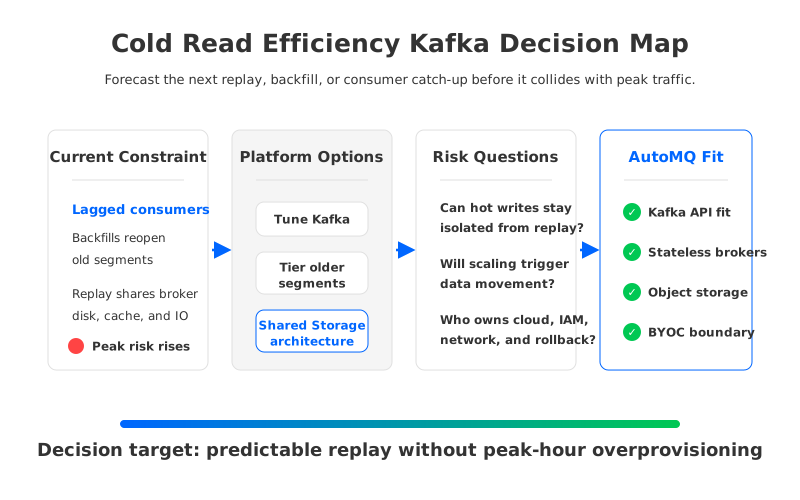
Teams usually search for cold read efficiency kafka after a pattern appears in production: a consumer group falls behind, an analytics job replays retained data, or a backfill opens old offsets as live traffic rises. Kafka can read old data; replay is part of its value. The painful part is that a cold read can turn a quiet storage assumption into a live capacity problem.
Cold read efficiency in Kafka is the ability to serve historical reads, catch-up consumers, and replay workloads without disrupting hot writes, tailing reads, recovery, or the budget. That definition is deliberately broader than read throughput. A platform team preparing for a traffic spike has to ask a harder question: if old data becomes active again, what else does that path compete with?
1Why teams search for cold read efficiency kafka
Cold reads are often underestimated because they start as a correctness requirement rather than a capacity plan. A fraud model rebuilds features for a month of events. A repaired data lake sink must catch up. A dashboard reprocesses history after a schema fix. A Consumer group that was healthy during steady state becomes the heaviest reader after a deployment issue.
The search query is usually a proxy for several concerns at once:
- Can a lagged Consumer group catch up without increasing producer latency?
- How much retained data should sit on broker-local disks versus object storage?
- Will a replay evict hot data from the page cache or saturate disk bandwidth?
- Does scaling the broker fleet require moving large Partition replicas?
- Which cost line will grow during the spike: compute, storage, request volume, or cross-AZ traffic?
Those questions matter because Kafka operators rarely schedule replays in isolation. A replay is often triggered by the same business event that raises live traffic: a sale, product launch, incident recovery, campaign, market open, or downstream outage. If the cluster was sized for average writes and normal consumer fan-out, the cold path becomes the surprise.
2The production constraint behind the problem
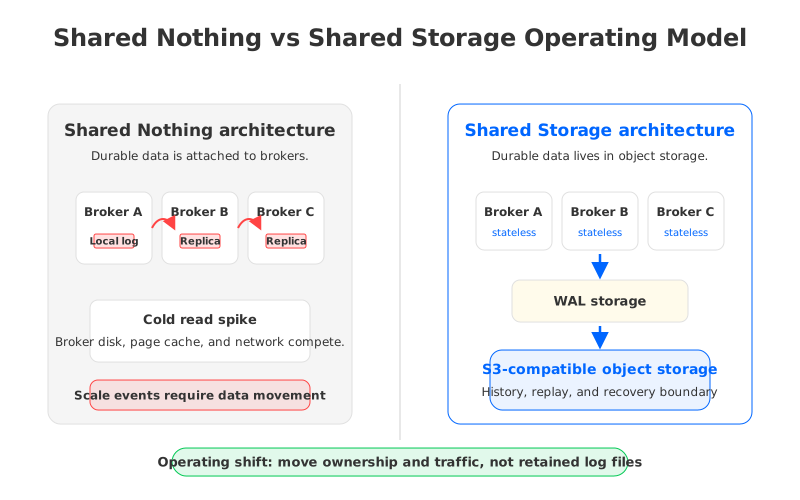
Traditional Kafka was designed as a Shared Nothing architecture. Each broker owns local storage, each Partition has a leader, and durability comes from replication among brokers. Apache Kafka documentation describes the core mechanics around Topics, Partitions, Consumer groups, Offsets, transactions, KRaft, and client behavior in detail. The operational consequence is that storage, compute, and data ownership are tightly coupled at the broker boundary.
That coupling is what turns cold reads into a production constraint. A consumer catching up from older offsets may force a broker to read historical log segments from disk. If those reads miss the page cache, the broker has to use disk bandwidth and kernel cache behavior that hot writes and fresh reads also depend on. If the same broker is serving leaders for hot Partitions, the old-data read path can affect the live-data path even when the application team thinks it is only replaying history.
Capacity planning then becomes conservative. Teams provision disk for retention, catch-up, replica movement, and failure recovery. They keep broker counts higher than steady-state compute would require because removing a broker can mean moving retained Partition data elsewhere. They may also place brokers across Availability Zones for resilience, which introduces network paths that must be understood against cloud provider pricing.
Tiered Storage changes part of this picture by moving older log segments to remote storage. It can be a practical way to reduce pressure from long retention, and it deserves a fair evaluation when the main problem is retained bytes. But Tiered Storage does not automatically make brokers stateless, remove every hot-path bottleneck, or eliminate the need to test remote-read behavior during catch-up. The question is not whether data can live in object storage. The question is which component owns the read path when history becomes active again.
3Architecture options and trade-offs
A useful cold read plan starts with workload shape, not a vendor SKU. Measure write throughput, read fan-out, message size, Partition count, retention, compression ratio, and the expected replay window. Then separate the problem into four layers: client semantics, broker behavior, storage path, and operating boundary. If these layers are mixed together, teams debate vague architecture labels while missing the next incident path.
The main options are not mutually exclusive, but each one moves a different constraint:
| Option | What it helps | What still needs testing |
|---|---|---|
| Broker and client tuning | Fetch size, consumer parallelism, quotas, and batching can reduce avoidable pressure. | It does not change the fact that retained data is tied to broker-local storage in a Shared Nothing architecture. |
| More broker capacity | Extra disk, CPU, and network headroom can absorb replay peaks. | Overprovisioning raises steady-state TCO and still leaves scaling tied to data movement. |
| Tiered Storage | Older segments can move to remote storage, reducing local retention pressure. | Remote-read latency, cache behavior, broker involvement, and hot-path impact must be validated. |
| Shared Storage architecture | Durable data is separated from broker lifecycle, making compute more elastic. | Object storage, WAL storage, cache sizing, metadata scale, and migration readiness become first-class tests. |
The right answer depends on why cold reads are becoming important. If cold reads are rare, bounded, and mostly caused by inefficient consumers, tuning may be enough. If retention is growing but replay is not on the critical path, Tiered Storage may be the simplest improvement. If replay, backfill, failover, and bursty traffic are all part of the normal operating model, the platform team should evaluate whether the broker should continue to own durable history locally.
That last point is where cost analysis becomes more useful than a generic “Kafka is expensive” statement. A serious TCO model should split storage capacity, write path durability, object-store requests, broker compute, inter-zone traffic, observability, and human operations. AWS publishes S3 pricing and data transfer pricing separately, and the same separation should show up in your model. If one spreadsheet cell hides storage and networking assumptions, the next replay will expose the gap.
4Evaluation checklist for platform teams
A cold read evaluation should be run before the traffic event, not during it. The goal is to find the point where historical reads begin to change live-service behavior. That means the test has to include both the hot path and the cold path at the same time: producers keep writing, normal consumers keep tailing, and one or more consumer groups read from older offsets until they catch up.
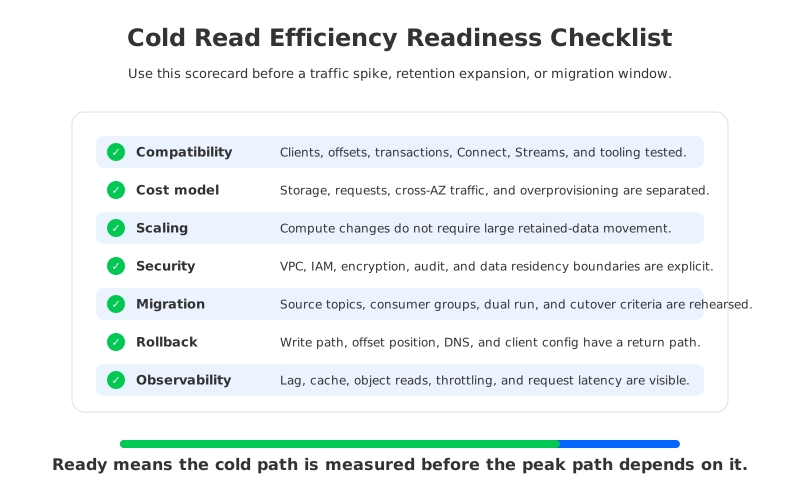
Use the following scorecard as a readiness gate:
- Compatibility: Verify Producer, Consumer, AdminClient, transactions, idempotent producers, ACLs, authentication, compression, Kafka Connect, Kafka Streams, and schema tooling. Kafka compatibility is valuable because it limits application migration work, but the exact client behavior still needs proof.
- Cost model: Separate storage capacity, request volume, network transfer, compute, and operational labor. Avoid a single blended cost number that hides which line item grows during replay.
- Scaling behavior: Add and remove compute while retained data exists. If the cluster needs a long reassignment cycle before it can serve the target traffic shape, the cold read plan is also a scaling plan.
- Security and governance: Confirm VPC boundaries, IAM permissions, encryption, audit logs, PrivateLink or private connectivity requirements, and data residency controls before object storage becomes part of the streaming architecture.
- Migration and rollback: Test source-topic inventory, consumer group positions, offset continuity, dual-run behavior, DNS or bootstrap changes, and the path back to the original cluster if cutover fails.
- Observability: Track consumer lag, request latency percentiles, broker queue time, cache hit ratio, object-store read throughput, throttling, compaction, and any storage-specific limiter queues.
The most useful metric is not a single maximum cold read throughput number. It is the slope: how producer latency, tailing-read latency, consumer lag, and infrastructure cost change as more historical data is read. A platform that looks good in an isolated replay benchmark may still be poor for production if the same test degrades hot writes or forces operators to keep unused broker capacity online all month.
5How AutoMQ changes the operating model
After the neutral evaluation, the architectural requirement becomes clearer: keep Kafka-facing behavior stable while reducing durable state attached to broker lifecycle. AutoMQ is a Kafka-compatible streaming platform built around Shared Storage architecture. It keeps Kafka protocol and ecosystem compatibility while replacing broker-local log storage with S3Stream, WAL storage, data caching, and S3-compatible object storage.
This changes the cold read conversation in three ways. First, brokers become stateless compute nodes rather than owners of long-lived local log files. When compute capacity changes, the platform can focus on leadership, metadata, traffic placement, and data still in the WAL path instead of moving retained Partition data between broker disks. That matters before a spike because scale-out and recovery are less likely to become data-copy projects.
Second, the hot and cold paths are designed as separate operating concerns. AutoMQ documentation distinguishes Tailing Read for fresh data from Catch-up Read for historical data. Writes are persisted through WAL storage before data is uploaded to object storage, while retained data is served through cache-aware reads from S3 storage. This does not mean every historical read has the same latency as a hot read. It means the architecture gives operators explicit components to size, monitor, and test instead of relying on accidental page cache behavior.
Third, the deployment boundary can stay inside the customer environment. AutoMQ BYOC runs the control plane and data plane in the customer cloud account, and AutoMQ Software supports private environment deployment. Cold read efficiency often pulls in object storage permissions, network placement, encryption, audit, and cost allocation. Keeping those resources inside the customer boundary makes the architecture easier to evaluate with cloud, security, and procurement teams in the same room.
There are still trade-offs to test. AutoMQ Open Source uses S3 WAL, while AutoMQ commercial editions support additional WAL storage options for different latency and deployment profiles. Object storage choice, Region, bucket policy, cache sizing, object compaction, and workload shape all affect results. A credible proof of concept should include normal traffic, forced catch-up reads, broker replacement, scale-out, scale-in, and rollback. The value is that the plan shifts from “how much local durable data must every broker carry?” to “how should compute, cache, WAL storage, and object storage be sized?”
6A practical migration readiness path
Start with an inventory, not a migration tool. List the Topics where replay matters, the Consumer groups that are allowed to lag, the applications that depend on transactions or idempotent producer behavior, the connectors that need schema and offset continuity, and the retention policies that drive storage cost. This inventory becomes the contract for any Kafka-compatible target, including a self-managed upgrade, a managed Kafka service, Tiered Storage, or Shared Storage architecture.
Then run a replay-shaped proof of concept. Produce representative traffic, pause one or more consumers long enough to create historical lag, and restart them while producer load continues. Record live-path latency, catch-up speed, object or disk read volume, broker resource use, network paths, and total cloud cost. Repeat the test during a simulated scale event. If the result depends on keeping excess broker capacity online all month, label that as an operating cost, not as a benchmark detail.
Finally, design the cutover as an operational workflow. If AutoMQ is the target, Kafka Linking can support migration patterns that preserve data and offset continuity for eligible source clusters, but the migration plan still needs application validation and rollback criteria. The teams that succeed are usually the ones that treat cold reads as a production behavior to rehearse, not an incident behavior to rediscover.
7FAQ
7.1What is a cold read in Kafka?
A cold read is a read from older retained data rather than the freshest tail of a Topic. It often appears when a Consumer group is catching up, a backfill replays history, or an analytics job reads from earlier Offsets.
7.2Is Tiered Storage enough for cold read efficiency Kafka planning?
Tiered Storage can help when local retention pressure is the main problem. It still needs production testing for remote-read latency, broker involvement, cache behavior, and live-traffic impact during catch-up.
7.3Should every Kafka workload move to Shared Storage architecture?
No. Short-retention, low-replay workloads may work well with traditional Kafka plus careful tuning. Shared Storage architecture becomes more relevant when retention growth, replay, bursty traffic, broker replacement, or cloud TCO are recurring operating concerns.
7.4How should platform teams measure cold read efficiency?
Measure cold reads while normal writes and tailing reads continue. Track catch-up speed, producer latency, tailing-read latency, consumer lag recovery, broker utilization, storage reads, network transfer, and cost.
7.5Where does AutoMQ fit in the decision?
AutoMQ fits when a team wants Kafka compatibility while changing the storage and scaling model. Its Shared Storage architecture, stateless brokers, WAL storage, object-storage-backed durability, Zero cross-AZ traffic design, and customer-controlled deployment options are most relevant for replay-heavy and elasticity-sensitive workloads.
8Closing the loop before the spike
The next traffic spike will not wait for a clean benchmark window. If a replay, backfill, or lagged Consumer group can become active during that spike, cold read efficiency belongs in the capacity plan ahead of the launch window. Build the scorecard, run the mixed hot-and-cold test, and decide whether the current broker-local model is still the right operating boundary.
If your evaluation points toward Kafka compatibility with Shared Storage architecture, review AutoMQ with your own workload and cloud constraints. Start with an architecture discussion through AutoMQ Cloud and bring your replay test, retention window, and cost model to the conversation.


