
Table of Contents
Table of Contents
Someone searching for idle broker waste kafka is usually past the first round of Kafka cost optimization. Topic retention, instance family, disk size, producer compression, and a few underused clusters have already been checked. The harder question appears when finance sees an expensive platform while SRE still needs every broker before the next campaign, market open, settlement batch, or data science backfill.
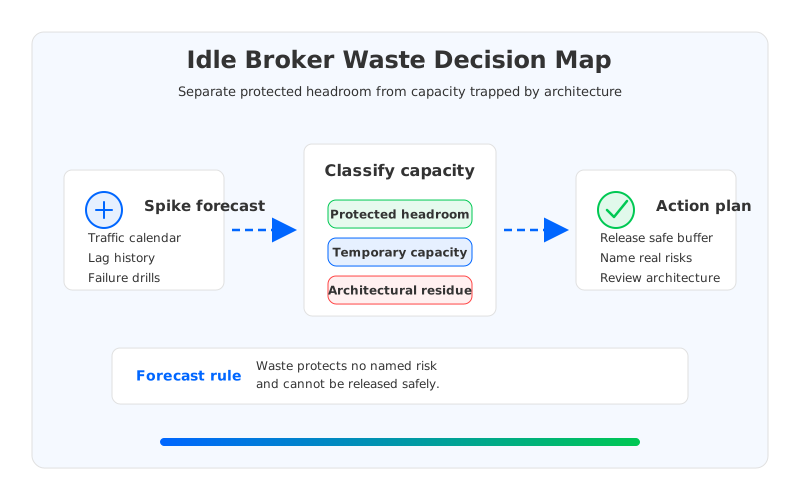
That tension is the real problem. Idle broker waste is not the same as unused capacity. Some idle capacity is insurance against traffic spikes, leader movement, consumer catch-up reads, broker failure, and rolling maintenance. Waste begins when the platform cannot explain which part of that buffer protects a known risk and which part exists because the architecture makes capacity hard to release.
The useful forecast is not "how many brokers look quiet this week?" It is "which brokers, disks, and network paths will remain paid for after the next peak, and what would it take to scale them down safely?" That framing turns a vague cost complaint into an engineering model that FinOps, SRE, and platform teams can debate with the same data.
1Why teams search for idle broker waste kafka
Kafka teams rarely over-provision because they enjoy spare infrastructure. They do it because Kafka is attached to systems that punish under-provisioning quickly. A broker that saturates disk, network, CPU, or page cache at the wrong moment can turn into producer latency, consumer lag, under-replicated partitions, long reassignment windows, or a recovery drill during business hours.
The search phrase shows up when those defensive choices become difficult to defend. A platform lead may know that a cluster is sized for quarterly peaks, but a FinOps reviewer sees 30 days of low average utilization. A cloud architect may know that disk cannot be shrunk without data movement, but a procurement team sees reserved compute. An SRE may know that rebalancing after a spike is operationally risky, but a CTO wants the streaming platform to behave more like elastic cloud infrastructure.
The first mistake is to treat every idle broker as waste. The second mistake is to treat every peak as sacred. A serious model separates four different forms of capacity:
- Peak-serving capacity handles expected spikes with an agreed safety margin tied to a workload calendar.
- Recovery capacity absorbs broker failures, leader movement, rolling upgrades, and consumer catch-up reads.
- Migration or rebalancing capacity exists while data moves or topology changes, and should have an exit condition.
- Architectural residue remains because local disks, partition placement, or cross-zone replication make scale-down risky.
Only the last category is pure waste. The trouble is that traditional Kafka often blends all four categories into the same broker count, which makes the bill hard to explain and harder to reduce.
2The production constraint behind the problem
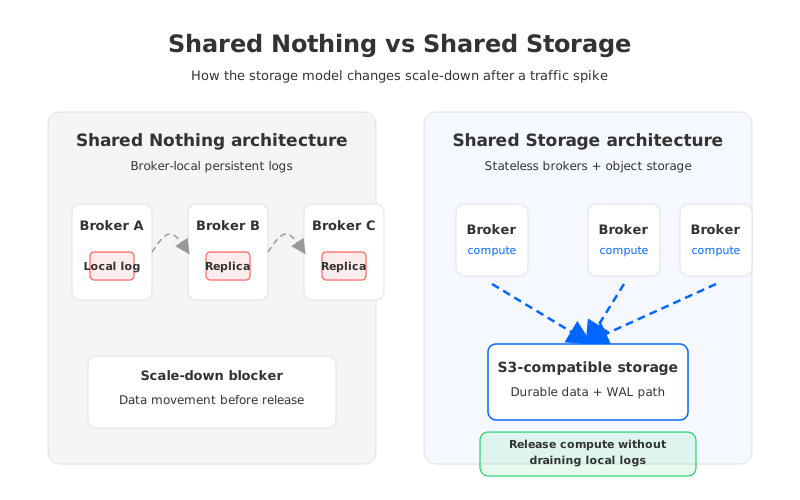
Traditional Kafka uses a Shared Nothing architecture. Each broker owns local log segments for assigned partitions, and durability is achieved through replication across brokers. That design made sense for data center hardware because storage, compute, and network were operated as a relatively fixed system. In cloud environments, the same model turns capacity into a bundle: add brokers for throughput and you often add storage; add disk for retention and you may add compute; move partitions and you move data through the network.
This bundling is what makes idle broker waste stubborn. A quiet broker may still hold partition replicas that need to remain available. A disk-heavy broker may have low CPU but cannot be removed until its data is reassigned. A cluster may need extra brokers before a known spike because adding them after the spike begins would trigger rebalancing work at the worst possible moment. The architecture does not merely consume capacity; it makes capacity stateful.
Average broker utilization hides the shape of Kafka risk. Produce traffic, consume traffic, catch-up reads, retention growth, controller activity, and replication stress different parts of the system. A broker that looks idle by CPU may still hold important storage. A broker that looks idle by network may preserve replica distribution across Availability Zones. A cluster that looks oversized during the day may be correctly sized for a replay workload at midnight.
That is why a cost forecast based only on utilization usually disappoints. It identifies symptoms, not constraints. The better forecast starts from the operations that prevent scale-down:
| Constraint | What it means for idle broker waste | What to measure |
|---|---|---|
| Broker-local storage | Capacity waits for partition data movement or deletion. | Disk per broker, ownership, reassignment backlog |
| Replication and placement | Fault tolerance depends on replica and leader distribution. | Under-replicated partitions, ISR health, leader skew |
| Catch-up reads | Backfills and slow consumers can consume spare I/O. | Consumer lag, historical reads, cache hit ratio |
| Rebalancing windows | Scale-down depends on data movement and leadership changes. | Reassignment duration, saturation, maintenance windows |
| Cloud network paths | Multi-AZ replication and routing can add cost. | Inter-AZ transfer, client placement, broker traffic by AZ |
The table does not tell you to shrink brokers. It tells you where the shrink decision becomes risky. That difference matters, because a credible cost reduction plan is the one the on-call team can still support during a bad week.
3Architecture options and trade-offs
Once idle capacity has been classified, teams usually compare three paths. The first is to keep the current Kafka architecture and improve governance. Workload calendars, topic-level retention reviews, chargeback, broker utilization dashboards, and rules for temporary capacity can reduce accidental waste without changing the platform.
Governance has a limit, though. It cannot make broker-local data stateless. If scale-down requires long partition reassignment, governance may tell you where waste lives but still leave you unable to remove it quickly. The team gets a better spreadsheet and the same operational bottleneck.
The second path is Tiered Storage. Apache Kafka's Tiered Storage, introduced through KIP-405, moves older log segments to an external store while retaining recent data locally. For long retention workloads, this can reduce disk pressure and make retention planning less painful. It is meaningful when historical data growth, not elastic compute, is the main problem.
Tiered Storage does not turn brokers into stateless compute nodes. The hot set, leader placement, local write path, and operational topology still matter. If the idle broker waste comes from peak compute headroom, cross-zone replication behavior, or slow scale-down after traffic spikes, Tiered Storage may improve one part of the cost model while leaving the operating model mostly intact.
The third path is a Kafka-compatible platform built around Shared Storage architecture. Durable data lives in shared object storage, while brokers focus on protocol handling, partition leadership, caching, and scheduling. The trade-off changes: teams must evaluate object-storage-backed durability, WAL (Write-Ahead Log) choices, cache behavior, and cloud boundaries, but scale-down no longer depends on copying every broker-local byte.
Cost and reliability need to be discussed together. A platform that releases compute quickly but weakens Kafka compatibility is not a clean answer. One that preserves compatibility but hides control-plane or data-plane boundaries may not fit regulated environments. Architecture is valuable only when it changes the operating model without breaking the contracts your applications already rely on.
4Evaluation checklist for platform teams
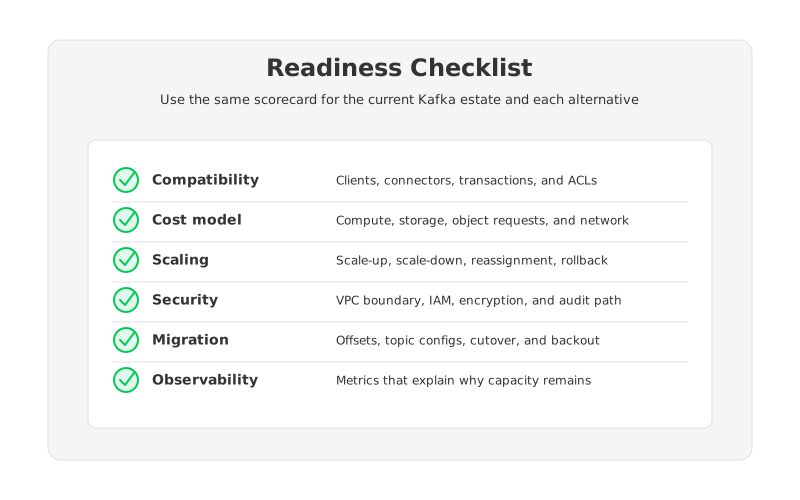
The practical way to evaluate idle broker waste is to score the current platform and each alternative against the same questions. Keep the checklist short enough to use in a real design review. If a criterion cannot be measured, assign an owner before making the platform decision.
| Area | Question to answer | Evidence to collect |
|---|---|---|
| Compatibility | Can producers, consumers, Kafka Connect, and stream processors run without rewrites? | Client versions, protocol features, transactions, ACLs |
| Cost model | Which costs scale with peak capacity, retained data, and cross-AZ traffic? | Compute, storage, requests, data transfer, support |
| Elasticity | How long does it take to add and remove capacity after a spike? | Scale timing, reassignment duration, rollback plan |
| Failure recovery | What happens when a broker, zone, storage path, or controller fails? | Failure drills, RTO, ISR or equivalent health |
| Governance | Where do control plane, data plane, credentials, logs, and data reside? | VPC boundaries, IAM, encryption, access review |
| Migration | Can offsets, topic configuration, and consumer progress survive cutover? | Tool behavior, backout steps, validation plan |
| Observability | Can the team see the constraint that prevents scale-down? | Broker metrics, storage metrics, lag, rebalance state |
Score with production traces, not only architecture diagrams. Take one representative cluster and replay the last spike on paper: when traffic rose, which brokers saturated, which consumers fell behind, how long the cluster stayed oversized, and which step blocked capacity removal. That exercise usually reveals whether the waste is a policy problem, a monitoring problem, or an architecture problem.
A useful scorecard has three outputs: capacity that can be removed now, capacity that protects a named reliability risk, and capacity trapped by broker-local storage or slow topology changes. The third bucket is where a Shared Storage architecture deserves serious evaluation.
5How AutoMQ changes the operating model
If broker-local storage is the main source of architectural residue, AutoMQ is one Kafka-compatible option to test. AutoMQ keeps the Kafka protocol and common ecosystem contracts, but replaces broker-local persistent logs with S3Stream, a streaming storage layer built on shared object storage and WAL storage. The result is a Shared Storage architecture where AutoMQ Brokers are stateless from the perspective of durable Kafka data.
That distinction changes the idle-capacity forecast. In a Shared Nothing architecture, removing a broker means asking where its partition data will move and how much network, disk, and time the movement will consume. In AutoMQ's Shared Storage architecture, durable data already lives in S3-compatible object storage. Brokers still handle compute, leadership, caching, and traffic, but removal is not equivalent to draining local logs.
The immediate benefit is operational clarity. Retained data belongs in the storage model, while peak request handling belongs in the broker model. Stateless brokers also make Auto Scaling and Self-Balancing easier to reason about because the controller changes ownership and traffic placement instead of treating every capacity adjustment as a bulk data-copy event.
AutoMQ also changes the cloud-network part of the discussion. Traditional multi-AZ Kafka deployments often pay for replication traffic because replicas are copied between brokers across zones. AutoMQ's object-storage-backed design is built to avoid that broker-to-broker replication path and supports Zero cross-AZ traffic in the Shared Storage model. For FinOps teams, that means the idle broker forecast should include not only unused compute, but also whether the architecture creates network cost while preserving capacity for failures.
There are still real evaluation questions. WAL type matters because S3 WAL, Regional EBS WAL, and NFS WAL have different latency, durability, and deployment characteristics. Cache sizing still matters for Tailing Read and Catch-up Read behavior. Object storage request patterns and customer-controlled deployment boundaries also need review, especially for AutoMQ BYOC or AutoMQ Software.
The right pilot is not a synthetic benchmark that only measures maximum throughput. Use one workload with an actual spike profile, retention policy, consumer lag behavior, and maintenance window. Then measure whether idle capacity can be released after the spike without long data movement or broken Kafka client compatibility.
6FAQ
6.1Is every idle Kafka broker waste?
No. Some idle broker capacity protects peak traffic, broker failure, rolling maintenance, and catch-up reads. Waste is capacity that cannot be tied to a named reliability or migration requirement.
6.2Why does broker-local storage make scale-down harder?
When durable partition data lives on brokers, removing a broker can require reassignment and data movement. That consumes bandwidth, takes time, and may collide with production traffic.
6.3Does Tiered Storage solve idle broker waste?
Tiered Storage can help when the main problem is long-retention data on local disks. It does not fully remove the coupling between brokers, hot writes, leadership, cache, and topology.
6.4What should FinOps teams ask Kafka platform owners?
Ask which idle capacity protects a named risk, which is temporary, and which remains because scale-down is risky. The last category is the clearest architecture-review target.
6.5When should AutoMQ enter the evaluation?
AutoMQ should enter the evaluation when the main constraint is broker-local storage, slow reassignment, cross-AZ replication cost, or coupled compute and storage.
7Closing the forecast
Return to the original search: idle broker waste kafka. The answer is not a single utilization threshold. It is a forecast explaining why capacity exists, when it can be released, and which constraint keeps it on the bill.
If broker-local storage keeps showing up in your scorecard, test a Kafka-compatible Shared Storage architecture against one real workload. Start with your spike calendar, consumer lag history, retention policy, and failure drills, then evaluate whether the platform can release capacity without application rewrites. To explore that path in a customer-controlled deployment, use the AutoMQ deployment entry point.


