
Table of Contents
Table of Contents
Teams usually search for low carbon streaming infrastructure when a future traffic spike has become specific enough to budget for but not specific enough to size with confidence. A product launch is coming. A model-serving pipeline is expected to backfill more context. A fraud system wants longer replay windows before a seasonal peak. The platform team is asked a reasonable question: can the streaming layer absorb the spike without keeping the full peak footprint online for the rest of the year?
That question is not only about carbon reporting. It is about the amount of unnecessary work a streaming platform performs to keep data durable, replayable, and available under change. In Kafka-compatible infrastructure, that work shows up as broker headroom, local storage reservations, replica traffic, recovery movement, backfill overlap, and operator time. The carbon-aware forecast starts before the spike because, once a cluster is already hot, the only safe answer is usually more capacity.
1Why teams search for low carbon streaming infrastructure
The phrase sounds like a sustainability query, but the underlying intent is operational. FinOps wants to know whether the streaming estate is paying for idle compute. SREs want to know whether scaling down after a spike will trigger partition movement or recovery work. Architects want to understand whether longer retention for AI, analytics, or audit use cases will force the hot broker fleet to carry more data than it needs.
This is why a useful forecast has to connect three views that are often reviewed separately:
- Demand shape. How much of the workload is steady traffic, short burst, scheduled backfill, or catch-up consumption after downstream delay?
- Durability path. How many durable writes, replicas, storage services, and cross-zone transfers are involved before a record becomes safe to replay?
- Change path. What happens when a broker is added, removed, replaced, or isolated during the week around the spike?
Average utilization is too blunt for this job. A cluster can look efficient during quiet hours and still waste resources when the next peak forces rushed scale-out, duplicate migration traffic, or conservative overprovisioning. The better metric is avoidable work per retained event across the normal path and the change path.
2The production constraint behind the problem
Apache Kafka® earned its place because its contract is practical: producers write to topics, consumers track offsets, consumer groups divide work, and the log remains available for replay. That contract is why teams hesitate to change streaming infrastructure even when cost, capacity, or sustainability pressure rises. Breaking offset behavior, transaction expectations, connectors, observability, or access-control workflows can cost more than the resources a replacement platform saves.
The constraint is therefore not "use fewer resources" in the abstract. The real constraint is to reduce avoidable infrastructure work while preserving the Kafka-facing behavior that applications already depend on. That means the review has to cover compatibility and operations together. A replacement platform that looks efficient on a cost slide but requires client rewrites, fragile migration windows, or unclear rollback paths will not survive production review.
Traditional Kafka's Shared Nothing architecture makes this trade-off especially visible. Each broker stores local log data for its partitions, and replication protects availability. This is a strong model for predictable workloads and teams that are comfortable operating Kafka. The problem appears when compute elasticity and durable storage ownership are tied together. Adding brokers means adding compute and changing partition ownership; depending on the situation, it can also mean moving or catching up data. Removing capacity after the spike can be even harder because the platform team has to prove that scale-in will not create the next incident.
3Shared Nothing architecture turns spikes into standing reservations
Capacity planning for a traffic spike is uncomfortable because the peak and the recovery path are both expensive. The peak needs enough brokers, network, and local storage to keep produce latency and consumer lag within bounds. The recovery path needs enough slack to survive a failed broker, delayed consumer group, or replay job while the spike is still unfolding. Operators know this, so they reserve more headroom than the steady state requires.
Tiered Storage can improve the storage side of that picture by offloading older log segments to object storage. For retention-heavy workloads, that can be a reasonable step because not all historical data needs to sit on broker-attached disks. But Tiered Storage does not turn the hot path into a pure compute problem. The active log, partition leadership, local storage, and replication behavior still shape how much capacity must remain close to the brokers during the spike.
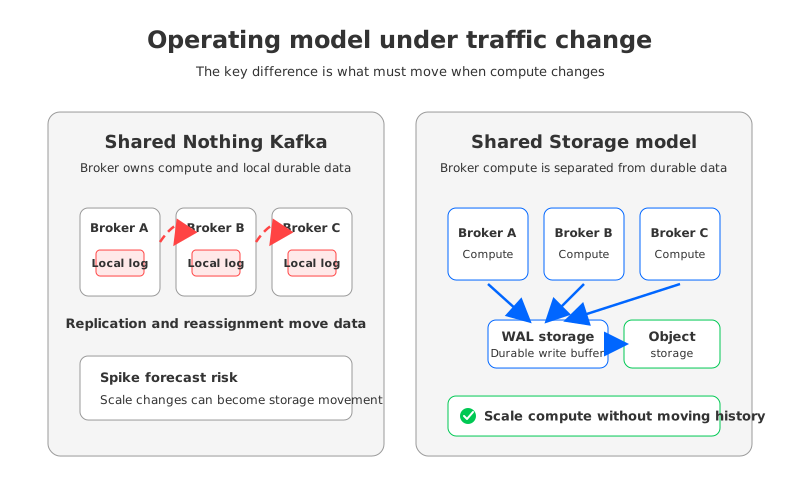
That distinction matters for low-carbon forecasting because the first thing to eliminate is not every resource; it is resource work that exists only because the architecture makes change expensive. If the team avoids scale-in because partition movement is risky, the idle capacity becomes part of the carbon footprint. If every broker replacement creates network-heavy recovery, failure handling becomes part of the footprint. If long retention forces the hot fleet to plan around cold data, the retention policy is really a compute policy in disguise.
4Architecture options and trade-offs
Most teams do not evaluate sustainability by picking a single vendor name. They compare operating models. Self-managed Kafka offers control and familiarity, managed Kafka services transfer some operational burden, Tiered Storage changes long-retention economics, and shared storage designs change the relationship between broker lifecycle and durable data. Each option can be the right answer for a specific workload.
Use the following decision map to keep the discussion concrete before any product decision:
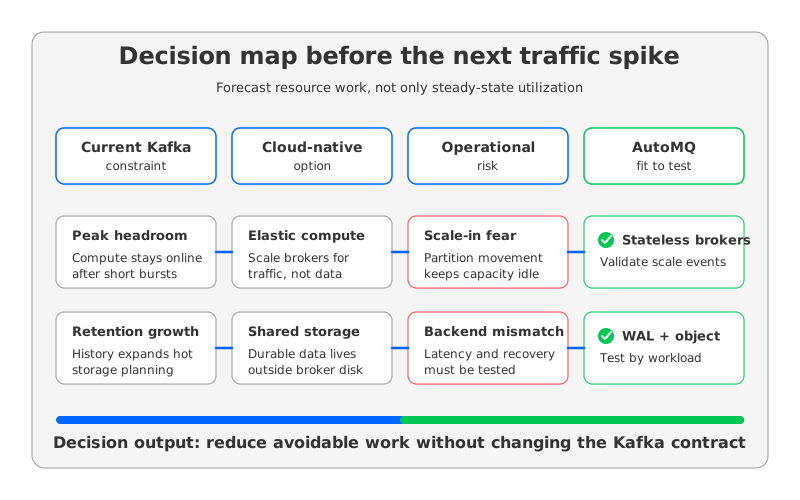
| Evaluation area | What to forecast before the spike | Why it affects carbon and cost |
|---|---|---|
| Compatibility | Client versions, transactions, idempotent producers, consumer groups, Kafka Connect, ACLs, quotas, and monitoring agents | Rewrites and migration overlap create extra work even if the target platform is efficient after cutover |
| Storage ownership | Whether retained history stays broker-local, moves to a remote tier, or lives in shared object storage | Storage placement decides whether long retention expands the hot broker footprint |
| Elasticity | Scale-out time, scale-in confidence, partition movement, and recovery behavior | Slow or risky scale changes turn short peaks into long standing reservations |
| Network movement | Producer routing, replication, consumer reads, backfill, cross-zone transfer, and failover traffic | Network-heavy durability and recovery paths become recurring resource consumption |
| Governance boundary | Where payloads, metadata, keys, logs, metrics, identities, and administrative access live | A low-resource design still fails if it cannot meet residency, audit, or ownership requirements |
The table prevents a common mistake: treating low-carbon infrastructure as a generic optimization pass. Compression, cleanup, and right-sizing are useful, but they operate inside the existing architecture. If the architecture makes every traffic change look like a data movement event, the forecast has to say so.
5Evaluation checklist for platform teams
A practical checklist should start from workload mechanics rather than sustainability language. Pick one representative spike scenario and run it as a planning exercise: traffic doubles for 48 hours, a downstream consumer falls behind, one broker is replaced, and a backfill starts while the cluster is still hot. The point is not to dramatize the failure path. It is to reveal which resources remain online because the team cannot safely change them.
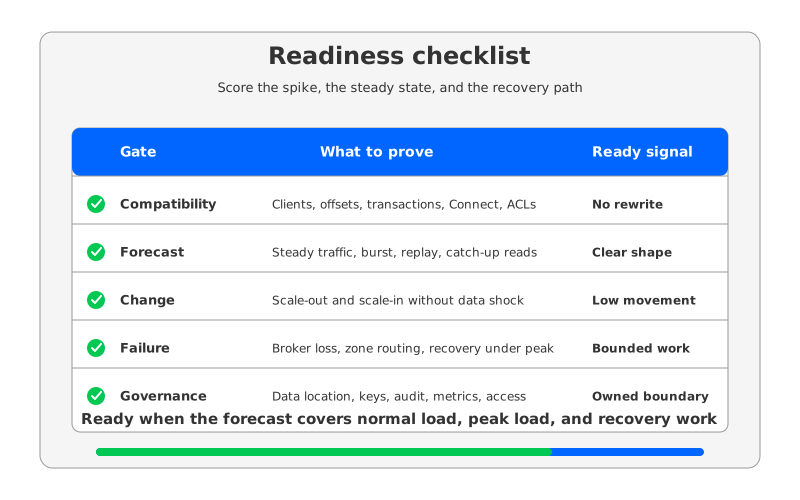
Before selecting or redesigning a Kafka-compatible platform, score the architecture against these gates:
- Compatibility gate. Verify the Kafka clients, serialization formats, producer settings, consumer group behavior, offset tooling, transactions where used, connectors, and observability stack that the production system actually runs.
- Forecast gate. Separate steady traffic, scheduled burst, replay, backfill, and catch-up reads. A platform that can absorb one type of spike may still struggle when replay and tail reads compete.
- Change gate. Measure what moves when capacity changes. Compute-only scaling is different from scaling that also triggers data reassignment, replica catch-up, or manual partition work.
- Failure gate. Include the resource cost of broker loss, zone-local routing changes, and recovery while the spike is active. Failure behavior is part of the capacity plan, not an afterthought.
- Governance gate. Confirm data location, key ownership, control-plane access, audit logs, metrics export, and support boundaries before the migration plan is considered viable.
- Rollback gate. Budget the temporary footprint of migration, validation, dual operation, and rollback. A low-carbon target state still needs a safe transition path.
This checklist also helps teams avoid a false sense of precision. Public cloud carbon dashboards and sustainability tools can summarize resource impact, but they cannot explain why a broker fleet is overprovisioned or why a backfill creates cross-zone pressure. Architecture review supplies the causal chain.
6How AutoMQ changes the operating model
After that neutral evaluation, AutoMQ becomes relevant as a Kafka-compatible streaming platform that changes the storage model beneath the Kafka protocol surface. AutoMQ uses a Shared Storage architecture: brokers handle Kafka-facing compute, while S3Stream replaces Kafka's broker-local log storage with a combination of WAL (Write-Ahead Log) storage and object storage. Durable data is not bound to a broker's local disk, so brokers can be treated as stateless compute nodes for many operational events.
That change matters for traffic-spike forecasting because it reduces the number of reasons to keep peak compute online after the peak has passed. If durable stream data lives in shared storage, adding or removing brokers does not have to mean relocating the full durable dataset. WAL storage handles low-latency persistence before data is uploaded to object storage, while object storage becomes the main data repository. Different WAL types can be selected for different latency and deployment requirements, so the review should still include workload-specific latency tests rather than assuming one storage backend fits every case.
AutoMQ also changes the multi-zone discussion. In a traditional Kafka deployment, inter-zone replication and routing can become structural network work. AutoMQ documentation describes a Zero cross-AZ traffic design based on shared storage and zone-aware routing. For a low-carbon forecast, the important point is not a slogan; it is the mechanism. Fewer broker-to-broker replica transfers and less zone-crossing client traffic can reduce the resource work that appears during normal writes, recovery, and scaling events.
The governance boundary is part of the same evaluation. AutoMQ BYOC runs the control plane and data plane in the customer's cloud account VPC, while AutoMQ Software is designed for customer-operated private environments. For teams that treat sustainability, cost, and data ownership as one review, those deployment boundaries let them evaluate resource efficiency without moving the streaming data plane outside their control model.
7Forecasting before the spike
The right time to make a streaming platform lower carbon is during design review, not during an incident. Start with the upcoming spike and write down the work the platform must do before, during, and after it. Then separate necessary work from architectural overhead. Necessary work includes accepting records, preserving durability, serving consumers, and retaining data for replay. Architectural overhead includes data movement caused by local storage ownership, idle capacity kept because scale-in is risky, and migration overlap created by weak compatibility.
One useful scorecard is deliberately simple:
| Question | Green signal | Warning signal |
|---|---|---|
| Can compute scale down after the spike? | Scale-in does not require moving large amounts of durable data | Brokers stay online because reassignment or recovery risk is too high |
| Can retained history grow independently? | Retention growth is mostly a storage policy decision | Long retention forces larger broker-local disks or more brokers |
| Can failure recovery stay local to the mechanism? | Broker replacement focuses on leadership and cache warm-up | Recovery requires heavy replica catch-up during peak pressure |
| Can migration be rehearsed? | Offset behavior, producers, consumers, and rollback are testable before cutover | The migration plan depends on a single disruptive switch |
Back at the original search query, low-carbon streaming infrastructure is not a request for a prettier dashboard. It is a request for a Kafka-compatible event backbone that does less unnecessary work when traffic changes. If your next spike forecast keeps turning into permanent broker headroom, replica traffic, and cautious scale-in delays, evaluate whether shared storage should be part of the next architecture cycle. To examine the AutoMQ path, start with the cloud deployment boundary and run one real workload through the compatibility, scaling, and recovery gates: explore AutoMQ BYOC.
8FAQ
8.1Is low-carbon streaming infrastructure the same as Kafka cost optimization?
Not exactly. Kafka cost optimization focuses on cloud spend, while low-carbon infrastructure focuses on the resource work behind that spend. In practice, the two reviews often overlap because idle brokers, unnecessary replica movement, excess storage, and backfill overlap affect both cost and resource footprint.
8.2Does Kafka Tiered Storage solve the spike-planning problem?
Tiered Storage can help with long-retention storage pressure by offloading older data to object storage. It does not automatically make broker compute stateless, remove hot-path replication, or make scale-in safe after a burst. Treat it as one useful option, not as the whole sustainability plan.
8.3What should teams measure before migrating to a shared storage architecture?
Measure client compatibility, producer latency, consumer lag, replay behavior, object-storage request patterns, broker replacement, scale-out, scale-in, and rollback. The migration decision should be based on your own workload shape, not on a generic architecture diagram.
8.4Where does AutoMQ fit for teams with strict data-control requirements?
AutoMQ BYOC runs in the customer's cloud account VPC, and AutoMQ Software is designed for customer-operated private environments. That makes it relevant for teams that want Kafka-compatible behavior, cloud-native storage economics, and clear control over where the streaming data plane operates.
9References
- Apache Kafka Documentation
- Apache Kafka Tiered Storage
- AWS Well-Architected Framework: Sustainability Pillar
- AWS Well-Architected Framework: Data access and storage patterns
- Amazon S3 data durability
- Amazon S3 pricing
- AutoMQ documentation: compatibility with Apache Kafka
- AutoMQ documentation: architecture overview
- AutoMQ documentation: WAL storage
- AutoMQ documentation: reducing inter-zone traffic


