
Table of Contents
Table of Contents
Fraud click detection starts as a model problem and quickly becomes an event-streaming problem. An ad platform can score a click in milliseconds, but the signal is rarely final at that moment. Device reputation changes, conversion quality arrives later, and suspicious publisher patterns may only appear after thousands of events line up. That is why teams search for fraud click detection kafka: they need a way to ingest high-volume click events, replay history after detection logic changes, and keep billing, investigation, and model-feedback systems aligned.
The difficult part is not putting a click into a topic. The difficult part is deciding what must be replayable, what must be low latency, what can be corrected later, and what cannot be duplicated without financial damage. A false negative wastes advertiser budget, while a false positive can block legitimate inventory. Kafka-compatible streaming gives teams the durable log, consumer groups, and offset control needed for this workflow, but infrastructure has to be evaluated against fraud response, not a generic benchmark.
1Why teams search for fraud click detection kafka
Click fraud pipelines combine more event types than the keyword suggests. A production system may ingest raw click events, impression context, campaign metadata, device and IP signals, conversion events, publisher reputation updates, investigation labels, and chargeback decisions. Some events block obvious abuse immediately. Others become delayed labels for model training, invoice reconciliation, or traffic-quality audits.
Kafka fits this shape because it separates event production from event use. The real-time scoring service, feature builder, billing pipeline, investigation dashboard, and offline model-training job can all consume the same click stream at their own pace. Consumer offsets give each system independent progress. Retention gives the fraud team a replay window when a model threshold, feature transformation, or allowlist rule was wrong. Kafka Connect and compatible ecosystem tools can move selected streams into analytical or operational stores without turning every producer into an exporter.
The design mistake is treating fraud detection as one stream because it has one business label. Raw click events, scored click events, late conversion labels, investigation outcomes, and billing adjustments have different schemas, retention windows, access rules, and correctness requirements. A better starting point is to define streams by operational contract: latency, ordering, replay, privacy scope, and the consequence of duplicate processing.
2The production constraint behind the problem
Fraud traffic is bursty by design. A normal campaign can run quietly for hours, then receive a wave of low-quality clicks from a botnet, compromised publisher, or misconfigured partner integration. The platform has to absorb the burst while preserving enough history to explain what happened later. The ingest path wants speed, the investigation path wants detail, and the finance path wants a clean answer about which clicks are billable.
Traditional Kafka's Shared Nothing architecture places partition data on broker-local storage and uses replication across brokers for durability and availability. That model is familiar and proven, but it couples compute, storage, partition placement, and data movement. When click volume or retention grows, operators think about broker CPU, disk, network, replica placement, reassignment, and tiering. When a broker fails or a cluster needs resizing, recovery work is tied to partition location.
For fraud click detection, that coupling shows up in specific operational pressures:
- Burst capacity becomes a standing reservation. Teams often size for attack traffic because delayed scoring can spend real budget before a reviewer or model catches up.
- Replay windows become storage commitments. Fraud teams need history after rules change, but long retention on high-volume click streams can dominate disk or tiered-storage planning.
- Delayed labels complicate offsets. Conversion quality, publisher investigations, and chargebacks may arrive hours or days after the click, so consumers must replay or join data without corrupting billing state.
- Cross-zone traffic becomes unit economics. Multi-AZ deployments improve availability, but broker replication and read fanout can create network charges that scale with event volume.
- Migration risk is financial. Losing offsets, double-processing clicks, or replaying billing adjustments incorrectly can affect advertiser invoices.
Kafka remains the right abstraction for many teams, but the platform choice becomes specific: the system needs Kafka-compatible semantics plus an operating model for replay, elasticity, governance, and cost under adversarial traffic.
3Architecture options and trade-offs
Self-managed Apache Kafka gives teams the most control. A mature platform team can tune broker configuration, client settings, partition strategy, storage, network placement, security policy, and upgrade cadence. The trade-off is ownership: the team also owns broker lifecycle, partition movement, capacity planning, incident response, connector operations, and cost analysis.
Managed Kafka reduces some of that operational surface. It can fit teams that want Kafka semantics but prefer a provider to handle broker provisioning and routine maintenance. The evaluation still cannot stop at "managed." Fraud workloads need careful inspection of storage costs, network paths, private connectivity, connector boundaries, scaling behavior, version compatibility, and burst limits.
The third option is a Kafka-compatible shared storage architecture. Brokers are less tightly bound to persistent local disks, and durable stream data lives in a shared storage layer such as object storage, usually with a write-ahead log layer for the hot write path. The evaluation question changes from "how many broker-local copies do we need?" to "how does the system preserve Kafka behavior while separating compute from durable storage?"
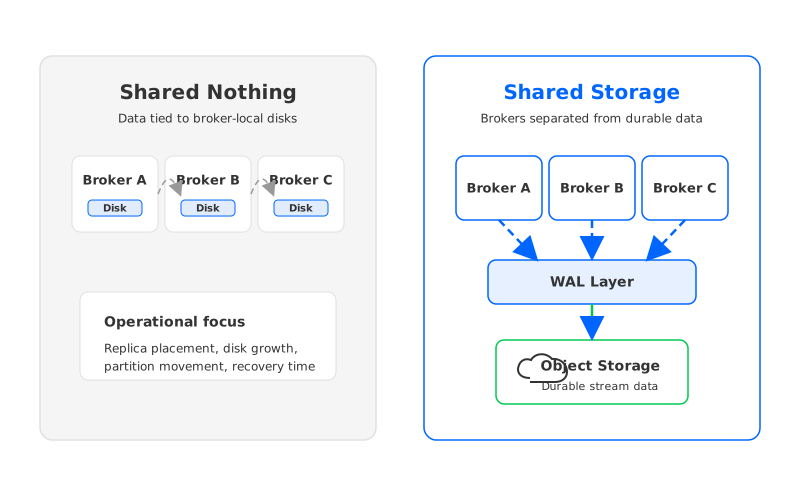
This architecture does not remove hard engineering problems. A serious platform still has to explain write latency, WAL durability, object-storage request efficiency, metadata correctness, failover, and observability. The value is narrower: retention and recovery are no longer pinned to individual broker disks in the same way. For click fraud detection, that changes how teams reason about attack bursts, replay windows, and cost after the burst.
4Evaluation checklist for platform teams
A practical evaluation begins with the fraud workflow, not the vendor category. Trace a click from ingestion through scoring, feature enrichment, billing eligibility, investigation, reporting, and model feedback. Then write down which step can be corrected later and which step must be exactly controlled. Kafka can carry these events, but the platform has to make operational boundaries visible.
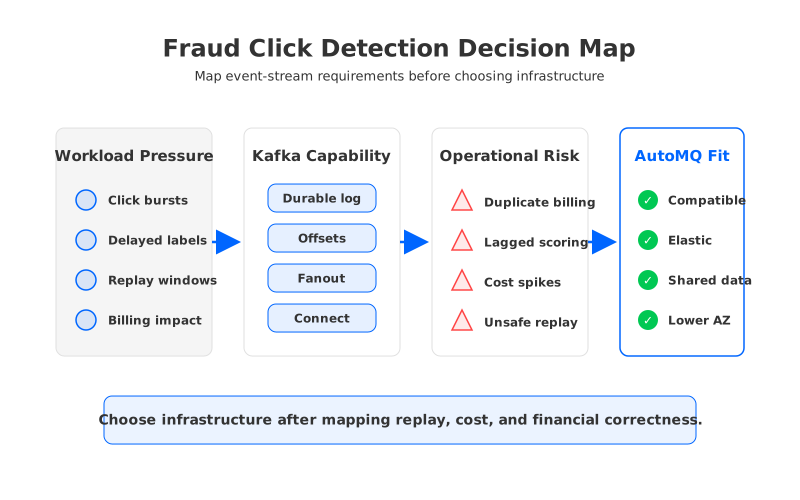
Use the following matrix as an engineering checklist:
| Evaluation area | What to test | Why it matters for fraud click detection |
|---|---|---|
| Kafka compatibility | Producers, consumers, offsets, consumer groups, Connect jobs, ACLs, and monitoring integrations. | Fraud systems span ads, billing, data science, and trust teams; application rewrites expand migration risk. |
| Replay behavior | Retention windows, offset reset procedures, idempotent consumers, backfill isolation, and correction workflows. | Detection logic changes after the fact; teams need replay without double-charging or double-blocking. |
| Cost model | Broker compute, storage, object requests, read fanout, private networking, and cross-zone traffic. | High-volume click streams can make storage and network costs grow faster than model-serving cost. |
| Elasticity | Burst ingestion, consumer lag recovery, partition movement, scale-down behavior, and impact on retained data. | Fraud attacks should not permanently increase the infrastructure footprint. |
| Governance | Schema evolution, PII boundaries, encryption, topic ownership, access reviews, and evidence retention. | Click events may contain identifiers, location signals, device data, and billing context. |
| Recovery | Broker failure, zone impairment, replay after bad rules, connector restart, and billing reconciliation. | The system must recover infrastructure and preserve financial correctness. |
| Migration | Dual-run validation, offset mapping, topic cutover, rollback path, and downstream consistency checks. | A bad migration can look like a fraud spike or hide a real one. |
The matrix exposes a useful distinction: Kafka health and fraud-system health are related but not identical. A broker cluster can look stable while enrichment is stale. Good observability connects broker metrics, consumer offsets, model freshness, campaign budget impact, and investigation queue age.
5How replay changes the fraud model
Replay is not a generic "nice to have" for fraud detection. It is how the team corrects reality after learning more. A click that looked legitimate at 10:01 may be suspicious at 14:30 after device reputation, conversion quality, and publisher patterns change. The stream design has to preserve enough context to rerun the relevant window without mixing old and new decisions into the same billing path.
That calls for a separation between facts, scores, and decisions. A raw click event records what happened. A score event records how a model interpreted that click at a specific model version. A decision event records what the business did with that score. Keeping these event types distinct lets the fraud team replay scores without pretending historical decisions never happened.
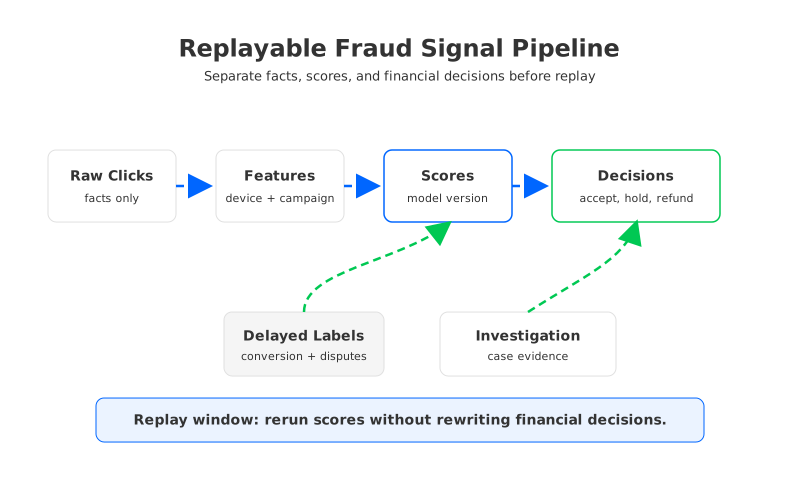
The consumer design matters as much as the topic design. Scoring consumers should be idempotent because replays are expected. Billing consumers should treat adjustment events as explicit financial records, not side effects of reading an old click twice. Investigation systems should store decision context so an analyst can explain which model, rule set, and evidence window were active.
This is where retention policy becomes a product decision. Keeping raw click events for a few hours may be enough for low-risk analytics, but it is rarely enough for fraud operations that depend on delayed labels. The right retention window follows from the detection lifecycle: how long conversion signals take to arrive, how long advertisers can dispute traffic, how often models are retrained, and how quickly a replay can be validated.
6How AutoMQ changes the operating model
Once the evaluation is framed around compatibility, replay, elasticity, governance, and cost, AutoMQ enters as an architecture option rather than a shortcut. AutoMQ is a Kafka-compatible streaming platform that keeps the Kafka protocol surface while moving away from the traditional broker-local storage model. It uses stateless brokers, a WAL layer for the immediate write path, and shared object storage for durable stream data.
That distinction matters because the busiest part of the workload and the longest-lived part of the data are often different. An attack burst may require temporary ingest capacity and rapid consumer recovery. The later investigation may require retained raw events, scores, and decision history long after the burst has disappeared. In a broker-local model, those requirements compete inside broker sizing and partition-placement decisions. In a shared storage model, compute and durable storage can be reasoned about more independently.
AutoMQ's Kafka compatibility is relevant because adtech systems are rarely greenfield. Existing producers may use Kafka clients, and consumers may depend on consumer groups, offsets, security configuration, and Kafka Connect pipelines. Compatibility does not remove validation work, but it changes the migration scope: teams can test endpoint behavior, topic settings, offset strategy, and connector paths without assuming an application rewrite.
The shared storage design also changes the cost conversation. Traditional Kafka deployments often replicate data between brokers and can generate inter-zone traffic depending on placement and read patterns. AutoMQ documents a shared-storage model and zone-aware approach that can reduce cross-AZ traffic. For high-volume click streams with replay and fanout, that is worth modeling because network cost can shape unit economics.
Architecture does not make fraud detection easy. Models, labels, governance, and business rules still decide detection quality. The narrower claim is testable: when durable stream data is separated from broker-local disks, platform teams have more room to scale compute for bursts, retain history for replay, and recover brokers without treating data movement as the center of every operational event.
7Production readiness scorecard
Before a fraud click stream becomes the source of billing truth, run a readiness review with platform engineering, ads engineering, data science, security, finance, and fraud operations. Ask whether the organization knows how to correct, replay, and explain decisions under pressure.
A useful scorecard includes five exercises:
- Replay a known bad window. Change a detection rule for a bounded interval and prove that scoring can be rerun without duplicating billing side effects.
- Trace one click across systems. Follow the click from ingestion through scoring, billing eligibility, investigation, reporting, and model feedback.
- Test burst scale-up and scale-down. Produce a realistic attack profile and verify that temporary capacity does not become permanent over-provisioning.
- Validate delayed labels. Join late conversion or chargeback signals to historical clicks and confirm that the correction workflow is explicit.
- Rehearse migration rollback. Dual-run a narrow topic group, compare output, prove offset handling, and document the rollback trigger before expanding traffic.
These exercises reveal ownership gaps. Who approves schema changes that affect billing? Who can pause a chargeback consumer? Who confirms that replay corrected the right window? Kafka provides the durable event log, but production safety comes from contracts around that log.
For teams evaluating Kafka-compatible infrastructure for fraud click detection, model peak throughput, read fanout, retention windows, topic count, partition strategy, networking, delayed labels, and migration constraints. If shared-storage Kafka fits, review the AutoMQ architecture docs and test the assumptions against your click pipeline.
8References
- Apache Kafka documentation: https://kafka.apache.org/documentation/
- Apache Kafka consumer configuration reference: https://kafka.apache.org/documentation/#consumerconfigs
- Apache Kafka semantics documentation: https://kafka.apache.org/documentation/#semantics
- Apache Kafka Connect documentation: https://kafka.apache.org/documentation/#connect
- AutoMQ architecture overview: https://docs.automq.com/automq/architecture/overview?utm_source=blog&utm_medium=reference&utm_campaign=fraud-click-detection-kafka
- AutoMQ compatibility with Apache Kafka: https://docs.automq.com/automq/what-is-automq/compatibility-with-apache-kafka?utm_source=blog&utm_medium=reference&utm_campaign=fraud-click-detection-kafka
- AutoMQ inter-zone traffic overview: https://docs.automq.com/automq/eliminate-inter-zone-traffics/overview?utm_source=blog&utm_medium=reference&utm_campaign=fraud-click-detection-kafka
- Amazon S3 pricing: https://aws.amazon.com/s3/pricing/
9FAQ
9.1Is Kafka a good fit for fraud click detection?
Kafka is a strong fit when click events need durable ingestion, independent consumers, replay, and integration with scoring, billing, analytics, and investigation systems. It is less useful for a small synchronous-only check with no replay or fanout. Most ad platforms need both: a fast decision path and replayable streams for scoring, reconciliation, and investigation.
9.2What should be replayable in a click fraud pipeline?
Raw click events, model-score events, delayed labels, investigation decisions, and billing adjustments should be modeled separately. Raw and score streams are usually replay candidates. Billing adjustments should be explicit financial records so replaying an old click does not charge, refund, or block traffic twice. Retention follows dispute periods, delayed conversions, and retraining cadence.
9.3How should teams split Kafka topics for fraud detection?
Split topics by operational contract rather than by team name. Raw clicks, enriched features, model scores, decision events, delayed labels, and billing adjustments often need different schemas, retention policies, access rules, and consumer guarantees. Cleaner boundaries make replay safer because scoring can rerun without rewriting the financial record.
9.4What Kafka metrics matter most for fraud click detection?
Consumer lag, producer errors, broker health, partition imbalance, and connector status are necessary but incomplete. Add fraud-specific metrics such as model-score freshness, delayed-label backlog, suspicious-click rate, investigation queue age, and campaign impact. The goal is to know whether the fraud workflow is healthy, not only whether Kafka is online.
9.5When should AutoMQ be considered?
Consider AutoMQ when Kafka compatibility is required but broker-local storage, retention growth, cross-zone traffic, burst scaling, or slow recovery are constraints. The fit is strongest when teams want to keep Kafka clients and ecosystem tools while evaluating shared storage with stateless brokers. Validate latency, replay behavior, security boundaries, and rollback against the fraud workflow before moving production traffic.


