
Table of Contents
Table of Contents
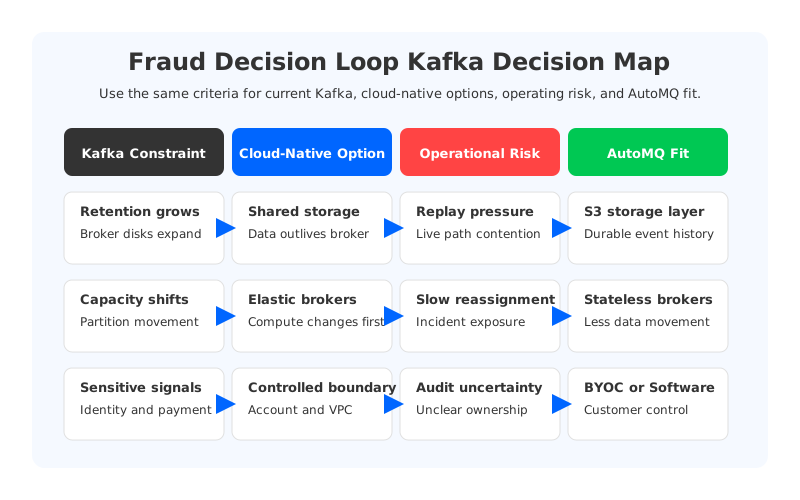
Teams searching for fraud decision loops kafka are usually past the whiteboard stage. They already know that card authorization, login risk, account takeover detection, payout review, claim routing, or marketplace abuse cannot wait for a daily batch job. The harder question is whether their Kafka-compatible event stream can keep the loop reliable when traffic spikes, models change, analysts ask for replay, and security reviewers ask where sensitive signals live.
A fraud decision loop is not one pipeline. It is a contract between event capture, feature computation, model or rule evaluation, action, feedback, and audit. Kafka can support that contract because it gives teams durable topics, partitions, offsets, Consumer groups, replay, and a large client ecosystem. The platform decision starts when those primitives have to survive production pressure without turning every fraud roadmap item into a broker storage project.
1Why Teams Search for fraud decision loops kafka
Fraud systems tend to expose infrastructure problems before other analytics workloads do. A late dashboard is annoying. A late fraud feature can approve a transaction, miss a suspicious login, release a payout, or send a case to the wrong review queue. That is why platform teams start asking different questions once fraud teams depend on Kafka: not "can events move?" but "can the decision path keep its promises when state, replay, cost, and governance all move at once?"
The pressure is uneven by design. Login events may be steady during normal hours and burst during an attack. Payment events may spike during a promotion. Analyst feedback may arrive hours or days after the original decision. Model teams may need to replay recent history after changing a feature definition. Each workload pulls on a different part of the streaming platform, so a capacity plan based only on average write throughput misses the real operating shape.
That shape creates a simple architectural test. If a team can change rules, rebuild features, add consumers, extend retention, and scale brokers without disturbing the live decision path, the platform is doing its job. If every change starts a debate about disk expansion, partition reassignment, cross-zone replication, or maintenance windows, the streaming layer has become part of the fraud risk model.
2The Production Constraint Behind the Problem
Traditional Kafka runs as a Shared Nothing architecture. Each broker owns local log storage for the partitions it hosts, and durability comes from replication across brokers through leader and follower replicas. That model is proven and well understood. It also couples four things that fraud teams would prefer to move independently: compute capacity, local storage, partition placement, and replication traffic.
The coupling shows up in ordinary operations. Longer retention means more broker storage. More consumers may turn a once-light topic into a hot replay source. Rebalancing partitions after adding brokers can move large volumes of data. Multi-Availability Zone deployments improve resilience, but broker-to-broker replication can create recurring network traffic that must be budgeted and observed. None of these behaviors make Kafka unsuitable for fraud workloads. They do mean the team has to account for storage-bound operations as part of the decision-loop design.
The next trap is treating Tiered Storage as a complete answer. Apache Kafka Tiered Storage can move older log segments to remote storage while keeping recent data on broker-local disks. That is useful for some retention and historical-read problems, and it deserves a fair evaluation. The important distinction is that tiering changes the storage hierarchy, while a Shared Storage architecture changes the ownership model. In tiered Kafka, brokers still matter as stateful nodes for the hot path. In shared-storage streaming, durable data is not permanently anchored to a broker's local disk.
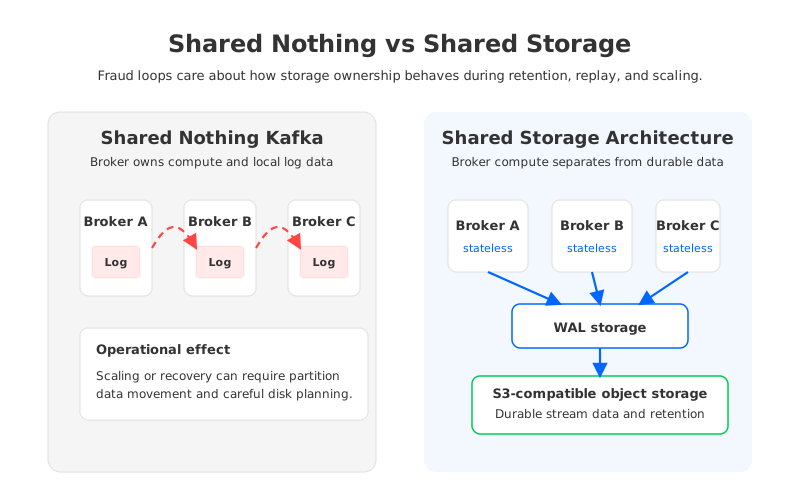
For fraud decision loops, that difference matters most during change. A stable cluster with predictable traffic may be fine with local broker storage and careful operations. A platform that supports frequent model refreshes, long replay windows, additional downstream consumers, and bursty attack patterns needs a stronger separation between "where data lives" and "which broker is serving it."
3Architecture Options and Trade-Offs
The neutral evaluation should start with the loop, not the product category. A login-risk loop that runs inline with a user request has a different latency budget from a payout-review loop that can tolerate a short delay but needs stronger audit trails. A feature-store rebuild has a different read profile from tailing consumers that feed a live rules engine. Put those loops into classes before comparing platforms.
Once the loops are classified, compare architecture options against the same criteria:
| Evaluation area | What to verify | Why it matters for fraud decisions |
|---|---|---|
| Kafka compatibility | Producer behavior, Consumer group behavior, offsets, partitions, security, clients, stream processors, and Kafka Connect integration. | Migration risk falls when applications keep Kafka semantics and tooling. |
| Freshness and replay | Consumer lag under live traffic, catch-up reads, state rebuilds, and retention windows. | Fraud teams need current signals and the ability to repair or rebuild state after logic changes. |
| Elasticity | Broker add, remove, replace, and failure recovery behavior under load. | Attack patterns and launch traffic should not turn capacity changes into incidents. |
| Storage economics | Retention cost, remote read cost, local disk growth, and cloud network traffic. | Fraud data is often kept for investigation, audit, model training, and replay. |
| Governance boundary | Account ownership, VPC (Virtual Private Cloud) placement, encryption, audit, access control, and data residency. | Sensitive identity, account, payment, and behavioral signals need clear operating boundaries. |
| Migration and rollback | Topic mapping, offset handling, dual-read or proxy paths, cutover plan, and rollback criteria. | A decision-loop migration cannot rely on hope once producers and consumers are split across systems. |
This table prevents two common mistakes. The first is optimizing for append throughput while ignoring replay and governance. The second is choosing a low-cost storage model without testing the live decision path. Fraud workloads punish both mistakes because the platform has to serve fresh actions and after-the-fact reconstruction from the same event history.
A practical review should also include failure drills. Kill a broker during a replay. Force a consumer group to catch up after a processor restart. Extend retention and measure storage behavior. Rotate credentials for a sensitive topic. Simulate a model rollback that requires consumers to return to a known offset. These drills are not theatrical exercises. They tell the platform team whether Kafka primitives are still usable when the business is under pressure.
4Evaluation Checklist for Platform Teams
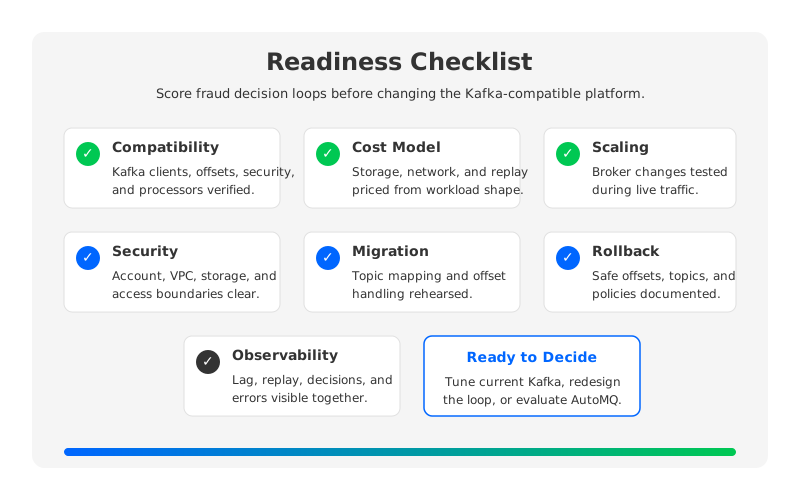
The readiness review should produce a score that engineering, risk, security, and application teams can all understand. A platform that passes only the infrastructure portion is not ready. A fraud loop also needs clean ownership, observable state transitions, and a recovery path that operators can execute under time pressure.
Start with the topic contract. Topic keys should match the entity whose state is being built, such as account, device, merchant, claim, or payment instrument. Schemas should have owners. Producers should know whether an event is an observation, a state change, a decision, or a feedback label. Consumers should be able to rebuild state from known offsets instead of relying on hidden side effects.
Then define the decision deadline. Some fraud decisions run inline with a request and have strict tail-latency constraints. Others are operational decisions where a few seconds of delay may be acceptable, but auditability matters more. Mixing those loops under one generic "real-time fraud" label leads to noisy alerts and poor platform choices. Each loop needs its own freshness objective and replay objective.
Security review belongs in the first design pass. Fraud streams can include personal data, payment metadata, device identifiers, behavioral signals, and internal risk scores. The platform should make it clear who controls the cloud account, who can access storage, how client traffic reaches brokers, how audit logs are retained, and which teams can change topic permissions. These are architecture inputs, not paperwork after deployment.
Cost review should use the team's own workload shape. Public cloud pricing pages can tell you how object storage, data transfer, and private connectivity are charged, but they cannot tell you how many consumers will replay a high-risk topic after a rule change. Use provider pricing as the unit-cost source and your event profile as the demand model. That keeps the discussion grounded without inventing universal cost claims.
5How AutoMQ Changes the Operating Model
After the evaluation frame is clear, AutoMQ becomes one concrete option for teams that need Kafka compatibility with a cloud-native operating model. AutoMQ is a Kafka-compatible streaming platform built around a Shared Storage architecture. It keeps Kafka protocol semantics while moving durable stream data to S3-compatible object storage through S3Stream and WAL (Write-Ahead Log) storage.
The key shift is that AutoMQ Brokers are stateless brokers rather than long-lived owners of local persistent data. Brokers still handle Kafka requests, partition leadership, caching, and scheduling work, but durable data is not tied to broker-local disks. For fraud decision loops, this can reduce the amount of operational work hidden behind retention growth, broker replacement, and scaling events.
The Shared Storage architecture also changes how teams think about replay. In a broker-local model, long retention and catch-up reads can become storage planning exercises for each broker. With AutoMQ, S3 storage is the main durable layer, and WAL storage provides the write path and recovery buffer. The exact latency and durability profile depends on the selected WAL type, so production planning should specify whether the workload uses S3 WAL, Regional EBS WAL, or NFS WAL rather than treating WAL storage as a single performance category.
AutoMQ BYOC and AutoMQ Software are especially relevant when fraud data must stay inside a customer-controlled account, VPC, or private environment. The point is not only compliance language. It affects how security teams review network paths, object storage permissions, observability data, and operational access. A streaming platform for fraud has to be explainable to people who do not run Kafka but are accountable for sensitive data.
Migration is the other operating concern. AutoMQ's Kafka Linking capability is designed for Kafka-compatible migration with byte-level topic synchronization and Consumer group progress handling, while teams still need to plan cutover windows, application validation, and rollback criteria. For fraud systems, the migration plan should include the action path, not only the topics. A producer cutover that works technically can still fail the business if downstream decisions cannot prove which offsets, rules, and features were active.
6A Migration Scorecard for Fraud Decision Loops
Before a platform change, score each loop against seven questions. A "no" does not mean the migration should stop. It means the team has found a design gap before production traffic finds it.
| Question | Ready signal |
|---|---|
| Compatibility | Existing clients, processors, and connectors can run with Kafka-compatible behavior that has been tested under the target version. |
| Freshness | The loop has a measurable lag objective tied to a business action, not a generic cluster average. |
| Replay | Operators can rebuild state from a known offset while live traffic continues. |
| Governance | Sensitive data boundaries are documented in terms of account, VPC, storage, identity, and audit controls. |
| Cost | Storage, network, and connectivity assumptions are tied to cloud provider pricing and the team's own traffic profile. |
| Observability | Dashboards show producer health, Consumer lag, catch-up reads, decision output, and error handling together. |
| Rollback | The team knows which topics, offsets, applications, and decision policies define a safe rollback point. |
This scorecard keeps the discussion practical. A team with weak schemas may need to fix topic ownership before changing platforms. A team with stable workloads may only need better replay tests and lag alerts. A team that is already constrained by broker-local storage, partition movement, and retention economics has a stronger reason to evaluate a shared-storage Kafka-compatible platform.
Fraud decision loops reward boring reliability: fresh signals arrive, state can be rebuilt, actions are idempotent, operators can explain what happened, and capacity changes do not become incidents. If broker-local storage and data movement are starting to slow that loop, evaluate AutoMQ as a Kafka-compatible shared-storage foundation for cloud-native streaming.
7FAQ
7.1What is a fraud decision loop?
A fraud decision loop is the path from event capture to feature computation, model or rule evaluation, action, feedback, and audit. It matters because decisions such as approve, block, challenge, hold, or route can be wrong when the system uses stale or incomplete signals.
7.2Why use Kafka-compatible streaming for fraud decision loops?
Kafka-compatible streaming gives teams durable topics, ordered partitions, offsets, Consumer groups, replay, and a mature client ecosystem. Those primitives help multiple fraud services share event history while keeping producers and consumers decoupled.
7.3Is latency all that matters?
No. Latency matters most for inline authorization and login flows, but production fraud platforms also need replay, governance, observability, migration safety, idempotent actions, and cost control. A fast pipeline that cannot rebuild state after a model change is still fragile.
7.4How is Shared Storage architecture different from Tiered Storage?
Tiered Storage moves older log segments to remote storage while brokers still keep recent data locally. Shared Storage architecture changes the ownership model by placing durable stream data in shared storage, which can make brokers more elastic and reduce dependence on broker-local disks.
7.5When should a team evaluate AutoMQ?
Evaluate AutoMQ when Kafka compatibility is important, but broker-local storage, data movement, retention growth, cross-zone traffic, or customer-controlled deployment boundaries are becoming recurring constraints. The strongest signal is not one pain point. It is the combination of replay, elasticity, governance, and migration risk.


