
Table of Contents
Table of Contents
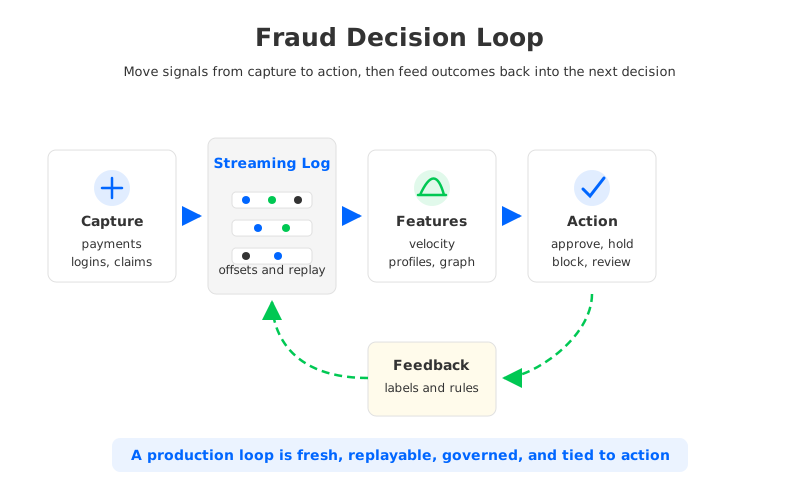
Fraud teams rarely lose sleep because one event was late in a dashboard. They lose sleep when a payment, login, account change, quote, claim, or checkout event reaches the decision path too late to change the outcome. A fraud decision loop is the path from signal capture to risk scoring, policy evaluation, human or automated action, and feedback into the next decision. When that loop is slow, the organization is not only observing fraud after the fact. It is letting stale context participate in decisions.
That is why teams search for fraud decision loops streaming. They are not asking whether Kafka can carry events. They are asking whether a streaming platform can support production fraud operations where feature freshness, replay, governance, elasticity, and cost all matter at the same time. The architecture has to move from event capture to action without turning every new fraud model, rule rollout, or retention requirement into a broker capacity project.
1Why fraud decision loops need streaming signals
A fraud decision loop starts with business events: card authorization attempts, login anomalies, device fingerprint changes, account profile edits, velocity counters, IP reputation updates, shipment changes, claim submissions, support interactions, and chargeback outcomes. Each event may be small, but the decision depends on how quickly it can be correlated with the surrounding history. A single transaction is less useful than the pattern around it.
Batch processing can still be useful for model training, investigation, reporting, and policy analysis. The operational decision path is different. If the system needs to decide whether to approve a transaction, step up authentication, hold a payout, route a case to review, or update a risk feature before the next request arrives, delayed processing changes the business result.
Production fraud streaming usually has four connected workloads:
- Signal capture from applications, payment gateways, identity systems, mobile clients, APIs, and third-party feeds.
- Feature computation that turns raw events into counters, windows, entity profiles, device history, and model inputs.
- Decision execution through rules engines, model serving, case systems, customer messaging, or authorization APIs.
- Feedback and replay from chargebacks, confirmed fraud labels, analyst decisions, and policy updates.
Kafka-compatible streaming fits this pattern because it gives multiple services a shared event contract: ordered partitions, durable logs, offsets, consumer groups, replay, and a mature client ecosystem. The harder part is operating that contract when fraud workloads become important enough to affect revenue, customer experience, and compliance review.
2The production constraints behind the search
Fraud platforms are sensitive to lag, but lag is only one symptom. The deeper constraint is that every part of the loop scales differently. Login events may be steady, checkout events may spike during a campaign, and a model refresh may require replaying recent history into a feature store.
The result is a streaming platform that has to serve live decisions and historical correction at the same time. Retention defines how far back the team can replay after a model, feature, schema, or rule changes. Consumer lag says whether the decision path is using the current state of the world. Data residency and access controls decide whether sensitive customer signals can flow through the platform at all.
Platform teams should evaluate these constraints together:
| Constraint | What it means for fraud decision loops | Architecture question |
|---|---|---|
| Freshness | Risk features and rule inputs must reflect the latest relevant activity. | Can consumers catch up without disturbing live traffic? |
| Replay | Labels, feature logic, and model inputs change as fraud patterns evolve. | Is long retention affordable and operationally safe? |
| Elasticity | Fraud spikes, launches, and investigations create uneven load. | Can broker capacity change without large data movement? |
| Governance | Signals often include account, payment, identity, and behavioral data. | Who controls the account, network, storage, and audit boundary? |
| Actionability | The loop must lead to a decision, not only a stream of observations. | Are downstream systems idempotent, observable, and recoverable? |
This evaluation should happen before choosing a product or service. A cluster that benchmarks well for append throughput may still be weak for fraud if retention is expensive, partition movement is slow, or a security boundary blocks sensitive data. A mature Kafka deployment may be enough when the team has stable traffic, modest retention, clear topic ownership, and reliable consumers.
3Architecture patterns teams usually compare
Most production designs begin with a familiar shared-nothing Kafka architecture. Brokers store partition logs on local disks, replicate partitions for durability, and serve producers and consumers through the Kafka protocol. This model is well understood and has a large ecosystem around it. It is also operationally coupled: broker compute, broker storage, partition placement, and replication are tied together.
That coupling matters in fraud systems because the workload is both latency-sensitive and replay-heavy. If the team adds brokers, replaces brokers, expands storage, or changes partition placement, the cluster may need to move partition data. If retention grows to support investigation or reprocessing, broker storage requirements grow with it. If replicas span availability zones, replication traffic can become a recurring cloud cost driver.
Tiered storage can help by moving older log segments to object storage, especially when historical reads are less frequent than tailing reads. The platform team still needs to understand which data remains on broker-local storage, how catch-up reads behave, and how failure recovery affects live decision traffic. Tiering improves the storage hierarchy; it does not automatically make brokers stateless.
Kafka-compatible shared storage changes a different part of the system. In this pattern, brokers continue to speak Kafka protocol, while durable stream data is placed in shared storage rather than permanently bound to broker-local disks. The platform still needs a fast write path and careful metadata management, but brokers can behave more like elastic compute nodes. For fraud workloads, that separation can make retention, replay, and capacity changes less dependent on moving large volumes of local broker data.
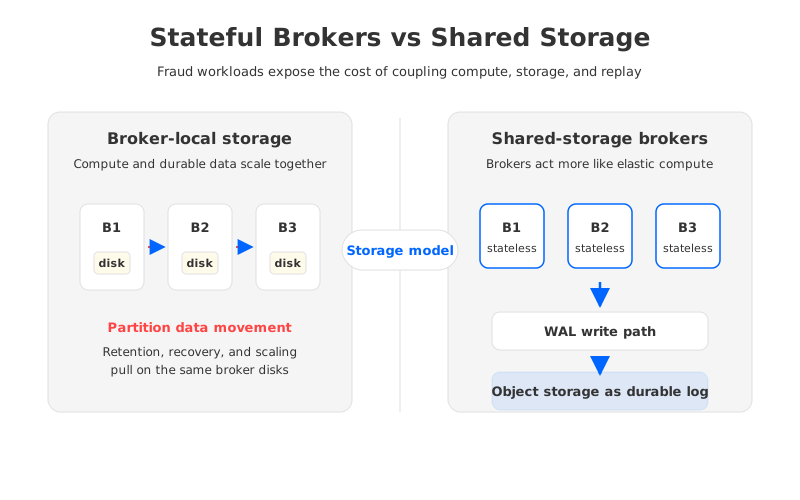
The decision is not "old Kafka is bad, shared storage is good." A stable, well-sized Kafka deployment can run critical fraud pipelines for years. The question is whether the next phase of the fraud roadmap will make storage-bound operations a recurring source of risk. If every new model rollout requires more retention, every investigation requires faster replay, and every traffic spike creates broker pressure, the storage model deserves a fresh look.
4Design the loop from action backward
A practical fraud architecture review should begin at the action point. What must be true for the system to approve, block, challenge, hold, or route a case with confidence? Working backward prevents the streaming layer from becoming an isolated ingestion project.
First, define the decision deadline. Some loops run inline with a user request, such as payment authorization or login challenge. Others run near-real time, such as payout review, account risk scoring, or claim routing. The streaming platform does not need the same latency target for every loop, but it does need clear service-level expectations for each one.
Second, define the state contract. Fraud decisions often depend on entity state: account age, device history, merchant behavior, transaction velocity, previous declines, review outcomes, and model features. Kafka topics should represent events and state changes with stable keys, schemas, and ownership. Downstream processors should be able to rebuild state from known offsets when logic changes.
Third, define the correction path. Fraud labels arrive late. Analysts reverse decisions. Models drift. Rules create false positives. A serious decision loop needs replay, idempotent writes, and auditability so that the team can repair downstream state without inventing a one-off recovery process during an incident.
This is where Kafka mechanics become useful. Offsets give consumers a recoverable position. Consumer groups let multiple services process the same topic independently. Transactions and idempotent producers can help when updates across topics or downstream state must be coordinated. These features do not design the fraud system by themselves, but they give platform teams primitives for building recoverable, inspectable data paths.
5Evaluation checklist for platform teams
The checklist should combine data platform concerns with fraud-specific operating needs. If the checklist is only about throughput, it misses the reason fraud teams asked for streaming in the first place.
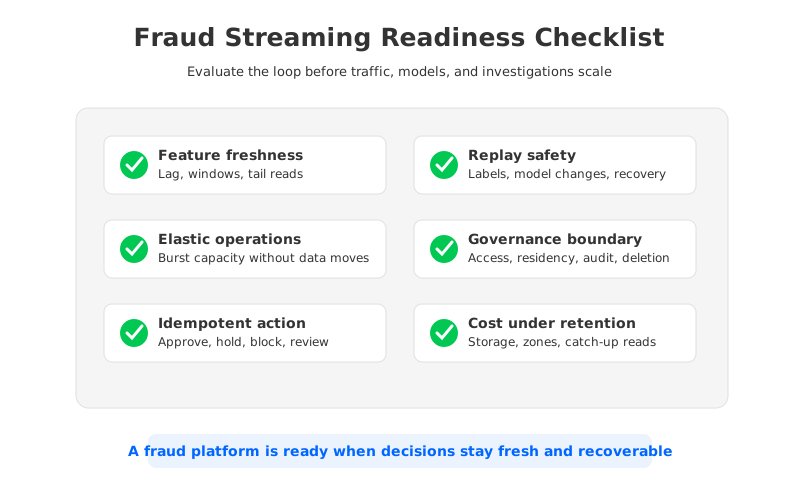
Start with compatibility. If existing applications already publish Kafka events or if fraud processors use the Kafka client ecosystem, a Kafka-compatible platform can reduce migration risk. Compatibility should cover producer and consumer behavior, partition semantics, offset management, consumer groups, security integration, observability, Kafka Connect where relevant, and stream processing frameworks.
Then test replay under pressure. Rebuilding a feature store after a schema change is not the same as reading a few old records. A useful test simulates a model or rule update while live traffic continues. Watch consumer lag, broker load, network traffic, storage reads, and operator intervention. If replay threatens the live decision path, the architecture has a hidden coupling.
Governance should be tested as an engineering requirement, not a final approval step. Fraud signals may include personally identifiable information, payment metadata, account behavior, and device identifiers. The platform needs clear encryption, access control, audit, deletion, retention, and residency boundaries. Teams operating in a customer-controlled cloud account or private network should also evaluate platform fit.
Cost belongs in the same review. Fraud systems often keep data for replay, investigation, model training, and audit. That makes storage and cross-zone traffic more important than the first capacity spreadsheet suggests. Use published cloud provider pricing and your own traffic profile rather than generic benchmarks. The right question is not whether streaming is affordable in isolation. The right question is whether the loop remains cost-effective as retention windows, feature consumers, and investigation use cases grow.
6Where AutoMQ changes the operating model
After the evaluation frame is clear, AutoMQ becomes one concrete architecture option. AutoMQ is a Kafka-compatible, cloud-native streaming platform that uses a Shared Storage architecture built on S3-compatible object storage and WAL storage. The intent is to preserve the Kafka API while changing the storage and elasticity model underneath.
For fraud decision loops, that matters in several specific places:
- Kafka-compatible integration path. Producers, consumers, stream processors, and connectors can stay centered on Kafka semantics while the platform changes its storage model.
- Shared Storage architecture for replay. Durable stream data is stored in shared object storage rather than being permanently tied to broker-local disks, which can make long retention and reprocessing less dependent on broker disk expansion.
- Stateless brokers for elastic operations. Brokers can be added, removed, or replaced with less data movement pressure because durable data is not anchored to local disks.
- Customer-controlled deployment boundary. AutoMQ BYOC and AutoMQ Software are relevant when fraud data must stay within a customer cloud account, VPC, or operational boundary.
- Continuous balancing model. AutoMQ's self-balancing design is aimed at reducing manual reassignment work as traffic and cluster topology change.
None of this removes the need to design the fraud loop carefully. A streaming platform cannot fix ambiguous ownership, weak schemas, non-idempotent decisions, or missing audit trails. It can, however, reduce the operational friction around retention, replay, capacity changes, and cloud storage economics when Kafka compatibility remains a hard requirement.
7Decision table: optimize, redesign, or evaluate AutoMQ
The useful decision is usually which layer should change first. Some fraud teams should tune their existing Kafka deployment. Others should redesign topics, schemas, and processors before touching the infrastructure. Teams that are already constrained by broker-local storage, data movement, and retention cost should evaluate a different streaming storage model.
| Situation | Best next move | Why |
|---|---|---|
| One or two fraud streams with stable traffic and short retention | Optimize the current Kafka deployment. | Improve lag monitoring, schemas, retry handling, and downstream idempotency first. |
| Many feature consumers need the same events for different models | Revisit topic ownership and replay design. | Duplicate pipelines can hide retention and governance problems. |
| Frequent model refreshes require large reprocessing windows | Evaluate the storage and replay model. | Broker-local storage may become the bottleneck for retention and catch-up reads. |
| Traffic spikes cause capacity changes or partition movement stress | Test elastic broker operations. | The cluster should absorb bursty fraud workloads without lengthy manual reassignment. |
| Sensitive fraud data must stay inside a controlled cloud boundary | Evaluate BYOC or self-managed deployment options. | Governance can decide whether the architecture is usable in production. |
| Kafka clients and processors are deeply embedded | Prefer Kafka-compatible migration paths. | Avoid rewriting application integrations while changing platform foundations. |
Fraud decision loops reward architectures that are boring in the right way: fresh signals arrive, state can be rebuilt, actions are idempotent, operators can explain what happened, and capacity changes do not become incidents. If your current Kafka environment already provides that, keep improving it. If broker-local storage and data movement are starting to slow the loop, explore AutoMQ as a Kafka-compatible shared-storage path for cloud-native streaming.
8References
- Apache Kafka Documentation
- Apache Kafka Consumer Groups and Offsets
- Apache Kafka Transactions
- Apache Kafka Protocol Guide
- AutoMQ Architecture Overview
- AutoMQ S3Stream Shared Streaming Storage
- AutoMQ Continuous Self-Balancing
- AWS Well-Architected Framework: Reliability Pillar
9FAQ
9.1What is a fraud decision loop?
A fraud decision loop is the path from event capture to risk feature computation, model or rule evaluation, action, and feedback. It matters because fraud decisions are time-sensitive. If signals arrive too late, the system may approve, block, challenge, or route a case using stale context.
9.2Why use Kafka-compatible streaming for fraud detection?
Kafka-compatible streaming gives fraud teams durable event logs, ordered partitions, offsets, consumer groups, replay, and a large ecosystem of clients and processors. Those primitives help teams feed multiple risk services, rebuild state from known positions, and keep producers and consumers decoupled.
9.3Is latency the only metric that matters for fraud streaming?
No. Latency matters, but production teams also need replay, governance, observability, cost control, idempotent downstream actions, and a clear recovery path. A low-latency pipeline that cannot replay after a model change is still fragile.
9.4How does shared storage help fraud decision loops?
Shared Storage architecture separates durable stream data from broker-local disks. For fraud workloads with long retention, frequent replay, and bursty capacity needs, that separation can reduce the operational coupling between storage growth and broker changes.
9.5When should a team evaluate AutoMQ?
Evaluate AutoMQ when Kafka compatibility is important but broker-local storage, partition reassignment, retention cost, cross-zone replication, or customer-controlled deployment requirements are becoming recurring constraints. It is most relevant when the team wants to keep Kafka semantics while changing the cloud operating model.


