
Table of Contents
Table of Contents
Teams searching for ai decisioning data plane kafka are usually trying to fix a production problem, not name an architecture category. They have models, rules, agents, or recommendation services that need fresher operational context than a batch feature table can provide. They also have Kafka somewhere in the path already, because the business events behind those decisions are ordered, replayable, and consumed by more than one system.
The pressure comes from a simple mismatch. AI decisioning wants the latest eligible signal before it acts, but production infrastructure has to pay for every extra byte retained, every replay, every cross-team consumer, and every governance control that keeps sensitive data usable. A data plane that is fast but hard to govern will eventually be slowed down by security review. A data plane that is governed but hard to scale will eventually miss the decision window. The useful question is not whether Kafka can carry events. It is whether the Kafka-compatible operating model can keep freshness, cost, and governance in balance when AI workloads become operational systems.
1Why teams search for ai decisioning data plane kafka
An AI decisioning data plane is the streaming layer that feeds production decisions: fraud approvals, next-best actions, agent routing, dynamic pricing, customer support copilots, risk controls, and feature generation for online inference. It is not the model-serving tier itself. It is the contract that says which events are available, how fresh they are, which consumers can read them, how far back they can replay, and how the platform recovers when a producer, stream processor, or downstream system fails.
Kafka is attractive in this role because it gives teams a durable event log with Topic and Partition ordering, independent Consumer groups, Offset-based progress, transactions for workloads that need atomic writes across partitions, and a large ecosystem around Kafka Connect, Kafka Streams, Schema Registry, observability, and security controls. Those properties matter for AI because the same signal often serves more than one decision path. A transaction event may feed fraud detection, customer support context, a retention model, and an audit trail at different speeds.
The search query also hides a governance requirement. AI systems create pressure to use more data in more places, but production teams still need consent handling, regional control, access review, lineage, retention policy, and auditability. A Kafka topic that carries behavioral events for feature generation may also carry personal data or regulated attributes. If the streaming layer cannot show who can read which signals and how stale each decision input was, the AI platform becomes difficult to defend in front of security, compliance, and incident review.
2The production constraint behind the problem
Freshness should be measured from source event to decision, not from producer acknowledgement to broker append. The real path includes producer buffering, partitioning strategy, broker health, connector delivery, stream processing, feature computation, serving-store update, and the application call that uses the data. A Kafka cluster can look healthy while an AI decision still uses stale inventory, an outdated risk score, or an old consent state because the bottleneck sits downstream.
Governance completes the triangle. The more valuable the decision, the more likely it is to involve sensitive context: user identity, account status, device behavior, support history, entitlement, payment signals, location, or policy state. Platform teams need topic-level access controls, schema discipline, encryption, audit logging, regional deployment boundaries, and a way to prove that replay does not violate retention or consent rules. In practice, the decisioning data plane succeeds only when freshness targets, cost envelopes, and governance controls are designed together.
3Architecture options and trade-offs
Traditional Apache Kafka uses a Shared Nothing architecture. Each Broker owns local storage for the partitions it hosts, and durability comes from replication through ISR (In-Sync Replicas) across Brokers. The model is mature and widely understood. It also couples compute, storage, and recovery work. When traffic grows, the cluster often needs more broker resources. When retention grows, the platform needs more local or attached storage. When leadership or partitions move, the system may have to move data as well as metadata.
Apache Kafka Tiered Storage is useful when historical retention is the main pressure. It allows older log segments to move to remote storage while the hot path remains on broker-local storage. That can reduce the pressure of keeping long histories, but it does not make Brokers stateless and it does not remove the need to operate the hot write path, local storage, leaders, and recovery behavior. For AI decisioning, that distinction matters because teams usually need both long replay windows and predictable fresh reads.
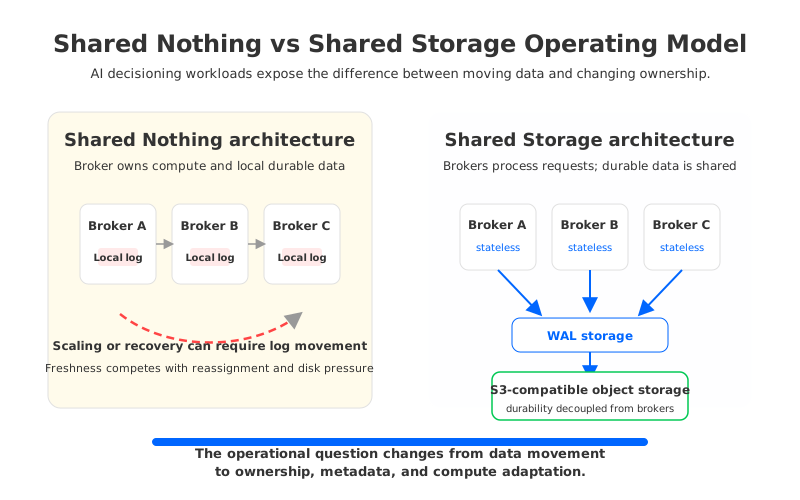
The evaluation should separate the application contract from the infrastructure contract. The application contract asks whether existing producers, consumers, offsets, transactions, connectors, monitoring tools, and security policies keep working. The infrastructure contract asks how much operational work is required to keep that API reliable as freshness, retention, replay, and governance demands change.
| Option | Where it fits | Risk to validate |
|---|---|---|
| Traditional Kafka on broker-local storage | Stable workloads, experienced Kafka teams, predictable retention | Replays and scaling may require careful data movement and capacity planning |
| Kafka with Tiered Storage | Teams whose main pain is historical retention | Hot-path storage and broker recovery still need close operational attention |
| Kafka-compatible Shared Storage architecture | Teams that want Kafka semantics with more elastic operations | Client compatibility, write path, replay throughput, and data boundaries must be tested |
| Fully managed streaming service | Teams that prefer service abstraction over infrastructure ownership | Data residency, network boundary, portability, and cost visibility need review |
There is no universal answer in this table. A well-run Kafka deployment can be the right platform for a decisioning workload with stable volume and a mature operations team. A managed service can be the right choice when organizational capacity is scarce and data-boundary requirements fit the provider model. Shared Storage architecture becomes interesting when the bottleneck is no longer the Kafka API, but the amount of storage-bound operational work required to keep that API usable.
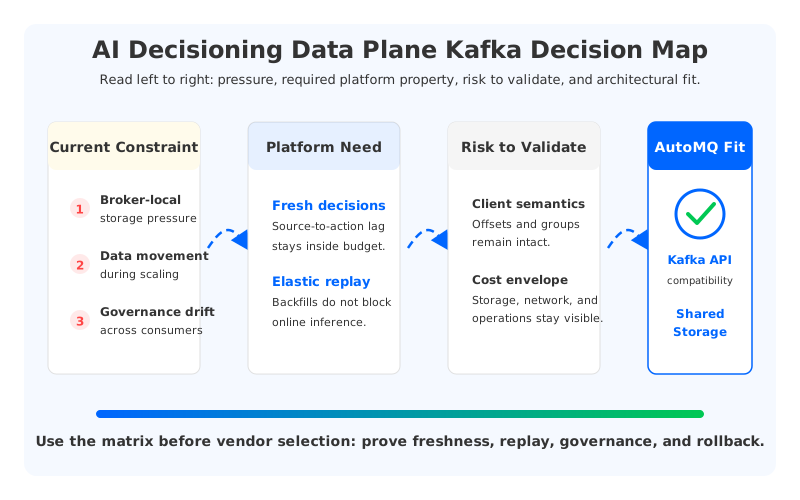
4Evaluation checklist for platform teams
A useful checklist starts with the decision, not the cluster. Pick one decision path and define the exact signals it needs before action: account state, inventory, risk score, consent, device history, customer context, entitlement, feature values, or prior model output. Then define how late each signal can be, who can read it, and how far back the team must replay it after a model, feature, schema, or policy change.
Use these questions before selecting or replacing the streaming platform:
- Freshness: Where do you measure source-to-decision lag, and what budget does each decision actually need?
- Compatibility: Which Kafka clients, Consumer groups, Offset behaviors, transactions, connectors, and schema tools must remain unchanged?
- Cost: Which costs scale with retention, replication, cross-AZ traffic, replay, read fan-out, and operational staffing?
- Elasticity: Can the platform absorb bursty writes, backfills, model refreshes, and additional Consumer groups without data movement becoming the slowest step?
- Governance: Which topics carry personal data, regulated attributes, consent state, or regional restrictions?
- Recovery: What happens when a broker fails, a connector falls behind, a bad feature is published, or a consumer has to rewind?
- Migration: Can teams cut over producers and consumers gradually while preserving correctness, rollback, and observability?
The point is to turn "real time AI" into engineering contracts. A statement like "fraud decisions must include payment and device signals produced within the previous 30 seconds, and the audit consumer must be able to reconstruct the decision input later" is testable. It creates a shared language for AI platform teams, data engineering, SRE, security, and application owners.
5How AutoMQ changes the operating model
After the neutral evaluation is clear, AutoMQ becomes relevant as a Kafka-compatible streaming platform built on Shared Storage architecture. It keeps the Kafka protocol and ecosystem contract while using S3Stream to move durable stream data into S3-compatible object storage. AutoMQ Brokers are stateless brokers from the perspective of persistent data ownership: they process Kafka requests, serve leaders, cache data, and coordinate work, but durable stream data is not bound to broker-local disks in the traditional Kafka sense.
That architectural change does not remove the need to test latency, throughput, or client behavior. It changes where the platform spends its operational effort. WAL (Write-Ahead Log) storage provides the durable write path, and S3 storage acts as the primary storage layer for stream data. Because durable data is shared, adding or replacing Brokers does not have to revolve around copying large local log segments between nodes. Partition reassignment and broker replacement become more about ownership, metadata, and traffic than about moving the entire data body.
For AI decisioning, the practical benefit is that elasticity and retention are less tightly coupled. A team can keep longer event histories for replay and audit while scaling compute around the work of serving active producers and consumers. A model refresh that creates catch-up read pressure should be tested as a real workload, but the architecture gives the team a different starting point: retained data lives in shared object storage, and broker capacity can be managed around current traffic and read behavior rather than around permanent local ownership of every log segment.
Governance boundaries matter as much as scaling. In AutoMQ BYOC, the control plane and data plane run in the customer's cloud account or VPC, and customer business data remains in customer-owned infrastructure. AutoMQ Software provides a deployment model for customer private data centers. Those boundaries are important for AI decisioning because the data plane may carry identity, consent, behavioral, financial, and audit signals. Keeping Kafka compatibility while making the deployment boundary explicit gives security and compliance teams something concrete to evaluate.
AutoMQ should still be validated like infrastructure, not accepted as a slogan. Test producer and consumer compatibility, Offset continuity, transactions if your workload uses them, connector behavior, replay throughput, access control, observability, failure recovery, and rollback. Shared Storage architecture changes the operating model; your workload has to prove that the change helps your freshness, cost, and governance constraints at the same time.
6A readiness scorecard for production AI decisions
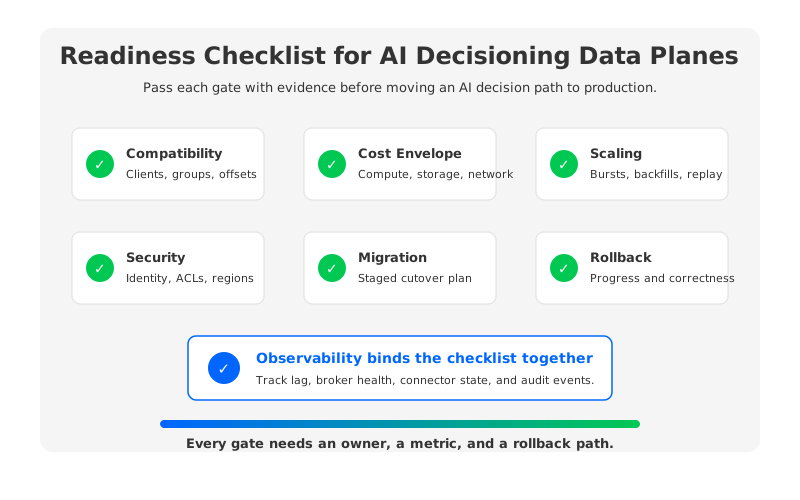
The safest evaluation starts with one bounded decision path. Good candidates include fraud feature updates, agent routing context, customer entitlement checks, risk review signals, recommendation eligibility, or support response context. Avoid starting with every event used by every model. A focused path exposes the real constraints while keeping rollback possible.
Score the candidate platform with evidence:
| Gate | Evidence to collect | Pass condition |
|---|---|---|
| Freshness | Source-to-decision lag across producer, stream, processor, and serving layer | The decision receives required signals inside its defined budget |
| Compatibility | Client tests for producers, consumers, offsets, transactions, and connectors | Existing Kafka behavior remains correct during normal and failure paths |
| Cost | Compute, storage, network, object storage, and operational effort | The cost envelope supports retention, replay, and fan-out growth |
| Governance | ACLs, schema policy, encryption, regional boundary, and audit trail | Security can trace who can read each sensitive signal |
| Recovery | Broker failure, connector lag, bad event, and consumer rewind drills | The team can recover without losing decision correctness |
| Migration | Staged cutover, rollback plan, and progress monitoring | Rollback preserves event order, consumer progress, and downstream state |
This scorecard prevents a common mistake: proving throughput while ignoring correctness. AI decisioning can be fast and wrong, or correct and too stale to matter. Production readiness means every gate has an owner, a metric, and a rollback path.
If the search that brought you here was ai decisioning data plane kafka, use the checklist before adding another model or agent to the stream. Define the decision budget, identify the signals that must be governed, and run a contained workload on AutoMQ when broker-local storage, scaling, replay, or data-boundary review are becoming blockers.
7FAQ
7.1What is an AI decisioning data plane?
An AI decisioning data plane is the production data layer that supplies fresh, governed, and replayable signals to AI-powered decisions. It usually includes event streams, processors, connectors, feature computation, audit capture, and serving integrations rather than only a model endpoint.
7.2Why use Kafka for AI decisioning?
Kafka is useful when decision signals need ordering, replay, independent consumers, durable retention, and integration with stream processors or external systems. Those properties are important when the same event feeds online inference, audit, backtesting, and downstream operations at different speeds.
7.3Does Kafka Tiered Storage solve the cost problem?
Tiered Storage can help with historical retention by moving older log segments to remote storage. It does not make Brokers stateless, and it does not remove hot-path operational work around local storage, leader ownership, and recovery. Teams should test it against their decision freshness and replay requirements.
7.4When should a team consider Shared Storage architecture?
Consider Shared Storage architecture when retention, replay, broker replacement, partition reassignment, or cross-zone traffic regularly affect the delivery schedule for AI workloads. The goal is not a different storage label; it is a Kafka-compatible operating model that reduces storage-bound operational friction.
7.5How should AutoMQ be tested for AI decisioning workloads?
Start with one bounded decision path and keep the existing path available during validation. Test client compatibility, source-to-decision lag, replay, connector behavior, access controls, observability, failure recovery, cost envelope, and rollback before expanding to more decisions.
8References
- Apache Kafka documentation
- Apache Kafka Consumer Design
- Apache Kafka Transactions and Semantics
- Apache Kafka Connect
- Apache Kafka KRaft
- Apache Kafka Tiered Storage
- AutoMQ Kafka compatibility
- AutoMQ architecture overview
- AutoMQ S3Stream Shared Streaming Storage
- AutoMQ BYOC overview
- AutoMQ zero cross-AZ traffic overview
- AWS EC2 data transfer pricing


