
Table of Contents
Table of Contents
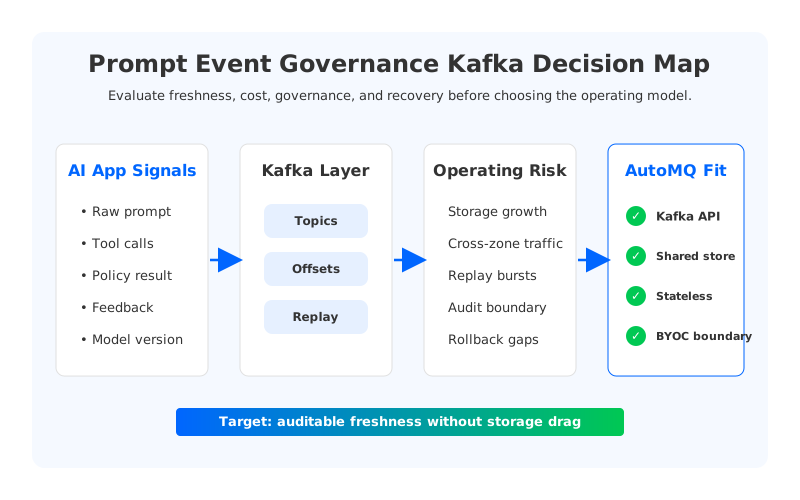
Teams searching for prompt event governance kafka are usually not asking whether prompts should be logged. They already know prompts, tool calls, retrieval context, policy decisions, model responses, user feedback, and redaction events need a durable trail. The harder question is how to keep that trail fresh enough for production AI systems without turning every prompt into a compliance artifact that is expensive to move, retain, replay, and explain.
Prompt event governance sits at an awkward intersection. Product teams want rapid iteration on agents and copilots. Security teams want traceability, deletion handling, and access boundaries. Data teams want a real-time AI data pipeline they can replay when a model, prompt template, or policy changes. Platform teams want the whole design to survive bursty traffic, long retention, and incident recovery without making Apache Kafka operations the bottleneck.
Kafka is a strong fit because it gives teams ordered records, Consumer group parallelism, Offset tracking, replay, Kafka Connect integration, transactions, and a mature client ecosystem. Those strengths do not remove the operating trade-off. Prompt events are small, frequent, sensitive, and often enriched by downstream systems. The platform decision extends beyond "can Kafka carry these events?" The sharper question is "which Kafka-compatible operating model keeps prompt governance useful when freshness, cost, and auditability pull in different directions?"
1Why teams search for prompt event governance kafka
Prompt governance becomes urgent when AI leaves the demo environment. In a demo, the application logs an input and output, the team reviews a few samples, and a dashboard looks convincing. In production, a single user interaction may include the original prompt, retrieved documents, authorization context, tool calls, guardrail decisions, model version, response metadata, human feedback, and a later correction. Each record may be needed by a different team for a different reason.
The search phrase usually hides four production questions:
- Freshness: How quickly do policy changes, blocked prompts, feedback, and prompt-template revisions need to appear in downstream systems?
- Cost: Which cost grows with events, retained bytes, cross-zone traffic, private connectivity, enrichment workers, and observability?
- Governance: Can the team prove which prompt, model, retrieval context, and policy version produced a response?
- Recovery: Can the pipeline replay a time window without duplicating audit records, losing deletion events, or mixing model versions?
These questions are connected. If the team slows ingestion to control cost, moderation and observability become stale. If it retains everything forever on broker-local storage, the Kafka cluster becomes a cost center before the AI product has stabilized. If it enriches events without offset discipline, the governance layer becomes a collection of logs rather than an auditable system of record.
2The production constraint behind the problem
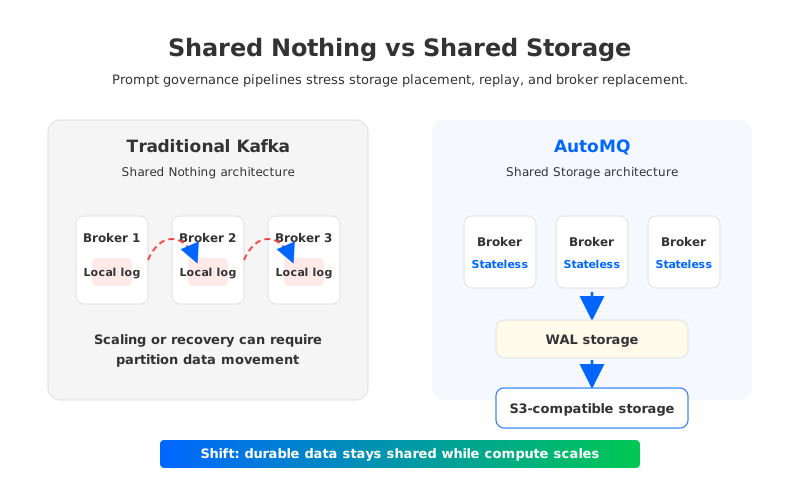
Traditional Kafka uses a Shared Nothing architecture: each Broker owns local persistent storage, and replication across Brokers protects availability. This model is proven and explicit. Operators can reason about leaders, followers, partitions, retention, and replication factor. The price of that clarity is coupling. Compute capacity, local storage, partition placement, recovery behavior, and rebalancing all meet at the Broker.
Prompt governance workloads put pressure on that coupling because their traffic shape is uneven. An agent release may double prompt volume for a few hours. A policy incident may trigger a replay of historical conversations through a different classifier. A compliance request may require a narrow but urgent scan over old events. With broker-local storage, the platform team often plans capacity around peak write rate, retained history, and recovery headroom at the same time. Those dimensions rarely grow together.
Cross-zone traffic is another constraint that shows up late in design reviews. Highly available Kafka deployments commonly span multiple Availability Zones (AZs). Replication, client placement, or private connectivity can create inter-zone data transfer. The exact price depends on cloud provider, region, and service, so production planning should verify the current pricing pages before committing to a cost model. The architectural point is stable: a durability model that copies every prompt event between zones has a different cost shape from one that persists data through a shared cloud storage layer.
The third constraint is data control. Prompt events can contain customer text, retrieved context, tenant identifiers, policy outcomes, and sometimes sensitive metadata even after redaction. A governance pipeline has to define where raw prompts live, where redacted events live, who can replay them, which logs enter a SIEM, and which operational metadata a vendor can see. The streaming architecture either makes that boundary straightforward to document or forces every integration to carry its own exception.
3Architecture options and trade-offs
The useful comparison is not "Kafka or not Kafka." The useful comparison is how each option handles ordering, replay, sensitivity, and operational ownership.
| Option | Where it fits | Main trade-off |
|---|---|---|
| Application-only logging | Early pilots and narrow internal tools | Fast to add, but weak replay, offset tracking, and cross-team ownership. |
| Batch audit export | Periodic compliance review with low freshness requirements | Simple retention path, but stale for moderation, drift detection, and incident response. |
| Kafka-backed prompt event stream | Multiple AI apps, ordered events, real-time enrichment, and replay | Strong governance substrate, but Kafka operations become part of the AI platform SLO. |
| Hybrid hot stream plus archive | Sensitive workloads with separate real-time and long-term evidence paths | Clearer data controls, but requires explicit lineage between hot records and archived evidence. |
A Kafka-backed design works because prompt governance is event-shaped. The application emits the prompt event. A redaction worker consumes it and writes a sanitized event. A policy engine adds a decision record. A feedback service writes user or reviewer outcomes. A monitoring job computes lag, failure rate, and policy drift. Each stage can carry the source Topic, Partition, Offset, schema version, model version, and policy version forward.
That design still needs discipline. Consumer group parallelism improves throughput, but partitioning has to preserve the order that matters, such as all events for a conversation, session, tenant, or request chain. Transactions and idempotent producers can protect some multi-step writes, but downstream sinks still need idempotent keys and clear duplicate handling. Kafka Connect can standardize source and sink integration, but connector ownership, dead-letter topics, schema evolution, and access control remain production work.
Tiered Storage deserves a careful look. Apache Kafka's Tiered Storage can move older log segments to remote storage, which helps long retention. It does not fully separate Broker compute from the active storage path, and it does not by itself answer who owns prompt replay, redaction boundaries, or policy lineage. For prompt governance, Tiered Storage may be enough when the primary issue is older retention. A Shared Storage architecture becomes more relevant when the team wants Kafka compatibility while reducing the operational weight of broker-local data placement.
4Evaluation checklist for platform teams
Start with compatibility. Prompt governance is usually added to applications that already have client libraries, authentication patterns, monitoring tools, and deployment pipelines. A replacement streaming layer that accepts produce and fetch requests but changes client behavior under transactions, Consumer group rebalancing, admin operations, or connector workloads creates migration risk. Compatibility should be tested with the actual producer settings, schema tooling, ACLs, quotas, and observability stack.
Move next to the cost model. Split the bill into compute, durable storage, retained history, cross-zone traffic, private connectivity, enrichment workers, index or lake writes, and observability. A single monthly estimate is useful for finance, but it is not enough for architecture. Platform engineers need to know which line grows with prompt count, which grows with retained bytes, which grows with the number of zones, and which grows when an incident forces replay.
Then test elasticity against real AI behavior. Prompt volume is not a smooth time series. Agent launches, customer onboarding, evaluation runs, prompt attacks, replay jobs, and incident investigations create bursts. The evaluation should ask whether useful capacity appears quickly, whether scaling requires heavy data movement, whether Consumer lag is observable by stage, and whether the pipeline can throttle enrichment without losing the raw governance trail.
Security review should be specific about event classes. Raw prompts, redacted prompts, policy decisions, embeddings, tool outputs, and operational logs do not always need the same retention period or access policy. A strong design separates these classes by Topic, schema, encryption policy, sink, and role. It also defines who can replay sensitive streams and how replay activity is audited.
Migration and rollback expose weak assumptions. A clean plan defines source topics, target topics, schema compatibility, offset mapping, dual-write or mirror strategy, validation metrics, cutover criteria, and rollback criteria. The rollback plan should answer a concrete question: if the new prompt governance path mishandles redaction or ordering, how do you return to a known-good offset without replaying bad evidence into the audit store?
5How AutoMQ changes the operating model
If the neutral evaluation points to Kafka-compatible streaming but the operational pain is tied to broker-local storage, the architecture lever is Separation of compute and storage. AutoMQ is a Kafka-compatible cloud-native streaming platform that keeps the Kafka protocol and ecosystem surface while replacing traditional broker-local log storage with a Shared Storage architecture backed by S3-compatible object storage.
That shift matters for prompt event governance because Brokers are no longer the long-term home of the data. In AutoMQ, AutoMQ Brokers handle Kafka protocol processing, leadership, caching, and request routing. Durable stream data is stored through S3Stream with WAL (Write-Ahead Log) storage and S3 storage. WAL storage provides the durable write path and recovery buffer, while S3 storage acts as the primary long-term data layer.
The operating model changes from "scale Brokers and move their local data" to "scale stateless brokers while durable data remains in shared storage." For prompt governance, that distinction affects the stressful moments: agent traffic spikes, replay jobs, retention growth, and node replacement. Capacity planning can focus more directly on request processing, cache behavior, retained data, and downstream enrichment limits instead of treating every scaling event as a storage migration event.
Deployment boundaries also matter. AutoMQ BYOC runs the control plane and data plane in the customer's cloud account and VPC. AutoMQ Software targets private data center deployments. For teams governing prompts derived from sensitive customer data, that boundary can be as important as storage mechanics. The goal is not to send prompt data to a different account for convenience. The goal is to operate a Kafka-compatible governance substrate inside the environment the organization already audits.
AutoMQ is not a substitute for prompt governance design. Teams still need schemas, redaction rules, idempotent sinks, role boundaries, retention policy, and replay procedures. It changes the platform layer underneath those controls. When the core requirement is Kafka compatibility plus lower friction around scaling, retention, and customer-controlled deployment, AutoMQ belongs in the shortlist.
6Readiness scorecard
Use a scorecard before committing to a platform or migration. Rate each item as pass, risk, or blocked. A blocked item should stop the rollout until ownership and evidence are clear.
| Area | Pass condition |
|---|---|
| Compatibility | Existing Kafka clients, Consumer groups, connectors, authentication, authorization, and monitoring work with minimal application change. |
| Freshness | The team can measure prompt-to-policy, prompt-to-lake, and prompt-to-alert lag, not only raw Consumer lag. |
| Cost | Compute, storage, network, private connectivity, enrichment, and observability costs are modeled separately. |
| Elasticity | Burst handling does not require long storage rebalancing before useful capacity appears. |
| Governance | Each derived event can be traced to prompt, model version, policy version, Topic, Partition, and Offset. |
| Recovery | Replay, rollback, deletion propagation, and redaction correction are tested before cutover. |
| Data boundary | Raw prompts, redacted events, embeddings, metadata, and logs stay within the intended account, VPC, region, or private environment. |
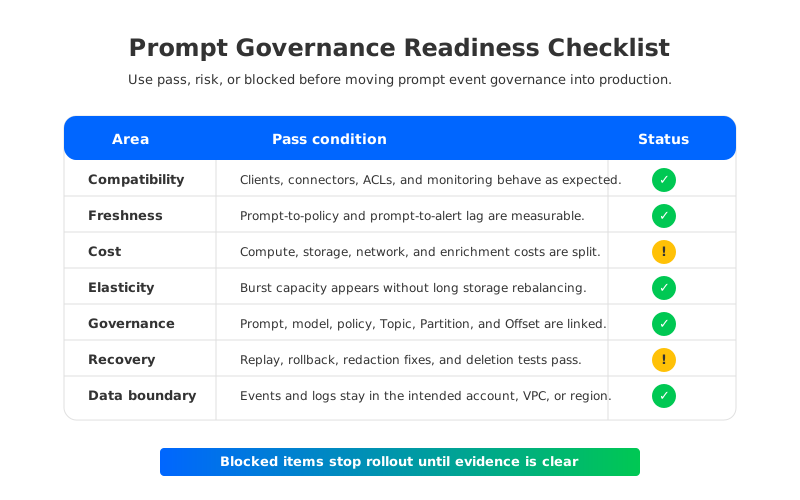
The scorecard is deliberately plain. Prompt governance fails when teams assume logging is the same as evidence, or assume replay is safe because the raw events are retained. A production design needs stronger guarantees: what happened, which policy applied, which model answered, which offset was processed, and how the team can recover if any of those answers are wrong.
7FAQ
7.1Is Kafka required for prompt event governance?
No. Small AI applications can start with application logs or batch exports. Kafka becomes valuable when prompt events need ordering, replay, Consumer group parallelism, enrichment, auditability, and integration across multiple teams.
7.2What should be included in a prompt event?
At minimum, capture a request identifier, tenant or application context, prompt or redacted prompt, model identifier, prompt template version, policy version, response metadata, tool-call metadata, timestamp, and lineage fields such as Topic, Partition, and Offset. Sensitive fields should follow the organization's classification and retention policy.
7.3Does Tiered Storage solve prompt governance retention?
Tiered Storage can help retain older Kafka data in remote storage. It does not by itself separate Broker compute from the active storage path, define redaction policy, or prove lineage across derived events. Compare it with Shared Storage architecture when scaling, replay, and broker-local data movement are part of the problem.
7.4Where should AutoMQ enter the evaluation?
After the team has defined compatibility, freshness, cost, governance, migration, and deployment-boundary requirements. AutoMQ is most relevant when the team wants Kafka compatibility but does not want broker-local storage and data movement to dominate the operating model.
The first missing prompt audit trail often looks like an application logging issue. By the time it reaches the platform team, it is a streaming architecture question about offsets, storage, cost, and recovery. If your team is evaluating a Kafka-compatible layer for prompt event governance, run the scorecard against real topics and replay scenarios. To test AutoMQ's operating model in your own environment, start here: try AutoMQ BYOC.


