
Table of Contents
Table of Contents
Teams searching for vector search update pipeline kafka are usually past the proof-of-concept stage. The demo already works: application events land in Apache Kafka, an embedding service creates vectors, and a vector database or search service updates the index. The hard question arrives later, when product catalogs, user behavior, permissions, documents, and model versions begin changing at different speeds. The business asks for fresh search results, the AI team asks for larger context, the platform team asks who will pay for burst capacity, and security asks where the embeddings live.
That tension is the real topic. A vector search update pipeline is not a single stream processor attached to a vector database. It is a freshness contract between source systems, Kafka topics, embedding workers, index writers, metadata stores, and rollback procedures. If the streaming layer cannot absorb bursts, preserve ordering, expose offsets, and recover cleanly, the vector index becomes a polished surface over stale or poorly governed data.
1Why teams search for vector search update pipeline kafka
Search freshness sounds like a product metric, but it becomes an infrastructure problem as soon as the index must reflect more than plain text. A product recommendation system may need the latest inventory, price, user profile, suppression rules, and embedding model version. An enterprise knowledge assistant may need document updates, permission changes, deletion events, and vector re-embeddings to land in the right order. In both cases, a stale vector is not only a relevance issue; it can become a governance issue.
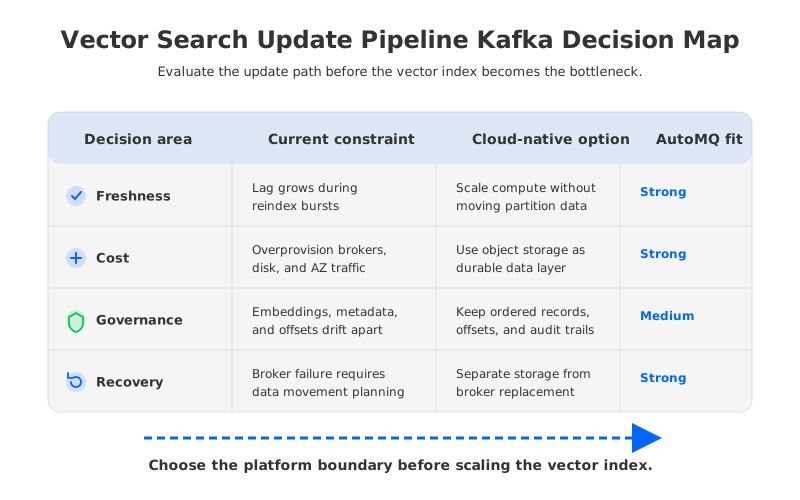
The phrase vector search update pipeline kafka usually hides four separate design pressures:
- Freshness pressure: How long can the index lag behind source-of-truth events before search quality or user trust drops?
- Cost pressure: How much broker, storage, network, embedding, and vector database capacity must be reserved for bursts?
- Governance pressure: Can the team prove which source event produced a vector, which model generated it, and which offset was indexed?
- Recovery pressure: Can the pipeline replay, pause, roll back, or rebuild without creating duplicate index entries or losing deletion events?
These pressures are connected. If teams lower cost by underprovisioning consumers, freshness suffers. If they chase freshness by scaling every component permanently, cost becomes hard to explain. If they rebuild indexes without a clear offset boundary, governance becomes guesswork. The pipeline needs a technical contract that links Kafka offsets, embedding jobs, index mutations, and operational ownership.
2The production constraint behind the problem
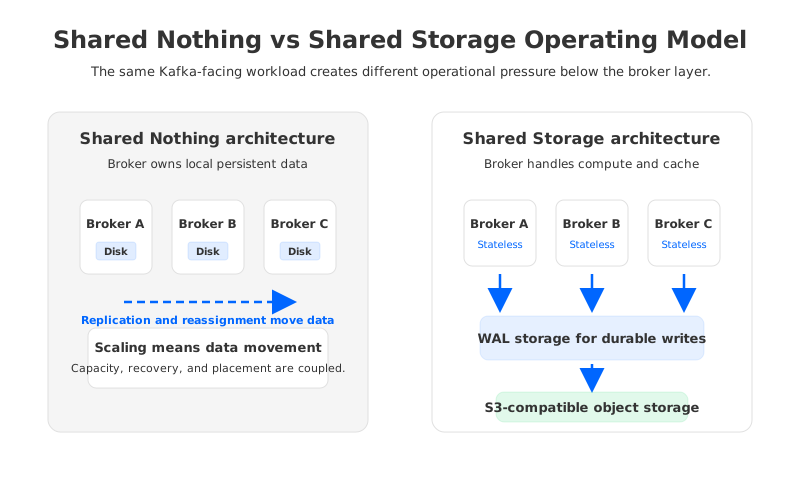
Vector update pipelines amplify that coupling. A catalog import or document sync may create a short write spike. A model upgrade may require replaying records through a different embedding version. A tenant with heavy usage may create a hot set of topics while other tenants remain quiet. In a broker-local storage model, the platform team often reserves enough Broker and disk capacity for the peak case, then pays for idle capacity during normal periods. The alternative is to scale closer to demand and accept more operational planning around partition reassignment, disk pressure, and recovery windows.
The second constraint is cross-zone data movement. A highly available Kafka deployment typically spans multiple Availability Zones (AZs), and replication or client placement can generate inter-zone traffic. Cloud provider pricing varies by region and service, so a responsible design should validate the actual traffic path against current pricing pages before making cost claims. The architectural point is stable even when the price changes: a pipeline that multiplies records across zones as part of its durability model has a different cost shape from a pipeline that stores durable data in a shared cloud storage layer.
The third constraint is ownership. AI platform teams tend to own embedding services and vector indexes, data engineering teams own source connectors and topics, and SRE or platform teams own Kafka. When freshness fails, each team can see a different symptom. The embedding queue is behind, the vector database write path is throttled, a Consumer group has lag, or a Broker is rebalancing. A good architecture makes those boundaries inspectable. A weak architecture lets the index drift while every team’s dashboard looks locally reasonable.
3Architecture options and trade-offs
There is no universal vector search pipeline. The right architecture depends on update frequency, index size, compliance boundaries, and how much replay the business can tolerate. The useful way to compare options is to separate the streaming log, embedding compute, index mutation path, and governance record instead of treating the pipeline as one component.
| Option | Where it fits | Main trade-off |
|---|---|---|
| Batch rebuild | Small indexes, low update frequency, simple recovery expectations | Operationally clear, but freshness is bounded by rebuild cadence. |
| Direct source-to-index sync | Narrow use cases with a single source and minimal ordering constraints | Fast to start, but offset tracking and replay discipline often become custom work. |
| Kafka-backed incremental updates | Multiple sources, ordered mutations, Consumer group parallelism, replay, and audit requirements | Stronger control plane for updates, but Kafka operations become part of the AI SLO. |
| Hybrid rebuild plus Kafka delta stream | Large indexes that need periodic compaction and low-latency deltas | More moving parts, but easier recovery when rebuild and delta boundaries are explicit. |
The Kafka-backed design is attractive because it gives platform teams a durable update log rather than a chain of point-to-point integrations. Source systems produce change events. Embedding workers consume partitions and write enriched events or index mutations. Index writers commit the vector update and track the Kafka Offset that made it into the index. If the index needs to be rebuilt, the team can replay from a known offset, route records through a controlled embedding version, and compare output against a target index.
That design still needs discipline. Consumer group parallelism can improve throughput, but it does not remove ordering constraints within a partition. Transactions and idempotent producers can help protect multi-step writes, but teams still need idempotent index mutations and a clear policy for deletes. Kafka Connect can standardize source and sink integration, but connector ownership, schema evolution, and dead-letter handling remain production responsibilities. KRaft removes the need for ZooKeeper in current Kafka architecture, but it does not make broker-local storage disappear.
The decision matrix is therefore less about product names and more about operating questions. Can the streaming layer scale during embedding bursts without long data movement? Can it retain enough history for index rebuilds without making local disk the dominant cost driver? Can the team prove that a deletion or permission change reached the vector index? Can the migration path preserve offsets and rollback options? A platform that answers those questions with explicit mechanics is stronger than one that only promises low latency in the happy path.
4Evaluation checklist for platform teams
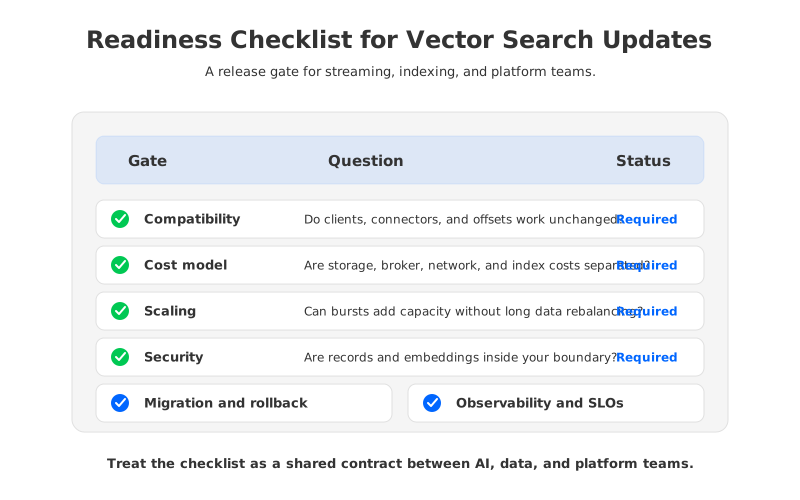
A practical evaluation starts with compatibility because the fastest way to create migration risk is to replace a known Kafka surface with something that behaves differently under load. Teams should verify client versions, producers, consumers, Kafka Streams jobs, Kafka Connect workers, schema tooling, authentication, authorization, and observability before debating architecture. Compatibility is not a slogan in this context; it is the difference between migrating a pipeline and rewriting every operational habit around it.
Once compatibility is clear, the evaluation should move to the cost model. Split the bill into compute, durable storage, retained history, inter-zone traffic, PrivateLink or private connectivity, vector database writes, embedding compute, and observability. Avoid blending these costs into one monthly number too early. Blended totals are useful for finance, but platform engineers need to know which cost grows with records, which grows with retained bytes, which grows with zones, and which grows with burst capacity.
The next gate is scaling behavior. For vector search, the platform must handle normal deltas and abnormal bursts. A normal delta is a steady stream of product changes, document edits, or user events. An abnormal burst is a catalog import, a tenant migration, a model rollout, or an incident recovery replay. The question is not whether more consumers can be launched. The question is whether the streaming layer can absorb the producer side, keep enough retained history, and rebalance work without turning the cluster itself into the slowest part of the pipeline.
Migration and rollback are the last gates because they expose weak assumptions. A clean migration plan defines source topics, target topics, offset mapping, dual-write or mirror strategy, validation metrics, cutover criteria, and rollback criteria. A clean rollback plan answers a harder question: if the candidate index or streaming layer is wrong, how do you return to a known-good offset without replaying bad mutations into production search?
5How AutoMQ changes the operating model
If the evaluation points to Kafka-compatible streaming but the operational pain is tied to broker-local storage, the architectural lever is compute and storage separation. AutoMQ is a Kafka-compatible streaming platform that keeps the Kafka protocol and ecosystem surface while replacing the traditional broker-local storage layer with a Shared Storage architecture backed by S3-compatible object storage.
That difference matters for vector search update pipelines because the Brokers are no longer the long-term home of the data. In AutoMQ, Brokers handle Kafka protocol processing, leadership, caching, and request routing, while durable stream data is stored through S3Stream with WAL storage and S3 storage. The WAL (Write-Ahead Log) provides a durable write buffer and recovery path; S3 storage is the primary long-term data layer. The operating model changes from “scale Brokers and move their local data” to “scale stateless brokers while durable data remains in shared storage.”
This does not remove the need for pipeline design. Embedding workers still need idempotency. Index writers still need offset tracking. Security teams still need data classification and access boundaries. What changes is the platform layer’s response to bursty AI workloads. When compute and durable storage are separated, capacity planning can focus more directly on request processing, cache behavior, retained data, and downstream indexing limits instead of treating every scaling event as a storage placement event.
AutoMQ also fits the governance boundary many AI teams want: AutoMQ BYOC runs the control plane and data plane in the customer’s cloud account and VPC, while AutoMQ Software targets private data center deployments. For teams handling embeddings derived from sensitive data, that deployment boundary can be as important as throughput. The goal is not to move AI data into another vendor’s account; the goal is to operate a Kafka-compatible streaming layer inside the boundary the organization already audits.
For migration, AutoMQ’s Kafka-compatible surface reduces application change, while AutoMQ Kafka Linking is designed for Kafka migration scenarios that need offset consistency and controlled cutover. Teams should still run a readiness exercise with representative topics, connectors, Consumer groups, failure tests, and rollback steps. The strongest migration plan treats compatibility as something to validate under the actual vector update workload, not as a checkbox at the start of the project.
6A practical scorecard
Use a small scorecard before committing to a platform or migration plan. Give each item a rating of pass, risk, or blocked. A single blocked item should stop the rollout until ownership is clear.
| Area | Pass condition |
|---|---|
| Compatibility | Existing Kafka clients, connectors, authentication, authorization, and monitoring work with minimal application change. |
| Freshness | The team can define and measure producer-to-index lag, not only Kafka Consumer lag. |
| Cost | Broker, storage, network, embedding, and vector database costs are modeled separately. |
| Elasticity | Burst handling does not require long storage rebalancing before useful capacity appears. |
| Governance | Every indexed vector can be traced to source event, model version, and Kafka Offset. |
| Recovery | Replay, rebuild, rollback, and deletion propagation are tested before cutover. |
| Data boundary | Records, embeddings, metadata, and operational logs stay within the intended deployment boundary. |
The scorecard is intentionally blunt. A vector search update pipeline can look healthy in a demo while hiding gaps in deletion handling, re-embedding strategy, or cost attribution. The job of the platform team is to make those gaps visible before the index is business-critical.
7FAQ
7.1Is Kafka required for vector search update pipelines?
No. Small or low-change indexes can work with batch rebuilds or direct source-to-index sync. Kafka becomes valuable when teams need ordered updates, replay, Consumer group parallelism, source integration, and auditability across multiple systems.
7.2What is the biggest mistake in a Kafka-based vector update pipeline?
The common mistake is treating the vector database write as the sole success condition. A production pipeline also needs offset tracking, delete propagation, model-version lineage, idempotent writes, backpressure handling, and a tested replay boundary.
7.3Does Tiered Storage solve the broker-local storage problem?
Tiered Storage can move older Kafka log segments to remote storage, which helps retention economics. It does not fully separate Broker compute from the active storage path. For bursty update pipelines, platform teams should compare Tiered Storage with a Shared Storage architecture rather than treating them as the same operating model.
7.4Where should AutoMQ enter the evaluation?
After the team has defined compatibility, freshness, cost, governance, scaling, and migration requirements. AutoMQ is most relevant when the team wants Kafka compatibility but does not want broker-local storage and data movement to dominate the operating model.
The first stale search result usually looks like a product issue. By the time it reaches the platform team, it has become a systems question about offsets, storage, cost, and recovery. If your team is evaluating a Kafka-compatible streaming layer for AI search updates, use the checklist above with your own topics and index workload. To test the AutoMQ operating model in your own environment, start from the AutoMQ console path here: try AutoMQ BYOC.


