
Table of Contents
Table of Contents
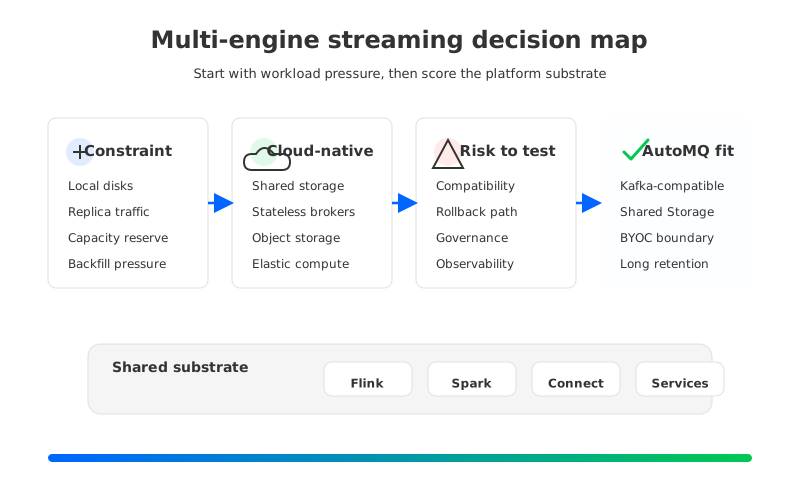
Teams do not search for multi engine stream processing kafka because they need another definition of streaming. They search because their batch windows are shrinking, their Flink jobs are multiplying, Spark still owns part of the estate, and the lakehouse team expects open tables rather than another private serving layer. Kafka is already the system of record for event flow, but the processing surface around it has become wider than one engine can comfortably own.
That pressure changes the platform question. The issue is no longer whether Kafka can feed a stream processor. It can. The harder question is whether the Kafka-compatible foundation can support several engines without turning every replay, retention change, schema decision, and capacity spike into a broker-local storage project. Multi-engine stream processing is a useful search phrase because it points to a real production boundary: the event log has to serve continuous jobs, operational consumers, lakehouse ingestion, and backfill workflows at the same time.
1Why teams search for multi engine stream processing kafka
The first engine is rarely the problem. A team starts with Flink for stateful event processing, Spark Structured Streaming for incremental data lake jobs, Kafka Streams for service-local transformations, or Kafka Connect for source and sink integration. Each choice is reasonable. The problem appears when the platform team has to make these engines share the same topics, retention policy, access model, replay windows, and recovery expectations.
At that point, Kafka becomes more than a transport layer. It becomes the coordination point between teams that have different views of time. Application teams care about low-latency consumption and offset progress. Data engineering teams care about reproducible backfills and table correctness. SREs care about broker health, network cost, and the blast radius of failed jobs. Governance teams care about schema evolution, identity, encryption, audit trails, and data residency.
The search intent usually has four questions underneath it:
- Can several processing engines consume from the same Kafka-compatible platform without fighting over retention, lag, and throughput?
- Can the platform support both tailing reads and historical catch-up reads without forcing large broker storage overprovisioning?
- Can the team migrate from batch windows to continuous processing while keeping rollback and replay paths explicit?
- Can the operating model stay manageable when compute engines scale independently from the streaming substrate?
These questions are not solved by picking a single stream processor. Flink, Spark Structured Streaming, Kafka Streams, and Connect each have different strengths, and many production systems need more than one. The substrate beneath them has to make that diversity survivable.
2The production constraint behind the problem
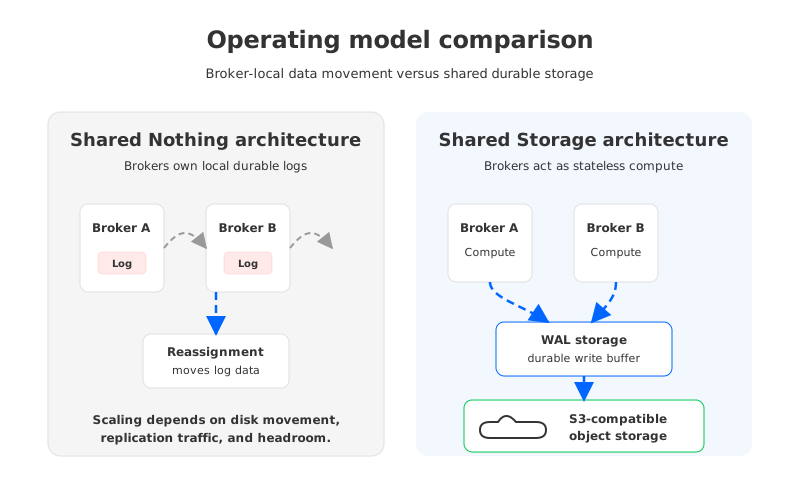
Traditional Kafka is a Shared Nothing architecture: each broker owns local log storage, and partition replicas are copied across brokers for durability. That design is coherent, battle-tested, and well understood. It also means that capacity planning is tied to broker-local disk, partition placement, replica movement, and the network path between availability zones. When one processing engine becomes three, the storage and recovery side of the system starts carrying pressure that application diagrams often hide.
Consider a platform with Flink jobs reading recent events, Spark jobs backfilling several days of data, Connect workers delivering to downstream systems, and service consumers maintaining operational state. All of those consumers may be valid. Yet their access patterns are different. Tailing reads want fresh data with low latency. Catch-up reads want throughput across older segments. Backfills may pull data that has not been hot in cache for hours or days. If the broker is also the place where durable storage lives, those reads compete with replication, leader balancing, and disk headroom.
The operational symptoms tend to look familiar:
- Capacity gets reserved for the worst week, not the average day. Storage-heavy retention and bursty backfills require broker disk and network headroom even when steady-state processing is calm.
- Rebalancing becomes a data movement event. Moving partitions can mean moving log data, so operational changes are constrained by copy time, network bandwidth, and failure risk.
- Cross-AZ traffic becomes part of the replication bill. Multi-AZ durability is desirable, but broker-to-broker replication can turn durability into recurring network transfer.
- Engine boundaries become team boundaries. A Spark backfill that causes lag for a Flink job is no longer a data engineering issue; it becomes a shared platform incident.
This is why the architecture under Kafka matters as much as the stream processors above it. Multi-engine processing increases the number of valid readers and writers. It also increases the number of times the platform has to answer a basic question: is this workload limited by processing logic, or by the way the event log stores and serves data?
3Architecture options and trade-offs
There are several defensible ways to build a multi-engine stream processing platform. The right answer depends on retention, latency, compliance, cloud boundaries, team skills, and the cost of migration. A useful evaluation starts by separating the processing layer from the streaming substrate instead of treating them as one purchase decision.
| Option | Where it works well | Operational trade-off |
|---|---|---|
| Traditional Kafka with local disks | Stable workloads, predictable retention, mature Kafka operations | Strong ecosystem, but broker storage, replication, and reassignment remain tightly coupled |
| Kafka with Tiered Storage | Longer retention where hot data remains broker-local | Historical data can move to object storage, but brokers still retain local storage responsibilities |
| Managed Kafka service | Teams that want provider-operated infrastructure | Lower operational ownership, with provider-specific controls, pricing, and migration constraints |
| Kafka-compatible Shared Storage architecture | Elastic cloud workloads, long retention, bursty backfills, and multi-engine reads | Changes the storage model; teams must validate compatibility, WAL choices, and deployment boundaries |
The table is deliberately neutral. A small workload with stable throughput may not need an architectural shift. A regulated team may value a managed service contract more than deep infrastructure control. A platform group with heavy backfills and long retention may care more about decoupling storage from broker compute. The decision becomes clearer when the team scores the substrate against the actual behavior of its engines.
4Evaluation checklist for platform teams
A multi-engine Kafka architecture needs a checklist that spans more than throughput. Throughput is visible during a benchmark, but governance, recovery, and migration risk decide whether the design survives production. Start with the engines, then work downward to the shared substrate.
| Evaluation area | Questions to ask before committing |
|---|---|
| Compatibility | Which Kafka client versions, producer semantics, transactions, Consumer group behavior, and Connect integrations must keep working? |
| Retention and replay | How far back do Flink, Spark, Connect, and service consumers need to read without affecting hot-path workloads? |
| Cost model | Which costs grow with storage, replication traffic, cross-AZ transfer, broker count, and backfill frequency? |
| Elasticity | Can broker compute scale without moving large volumes of partition data? |
| Governance | Where do identity, encryption, schema controls, audit logs, and data residency boundaries live? |
| Migration and rollback | How will topics, offsets, producers, consumers, and downstream sinks move while the old path remains recoverable? |
| Observability | Can the team distinguish processor lag, broker pressure, object storage behavior, and network bottlenecks? |
This checklist also prevents a common planning mistake: evaluating engines in isolation. Flink checkpointing, Spark micro-batches, Kafka Streams state stores, and Connect sink throughput all interact with Kafka offsets and topic retention. Apache Kafka documents Consumer group coordination, offsets, transactions, Kafka Connect, KRaft metadata, and Tiered Storage as separate capabilities, but production platforms experience them together. The platform has to preserve those semantics while absorbing uneven demand from multiple engines.
The most important line in the checklist is migration and rollback. A team can tolerate gradual tuning, but it cannot tolerate a migration path that loses offset meaning or makes backfill correctness unverifiable. Before choosing architecture, write down how each engine will pause, replay, verify, and resume. If that plan depends on every team executing a manual sequence perfectly, the platform is carrying hidden risk.
5How AutoMQ changes the operating model
Once the evaluation reaches storage coupling, AutoMQ becomes relevant as a Kafka-compatible cloud-native streaming platform built around Shared Storage architecture. It keeps Kafka protocol and API compatibility while moving durable data away from broker-local disks and into S3-compatible object storage. Brokers become stateless compute nodes that handle Kafka requests, partition leadership, caching, and scheduling rather than owning durable log data as local state.
That distinction matters for multi-engine processing because the event log is no longer forced to scale like a broker disk array. AutoMQ uses S3Stream, WAL (Write-Ahead Log) storage, S3 storage, and data caching to separate the low-latency write path from durable shared storage. Tailing reads can be served from hot data and cache paths, while catch-up reads can fetch historical data from object storage. The result is not that every workload becomes identical; the result is that broker replacement, reassignment, and scaling no longer have to mean bulk log migration.
For platform teams, the operating model changes in several practical ways:
- Engine diversity becomes easier to isolate. A Spark backfill still consumes resources, but it does not require the same broker-local disk assumptions as a hot consumer path.
- Retention becomes a storage policy, not a broker sizing tax. Longer replay windows can be planned around object storage economics and fetch behavior.
- Failure recovery focuses on ownership and metadata. With stateless brokers, recovery can emphasize leadership, scheduling, and cache warm-up rather than reconstructing local durable state.
- Deployment boundaries stay customer controlled. AutoMQ BYOC runs the control plane and data plane in the customer's cloud account, while AutoMQ Software supports private data center deployment.
AutoMQ also matters where stream processing meets lakehouse design. Table Topic can write streaming data into Apache Iceberg tables, giving teams a path when the desired output contract is an open table format rather than another Kafka sink. That does not replace Flink, Spark, or Connect. It gives the platform another option for workloads where continuous ingestion, table governance, and multi-engine analytics need to share the same infrastructure plan.
6A readiness scorecard for the migration path
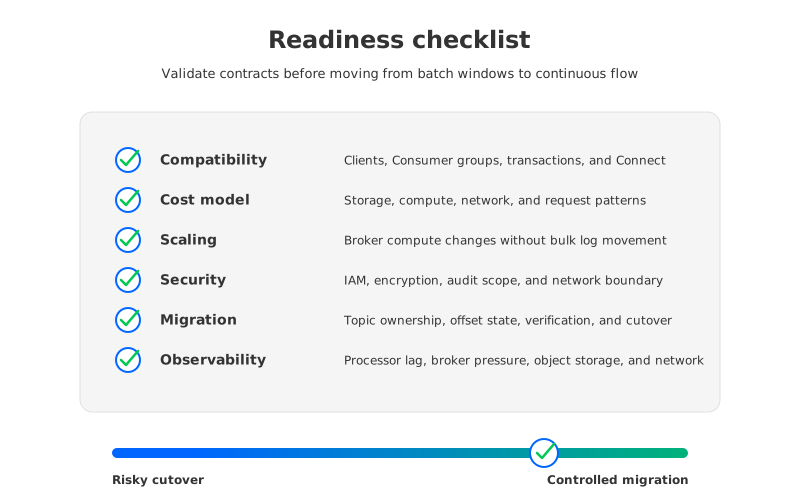
The move from batch windows to continuous flow should feel less like a big-bang rewrite and more like a series of reversible cuts. The scorecard below is designed for that planning meeting: platform, SRE, data engineering, and application teams in the same room, each forced to name their failure mode before the migration starts.
| Readiness item | Green signal | Red signal |
|---|---|---|
| Topic ownership | Producers, consumers, schemas, and retention owners are documented | Several engines write or transform data without a clear owner |
| Offset migration | Consumer group state and replay points are testable | Rollback depends on informal team memory |
| Backfill safety | Historical reads are load-tested away from hot-path assumptions | A large replay can starve tailing consumers |
| Cost visibility | Storage, network, broker compute, and object storage requests are measured separately | The bill is reviewed after incidents rather than before design |
| Security boundary | IAM, network paths, encryption, and audit scope are mapped | The data plane boundary is inferred from diagrams |
| Observability | Processor metrics and substrate metrics are correlated | Lag is treated as one number with many possible causes |
The scorecard is intentionally strict. A multi-engine platform gives teams more freedom, and that freedom has to be paid for with clearer contracts. Kafka offsets need owners. Backfills need budgets. Table outputs need governance. Object storage needs observability. A cloud-native Kafka-compatible substrate can reduce the storage coupling underneath these problems, but it does not remove the need for engineering discipline above it.
The original search phrase, multi engine stream processing kafka, is awkward because the problem itself is awkward. It sits between Kafka operations, stream processing, lakehouse architecture, and cloud cost control. If your current batch window is being squeezed by real-time requirements, the next step is to evaluate the substrate before adding yet another engine to the graph. To explore a Kafka-compatible Shared Storage architecture for that substrate, start with the AutoMQ deployment path.
7FAQ
7.1Is multi-engine stream processing the same as running several Kafka consumers?
No. Several consumers can share topics through Kafka Consumer groups, but multi-engine processing adds different execution models, state management patterns, checkpoint behavior, and backfill requirements. The platform has to support those differences without turning every engine into a separate streaming silo.
7.2Do teams still need Flink or Spark with AutoMQ?
Yes. AutoMQ is the Kafka-compatible streaming substrate, not a replacement for every processing engine. Flink, Spark, Kafka Streams, Connect, and table-oriented workflows still have their own roles. AutoMQ changes the storage and operating model underneath those workloads.
7.3Where does Tiered Storage fit in this decision?
Tiered Storage can help extend retention by moving older Kafka log data to remote storage. It does not make brokers fully stateless, and it does not remove every local storage responsibility. Teams should compare it with Shared Storage architecture based on retention, reassignment, recovery, and backfill behavior.
7.4What should be validated before migration?
Validate client compatibility, producer semantics, Consumer group behavior, offset migration, backfill load, security boundaries, observability, and rollback. The migration is not complete until each engine can pause, replay, verify, and resume in a controlled way.


