
Table of Contents
Table of Contents
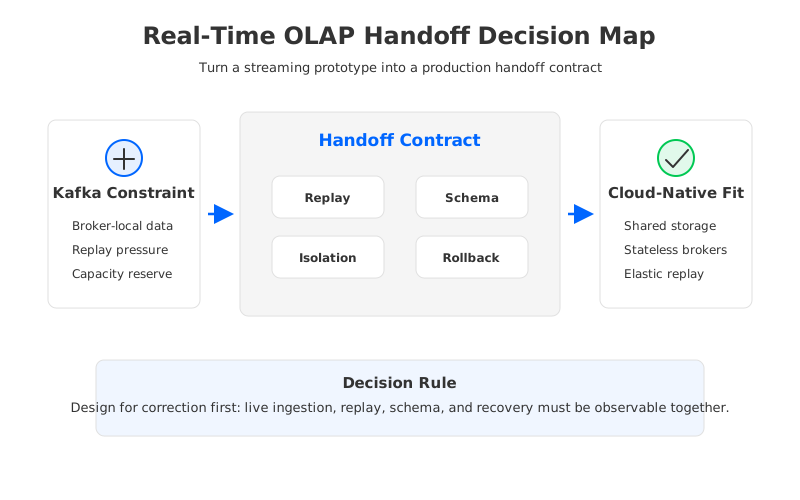
Teams do not search for real time olap handoff kafka because they want another definition of streaming. They search for it when the nightly batch window has stopped matching the business clock, but the production system still needs the safety properties that batch used to provide: replay, validation, schema control, backfill, and a clear place to recover from bad data. Kafka can move events continuously, and real-time OLAP systems can serve fresh queries, but the hard part is the handoff between them. The useful architecture question is not "Kafka or OLAP?" It is "what contract lets Kafka feed OLAP continuously without turning every ingestion spike, replay, or schema change into an incident?"
That contract matters because real-time OLAP sits on a different side of the system boundary than stream processing. Stream processors usually make decisions or produce derived streams as events arrive. Real-time OLAP systems materialize data for dashboards, drill-downs, operational analytics, alert investigations, and customer-facing metrics. The handoff has to preserve enough event history for correction while protecting the OLAP serving layer from unbounded upstream behavior. If that boundary is vague, the first large replay teaches the lesson in the least pleasant way.
1Why teams search for real time olap handoff kafka
The search usually starts with a familiar pressure pattern. A data platform team has Kafka topics that already carry production events, and an analytics team wants fresher data in Pinot, ClickHouse, Apache Doris, StarRocks, or another low-latency analytical engine. The first prototype is often straightforward: connect a topic, map fields, ingest records, and show a dashboard. The prototype proves that the data can move. Production proves that movement is not the same as an operating model.
The gap appears in the cases that prototypes avoid. A producer emits a malformed field long enough to pollute an important dashboard. A dashboard needs an additional dimension that was not part of the original materialization. A topic retention policy is shorter than the investigation window. A large consumer group rewind competes with live ingestion. A broker replacement triggers data movement at the same time that the OLAP cluster is already catching up. None of these events are exotic. They are normal consequences of using Kafka as the durable event backbone for an analytical serving path.
A useful handoff design answers six questions before the first production dashboard depends on it:
These questions turn a technology selection into an architecture decision. Kafka-compatible streaming platforms, connectors, stream processors, lakehouse table formats, and OLAP databases can all be valid parts of the system. The production risk is in assuming that one component removes the need for the contract between them.
2The production constraint behind the problem
Traditional Kafka was designed around a Shared Nothing architecture. Each broker owns local storage, partitions are tied to broker disks, and durability comes from replication between leader and follower replicas. That model is proven, but it converts analytical handoff pressure into broker-local pressure. When the OLAP side needs a large replay, the Kafka side must serve historical reads from the same cluster that is still accepting live writes. When the platform scales out or replaces brokers, partition reassignment can require data movement. When replicas span Availability Zones, replication can add network cost and operational noise.
The OLAP handoff amplifies those constraints because analytical consumers are not always polite consumers. A dashboard recovery may rewind many partitions. An additional materialized table may scan a long historical window. A failed ingestion job may restart with aggressive parallelism. Kafka's consumer group and offset model gives teams the tools to manage this, but the underlying storage model still determines how painful the operation becomes. Offsets describe where a consumer is in the log; they do not remove the cost of serving the bytes behind those offsets.
Apache Kafka features such as idempotent producers, transactions, Kafka Connect, KRaft, and Tiered Storage are important parts of the toolset. They help teams build stronger ingestion pipelines, remove ZooKeeper from the metadata quorum, and offload older log segments to remote storage. The distinction is that Tiered Storage is still a tiered model: local storage remains part of the active write and serving path, while remote storage extends retention economics. That can be useful, but it does not make brokers stateless or eliminate every scaling and reassignment concern.
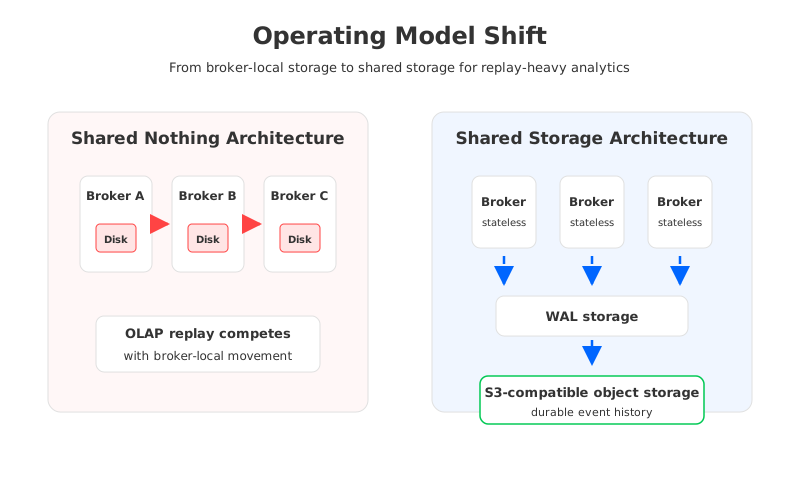
For OLAP handoff, the deeper question is whether the streaming backbone can make replay and scale events routine. If every materialization rebuild has to be negotiated with broker disk capacity, partition placement, and cross-zone movement, teams will limit the analytical use cases they allow. The platform may still be called real time, but its operating model remains batch-like: heavy changes are scheduled, guarded, and delayed because the storage layer is hard to move.
3Architecture options and trade-offs
There is no single correct architecture for every real-time OLAP handoff. A small operational dashboard with modest retention can run through Kafka Connect into an OLAP table with little extra machinery. A regulated data platform with multiple domains, long replay windows, and customer-facing analytics needs stronger contracts around schema, lineage, isolation, and rollback. The practical evaluation starts by separating the serving path from the durable event path.
| Option | Where it fits | Main trade-off |
|---|---|---|
| Direct Kafka-to-OLAP ingestion | Simple dashboards, stable schemas, moderate replay volume | Minimal moving parts, but replay and schema mistakes hit the OLAP engine directly |
| Stream processor before OLAP | Enrichment, deduplication, joins, windowed aggregates, data quality gates | Better control over output contracts, with more state and job lifecycle to operate |
| Kafka Connect or sink connectors | Standardized delivery into databases, warehouses, and search systems | Good ecosystem fit, but connector behavior must be tested for retries, ordering, and offset handling |
| Table format handoff | Lakehouse serving, Iceberg-based governance, multi-engine analytics | Stronger long-term data management, with catalog and compaction responsibilities |
| Kafka-compatible shared storage backbone | Large replay windows, elastic workloads, broker replacement, long retention | Changes the platform foundation, so migration and compatibility validation matter |
The table is intentionally neutral. A platform team can combine these patterns: Kafka for the event log, Flink for transformation, a connector for delivery, a table format for lakehouse governance, and OLAP for serving. The mistake is to evaluate each component as if it were isolated. The handoff fails at the boundaries: offset ownership between connector and processor, schema ownership between producer and table, replay ownership between Kafka and OLAP, and operational ownership between the platform and analytics teams.
A strong design also distinguishes live ingestion from corrective ingestion. Live ingestion optimizes for steady freshness and predictable resource use. Corrective ingestion optimizes for controlled replay, validation, and rollback. Treating both as the same pipeline creates awkward choices: throttle replays and accept slow recovery, or run replays fast and risk starving the live path. A production handoff needs separate policies even when both flows read from the same Kafka topics.
4Evaluation checklist for platform teams
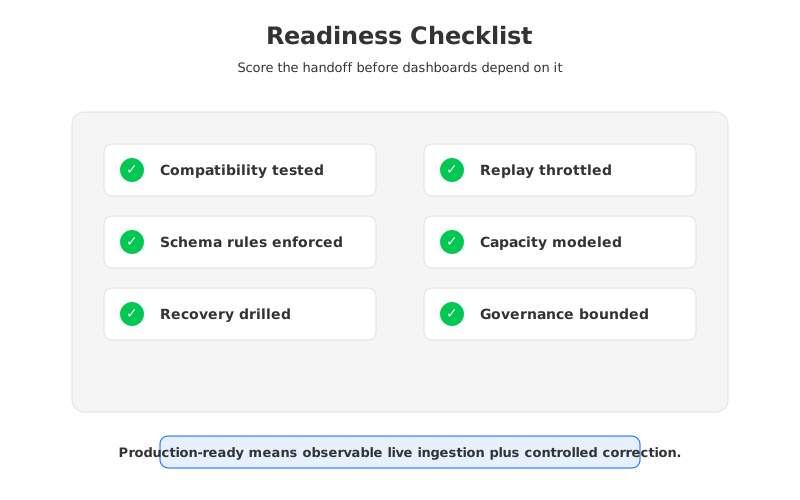
Before choosing a platform or declaring the design ready, test it against the failure modes that the system will eventually see. The goal is not to add process for its own sake. It is to find the places where a missing contract will become an outage.
The checklist changes the conversation from "can we stream into OLAP?" to "can we recover the serving layer without destabilizing the event backbone?" That is the right bar for production. A real-time dashboard is only useful if the path behind it can survive correction.
5How AutoMQ changes the operating model
After the neutral checklist, the architecture requirement becomes clearer: the streaming backbone should preserve Kafka semantics while reducing the operational coupling between brokers and persistent data. AutoMQ fits this category as a Kafka-compatible streaming platform built around Shared Storage architecture. It keeps the Kafka protocol and ecosystem surface while moving persistent data from broker-local disks to S3-compatible object storage through S3Stream and WAL storage.
That shift matters for real-time OLAP handoff because broker replacement, scaling, and replay pressure become less tied to local disk ownership. AutoMQ Brokers are stateless in the storage sense: persistent data is stored in shared object storage, while brokers handle Kafka protocol processing, partition leadership, caching, and scheduling. WAL storage provides the durable write buffer, and object storage becomes the main data layer. The result is not that OLAP ingestion becomes effortless. The result is that the platform has a better base for elastic replay, longer retention, and predictable recovery.
This is also where deployment boundaries matter. AutoMQ BYOC runs the control plane and data plane inside the customer's cloud account and VPC, while AutoMQ Software targets private data centers. For teams evaluating real-time analytics on sensitive data, that boundary can be as important as the storage design. The handoff may involve customer events, operational telemetry, and business metrics that should stay under customer-controlled networking, identity, storage, and audit policies.
AutoMQ's Table Topic extends the same architectural direction into lakehouse-style handoff by writing streaming data into Apache Iceberg tables. It does not replace every stream processor or every OLAP engine. It gives teams another path when the desired serving contract is closer to open table storage, catalog governance, and multi-engine analysis than to a single OLAP sink. The decision point is the same: start from the output contract, then choose the path that makes replay, governance, and recovery explicit.
The most useful way to evaluate AutoMQ for this use case is to run a proof of concept around operational events rather than only happy-path throughput. Create a representative topic, attach the intended connector or ingestion job, run live writes, trigger a controlled rewind, rebuild one serving table, and scale the streaming layer while measuring freshness and lag. If the platform can keep the handoff understandable during that test, it is much closer to production than a demo that only shows a fast dashboard.
6A readiness scorecard you can use
Give each item a score from 0 to 2: 0 means undefined, 1 means partially defined or manually operated, and 2 means documented, tested, and observable. A score below 10 does not mean the project should stop. It means the handoff is still closer to an experiment than a production serving path.
| Dimension | 0 | 1 | 2 |
|---|---|---|---|
| Source-of-truth contract | OLAP table treated as authoritative | Kafka log exists but rebuild policy is unclear | Kafka log is authoritative and serving tables are rebuildable |
| Replay control | Anyone can rewind or restart freely | Manual approval with limited throttling | Replay windows, priorities, and isolation are enforced |
| Schema evolution | Producer changes flow through unreviewed | Compatibility rules exist but are uneven | Schema rules, validation, and rollback are tested |
| Capacity model | Live and replay traffic share one informal budget | Basic sizing exists for steady state | Live, replay, retention, and backfill capacity are modeled separately |
| Failure recovery | Recovery depends on individual operators | Runbooks exist for common failures | Recovery drills cover bad data, connector failure, and table rebuild |
| Governance | Access and retention are handled per tool | Central policies exist with gaps | Ownership, audit, retention, and deployment boundaries are explicit |
| Observability | Teams inspect each tool separately | Shared dashboards cover lag and errors | End-to-end freshness, lag, replay, and rejection signals are correlated |
The scorecard is deliberately plain. It forces the team to name the weak links. Most production risk in real-time OLAP handoff does not come from a single missing feature; it comes from a missing owner at the moment Kafka, the connector, the table, and the dashboard all behave correctly in isolation but incorrectly as a system.
If your Kafka-to-OLAP path is moving from a batch window to continuous flow, validate the handoff contract before you chase another sink setting. To test a Kafka-compatible shared storage foundation for this workload, start with the AutoMQ GitHub project and run a replay-focused proof of concept against your own ingestion pattern.
7FAQ
Is Kafka enough for real-time OLAP?
Kafka is the event backbone, not the analytical serving engine. It stores ordered event streams and supports replay through offsets and consumer groups. Real-time OLAP systems serve analytical queries over materialized data. The production design needs both the event contract and the serving contract.
Should the OLAP database read directly from Kafka?
Direct ingestion is reasonable when schemas are stable, replay volume is modest, and the OLAP engine can absorb ingestion spikes. Add a stream processor, connector policy, or table format layer when you need enrichment, validation, deduplication, replay isolation, or stronger governance.
How does Tiered Storage affect this design?
Tiered Storage can improve long-retention economics by offloading older Kafka log segments to remote storage. It does not by itself make brokers stateless, so teams still need to evaluate scaling, partition movement, local active data, and replay behavior.
Where does AutoMQ fit in the handoff?
AutoMQ fits at the Kafka-compatible streaming backbone layer. It is relevant when broker-local storage, long replay windows, scaling events, cross-zone traffic, and customer-controlled deployment boundaries are material parts of the real-time OLAP design.
What should a proof of concept measure?
Measure live ingestion freshness, controlled replay speed, connector or ingestion errors, rejected records, broker pressure, OLAP table rebuild time, and rollback behavior. A proof of concept that only measures steady-state dashboard latency misses the handoff risk.
8References
- Apache Kafka Documentation
- Apache Kafka KIP-405: Kafka Tiered Storage
- AutoMQ compatibility with Apache Kafka
- AutoMQ Shared Storage architecture comparison
- AutoMQ and Apache Kafka Tiered Storage
- AutoMQ Table Topic overview
- Apache Pinot ingestion documentation
- ClickHouse Kafka table engine documentation


