
Table of Contents
Table of Contents
Searches for serverless stream processing boundaries kafka usually come from teams that have already outgrown a neat batch schedule. The data lake wants fresher tables, the fraud model wants live features, the observability team wants longer replay, and the platform team is still being asked to make Kafka feel elastic without breaking the applications that depend on it. The hard part is not deciding whether stream processing should become more continuous. The hard part is deciding which operational responsibilities can move to a serverless or cloud-native layer while the Kafka contract remains stable.
That contract is more than a bootstrap address. It includes partitions, offsets, Consumer groups, transaction behavior, client compatibility, schema flows, retention expectations, and the failure modes that SREs have learned to operate. A serverless processing boundary that ignores those details can make dashboards look cleaner while moving risk into cutover, replay, or governance. A good boundary reduces operational work without hiding the state that still matters.
1Why Teams Search for serverless stream processing boundaries kafka
The phrase sounds awkward because the problem is awkward. Teams are not asking a purely academic question about stream processing engines. They are asking where the line should sit between application logic, Kafka infrastructure, managed processing, object storage, lakehouse tables, and cloud-account ownership.
Three pressures usually arrive together:
- Freshness pressure. Batch windows become too coarse when downstream systems expect minute-level or second-level updates. The team starts looking at Flink jobs, streaming SQL, Kafka Streams, or managed serverless processors.
- Elasticity pressure. Traffic no longer follows the provisioned shape of the Kafka cluster. Peaks, replays, backfills, and seasonal workloads make fixed broker capacity expensive to defend.
- Governance pressure. Security teams still need clear answers about where records live, which VPC handles traffic, who owns IAM permissions, and how audit trails are retained.
Those pressures point in different directions. Freshness invites more managed processing. Elasticity invites compute that can scale independently. Governance pushes the team to keep ownership boundaries explicit. This is why the right question is not "Should we go serverless?" It is "Which boundary can become more elastic without weakening data ownership, offset continuity, or recovery?"
2The Production Constraint Behind the Problem
Traditional Kafka deployments are built around Shared Nothing architecture: each broker owns local storage, and partition replicas are distributed across brokers for durability and availability. That design is coherent, and it remains a strong default for many workloads. But it also means that storage, compute, recovery, and capacity planning are tied to broker lifecycle.
When retained data grows, broker disks grow. When a broker fails, the cluster must restore service while respecting partition leadership and replication state. When capacity changes, the platform team has to think about data movement, rebalancing, rack or Availability Zone placement, and the cost of network paths. Tiered Storage can reduce local retention pressure by moving older segments to object storage, but it does not make brokers stateless. Recent data, leadership, and operational balancing still depend on the local broker model.
That coupling is what makes serverless boundaries difficult. A stream processing job may scale independently, but it still reads from partitions and commits offsets. A lakehouse sink may write continuously, but it still depends on replay semantics when the writer restarts. A managed service may hide workers, but the platform team still owns the answer to "Can we recover this pipeline from the last known good offset?"
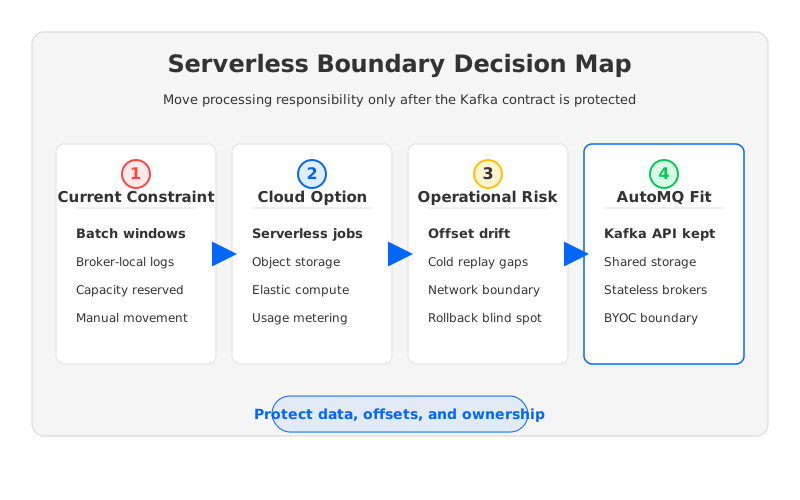
The decision map above is intentionally conservative. It treats serverless processing as a possible boundary change, not a magic eraser. Before moving responsibility to a cloud-native layer, the team has to preserve the Kafka-facing guarantees that users notice when they break: records are still ordered per partition, offsets remain meaningful, replays are predictable, and ownership of the data plane is documented.
3Architecture Options and Trade-Offs
There are several legitimate ways to draw the boundary. A platform team can keep Kafka provisioned and move only the processing layer to a serverless engine. It can use a managed Kafka service and accept the provider's deployment boundary. It can keep Kafka self-managed but add Tiered Storage for older data. It can also evaluate Kafka-compatible systems that keep the Kafka API while changing the storage architecture underneath.
The useful comparison is not a vendor list. It is an operating model comparison:
| Option | What becomes elastic | What remains sensitive | Best fit |
|---|---|---|---|
| Provisioned Kafka plus serverless processing | Processing workers and job execution | Broker storage, rebalancing, retained data, network paths | Teams with stable Kafka clusters and bursty compute |
| Managed Kafka plus managed processing | Service operations and some capacity planning | Data-plane boundary, pricing model, feature compatibility | Teams prioritizing managed operations |
| Kafka with Tiered Storage | Historical retention storage | Broker-local recent data, hot partitions, recovery model | Teams with long retention but stable broker sizing |
| Kafka-compatible shared storage | Broker compute, storage growth, and reassignment model | Object storage path, WAL choice, cache behavior, migration testing | Teams whose main pain is storage-coupled operations |
The table shows a pattern that gets lost in high-level "serverless" discussions. Processing elasticity and storage elasticity are different problems. A serverless job can remove worker management, but it does not remove the need to reason about Kafka offsets, retained data, and replay. A storage-decoupled Kafka architecture can make broker capacity more elastic, but the team still needs to test object storage behavior, WAL storage, cache warm-up, and workload-specific latency.
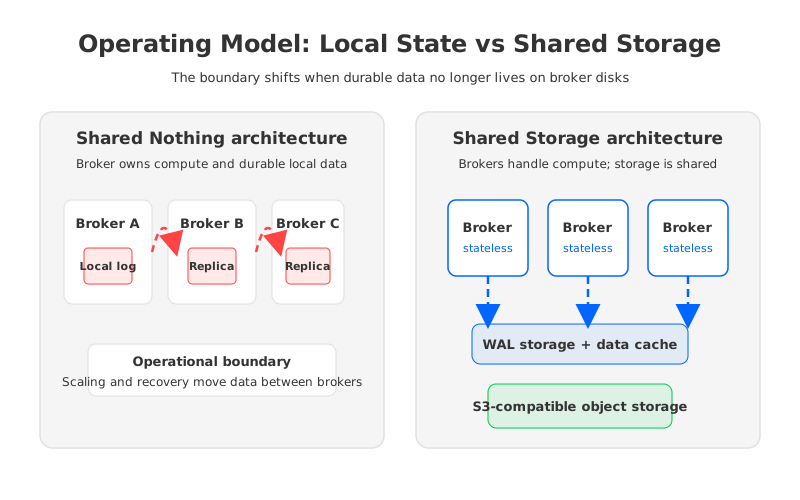
This distinction matters most during failure and migration. In a broker-local model, scaling and recovery often involve moving data or waiting for replicas to catch up. In a Shared Storage architecture, durable data is placed in shared object storage, while brokers focus on compute, protocol handling, caching, and leadership. The boundary shifts from "Which broker owns the data?" to "Which broker currently serves the partition, and how does it reach durable storage?"
4Evaluation Checklist for Platform Teams
A serious evaluation starts with compatibility because compatibility is where hidden work appears. Kafka clients are not all the same; teams depend on producer idempotence, transactions, offset commits, Consumer group rebalancing, connector behavior, schema workflows, and monitoring conventions. The Apache Kafka documentation is the baseline for these concepts, but production compatibility has to be tested against the client versions and patterns your organization actually runs.
Use this checklist before committing to a serverless or shared-storage boundary:
- Compatibility: Validate producer, consumer, transaction, connector, and schema behavior with representative workloads. Do not limit the test to a happy-path produce and consume script.
- Cost model: Model compute, storage, retention, replay, inter-zone networking, private connectivity, support, and migration time together. Cloud pricing pages separate many of these items; your architecture does not.
- Scaling path: Decide whether traffic peaks require scaling processors, brokers, storage, or all three. A boundary that scales the wrong layer will still leave the team manually clearing hot spots.
- Governance boundary: Document the data plane, VPC, IAM permissions, encryption model, audit logging, and operational access path. Serverless does not remove compliance questions; it changes where they are asked.
- Failure recovery: Rehearse broker loss, processor restart, object storage impairment, delayed consumers, and large replay. A design is not production-ready until the recovery path is boring.
- Migration and rollback: Keep cutover, offset continuity, dual-run validation, and rollback as first-class requirements. The risky part of migration is often the last 5% of traffic.
- Observability: Make lag, throughput, cold reads, object storage requests, WAL health, processor failures, and consumer progress visible in one operational story.
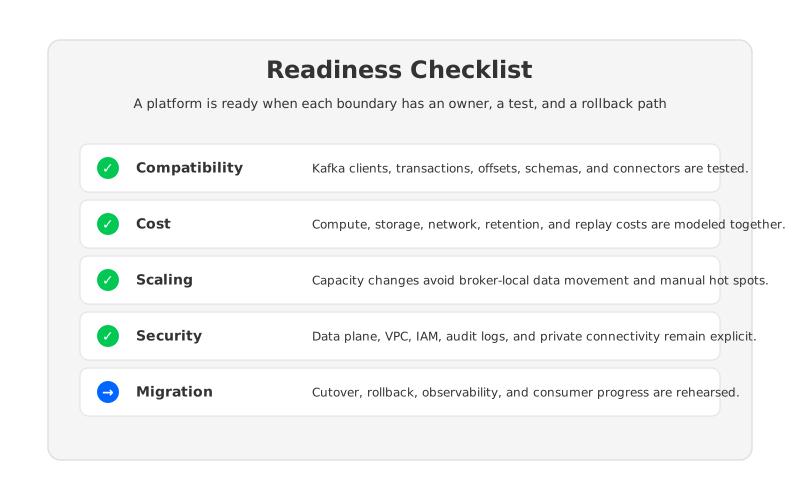
The checklist is strict because the term "serverless" can make ownership sound optional. It is not. The team may stop operating a worker fleet, but somebody still owns data freshness, durability, replay, cost, and access control.
5How AutoMQ Changes the Operating Model
Once the neutral evaluation is complete, AutoMQ fits into a specific category: Kafka-compatible streaming infrastructure with Shared Storage architecture. It keeps the Kafka-facing API and protocol contract while replacing broker-local durable log storage with S3Stream, WAL storage, data caching, and S3-compatible object storage. In practical terms, AutoMQ is not a serverless stream processing engine. It is a Kafka-compatible foundation that can make the infrastructure underneath continuous processing less stateful at the broker layer.
That difference is important. If your main problem is writing SQL over streams, you still need a processing engine. If your main problem is that every freshness, replay, and retention requirement turns into more broker-local storage and slower rebalancing, the storage architecture deserves attention. AutoMQ's stateless brokers are designed so broker replacement, scaling, and partition reassignment do not require the same kind of broker-to-broker data movement as traditional Kafka.
AutoMQ also gives platform teams a cleaner way to discuss deployment boundaries. AutoMQ BYOC runs control plane and data plane components in the customer's cloud account and VPC, which matters when regulated data, private networking, and IAM review are part of the decision. AutoMQ Software targets private data center deployments. AutoMQ Open Source uses S3 WAL and S3-compatible storage for teams that want to validate the architecture in a self-managed form. These deployment choices do not remove architecture review, but they make the ownership boundary explicit instead of treating it as an afterthought.
For stream processing teams, the more interesting implication is how infrastructure decisions affect continuous flow. A Flink job, Kafka Streams application, connector, or lakehouse writer still interacts with Kafka topics, partitions, and offsets. With a shared-storage Kafka-compatible layer underneath, the platform team can separate several concerns that were previously tangled together: broker compute can scale around traffic, retained data can live in object storage, and long-running consumers can be evaluated against cache and catch-up read behavior rather than broker disk placement alone.
Table Topic extends that idea for teams turning streams into lakehouse tables. Instead of treating Kafka as a transient queue before a separate ingestion pipeline, the platform can evaluate whether selected topics should materialize directly into Apache Iceberg tables. That does not make every pipeline table-native, and it should not bypass schema discipline. It does create another boundary option for teams moving from batch windows toward continuous lakehouse updates.
The safest way to evaluate AutoMQ is to bring your hardest boundary questions into the proof of concept:
- Choose one workload with strict freshness requirements and one workload with painful replay or retention.
- Test the exact client versions, connector paths, schemas, and Consumer group behavior you run in production.
- Measure operational behavior during scaling, broker replacement, and catch-up reads, not only steady-state throughput.
- Confirm who owns the data plane, object storage bucket, IAM policy, network path, and audit trail.
- Rehearse migration and rollback with offset continuity as a release gate.
That sequence keeps the evaluation grounded. AutoMQ is most relevant when the platform problem is not "we need a serverless button," but "we need Kafka-compatible continuous flow without binding every operational decision to broker-local durable storage."
6FAQ
6.1Is serverless stream processing the same as serverless Kafka?
No. Serverless stream processing usually refers to managed or elastic execution of processing jobs. Serverless Kafka, managed Kafka, and Kafka-compatible shared storage are infrastructure choices. They can work together, but each changes a different boundary.
6.2Does Tiered Storage solve the same problem as Shared Storage architecture?
Not completely. Tiered Storage offloads older log segments to object storage while retaining the broker-local model for recent data and broker operations. Shared Storage architecture moves the durable storage premise itself, so brokers can become more stateless.
6.3When should AutoMQ enter the evaluation?
Evaluate AutoMQ when Kafka compatibility matters and the operational pain is tied to broker-local storage, retained data growth, slow reassignment, replay-heavy workloads, or customer-controlled deployment boundaries. It should be tested alongside your processing engine, not confused with the processing engine.
6.4What should be tested before production migration?
Test compatibility, offset continuity, producer and consumer behavior, connector paths, schema handling, scaling, observability, cutover, and rollback. A migration plan that only tests data copy is incomplete.
7Closing Boundary
The search starts with serverless stream processing, but the production decision ends with boundaries: where data lives, who owns recovery, how offsets survive cutover, and which layer scales when traffic changes. If your current Kafka estate is blocking continuous flow because broker compute and durable storage are too tightly coupled, evaluate a Kafka-compatible shared-storage model with the same discipline you would apply to any production migration.
For a hands-on next step, review AutoMQ's architecture and run a BYOC-oriented evaluation with your own workload shape through AutoMQ Cloud.


