
Table of Contents
Table of Contents
Your Kafka estate probably did not begin as a platform. It began as an event bus: a reliable place for services to publish domain events and avoid another point-to-point interface. That works while the number of teams is small and the goal is delivery. The pressure changes when Kafka becomes the data path for analytics, fraud decisions, AI context refresh, CDC fan-out, and replay-based recovery. At that point, teams stop asking whether events can move. They ask whether the organization can operate streaming as a shared product.
That is why searches for an event bus to streaming platform roadmap tend to appear after Kafka is already successful. The cluster is valuable enough that many teams depend on it, but the operating model still reflects its first use case. Topics exist without clear owners, retention periods encode old assumptions, and consumer lag is investigated during incidents rather than managed as a platform SLO. Storage and network costs rise as replay and fan-out increase. A roadmap has to fix the system around Kafka, not replace one cluster with another and hope the platform problem disappears.
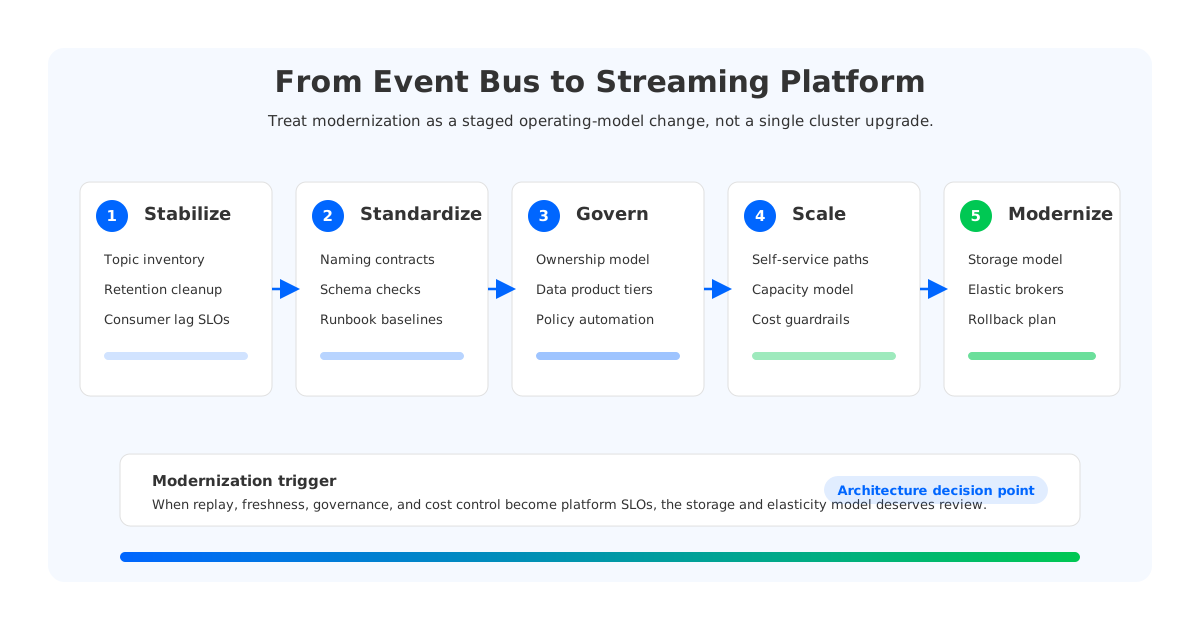
The useful framing is maturity, not migration. A mature streaming platform gives application teams a governed way to create, publish, consume, replay, and retire event streams. It gives platform teams a way to plan capacity, cost, reliability, and change without becoming a ticket queue. This roadmap starts with operating disciplines, then evaluates architecture options when storage, elasticity, and deployment boundaries become limiting factors.
1The Shift From Event Bus to Streaming Platform
An event bus is optimized for connectivity. Producers publish events, consumers react, and the organization gets looser coupling than synchronous APIs alone can provide. A streaming platform has a wider contract. It must preserve data products, support replay, make schemas and ownership visible, and let multiple teams build real-time systems without negotiating every detail with a central Kafka administrator.
The difference shows up in the questions platform teams hear:
- Can a team replay six months of events without disturbing production consumers?
- Which schema change broke a downstream model, and who approved it?
- How much headroom exists for a seasonal traffic spike, and who pays for idle capacity?
- Can a regulated topic be retained, replicated, and deleted according to policy?
- If the platform changes underneath clients, what is the rollback path?
Those are platform questions. Kafka's protocol, consumer groups, offsets, transactions, and log abstraction provide a strong foundation, but a foundation is not an operating model. The roadmap has to add standards, governance, self-service, cost accountability, and a storage review once the workload moves to long-lived, multi-tenant streaming data.
2Phase 1: Stabilize the Existing Estate
The first phase is deliberately unglamorous. Before a team can modernize the platform, it needs to know what it already runs. Kafka environments accumulate topics through launches, incident workarounds, and ownership changes. Some topics carry production-critical traffic with no documented owner. Others retain data for processes that no longer exist. Stabilization turns that hidden estate into inventory.
Start with topic hygiene. Record owner, business purpose, producer systems, consumer groups, retention, partition count, schema subject, and sensitivity class. The goal is not a perfect catalog on day one. The goal is to make operational risk searchable. A topic with unknown ownership and long retention is no longer an invisible liability; it becomes a work item.
Consumer lag deserves the same treatment. Event bus teams often treat lag as an incident symptom. Platform teams define lag expectations per workload class. A fraud decision stream and a nightly warehouse sink should not share the same alert threshold. Freshness SLOs turn lag from a raw metric into a product contract.
Stabilization also needs runbooks that reflect failure behavior. What happens when a broker fails, a disk fills, a consumer group stalls, or a topic needs emergency retention reduction? The first version can be simple, but it must include owners, commands, expected blast radius, and escalation paths. A platform that relies on oral tradition will eventually page the wrong person.
3Phase 2: Standardize Contracts Before Scaling Access
Self-service is dangerous when the underlying conventions are unclear. If every team creates topics with different naming, retention, partitioning, and schema practices, the platform becomes faster at producing inconsistency. Standardization gives teams guardrails before access expands.
A practical standardization layer includes:
- Topic naming rules that encode domain, environment, data class, and lifecycle state.
- Schema compatibility rules that match the consumer contract, not a generic default.
- Retention tiers for transient integration, operational replay, audit, and analytical backfill.
- Producer and consumer defaults for idempotence, retries, compression, and error handling.
- Runbook templates for ownership transfer, deprecation, reprocessing, and incident response.
The standards should be opinionated enough to prevent recurring mistakes, but flexible enough to support legitimate workload differences. A compact operational table often works better than a long policy document because developers can use it during design review.
| Platform area | Event bus habit | Streaming platform standard |
|---|---|---|
| Topic ownership | Created by the project that needed it | Owned as a data product with lifecycle and escalation |
| Retention | Chosen once during launch | Selected from reviewed tiers and revisited when use cases change |
| Schema evolution | Producer-controlled | Compatibility policy tied to downstream consumer impact |
| Capacity | Broker headroom managed centrally | Workload class, throughput, replay, and storage growth modeled together |
| Incidents | Cluster-centric response | Tenant-aware response with freshness and replay impact |
4Phase 3: Govern Streams as Data Products
Governance is often introduced too late, after the first compliance audit or painful downstream break. In a streaming platform, governance has to be close to the creation path. A topic is not a pipe. It is a continuously updated data product with producers, consumers, quality expectations, access controls, retention behavior, and a retirement plan.
Schema governance is the most visible starting point, but it is not the whole job. Platform teams also need ownership, access, lifecycle, and cost governance. A schema may be compatible while the topic is still unmanaged. A topic may have a clear owner while the retention policy still creates unnecessary storage growth. Governance becomes useful when these dimensions are visible together.
The operating model should make the healthy path the default. Developers should be able to request a stream, select a data class, choose a retention tier, register schema policy, and receive a production-ready topic without a long back-and-forth. Human review should focus on unusual risk: sensitive data, high replay needs, extreme fan-out, or cross-region replication.
5Phase 4: Scale With Self-Service, SLOs, and Cost Guardrails
Once standards and governance exist, platform teams can safely widen access. This is where Kafka stops being a specialist-operated cluster and becomes a product surface for the organization. The platform should expose approved templates, APIs, Terraform modules, dashboards, and runbook links. The goal is not to hide Kafka from engineers; it is to remove repetitive operational negotiation.
Scaling access also changes the cost conversation. In the event bus phase, Kafka cost is often treated as a platform line item. In the streaming platform phase, costs should be attributable to workload choices: retention, replay depth, partition count, throughput, fan-out, network movement, and idle headroom. Cost guardrails should appear before the invoice surprises the organization.
A good capacity model ties technical choices to economic behavior:
- Write throughput drives broker, network, and durability requirements.
- Retention and replay depth drive storage growth and recovery expectations.
- Consumer fan-out changes read pressure and network paths.
- Partition count affects parallelism, metadata load, and rebalancing.
- Peak-to-average ratio determines idle capacity for bursts.
None of these factors is bad by itself. They become painful when no one can see the trade-off at design time. A mature platform gives teams the information to choose intentionally. Some streams deserve long retention and high freshness. Others should be short-lived integration events with strict cleanup.
6Phase 5: Revisit Storage and Elasticity
Architecture review belongs after the operating model is understood. If a team skips directly to a new deployment architecture, it may carry the same ownership, governance, and lifecycle problems into a different system. Once the platform disciplines are in place, the Kafka storage model deserves a hard look.
Traditional Kafka keeps durable log segments on broker-local storage. That design is proven and widely understood. It also means brokers carry two responsibilities at once: serving compute and owning local durable data placement. When Kafka becomes a shared platform with long retention, large replay windows, uneven tenant growth, and frequent scaling pressure, that coupling shapes every operational decision.
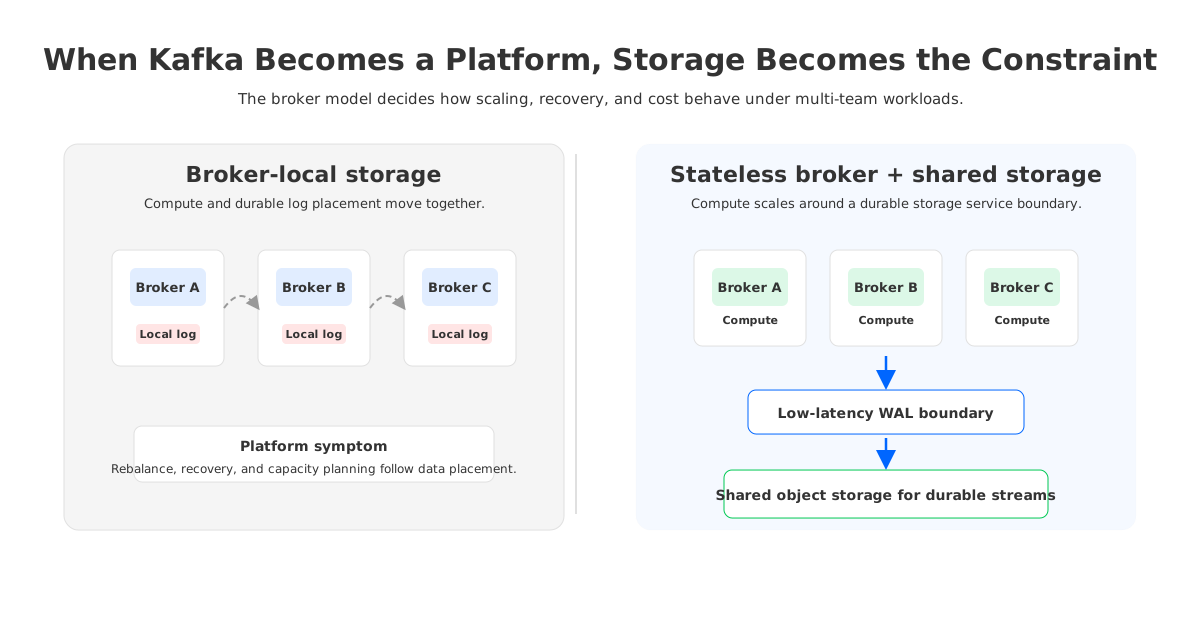
Broker-local storage can make scaling slower because data movement follows broker movement. Recovery may involve re-replication or rebalancing work, and cost planning gets harder when storage growth and compute headroom are purchased together. Tiered storage can reduce pressure by offloading older segments, and for many teams that is a reasonable step. The key question is whether the hot operational path still depends on brokers acting as durable storage owners.
Shared-storage Kafka-compatible architectures approach the problem from a different angle. Durable stream data lives in object storage or a storage service boundary, while brokers become closer to stateless compute. A write-ahead log absorbs low-latency writes before data is persisted into shared storage. This changes which operations are hard: scaling compute, replacing brokers, and planning retention can become less tied to local disk movement, while the platform team evaluates storage durability, write-path latency, metadata behavior, and cloud deployment boundaries.
This is where AutoMQ becomes relevant as one option in the modernization path. AutoMQ is a Kafka-compatible, cloud-native streaming platform that separates Kafka compute from durable stream storage through a shared-storage architecture. It is designed around stateless brokers, object storage, and a customer-controlled deployment boundary, including BYOC patterns. The right evaluation is not "replace Kafka because a roadmap says so." It is "test whether a Kafka-compatible shared-storage model removes the constraints our platform review has identified."
7Migration and Rollback Should Be Designed Together
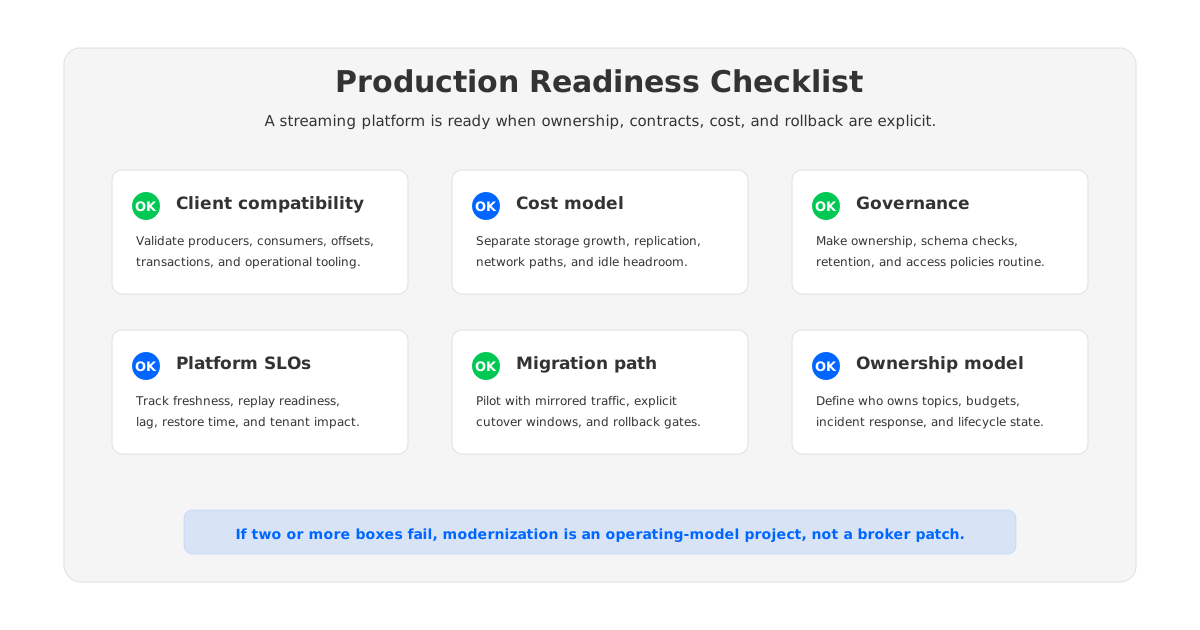
The safest modernization plans treat migration and rollback as one design problem. A platform team should know how producers move, how consumers validate offsets, how schemas are governed, how dual-write risk is controlled, and how the old path remains recoverable. The plan should be boring on purpose. Surprise is a poor migration strategy.
Start with a workload that has clear owners, measurable freshness expectations, and manageable downstream blast radius. Mirror traffic where possible. Compare consumer behavior, latency, lag recovery, dashboards, and cost shape under realistic retention. Do not declare success after a produce-consume smoke test. Kafka compatibility has to be validated at the client, tooling, and failure-mode levels.
Rollback criteria should be explicit before the pilot begins. Which metric triggers a pause? Which consumer result means offsets are unsafe? How long will the old topic remain authoritative? Who decides that the platform can move from pilot to production tier? These questions are uncomfortable during planning and much worse during an incident.
8Decision Table for Platform Teams
The final decision is rarely binary. Many organizations should improve their existing Kafka estate before changing architecture. Others will discover that the operating model is sound but storage and elasticity are now the bottleneck.
| Current signal | Likely next move | What to validate |
|---|---|---|
| Unknown topic ownership and inconsistent retention | Stabilize and standardize first | Inventory completeness, owner coverage, lifecycle policy |
| Frequent incidents from consumer lag and unclear freshness impact | Define workload SLOs | Lag thresholds, replay expectations, tenant blast radius |
| Developers wait on a central team for routine topic work | Build self-service with guardrails | Templates, access controls, schema checks, runbook links |
| Storage growth and broker scaling dominate planning | Review storage architecture | Local disk coupling, tiering fit, shared-storage alternatives |
| Cloud cost grows faster than workload value | Add cost attribution | Retention tiers, fan-out, network paths, idle headroom |
| Migration risk blocks modernization | Pilot with rollback gates | Client compatibility, offset behavior, observability, fallback path |
The road from event bus to streaming platform is not a straight line. Some teams will loop back from cost review to retention policy. Others will discover that schema governance matters more than broker count. Each phase should reveal the next constraint with more precision.
If your Kafka environment is already carrying platform-level responsibilities, start by mapping the operating model rather than shopping for a replacement. Then test architecture changes against the constraints you can name. When broker-local storage and compute coupling become the constraint, evaluate Kafka-compatible shared-storage systems with the same discipline you apply to schemas, SLOs, and rollback. To explore that path, review the AutoMQ architecture documentation and pilot one workload with clear ownership, freshness, and rollback criteria.
9References
- Apache Kafka Documentation
- Apache Kafka KRaft Documentation
- Apache Kafka Tiered Storage Documentation
- AutoMQ Architecture Overview
- AutoMQ Difference with Apache Kafka
- AutoMQ WAL Storage Documentation
10FAQ
10.1What is the difference between an event bus and a streaming platform?
An event bus focuses on event delivery between systems. A streaming platform adds ownership, governance, replay, retention, freshness SLOs, self-service, cost attribution, and lifecycle management around those streams. Kafka can support both models, but the operating model has to mature as more teams depend on it.
10.2When should a Kafka team modernize architecture instead of improving operations?
Improve operations first when ownership, schema policy, retention, and runbooks are inconsistent. Review architecture when those disciplines exist and the remaining constraints come from storage growth, broker replacement, data movement, scaling speed, or cost coupling between compute and durable data.
10.3Does moving from event bus to streaming platform require replacing Kafka?
No. Many teams can make substantial progress by improving topic hygiene, governance, observability, and self-service around existing Kafka clusters. Architecture modernization becomes relevant when the platform needs elasticity, storage economics, or deployment boundaries that are difficult to achieve with the current broker-local model.
10.4How does AutoMQ fit into a streaming platform roadmap?
AutoMQ fits as a Kafka-compatible shared-storage option for teams evaluating stateless brokers, object-storage-backed durability, elastic capacity, and customer-controlled cloud deployment boundaries. It should be evaluated through a pilot that validates client compatibility, workload SLOs, cost behavior, observability, and rollback.
10.5What should be included in a first modernization pilot?
Choose a workload with clear owners, measurable freshness expectations, known consumers, manageable blast radius, and a documented rollback path. Validate producer behavior, consumer offsets, schema compatibility, lag recovery, operational dashboards, cost shape, and incident runbooks before expanding to a broader platform tier.


