
Table of Contents
Table of Contents
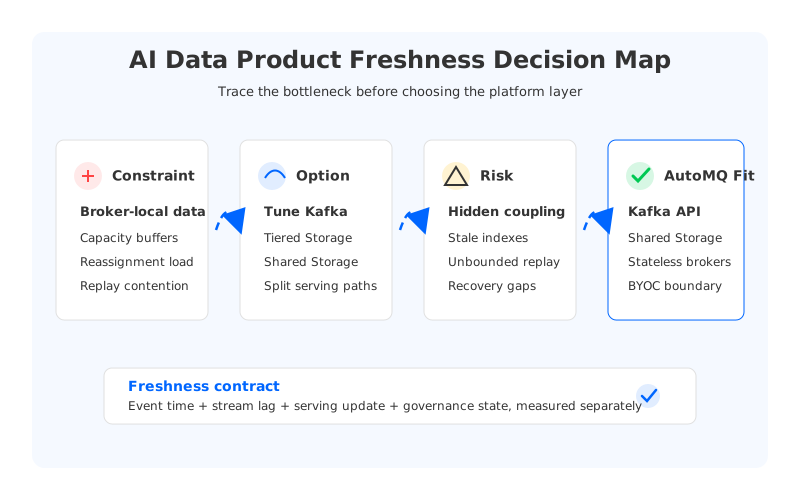
Teams searching for ai data product freshness kafka usually have a problem that is more specific than "make the pipeline real time." A recommendation model is acting on stale inventory. A support copilot is summarizing a customer state that changed 20 seconds ago. A fraud workflow is reading the right event stream but from the wrong point in time because consumer lag, feature refresh, and model-serving windows are measured by different teams. The question is not whether Kafka can move events quickly. The question is whether the data product built on top of Kafka can stay fresh when production traffic, retention, recovery, governance, and cost all push against the same infrastructure.
That distinction matters because AI systems turn freshness into user-visible behavior. Batch analytics can tolerate a delayed dashboard if the business accepts a slower decision loop. AI applications often cannot hide the delay: the answer, action, or ranking is produced while the user is still in the workflow. In that setting, data freshness is not a single metric. It is a chain of commitments from event capture through Kafka topics, consumer groups, state stores, online features, vector indexes, data lake tables, and model execution.
The useful architecture question is therefore narrower and harder: how should platform teams design a Kafka-compatible streaming backbone so AI data products can stay fresh without turning every new use case into a capacity-planning exercise?
1Why teams search for ai data product freshness kafka
The search phrase sounds like SEO language, but the intent behind it is practical. AI platform teams are trying to connect two operating models that developed separately. Kafka operators think in Topics, Partitions, Offsets, replication, retention, broker capacity, and Consumer group lag. AI product owners think in context age, feature availability, retrieval quality, model confidence, policy checks, and action latency. Both sides use the word "freshness," but they measure different parts of the path.
For a production AI data product, freshness has at least four layers. The first is event-time freshness: how long it takes a business event to enter the stream after it happens. The second is stream-processing freshness: how far downstream consumers are from the latest committed Offset. The third is serving freshness: how quickly a feature store, vector index, or online state service reflects the latest accepted event. The fourth is governance freshness: whether schema, consent, lineage, and policy metadata are updated quickly enough to make the AI action defensible.
Those layers are connected, but they are not identical. A Kafka topic can be healthy while the vector index is stale. A Consumer group can have low lag while a downstream enrichment service is falling behind because it waits on a rate-limited API. A lake table can be available for analytics while the online model still uses yesterday's feature snapshot. Good architecture keeps those boundaries visible instead of collapsing them into a single "real-time pipeline" label.
This is where Kafka remains a strong foundation. Apache Kafka gives teams durable event logs, partitioned ordering, Consumer groups, transactions, Kafka Connect, and broad client compatibility. Those primitives are still useful for AI systems because they make change observable and replayable. The risk appears when the storage and operations model underneath Kafka becomes the bottleneck that determines how quickly the AI layer can absorb new data.
2The production constraint behind the problem
Traditional Kafka is built around a Shared Nothing architecture. Each broker owns local storage, and each Partition has replicas placed across brokers for durability and availability. That model is battle-tested and conceptually clean. It also means that storage, compute, replication, failure recovery, and scaling are tied to broker-local data. When traffic grows, the platform team does not only add compute; it also changes where durable data lives.
For AI data products, that coupling shows up at exactly the wrong time. Freshness pressure is bursty. A product launch, fraud wave, support incident, marketplace event, or embedding backfill can create a temporary spike in writes, reads, and historical replay. A Shared Nothing Kafka cluster can handle many of those events, but the operational response often involves capacity buffers, reassignment planning, disk headroom, and broker-to-broker data movement. The infrastructure starts making product decisions: which AI use cases get fresher data, how much history can be replayed, and how quickly a new workload can be onboarded.
The issue is not that broker-local storage is flawed in every environment. It is that AI workloads amplify the parts of the model that are most expensive to operate in the cloud:
- Capacity has to be reserved before demand is proven. Freshness-sensitive workloads are hard to queue, so teams keep extra broker, disk, and network capacity available for bursts.
- Scaling can trigger data movement. Adding or replacing brokers may require Partition reassignment, and reassignment competes with foreground traffic.
- Multi-AZ durability creates network pressure. Replication across Availability Zones protects the log, but it can also make network cost and throughput part of the freshness budget.
- Replay is no longer a rare incident path. AI teams replay history to rebuild features, refresh indexes, test prompts, and audit decisions, so cold reads become a product workflow instead of a disaster-recovery exception.
These constraints explain why a technically "real-time" Kafka pipeline can still produce stale AI behavior. The platform may ingest quickly under normal load, but every unusual condition forces a trade-off between freshness, cost, recovery, and operational safety.
3Architecture options and trade-offs
There are several defensible ways to improve AI data product freshness with Kafka. The right answer depends on whether the bottleneck is inside Kafka, around Kafka, or downstream from Kafka. A useful evaluation starts by separating pipeline semantics from infrastructure mechanics.
| Architecture choice | What it helps | What to watch |
|---|---|---|
| Tune existing Kafka clusters | Improves producer batching, consumer fetch behavior, partition count, and lag monitoring. | Does not change broker-local storage, reassignment, or replication economics. |
| Add stream processing and serving SLAs | Makes feature, index, and policy freshness measurable beyond Kafka lag. | Can expose downstream bottlenecks that Kafka metrics alone did not show. |
| Use Tiered Storage | Moves older log segments to object storage while keeping recent data local. | Helps retention economics, but brokers still keep local active logs and operational state. |
| Adopt Shared Storage architecture | Moves durable streaming data to shared object storage and makes brokers closer to stateless compute. | Requires careful validation of latency, WAL design, compatibility, and failure recovery. |
| Split hot online and analytical paths | Lets AI serving and lake analytics use different freshness targets. | Adds governance and reconciliation work if the two paths drift. |
The table is intentionally neutral because no serious platform team should choose a streaming architecture from a feature list alone. If your main problem is an unbounded enrichment dependency, changing Kafka storage will not fix it. If your main problem is that broker operations slow down scaling and recovery, no amount of dashboard polish will remove the coupling. The important move is to name the constraint before naming the platform.
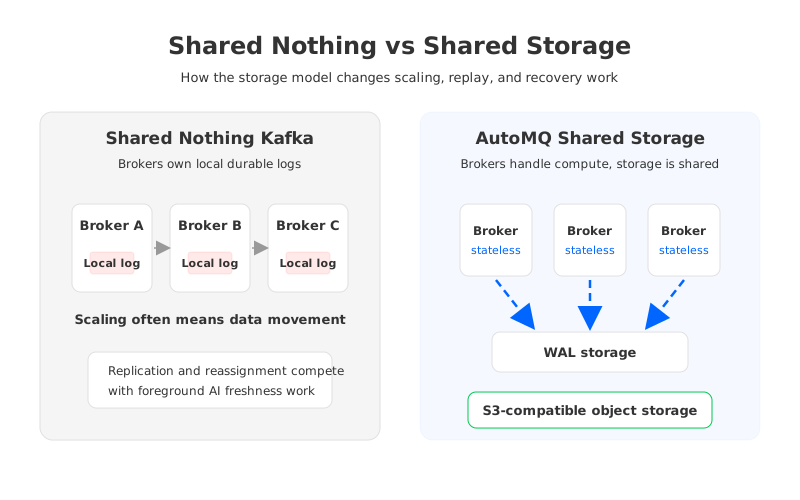
Tiered Storage deserves special attention because it is often confused with diskless or shared-storage Kafka. Apache Kafka's Tiered Storage moves older log segments to remote storage, which can reduce pressure from long retention. That is useful, especially for replay-heavy organizations. But the active write path and broker-local operational model remain materially different from a system where durable log storage is designed around shared object storage from the beginning.
That difference matters for AI freshness because the painful moments are often operational, not semantic. A team can define perfect freshness SLAs and still miss them if scaling requires cautious reassignment windows. A team can retain long history and still struggle if replay traffic interferes with hot serving traffic. A team can use the Kafka protocol correctly and still spend too much engineering time deciding which workload is allowed to consume broker headroom.
4Evaluation checklist for platform teams
The practical checklist starts with the data product, not the broker. Pick one AI workflow and trace the data path from event source to model action. For each hop, write down the freshness target, failure behavior, replay path, and owner. The exercise usually exposes disagreements that were hidden behind the phrase "real time."
Use this scorecard before comparing platforms:
The strongest teams make this checklist executable. They create a small representative workload, run it through normal traffic, backfill, failover, and rollback scenarios, and record where freshness degrades first. That gives architects a better signal than vendor benchmarks because it tests the exact friction that will govern their own AI data products.
5How AutoMQ changes the operating model
Once the evaluation framework points to storage and operations as the constraint, AutoMQ becomes relevant as a Kafka-compatible streaming platform built around Shared Storage architecture. It keeps the Kafka protocol and ecosystem model, but changes the storage layer: durable data is written through S3Stream, with WAL (Write-Ahead Log) storage for durability on the write path and S3-compatible object storage as the main storage layer. Brokers become stateless in the sense that durable Partition data is no longer tied to broker-local disks.
That shift changes the operating model more than the application model. Producers and consumers still talk Kafka. Topics, Partitions, Offsets, Consumer groups, and Kafka Connect remain the conceptual interface. Under the hood, however, scaling a broker fleet is closer to changing compute ownership and traffic placement than moving large amounts of local log data. For AI teams, the value is not a magic freshness guarantee; it is removing one of the infrastructure behaviors that often makes freshness expensive to maintain.
The difference is most visible under change. When workloads spike, stateless brokers give platform teams a cleaner path to add compute capacity. When a broker fails, recovery is less dependent on rebuilding local durable state. When a new AI workload needs historical replay, object-storage-backed retention and cache-aware reads give architects a more explicit place to reason about hot and cold access patterns. AutoMQ also supports customer-controlled deployment boundaries through AutoMQ BYOC and AutoMQ Software, which matters when AI governance requires data to remain in the customer's cloud account, VPC, or private environment.
AutoMQ is not a substitute for freshness design in the application layer. Teams still need schema discipline, idempotent processing, consumer-lag budgets, serving-store observability, and rollback paths. The architectural benefit is narrower and more useful: it reduces the amount of Kafka operations work that leaks into every freshness decision. A platform team can spend more time defining which data product needs which freshness contract, and less time deciding whether the broker fleet can survive the next backfill.
6A readiness checklist for the final decision
The final decision should be boring in the best sense: a scorecard, a test plan, and a migration boundary. If the platform cannot explain how a data product recovers from stale context, it is not ready for production AI. If the platform cannot explain how Kafka-compatible infrastructure scales under bursts, it is not ready for many AI data products at once.
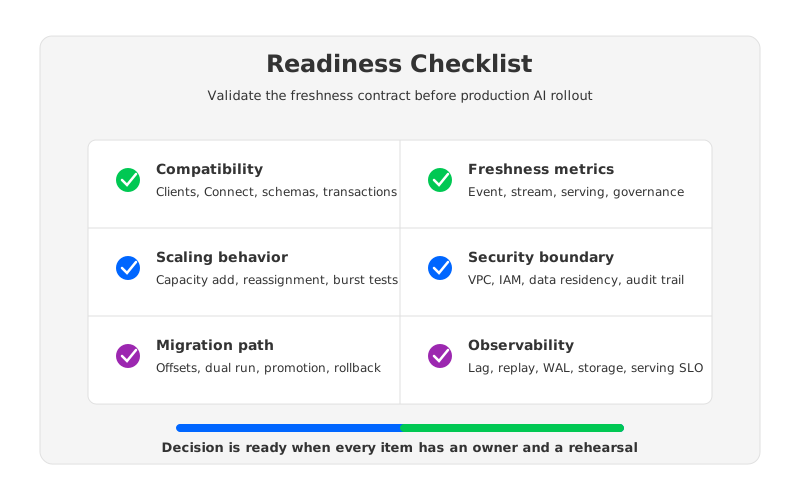
Start with one high-value workflow rather than the entire AI platform. Define the maximum acceptable age of context at the moment of model action. Then work backward through the event stream, processing jobs, serving stores, indexes, and policy checks. Every hop should have an owner, metric, alert, replay path, and rollback plan. Freshness becomes manageable when it stops being a slogan and becomes a contract between teams.
For Kafka-compatible platform evaluation, the strongest signal is a live rehearsal. Run a representative producer workload, a consumer group with stateful processing, a replay job, and a downstream serving update. Add capacity. Kill a broker. Rebuild a feature. Promote or roll back a migration path. Watch where freshness degrades and which team has to act. That is the moment when architecture diagrams turn into operating reality.
If that rehearsal shows broker-local storage and data movement dominating your decisions, explore AutoMQ's Shared Storage architecture and Kafka-compatible deployment options. The next step is to validate the model against your own workload, retention, cloud boundary, and recovery requirements: talk to AutoMQ about a BYOC evaluation.
7FAQ
7.1Is Kafka enough for AI data product freshness?
Kafka is a strong event backbone, but it is not the whole freshness architecture. Teams still need downstream freshness metrics for stream processing, serving stores, vector indexes, model actions, schemas, and policy checks.
7.2Is Consumer lag the same as AI data freshness?
No. Consumer lag is one important signal, but it measures a Kafka Consumer group's position relative to the log. AI data freshness also includes event capture delay, processing delay, serving-store update delay, and the age of context when the model acts.
7.3Does Tiered Storage solve freshness problems?
Tiered Storage can help with long retention and historical reads, but it does not fully change the broker-local operating model. If the bottleneck is broker scaling, reassignment, or recovery, evaluate whether Shared Storage architecture is a better fit.
7.4Where should AutoMQ appear in an AI data architecture?
AutoMQ fits where teams want Kafka-compatible streaming with cloud-native operations, Shared Storage architecture, stateless brokers, and customer-controlled deployment boundaries. It should still be evaluated with the same compatibility, freshness, recovery, and governance checklist as any production platform.
8References
- Apache Kafka documentation
- Apache Kafka Connect documentation
- Apache Kafka KRaft documentation
- Apache Kafka Tiered Storage documentation
- AutoMQ compatibility with Apache Kafka
- AutoMQ Shared Storage architecture overview
- AutoMQ WAL storage documentation
- AutoMQ Kafka Linking overview
- AutoMQ Table Topic overview


