
Table of Contents
Table of Contents
Teams searching for ai data quality gates kafka are usually past the prototype stage. The AI application is already reading documents, consuming events, calling tools, or enriching customer-facing workflows, and the platform team is trying to answer a harder question: which data is allowed to influence the next action while the system is still running? Batch validation can still protect warehouses and offline training sets, but it cannot stop a bad event from entering a retrieval index, a feature stream, or an agent decision path after the fact.
That is where data quality gates change from a data engineering checklist into a streaming architecture problem. A gate is not only a test for null values or schema drift. In an AI pipeline, it is a decision point that may quarantine an event, route it for human review, attach confidence metadata, trigger a compensating action, or let the event continue toward model context. Kafka enters the picture because these decisions need durable ordering, replay, independent consumers, and a place where producers do not need to know every downstream quality rule in advance.
The difficult part is the operating model behind the gate. AI workloads often mix high-volume telemetry, sparse business events, retrieval signals, user corrections, and generated outputs. A single source event may fan out into validation, enrichment, indexing, evaluation, monitoring, and audit consumers. If the streaming layer cannot scale, recover, and retain data without turning every change into a broker-local storage project, the quality gate becomes another fragile service in the middle of the AI path.
1Why Teams Search for ai data quality gates kafka
The search query is specific because the pressure is specific. AI platform teams are no longer asking whether they should validate data. They are asking how to keep validation close enough to the event stream that bad data does not travel faster than the team can detect it. A traditional pipeline might discover a bad customer profile, malformed entitlement event, or stale inventory update during an hourly job. An AI assistant may use that same event within seconds to answer a user, draft an action, or call a tool.
Kafka's producer, topic, partition, offset, and consumer group model gives teams useful control points. Producers can publish raw events without embedding every rule. Quality gate consumers can read in order, maintain their own offsets, and publish accepted, rejected, or enriched events to separate topics. Other teams can subscribe to the same stream for observability, audit, lakehouse ingestion, or model evaluation without blocking the gate. That independence matters because AI quality is rarely owned by one team.
The core requirements tend to cluster into five groups:
- Freshness: Events must be validated quickly enough to influence live AI behavior, not only offline reports.
- Replayability: Teams need to rebuild indexes, features, and evaluation sets after schema, prompt, model, or policy changes.
- Isolation: A failed experiment, slow enrichment job, or noisy consumer should not block compliance or production consumers.
- Governance: Sensitive payloads need explicit retention, redaction, access control, and ownership boundaries.
- Elasticity: Agentic workflows can turn one user request into many events, which makes validation burstier than ordinary application logging.
These requirements point toward streaming quality gates, but they do not automatically settle the platform decision. The team still has to decide how much operational state should live on brokers, how long data should be retained, and what happens when the gate becomes a dependency for production AI actions.
2The Production Constraint Behind the Problem
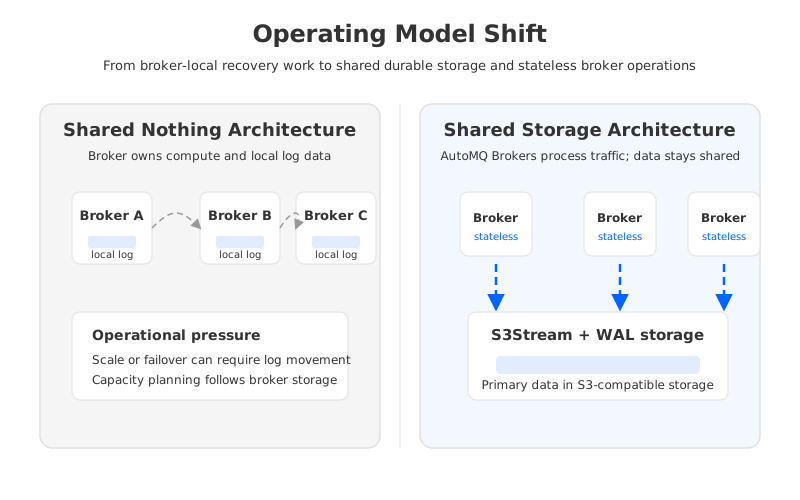
Traditional Kafka is built on a Shared Nothing architecture. Each broker manages local storage, and durability is achieved through replica placement and ISR (In-Sync Replicas) replication. This design is mature and widely understood, but it also couples compute, storage, and data movement. When retention grows, brokers carry the storage pressure. When brokers change, partition placement and local log movement become part of the operational work.
Apache Kafka Tiered Storage can help when the dominant issue is long retention. It moves older log segments to remote storage while keeping the active log and broker ownership model in place. For teams whose quality gate mostly needs historical replay, that may be a practical fit. It does not make brokers stateless, though, and it does not remove the need to reason about active data, partition leadership, broker-local operations, and recovery paths.
The architecture question is therefore narrower and more useful than "Does Kafka support quality gates?" Kafka can support the event contract. The real question is what operational work the team accepts when the quality gate becomes central to AI behavior. If every scale event or failure recovery depends on broker-local data movement, the gate inherits that burden. If durable data is separated from broker compute, the operating model shifts toward metadata, cache behavior, traffic placement, and application-level correctness.
3Architecture Options and Trade-Offs
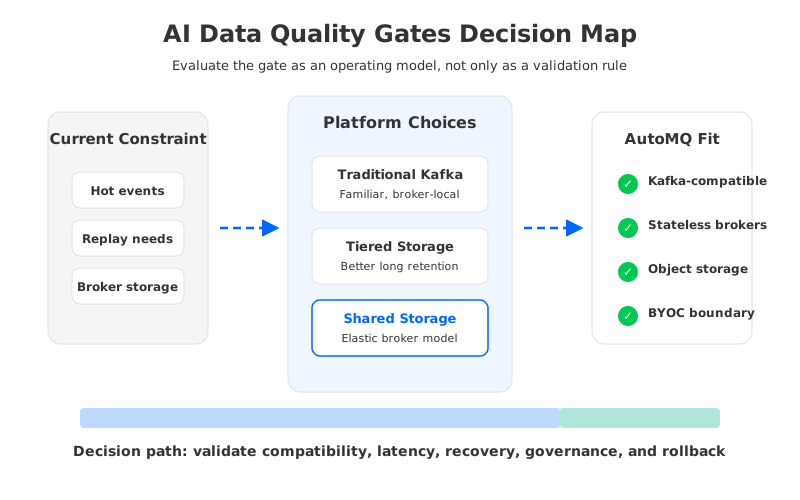
A practical platform review separates the data quality pattern from the Kafka infrastructure model. The pattern is usually stable: publish raw events, run quality checks as independent consumers, write accepted and rejected paths, retain enough metadata for replay, and expose observability for lag, rejection rate, rule version, and downstream impact. The infrastructure decision is about how that pattern behaves under burst, failure, retention growth, and migration.
The main options are easier to compare when the team looks at the same questions for each one:
| Option | Strong fit | Trade-off to test |
|---|---|---|
| Traditional Kafka on local or cloud block storage | Stable workloads and teams with strong Kafka operations | Scaling and recovery remain tied to broker-local data and partition placement |
| Kafka with Tiered Storage | Long retention where older data can move to remote storage | Active data, hot reads, and broker ownership still depend on local storage behavior |
| Kafka-compatible Shared Storage architecture | Cloud-native teams that want elastic broker operations and customer-controlled deployment boundaries | Requires validation of compatibility, latency profile, WAL choice, and migration plan |
This is not a ranking from old to new. A team with predictable traffic, short retention, and deep Kafka expertise may prefer the operational familiarity of traditional Kafka. A team with long historical replay needs may get meaningful value from Tiered Storage. Shared Storage becomes more compelling when the recurring pain is operational change: adding brokers, replacing brokers, isolating failures, extending retention, or reducing cross-AZ data movement without making every change a data relocation project.
Cost evaluation should be specific to the gate's workload. A quality gate may have small records, high write frequency, multiple downstream consumers, and periodic replay. The cost model should include broker compute, storage media, object storage, remote storage requests, network transfer, observability, and engineering time spent on rebalancing or recovery. Single-line cost claims are not useful unless they explain the workload and deployment assumptions behind the number.
Governance is just as important as cost. Some organizations can use a fully managed service and optimize for low operational ownership. Others need the data plane to stay in a customer-controlled cloud account or private network boundary because prompts, user context, retrieval results, and policy decisions are sensitive. The right architecture depends on which boundary matters most: operational delegation, data control, migration risk, or compatibility with existing Kafka applications.
4Evaluation Checklist for Platform Teams
Start the evaluation at the event contract, not the cluster. Define the events that enter the quality gate, the fields that must be checked, the rules that can reject or enrich an event, and the metadata that must survive replay. A useful gate records more than pass or fail. It records rule version, timestamp, reason code, source identity, schema version, and the downstream route chosen for the event.
Then map the consumers. A live AI application may need accepted events quickly. A lakehouse sink may need all accepted and rejected events for later analysis. A policy team may need only rejections and borderline cases. A model evaluation job may need replay across a time window after a prompt or model change. If these consumers have different latency, retention, and access requirements, topic design and access control should reflect those boundaries.
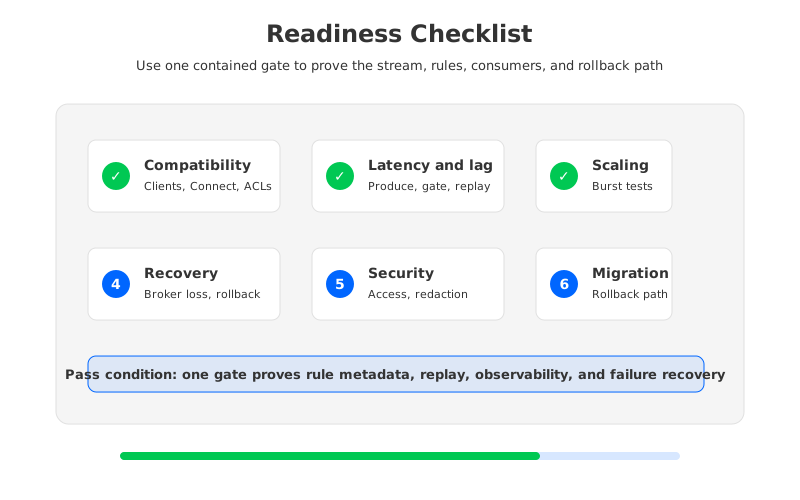
For the platform itself, the checklist should be concrete enough to run in a design review:
The most revealing review question is blunt: what has to happen when a broker disappears during a gate backlog? If recovery is mostly leader changes, metadata updates, cache warmup, and traffic redistribution, the platform has one operating profile. If recovery includes reconstructing broker-local data or moving partitions before the gate can regain health, it has another. Both can be engineered, but they create different burdens for a team that is also managing models, prompts, governance rules, and application releases.
5How AutoMQ Changes the Operating Model
After that neutral evaluation, AutoMQ fits one category in the matrix: a Kafka-compatible streaming platform built around Shared Storage architecture. It keeps the Kafka protocol and ecosystem contract while replacing broker-local persistent log storage with S3Stream, a storage layer that writes durable stream data through WAL (Write-Ahead Log) storage and stores primary data in S3-compatible object storage.
This changes the quality gate's operating model because event capture is not the hard part. The harder work is keeping accepted, rejected, and enriched streams available while rule sets change, downstream consumers fall behind, and AI traffic arrives in bursts. In AutoMQ's architecture, AutoMQ Brokers handle Kafka protocol processing, partition leadership, scheduling, and caching, while durable data is not owned by a broker's local disk. Scaling and recovery can therefore focus more on traffic and ownership than on copying local logs.
That difference matters most when the quality gate becomes a shared dependency. Adding capacity does not have to mean a long data relocation cycle. Replacing a broker does not make its local disk the recovery anchor. Long retention can align with object storage capacity instead of broker disk sizing. For cloud deployments where cross-AZ traffic is part of the cost and operations review, AutoMQ's S3-based Shared Storage architecture also gives teams a different way to reason about replication paths and data locality.
AutoMQ BYOC is relevant when data quality metadata is sensitive enough that deployment boundaries are part of the design. In BYOC, the control plane and data plane run in the customer's cloud account or VPC, and business data remains in customer-owned infrastructure. That boundary does not remove the need for encryption, access control, redaction, or retention design, but it gives governance teams a clearer ownership model for prompts, retrieval context, tool outputs, rule results, and rejection evidence.
The validation work still matters. Teams should test client compatibility, connector behavior, produce latency, gate processing lag, replay, observability, authorization, schema evolution, and rollback under their own workload. Shared Storage architecture changes the infrastructure burden; it does not excuse weak event modeling. The useful claim is precise: for Kafka-compatible quality gates that must stay elastic, recoverable, and governed, stateless brokers and object-storage-backed durability can reduce the work tied to broker-local data placement.
6Migration Path: Prove One Gate Before Moving the Platform
The safest migration starts with one contained quality gate, not a full AI data platform cutover. Good candidates include retrieval freshness checks, entitlement validation, profile completeness checks, tool-output validation, or policy-decision routing. These streams are meaningful enough to expose ordering, replay, retention, and security requirements, but contained enough that rollback does not disrupt every AI application.
The benchmark should match the workload. Synthetic throughput is useful only when it reflects event size, partition keys, consumer fan-out, retention, replay windows, and failure behavior. AI data quality gates are not passive log filters. They decide which data can influence AI action. When that decision is represented as a durable, replayable, governed event stream, Kafka-compatible infrastructure becomes part of the trust boundary.
Return to the first question: which data is allowed to influence the next action while the system is still running? If the answer depends on ad hoc validation buried in application code, the architecture is not ready. Use the checklist, prove one gate end to end, and evaluate AutoMQ BYOC when Kafka-compatible semantics, Shared Storage architecture, and customer-controlled deployment boundaries need to work together.
7FAQ
7.1What is an AI data quality gate in Kafka?
An AI data quality gate is a streaming decision point that validates, enriches, quarantines, or routes events before they influence AI applications. Kafka provides the durable topics, offsets, ordering, replay, and independent consumers that make the gate observable and recoverable.
7.2Should data quality gates run before or after enrichment?
Most production designs use multiple gates. Basic schema, identity, and safety checks should happen before enrichment. More contextual checks can run after enrichment, especially when they need retrieval metadata, model confidence, policy results, or external reference data.
7.3Does Tiered Storage solve AI data quality gate scaling?
Tiered Storage can help with long retention by moving older log segments to remote storage. It does not make brokers stateless, so teams still need to validate active data behavior, broker recovery, partition placement, and hot replay performance for live gates.
7.4How much metadata should a quality gate record?
Record enough metadata to replay and explain the decision: rule version, schema version, source identity, timestamp, reason code, decision result, and downstream route. Avoid storing sensitive payloads directly when redaction, tokenization, or reference-based storage is more appropriate.
7.5How should teams start with AutoMQ?
Start with one contained quality gate, keep the existing path available, and test compatibility, latency, lag, replay, security, observability, and rollback. Review AutoMQ compatibility and architecture documentation before production planning.
8References
- Apache Kafka Documentation
- Apache Kafka Consumer Design
- Apache Kafka Transactions and Semantics
- Apache Kafka Connect
- Apache Kafka KRaft
- Apache Kafka Tiered Storage
- AutoMQ Compatibility with Apache Kafka
- AutoMQ Architecture Overview
- AutoMQ S3Stream Shared Streaming Storage
- AutoMQ WAL Storage
- AutoMQ zero cross-AZ traffic overview
- AWS overview of data transfer costs for common architectures


