
Table of Contents
Table of Contents
Teams do not search for customer loyalty events kafka because they need a reminder that loyalty programs have points, tiers, rewards, and member profiles. They search for it when the loyalty system has stopped being a marketing database and has become a decision loop. A purchase may change a member's tier, a refund may reverse a reward, a mobile app click may trigger an offer, and a fraud signal may block redemption before it reaches checkout. The difficult part is not writing these events into Kafka. The difficult part is making every downstream decision timely, replayable, governed, and cost-effective without turning the streaming platform into the bottleneck.
Customer loyalty workloads expose a specific kind of infrastructure pressure. The event stream is business-facing, but the failure mode is operational: lagging consumers delay offers, unclear ordering creates inconsistent balances, long retention inflates storage, and a migration that changes offsets can break finance, support, and digital channels. The platform team is asked to provide Kafka semantics, cloud elasticity, security boundaries, and predictable cost at the same time.
The useful question is not "Can Kafka handle loyalty events?" It can. The better question is which Kafka-compatible architecture lets loyalty move from events to decisions while controlling operations.
1Why teams search for customer loyalty events kafka
A loyalty program looks simple from the outside: members earn, burn, and receive offers. Inside the platform, those actions arrive as many event families with different ordering and governance needs. A purchase event may be keyed by member ID, a reward adjustment may be keyed by account ID, a coupon redemption may depend on both member and campaign, and a customer profile update may need to fan out to personalization, support, and analytics teams. Kafka helps because producers and consumers can evolve independently, Consumer groups can process partitions in parallel, and offsets give each application its own recoverable position in the stream.
The pressure appears when the stream becomes the system of coordination. Loyalty balances are not only analytical facts; they influence checkout, service recovery, fraud rules, and campaign eligibility. A delayed or duplicated event can create a support ticket. A poorly governed schema change can break a personalization model. A replay that competes with live traffic can turn a planned audit into a customer-facing incident. These are not abstract platform risks. They show up as inconsistent decisions in front of customers.
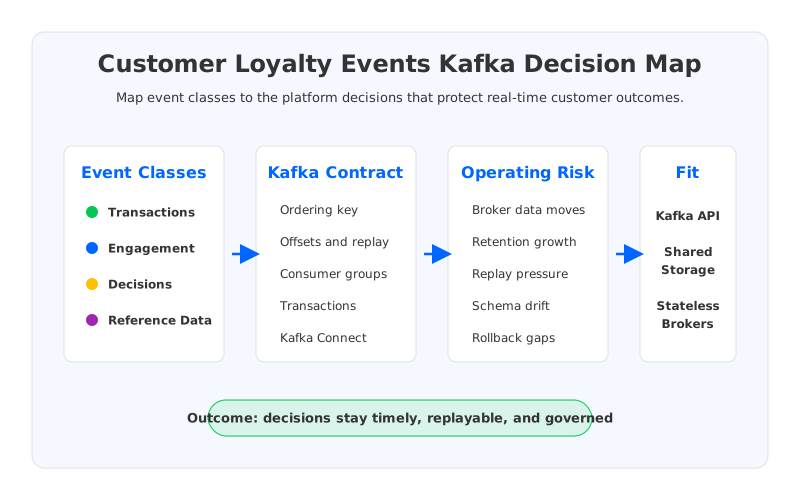
That is why the first design review should separate four event classes instead of treating "loyalty events" as one stream:
- Transaction events record purchases, refunds, cancellations, and adjustments. They need ordering by the business key that defines balance correctness.
- Engagement events capture clicks, opens, app sessions, store visits, and campaign interactions. They are high-volume and often feed scoring or segmentation systems.
- Decision events represent offer eligibility, tier changes, fraud outcomes, reward issuance, and redemption approvals. They need strong traceability because a human may later ask why the system made a decision.
- Reference events describe member profile changes, consent changes, campaign metadata, and partner configuration. They move more slowly, but a bad change can affect many consumers at once.
This classification changes the platform conversation. Instead of asking for a generic Kafka cluster, the team can ask which topics need strict ordering, which streams need long replay, which consumers can tolerate catch-up reads, and which events require tighter access control.
2The production constraint behind the problem
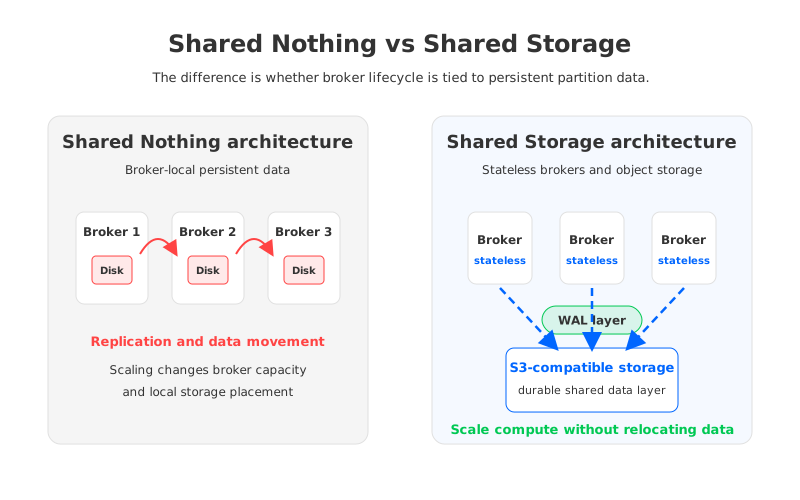
Traditional Kafka runs on a Shared Nothing architecture. Each broker owns local storage, and partitions are replicated across brokers for durability and availability. The model is proven and familiar, and it is still a reasonable fit for many clusters. It also means storage placement, partition leadership, replication, capacity planning, and data movement are tied together. When a loyalty workload grows, the team is not only scaling throughput. It is also managing broker-local data and the operational consequences of moving that data.
That coupling matters because loyalty traffic is uneven. A promotional campaign can create a burst of engagement events. A seasonal sale can multiply transaction volume. A data science team can add a historical replay for model training. A regulatory audit can require longer retention on events that were originally designed for operational use. If brokers must carry persistent partition data locally, each change becomes a capacity and reassignment question, not only an application design question.
Tiered Storage can reduce part of that pressure by moving older segments to remote storage while recent data remains on broker-local disks. It is worth evaluating when the main issue is retained data volume. But it does not make brokers stateless. The hot path, local disk sizing, partition leadership, and reassignment mechanics still need careful planning. For customer loyalty events, the distinction matters because live decisions, historical replay, and governance workflows share the same backbone.
3Architecture options and trade-offs
A practical evaluation starts by separating the application contract from the storage and operations model. The application contract is Kafka compatibility: Producer and Consumer APIs, offsets, transactions where needed, idempotent producers, admin operations, Kafka Connect integrations, and client behavior. The operations model is how the platform stores data, scales brokers, handles failures, isolates workloads, and controls cost. A loyalty team should score both. A familiar API without a clear migration path still carries risk. A better operating model that changes client semantics creates a different risk.
The choice is not one-dimensional. Self-managed Kafka gives experienced teams maximum control, but they own broker storage, upgrades, rebalancing, security hardening, and failure recovery. Managed Kafka reduces some infrastructure work, but the storage and networking model still depends on the service design and the provider's boundaries. Kafka-compatible cloud-native streaming keeps the application protocol while changing the way storage, scaling, and durability are handled underneath.
| Evaluation area | What to verify | Why it matters for loyalty events |
|---|---|---|
| Compatibility | Client versions, auth, transactions, idempotent producers, offset behavior, Kafka Connect, and admin APIs | Balances, redemptions, and campaign systems often depend on existing Kafka semantics |
| Cost boundaries | Compute, storage, network, retention, observability, and operational labor | Engagement events can be high-volume, while decision events may need longer retention |
| Elasticity | Scale-out behavior, broker replacement, partition reassignment, and catch-up reads | Campaign traffic and replay jobs can arrive at the same time |
| Governance | Schema evolution, topic ownership, access control, auditability, and data classification | Loyalty events often contain customer identifiers, consent state, and commercial decisions |
| Migration risk | Dual running, offset continuity, rollback, and validation windows | A bad cutover can produce inconsistent balances or missed decisions |
The right answer depends on the program's shape. A small loyalty workload with steady traffic and short retention may be served well by conventional Kafka operations. A platform that supports real-time offers, partner redemptions, customer support history, audit replay, and machine learning features needs a storage architecture that can absorb growth without turning every change into a broker data movement project.
4Evaluation checklist for platform teams
The checklist below is deliberately concrete. Vague criteria such as "high throughput" and "low latency" are too broad to guide a platform decision. Loyalty systems need the team to identify the specific contract between events and business decisions.
- Define the correctness key. For earning and redemption, decide whether ordering is by member ID, account ID, payment ID, or reward ledger ID. The wrong key can make a technically healthy stream produce inconsistent outcomes.
- Separate live decisions from replay workloads. Checkout and fraud consumers usually read the tail. Audit, analytics, and model training may read older data. Treat those access patterns as different platform requirements.
- Inventory client behavior. Record client versions, authentication, serialization, transactions, idempotent producer settings, and Consumer group ownership. Compatibility should be tested with real applications, not inferred from a protocol claim alone.
- Model retention by event class. Transaction and decision events may need a longer horizon than engagement events. Retention should be a policy choice, not a side effect of broker disk size.
- Test scaling under campaign pressure. Run a burst test that includes live writes, catch-up reads, and consumer lag recovery. A cluster that performs well on ingestion alone may still struggle when replay and decision consumers overlap.
- Design governance before the first incident. Topic ownership, schema review, access control, audit logs, and data classification should be part of the streaming platform, not a cleanup project after data spreads.
- Make rollback executable. Dual running, offset mapping, producer switch-over, validation, and rollback steps should be rehearsed before the first high-value topic moves.
This checklist prevents a common mistake: choosing a platform for ingestion capacity while ignoring the decision loop. In loyalty systems, the business value is not that an event was accepted. The value is that the right system can act on the event at the right time and still explain that action later.
5How AutoMQ changes the operating model
After the neutral evaluation, the architectural question becomes sharper: can a Kafka-compatible platform preserve the application contract while changing the storage and scaling model underneath it? AutoMQ is built for that category. It keeps Kafka protocol compatibility while replacing broker-local persistent storage with a Shared Storage architecture backed by S3-compatible object storage and a WAL (Write-Ahead Log) layer.
The practical effect is that AutoMQ Brokers are stateless brokers. Persistent data is not bound to a broker's local disk, so capacity changes and broker replacement are less about moving partition data and more about changing ownership, leadership, and traffic placement. For a customer loyalty platform, that shifts the operating model in three useful ways. Scaling can respond to campaign pressure without becoming a long data relocation exercise. Longer retention can be planned around object storage economics instead of broker disk sizing alone. Failure recovery can focus on restoring service ownership while durable data remains in shared storage.
The WAL layer is the detail that makes the design practical. A streaming platform cannot treat object storage as a slow afterthought on the write path and still serve operational decisions. AutoMQ uses WAL storage as a durable write path and recovery buffer, then persists data to object storage. AutoMQ Open Source supports S3 WAL, while AutoMQ commercial editions support additional WAL storage choices for different deployment and latency requirements. The important point is not that every loyalty workload uses the same WAL. The point is that the write path, main storage layer, and broker lifecycle are separated.
AutoMQ BYOC and AutoMQ Software also matter when loyalty events carry customer identifiers, consent state, partner terms, or commercial decisions. In AutoMQ BYOC, the control plane and data plane run in the customer's cloud account and VPC. In AutoMQ Software, they run in the customer's self-managed environment. That deployment boundary helps platform and security teams align streaming architecture with data residency, network isolation, and operational ownership requirements.
Teams still need good partition keys, schema governance, topic lifecycle rules, observability, and migration testing. A Shared Storage architecture changes the constraints; it does not replace the contract the platform team owns between events and decisions.
6Migration path: keep the business contract stable
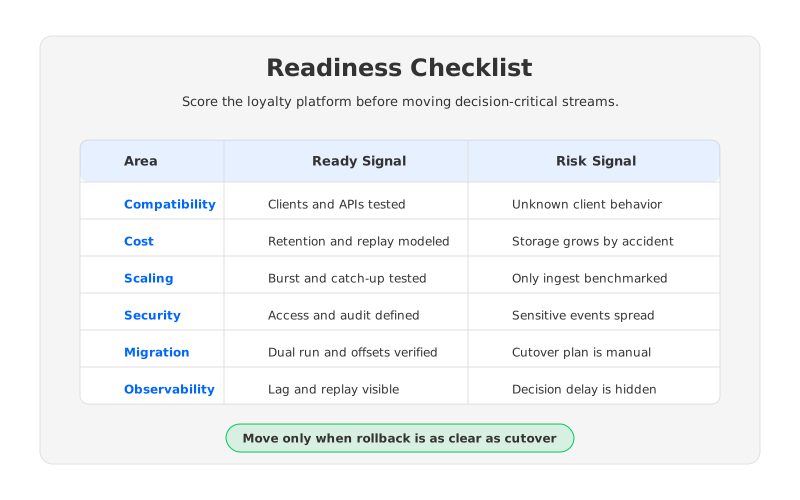
The safest loyalty migration is conservative where the business risk is highest. Keep producers and consumers speaking Kafka. Keep offsets visible. Move one topic family at a time. Prove rollback before moving reward ledger, redemption, fraud, or checkout-facing streams. A migration that looks fast in an infrastructure plan can still be unsafe if support teams cannot explain why a member's balance changed.
A readiness scorecard gives the team a better steering mechanism than a generic project plan.
| Area | Ready signal | Risk signal |
|---|---|---|
| Producers | Client versions, auth, serialization, and retry behavior are known | Store, partner, or mobile gateway producers are hard to update |
| Consumers | Consumer group owners and lag targets are documented | Decision, analytics, and support consumers share unclear ownership |
| Data model | Event classes, schemas, and topic owners are explicit | Raw events mix transaction, engagement, and reference data |
| Operations | Scaling, failover, and replay tests are rehearsed | Recovery behavior is assumed from small tests |
| Rollback | Offset and producer switch-over plans are tested | Rollback depends on manual offset edits during an incident |
For teams evaluating AutoMQ, Kafka Linking can be part of the migration discussion when the source environment and target instance meet the documented prerequisites. It is still worth treating migration as a production workflow rather than a feature checkbox: define success metrics, reserve capacity for synchronization, run parallel validation, and make the rollback procedure executable by the on-call team.
7FAQ
7.1Is Kafka a good fit for customer loyalty events?
Yes. Kafka is a strong fit when loyalty systems need independent producers and consumers, ordered processing within business keys, replay, and integration with stream processing or data integration tools. The design work is in key selection, retention, governance, and operations.
7.2What is the biggest architecture risk in a loyalty event platform?
The biggest risk is assuming that API compatibility is the whole platform decision. Loyalty workloads also need predictable replay, broker failure recovery, schema governance, access control, and a migration path that preserves offsets and decision history.
7.3Should engagement events and reward ledger events use the same topics?
Usually no. Engagement events and reward ledger events often have different ordering, retention, audit, and access-control needs. They can share the same streaming backbone, but topic boundaries should reflect the business contract each event family serves.
7.4Where does AutoMQ fit in the decision?
AutoMQ fits when a team wants Kafka-compatible behavior while changing the broker storage and scaling model. Its Shared Storage architecture, stateless brokers, and customer-controlled deployment options are most relevant when retention, elasticity, and operational ownership are first-class requirements.
The search for customer loyalty events kafka usually starts with a use case. It should end with an operating model decision. If your team is evaluating a Kafka-compatible loyalty event platform and wants to test a Shared Storage architecture without giving up the Kafka contract, try AutoMQ through the cloud console and validate it against your real producers, consumers, and replay workflows.


