
Table of Contents
Table of Contents
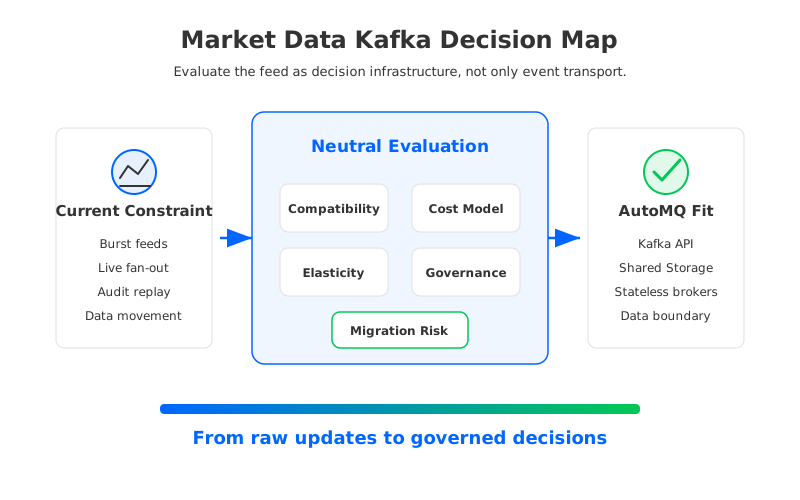
Teams do not search for market data distribution kafka because they need a textbook explanation of a producer writing to a topic. They search for it when market data has become a production boundary: price updates arrive in bursts, downstream applications compete for the same feed, replay windows matter for audit and model features, and degraded delivery can affect traders, risk systems, or customer-facing applications. The hard part is not moving events. The hard part is keeping the path from events to decisions predictable as volume, retention, fan-out, and governance expand together.
Market data distribution also exposes a tension that many general Kafka guides skip. A quote, trade, order book update, or derived signal may need low-latency delivery to live consumers and reliable replay for slower consumers. The same stream can feed pricing engines, risk checks, analytics stores, surveillance workflows, and machine learning features. Kafka fits this shape because producers and consumers can evolve independently, Consumer groups can parallelize processing, and offsets give each application a precise recovery position.
The useful question is therefore not "Can Kafka distribute market data?" It can. The better question is which Kafka-compatible architecture keeps distribution fast, auditable, and operable when the stream becomes shared infrastructure.
1Why teams search for market data distribution kafka
Market data looks like a streaming problem from the first diagram. Events arrive from venues, vendors, internal matching systems, pricing services, or enrichment jobs. Producers normalize records into topics. Consumers subscribe by asset class, venue, account, desk, or application boundary. That shape is familiar to Kafka teams, and it is one reason Kafka is common in financial services data platforms.
The pressure appears after the first clean deployment. The feed is continuous, but it is not smooth. Market opens, auctions, volatile price moves, vendor reconnects, and catch-up bursts can all change write and read pressure within short windows. A live pricing engine cares about tail latency, while a surveillance workflow may scan older events. A model feature job may need replay without disturbing the desks reading the latest market state. When those workloads share one backbone, the platform needs more than throughput. It needs isolation, retention discipline, predictable recovery, and an operating model that does not make every capacity change a data movement project.
Kafka's abstractions are still useful here. A Topic can represent raw venue events, normalized ticks, reference data changes, derived pricing signals, or risk decisions. A Partition gives ordering within a chosen key, such as instrument, venue, or account. A Consumer group lets pricing, analytics, compliance, and product applications consume independently. Offsets let each system recover at its own pace instead of coordinating through a shared database cursor.
The platform team still has to answer questions Kafka does not answer by itself:
- Which event keys preserve the ordering the business actually needs without creating permanent hot partitions?
- How much retention is required for replay, audit, and feature generation, and which storage layer should carry it?
- What happens when a historical consumer reads aggressively while live consumers are processing the tail?
- Can the team add capacity during a volatile session without moving a large amount of broker-local data?
- How are schemas, permissions, and data classifications governed when the same feed serves trading, risk, analytics, and product teams?
- What is the rollback path if the platform moves to a different Kafka-compatible backend?
These are not advanced edge cases. They are the normal lifecycle of a market data distribution system that succeeds.
2The production constraint behind the problem
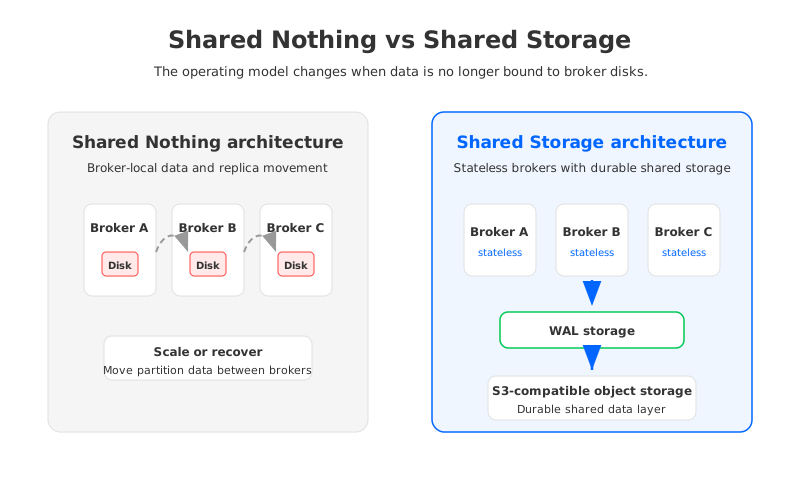
Traditional Kafka was built around a Shared Nothing architecture. Each broker owns local storage, and partition replicas are spread across brokers for durability and availability. That model is proven, widely understood, and still appropriate for many clusters. It also means storage placement, broker capacity, replication traffic, and partition movement are tightly coupled. When a market data workload grows, the team is not only scaling network and CPU. It is also expanding local storage, maintaining replica placement, and managing data movement during reassignment.
That coupling matters because market data creates uneven pressure. A small set of instruments can dominate update rates during volatility. One additional downstream desk, compliance process, or analytics job can create a sudden catch-up read pattern. Retention changes can turn a storage budget into a broker sizing exercise. If brokers must carry persistent partition data locally, scaling is not only a matter of adding nodes. The platform has to redistribute ownership and data, and the operational window for that redistribution competes with the workload that caused the need to scale.
Tiered Storage helps one part of the problem by moving older data to remote storage while keeping recent data on broker-local disks. It can reduce pressure from long retention, and it is worth evaluating when the main pain is historical storage footprint. But it does not make brokers stateless. The recent data path, partition leadership, local disk sizing, and reassignment model still need careful capacity design. For market data distribution, that distinction matters because the same platform often needs predictable tail reads, affordable replay, and elastic capacity during bursty sessions.
The constraint is easy to miss during the first architecture review. A whiteboard version of the system shows sources, Kafka, stream processors, and consumers. A production version also has broker failure domains, cross-zone traffic, retention policies, schema governance, access control, replay paths, and migration windows. Architecture is the difference between those two drawings.
3Architecture options and trade-offs
A practical evaluation starts by separating the application contract from the storage and operations model. The application contract is Kafka compatibility: producers, consumers, offsets, transactions where needed, Kafka Connect integrations, authentication, and client behavior. The operations model is how the platform stores data, scales brokers, handles failures, isolates workloads, and controls cost. A market data team should score both. A system that exposes a familiar Kafka API but forces a risky migration path is not operationally equivalent to Kafka. A system that improves operations but breaks client compatibility creates a different kind of risk.
There are three common directions.
| Option | Where it fits | Trade-off to examine |
|---|---|---|
| Self-managed Kafka | Teams that need maximum control and already have mature Kafka operations | Strong ecosystem fit, but the team owns broker storage, upgrades, rebalancing, and failure handling |
| Managed Kafka service | Teams that want to reduce infrastructure ownership while keeping a familiar operating model | Less day-to-day management, but storage, network, and scaling limits still depend on the provider's architecture |
| Kafka-compatible cloud-native streaming | Teams evaluating a different operating model without changing the application protocol | Potentially better elasticity and storage economics, but compatibility, migration, and governance must be verified carefully |
The right answer depends on the shape of the data platform. If the system only needs short retention, steady traffic, and a small number of consumers, conventional Kafka may be sufficient. If the system needs long replay windows, bursty ingest, many downstream teams, and strict control over where data lives, the storage architecture becomes a first-class decision.
Market data also forces teams to think about fault domains more explicitly than many analytics pipelines do. A broker failure during a quiet period is an operations event. A broker failure during volatile trading is a business event. The difference is not only the failure itself; it is whether recovery requires moving data, waiting for reassignment, or throttling consumers that are trying to catch up. The more local state each broker carries, the more recovery depends on the broker storage model.
4Evaluation checklist for platform teams
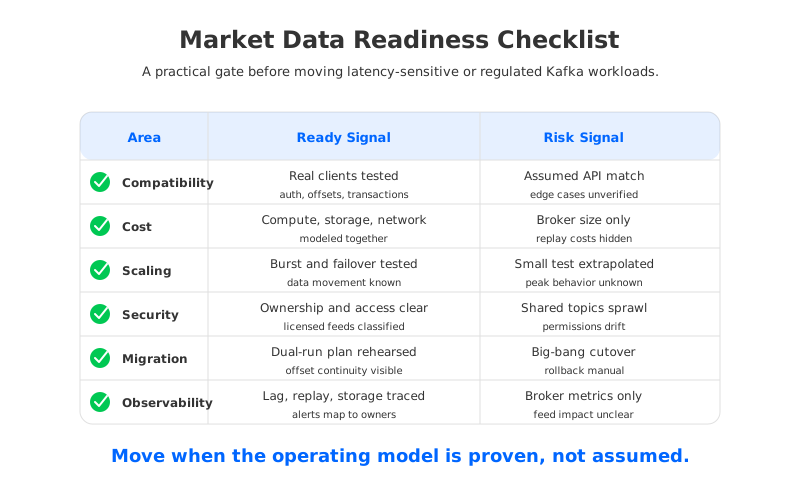
The checklist below is designed for teams that already understand Kafka basics and need a decision framework. It is intentionally concrete because vague platform criteria tend to hide risk until migration week.
- Compatibility: Verify producer and consumer client versions, authentication mechanisms, Kafka Connect usage, transactions, idempotent producers, offset behavior, and admin APIs. Compatibility should be tested with the team's real clients, not inferred from a broad platform claim.
- Partitioning model: Choose keys that preserve the ordering you need without creating permanent hot partitions. Instrument ID is common, but venue, asset class, account, or composite keys may be better depending on the decision being made.
- Retention and replay: Separate operational retention from analytical retention. Live pricing may need fast tail reads, while surveillance, audit, and model features may need longer replay windows.
- Scaling behavior: Ask what happens when write throughput doubles, when a historical consumer appears, or when a broker fails during a volatile session. The answer should include data movement, not only node count.
- Cost boundaries: Model compute, storage, network, observability, and operational labor. Market data can make retained storage and cross-zone movement visible long before compute is saturated.
- Governance: Treat schema evolution, topic ownership, access control, data classification, and audit trails as part of the streaming design. Market data can include licensed feeds, derived signals, and regulated business context.
- Migration and rollback: Test dual-running, offset continuity, producer switch-over, consumer catch-up, and rollback paths before moving latency-sensitive or regulated workloads.
This checklist also prevents a common mistake: choosing a platform only for ingestion throughput. In market data systems, the value of the pipeline is not that an event arrives. The value is that multiple teams can act on the event at the right time, with the right context, and with confidence that replay will not disturb the live feed.
5How AutoMQ changes the operating model
After the neutral evaluation, the architectural question becomes sharper: can a Kafka-compatible platform keep the application contract while changing the storage and scaling model underneath it? AutoMQ is built for that category. It keeps Kafka protocol compatibility while replacing broker-local persistent storage with a Shared Storage architecture backed by S3-compatible object storage and a WAL (Write-Ahead Log) layer.
The practical effect is that AutoMQ Brokers are stateless brokers. Persistent data is not bound to a broker's local disk, so capacity changes and broker replacement are less about moving partition data and more about changing ownership, leadership, and traffic placement. For a market data platform, that shifts the operating model in three ways: scaling becomes an infrastructure response to workload pressure, longer retention can be designed around object storage economics, and recovery can focus on service ownership while durable data remains in shared storage.
The WAL layer makes the design practical. AutoMQ uses WAL storage as a durable write path and recovery buffer, then persists data to object storage. AutoMQ Open Source supports S3 WAL, while commercial editions support additional WAL choices for different deployment and latency requirements. The point is that the write path, main storage layer, and broker lifecycle are separated.
AutoMQ BYOC and AutoMQ Software also matter for teams with strict data boundary requirements. In BYOC deployments, the control plane and data plane run in the customer's cloud account and VPC. In Software deployments, they run in the customer's own data center. That boundary is relevant when market data includes licensed feeds, derived signals, customer activity, or regulated business workflows. Platform teams still need their own security design, but the deployment model should not require business data to leave the environment they control.
This does not remove the need for engineering judgment. Teams still need good partition keys, schema governance, topic lifecycle rules, observability, and migration testing. A Shared Storage architecture changes the constraints; it does not absolve the platform team from owning the contract between events and decisions.
6Migration path: reduce change where risk is highest
The safest market data migration is conservative in the right places. Keep the producer and consumer contract stable. Keep offsets and replay behavior visible. Move one traffic class at a time. Prove rollback before the first latency-sensitive or regulated consumer moves. The more the platform changes underneath, the more disciplined the application cutover should be.
A readiness scorecard can be more useful than a generic project schedule:
| Area | Ready signal | Risk signal |
|---|---|---|
| Producers | Client versions, auth, and serialization are inventoried | Venue adapters or gateway clients are unknown or hard to update |
| Consumers | Consumer group ownership and lag targets are documented | Live, batch, and audit consumers share unclear responsibilities |
| Data model | Schemas and topic ownership are explicit | Raw topics carry mixed event types without governance |
| Operations | Scaling, failover, and replay tests have been rehearsed | Reassignment and recovery behavior is assumed from small tests |
| Rollback | Offset and producer switch-over paths are tested | Rollback depends on manual offset edits during an incident |
For teams evaluating AutoMQ, Kafka Linking can be part of the migration discussion when the source environment and target instance meet the documented prerequisites. Treat migration as a production workflow: define success metrics, reserve capacity for synchronization, run parallel validation, and make rollback executable by the on-call team.
7FAQ
7.1Is Kafka a good fit for market data distribution?
Yes, Kafka is a strong fit when the system needs independent producers and consumers, ordered processing within keys, replay, and integration with stream processing or data integration tools. The design work is in partitioning, retention, governance, and operations, not in the basic event-streaming model.
7.2What is the biggest architecture risk?
The biggest risk is coupling live delivery to storage movement. If scaling, recovery, or retention changes require heavy broker-local data movement, the platform can become fragile during bursts.
7.3When should teams consider a Kafka-compatible cloud-native platform?
Consider it when Kafka compatibility is required but the team wants a different operating model for storage, elasticity, failure recovery, or deployment boundaries. The evaluation should include real client compatibility tests and a migration rehearsal.
7.4Does Shared Storage architecture replace good topic design?
No. Shared Storage architecture changes broker lifecycle and storage economics, but topic ownership, partition keys, schema evolution, access control, and observability remain application and platform responsibilities.
If your market data distribution platform treats Kafka operations as a product, evaluate the operating model, not only the API. You can explore AutoMQ deployment options through AutoMQ Cloud.


