
Table of Contents
Table of Contents
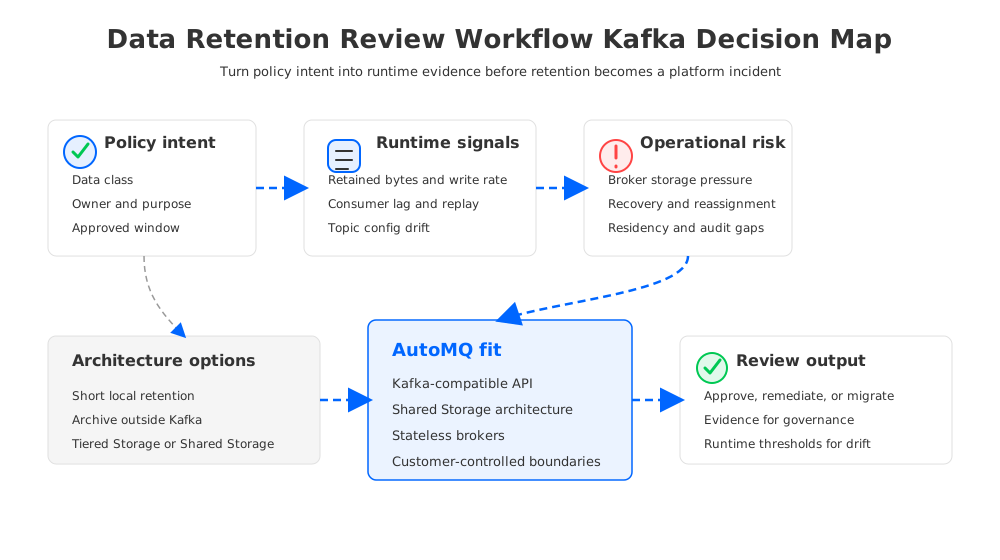
Teams searching for data retention review workflow kafka are rarely looking for a definition of retention. They already know that Apache Kafka can delete data by time, size, or compaction policy. The harder question is how to prove that a production cluster still matches the retention policy after topic owners change defaults, consumers fall behind, audit teams extend replay windows, and platform teams migrate workloads across environments. Retention starts as a governance sentence, but it becomes a runtime control loop.
That loop matters because Kafka retention is not only a compliance setting. It affects broker storage, recovery time, consumer restart behavior, replay cost, data contract enforcement, and the blast radius of a bad deploy. A review workflow that only checks retention.ms once per quarter will miss the real failure mode: policy drift accumulates in live topics long before anyone files a governance exception. The useful workflow connects policy intent to runtime signals, then gives platform teams a repeatable way to approve, challenge, or migrate retention choices.
1Why Teams Search for data retention review workflow kafka
The search usually appears when governance teams and Kafka operators have both learned that static policy is too thin. A security team may say that a topic containing user identifiers must keep data for a limited window. A fraud team may need longer replay because investigations arrive after the operational alert. A machine learning team may want historical events for feature recomputation, while the platform team sees broker disks growing faster than compute demand. None of those requests is wrong, but treating them as isolated tickets creates a cluster where retention is decided by urgency rather than architecture.
The first practical step is to separate retention intent from retention implementation. Intent describes the business and regulatory reason: incident review, audit evidence, model backfill, operational replay, or deletion after a fixed window. Implementation describes how Kafka keeps or removes records: time-based retention, size-based retention, Log compaction, topic-level overrides, consumer group offset behavior, and downstream archival. A healthy review asks whether the implementation still proves the intent under production load.
That distinction prevents a common mistake. Teams often approve retention at topic creation and assume the decision is finished. In production, retention changes when traffic rises, compression ratios change, consumers stop committing offsets, connectors duplicate streams, or a downstream system asks for a backfill. The review workflow has to watch those runtime signals because the policy decision is only valid while the workload profile stays within the assumptions used to approve it.
2The Production Constraint Behind the Problem
Traditional Kafka runs as a Shared Nothing architecture: each Broker owns local log data, and reliability comes from replicas distributed across Brokers. This design is durable and familiar, but it turns longer retention into broker-bound state. More retained data means more local or attached storage, larger failure recovery surfaces, and heavier partition reassignment when teams rebalance or replace Brokers. The operational pain is not that Kafka has retention knobs; the pain is that the retained bytes are tied to the same nodes that must serve live traffic.
This coupling shows up in reviews as a set of signals rather than one obvious alarm:
- Topic growth outpaces traffic growth. Write throughput may remain stable while retained bytes rise because policy changed from hours to days, or because compacted topics accumulate key history differently than expected.
- Consumer lag becomes a policy risk. If consumer groups lag beyond the approved recovery window, the platform cannot prove that applications can resume safely after an outage or rollback.
- Reassignment becomes a governance bottleneck. When retained data is broker-local, moving partitions is not only a scheduling task. It is also a data movement event that can compete with live workloads.
- Cost attribution becomes vague. Storage, replication, cross-zone traffic, cold replay, and connector fan-out can all be triggered by the same retention request, but they appear in different operational dashboards and cloud bills.
The review workflow should make those signals visible before a team asks for emergency storage. If the evidence stops at "this topic has 30 days of retention," the review is not connected to runtime. If the evidence includes write rate, retained bytes, compaction behavior, consumer lag, replay frequency, ownership, and downstream dependency count, the review becomes an architecture conversation.
3Architecture Options and Trade-Offs
There are several ways to handle Kafka retention pressure, and each one fits a different risk profile. Reducing retention is valid when data has no recovery, audit, or product value after a short window. Archiving to a lake can work when historical data is no longer needed through Kafka semantics. Tiered Storage can move older closed segments to remote storage, which helps with long-lived history. A Shared Storage architecture changes the operating model more deeply by moving durable Kafka data away from broker-local disks.
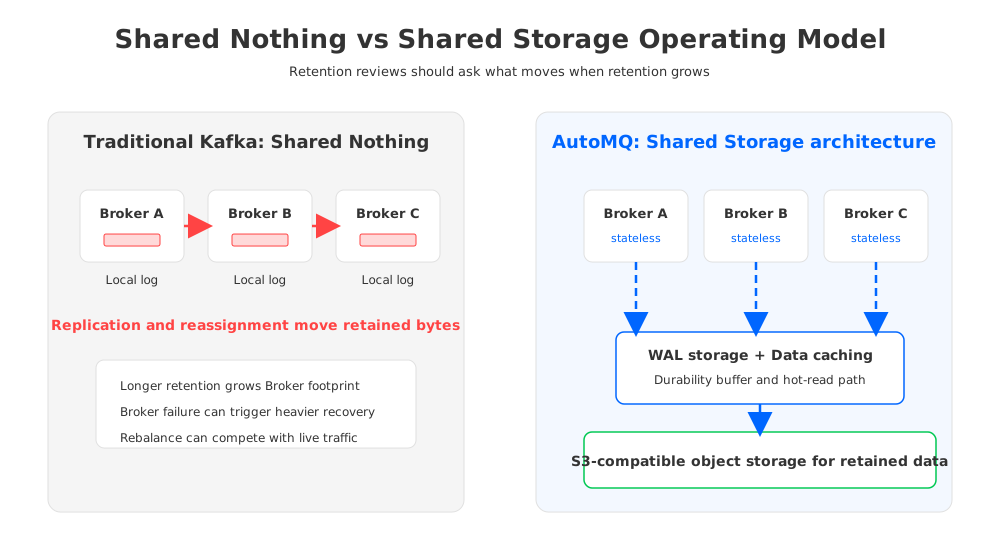
The trade-off is not "old Kafka versus cloud-native Kafka." It is about where retained data lives, what must move during scaling, and who controls the deployment boundary. A governance review should compare options with the same questions every time:
| Architecture choice | Retention strength | Operational constraint | Review question |
|---|---|---|---|
| Short local retention | Simple to operate for transient streams | Limited replay and audit value | Can downstream systems tolerate losing older events? |
| Archive outside Kafka | Good for evidence and analytics | Replay may leave Kafka semantics | Is archive access enough, or must consumers replay from Kafka? |
| Tiered Storage | Useful for older historical segments | Hot data and some operations remain broker-coupled | Does the review require elastic compute, or mainly longer history? |
| Shared Storage architecture | Retention is planned around object storage from the start | Requires evaluating WAL, cache, object storage, and control boundaries | Can the team separate durable bytes from Broker lifecycle? |
This matrix keeps the discussion neutral. A team with short-lived operational telemetry may choose strict deletion and external archive. A bank with audit streams may need longer retention but tight residency controls. An AI platform may care less about a single audit window and more about safe replay for feature recomputation. The right architecture is the one that preserves the policy while keeping runtime operations explainable.
4Evaluation Checklist for Platform Teams
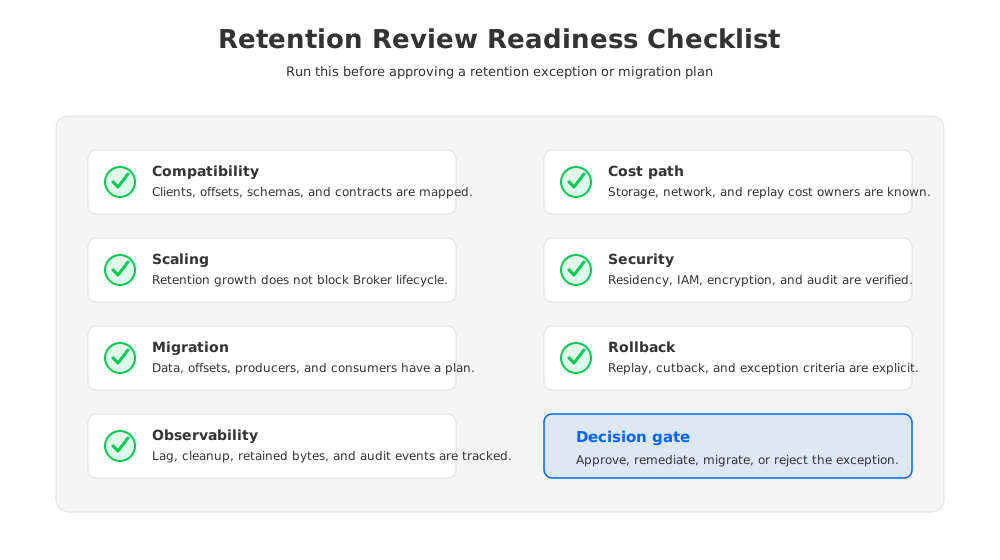
A retention review should be small enough to run often and precise enough to catch drift. The easiest pattern is to review topic classes rather than every topic from scratch. Group topics by data sensitivity, replay expectation, owner, write profile, and consumer dependency. Then sample the topics that carry the most risk: high-volume streams, regulated data, compacted topics, topics with many consumer groups, and topics that have changed retention settings since the last review.
Use this checklist as the review backbone:
- Policy and owner. Every topic class needs a named data owner, platform owner, retention intent, and deletion or compaction rule. The owner should be able to explain why the current window exists.
- Runtime evidence. Capture write throughput, retained bytes, segment cleanup behavior, consumer group lag, offset reset policy, and replay frequency. Static configuration alone is not enough evidence.
- Data contract fit. Retention should match schema evolution and contract rules. If consumers need old events after a schema change, the review should verify compatibility and rollback behavior.
- Cost and capacity path. Model whether retention growth lands on broker-local storage, object storage, network transfer, or connector fan-out. Avoid approving a policy without knowing which resource grows.
- Security boundary. Confirm encryption, access control, network isolation, audit logging, and data residency for the environment where retained data lives.
- Migration and rollback. If the current platform cannot support the retention window, define how data, offsets, producers, consumers, and connectors move without losing review evidence.
This is where governance and operations should meet. A security reviewer may not care about partition reassignment mechanics, but they do care whether a platform can keep regulated data available for approved replay without creating unmanaged copies. A Kafka operator may not own the legal retention requirement, but they do care whether the policy forces the cluster into constant resize events. The checklist gives both sides the same facts.
5How AutoMQ Changes the Operating Model
Once the neutral evaluation is complete, a different architecture requirement becomes visible: the platform should keep Kafka semantics while reducing the amount of durable state tied to individual Brokers. AutoMQ is a Kafka-compatible, cloud-native streaming platform built around Shared Storage architecture. It preserves Kafka APIs and ecosystem behavior while using S3Stream to place durable stream data in S3-compatible object storage, with WAL storage and Data caching handling write durability and hot reads.
For a retention review workflow, that shift changes the questions platform teams ask. Broker replacement is less tied to local log recovery because AutoMQ Brokers are stateless brokers. Scaling and reassignment focus more on ownership, metadata, traffic, and cache behavior than on copying retained partition data from one Broker to another. Retention growth becomes primarily a shared storage and access-pattern question, not a request to keep increasing broker-attached disks.
The governance boundary also becomes clearer for teams evaluating AutoMQ BYOC or AutoMQ Software. In AutoMQ BYOC, the control plane and data plane run inside the customer's cloud account and VPC, and customer business data stays in customer-owned storage. In AutoMQ Software, the same control and data boundaries apply inside the customer's private environment. That matters for retention reviews because data residency, network isolation, IAM, audit, and object storage policy are part of the customer's architecture review rather than hidden behind an external service boundary.
AutoMQ does not remove the need for data contracts or policy review. It changes the operational cost of honoring them. Teams still need to classify data, define retention windows, enforce access controls, test replay, and validate consumer compatibility. The difference is that a longer retention window does not have to mean heavier broker-local state, and a Broker lifecycle event does not have to become a retained-data movement project.
6A Practical Retention Review Workflow
The most useful workflow is deliberately routine: it runs on a schedule, reacts to drift, and produces evidence that both governance and platform teams can read. Start with a policy registry that maps topic classes to owners, data sensitivity, retention intent, and approved implementation. Then connect that registry to runtime signals from Kafka metrics, Admin API inventory, cloud storage metrics, consumer lag monitoring, schema history, access logs, and deployment events.
The review can follow a five-step loop:
| Step | Evidence to collect | Decision output |
|---|---|---|
| Inventory | Topic config, owner, data class, consumer groups, connector paths | Confirm the topic belongs to an approved class |
| Compare | Approved retention versus active retention.ms, retention.bytes, and cleanup.policy | Mark compliant, drifted, or needs exception |
| Stress | Retained bytes, write rate, lag, replay frequency, reassignment history | Decide whether the policy still fits the platform |
| Remediate | Config change, archive path, platform resize, architecture migration | Assign a change with rollback criteria |
| Revalidate | Post-change lag, cleanup behavior, access audit, cost path | Close the review with runtime evidence |
The loop should also define triggers outside the scheduled review. A topic crossing a retained-bytes threshold, a consumer group lagging near the approved window, a schema change that breaks backward compatibility, a migration plan, or a cloud storage policy change should reopen the review. That event-driven pattern is more reliable than waiting for a quarterly governance meeting to discover that production has already drifted.
7FAQ
7.1Is retention review the same as Kafka retention configuration?
No. Kafka retention configuration defines how the platform keeps or removes records. A retention review checks whether those settings, runtime signals, owners, data contracts, and platform architecture still satisfy the policy.
7.2Which Kafka signals matter most for retention governance?
Start with topic-level retention settings, retained bytes, write rate, cleanup policy, consumer group lag, offset behavior, schema evolution, replay activity, and connector fan-out. The exact signal set should reflect the data class and risk profile.
7.3When should a team evaluate Shared Storage architecture for retention?
Evaluate it when retention growth, replay, partition movement, broker replacement, or cross-environment migration makes broker-local storage the limiting factor. The goal is not longer retention by default; the goal is a cleaner operating model for approved retention.
7.4Does AutoMQ replace data governance tools?
No. AutoMQ provides a Kafka-compatible Shared Storage architecture and customer-controlled deployment boundaries. Governance teams still need catalogs, access policy, schema review, audit workflows, and approval records.
8Closing the Review Loop
Return to the original search query: data retention review workflow kafka. The useful answer is not another retention setting. It is a workflow that turns policy into runtime evidence and turns runtime drift into a concrete platform decision. If your review keeps finding the same storage, reassignment, replay, or residency risks, test the architecture rather than debating the policy again.
For teams evaluating a Kafka-compatible Shared Storage architecture, start with the AutoMQ technical materials and run the checklist against one retention-heavy topic class before redesigning the whole platform: explore AutoMQ deployment options.
9References
- Apache Kafka documentation
- Apache Kafka broker configuration:
log.retention.ms - Apache Kafka topic configuration:
retention.ms - Apache Kafka design: Log compaction
- Apache Kafka operations: Tiered Storage
- Apache Kafka consumer configuration:
auto.offset.reset - AutoMQ architecture overview
- AutoMQ Kafka compatibility
- AutoMQ S3Stream overview
- AutoMQ WAL storage
- AutoMQ BYOC environment documentation


