
Table of Contents
Table of Contents
Teams search for event audit evidence kafka when policy language has stopped being enough. A security review asks whether the platform can prove who produced a sensitive event, which service consumed it, whether the schema was valid, whether a retention rule was applied, and how the team would replay or isolate the affected window after an incident. Kafka can carry the runtime signals, but the evidence model depends on the architecture around the cluster.
The hard part is not collecting one more log stream. Audit evidence becomes useful only when it connects policy, data contracts, operational state, and recovery actions without asking every application team to rebuild the same timeline. Runtime evidence has to show that controls held while producers, Consumer groups, connectors, and platform operators were all changing at production speed.
That is why the platform conversation quickly moves from governance language to Kafka operating mechanics. A team needs to know how records are retained, how Offsets are preserved, how transactions behave, how Kafka Connect workers move data, and how the storage layer behaves during replay, scaling, and failure recovery. A useful audit trail is not a pile of logs; it is a decision path that connects an event to the platform state that carried it.
1Why teams search for event audit evidence kafka
The search usually starts with a narrow question and turns into a platform review. A governance team wants event-level evidence. A security lead wants access and change records. A Kafka platform owner wants an answer that does not make every topic owner build their own audit system. They are describing the same boundary: the stream is both a business record and an operational dependency.
In a mature Kafka environment, evidence has several layers. Producer identity and topic authorization show who was allowed to write. Schema and data contract checks show whether the event matched expectations. Offset commits and Consumer group membership show which applications progressed through the log. Connector configurations show which external systems received the data. Broker metrics, controller events, and storage records show whether the platform could preserve and replay evidence when the first explanation was wrong.
Those layers are easy to list and difficult to keep coherent. The operational question is where each evidence signal is generated, who owns it, and whether it survives the same incident that created the investigation. A broker-local disk failure, a rushed partition reassignment, or an overloaded replay job should not make the audit trail less trustworthy. If the evidence system depends on fragile local state, the audit program inherits the storage model's weaknesses.
2The production constraint behind the problem
Apache Kafka gives platform teams a strong foundation for audit evidence because it has stable abstractions: Topic, Partition, Offset, Consumer group, transactional writes, Kafka Connect, and KRaft metadata. These concepts create a shared vocabulary across application teams and auditors. The friction starts when compliance work changes workload behavior. Longer retention, replay windows, quarantine topics, high-cardinality metrics, and stricter change control all add load to the same cluster that must keep serving production traffic.
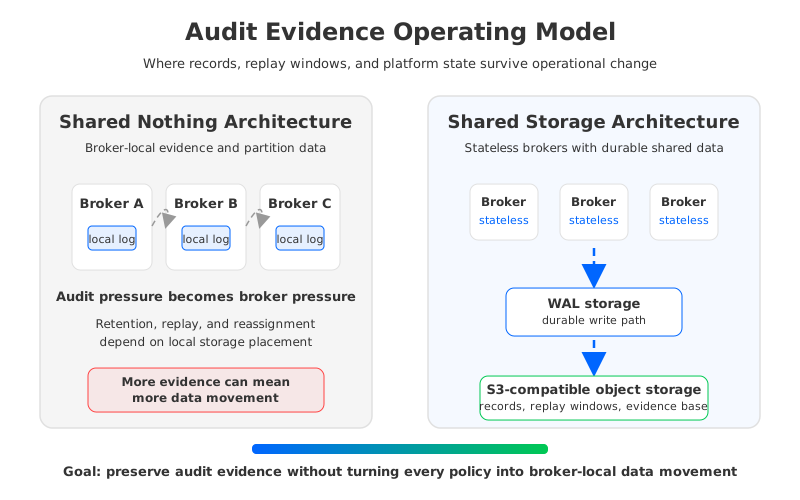
Traditional Kafka uses a Shared Nothing architecture. Each broker owns local log storage, partitions are placed on brokers, and replication keeps copies across broker nodes. That model is well understood, but it turns many governance decisions into broker-local capacity and data movement decisions. Keeping evidence longer means planning more storage. Replaying a suspicious interval means reading historical data while live traffic continues. Reassigning partitions during scale-out or maintenance can create operational noise exactly when the team wants a quiet, explainable system.
Tiered Storage helps by moving older log segments to remote storage, and it is useful for historical retention. It does not make brokers stateless or remove the need to reason about local hot data, leadership, metadata, and operational coordination. For audit evidence, the distinction matters. A team is not only trying to reduce storage pressure; it is trying to preserve a chain of custody through incidents, migrations, and policy changes.
Cost is part of the same constraint, even when the audit team does not own the bill. Evidence programs grow because each policy adds retained signals, each consumer adds access records, and every incident extends the question list. In cloud deployments, storage, data transfer, PrivateLink-style network paths, and regional boundaries all affect where evidence can live and how it can be accessed. The right architecture does not make governance free, but it keeps the cost model from fighting the control model.
3Architecture options and trade-offs
The practical platform choice is not "Kafka or governance." It is how much audit evidence belongs in the streaming platform, how much belongs in surrounding systems, and how much coupling the team can tolerate. Producer-side validation gives domain teams fast feedback, but it is hard to enforce across languages and release cycles. A schema registry gives centralized compatibility control, but schema validity does not prove data residency, access intent, or consumer behavior. A sidecar or stream processor can enrich audit records, but it becomes another runtime dependency.
A broker-centric approach can capture platform-level events close to the source of truth. That is attractive for authorization, topic changes, Consumer group changes, and controller activity. The trade-off is that the broker platform now has to carry both business traffic and evidence traffic. If the cluster is already storage-bound, adding audit retention and replay requirements can make a compliance control look like an availability risk.
A lake-centered approach stores audit trails and event snapshots outside Kafka. That is useful for long-term review, legal hold, and cross-domain analytics. The weakness is timing. During an incident, teams still need Kafka-native facts: which Offset was affected, which Consumer group committed past it, which connector task exported it, and whether the platform can replay the period without destabilizing current traffic. The lake can preserve evidence, but the streaming platform still has to explain how the evidence was produced.
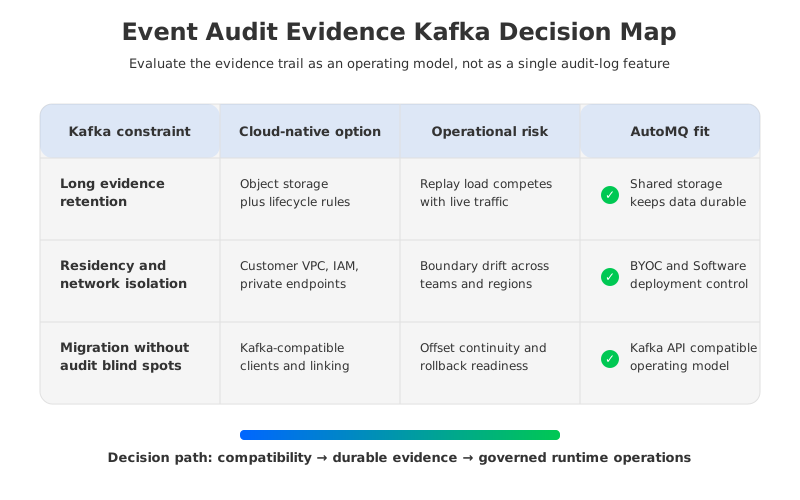
This decision map is a cleaner way to evaluate the options than asking whether one tool "does audit logs."
| Evaluation area | What to ask | Why it matters |
|---|---|---|
| Compatibility | Can existing Kafka clients, connectors, and operational tools keep working? | Audit controls fail when adoption requires a broad client rewrite. |
| Evidence durability | Where do runtime signals, records, metadata, and replay windows survive failure? | Evidence must outlive the incident that triggers review. |
| Cost model | Does retention, replay, and cross-boundary access grow predictably? | Compliance requirements usually expand rather than shrink. |
| Governance boundary | Can teams separate data plane, control plane, identity, and network ownership? | Security reviews need clear responsibility boundaries. |
| Migration path | Can the team preserve Offsets and rollback options while changing platforms? | Audit programs cannot pause production streams for a migration. |
The table deliberately separates the evidence problem from any one product feature. It also shows why the storage architecture is not a background detail. If records and runtime state remain tightly bound to broker-local storage, every governance requirement eventually becomes a broker operations question.
4Evaluation checklist for platform teams
An evidence architecture should be reviewed like a production system, not like a policy document. If a team cannot answer these questions, the gap will show up during an incident, an audit, or a migration.
- Identity and access: Confirm how producer identities, consumer identities, service accounts, topic ACLs, and operator actions are recorded. The record should identify both the caller and the resource boundary.
- Contract enforcement: Define where schema compatibility, required fields, privacy tags, and data contract exceptions are approved. A schema-only control is useful, but it does not cover every policy rule.
- Offset and replay evidence: Preserve enough information to connect a questionable event to affected Consumer groups, connector tasks, and downstream systems. A replay plan without Offset evidence is a recovery guess.
- Storage and retention: Document where raw events, rejected records, platform logs, metadata, and derived audit trails are retained. The retention plan should match the business value of the evidence, not only the default cluster setting.
- Network and residency: Show how traffic crosses Availability Zones, VPC boundaries, PrivateLink endpoints, and regions. Auditors will ask where data moved, not only where it was stored.
- Failure recovery: Test how evidence survives broker failure, controller failover, storage disruption, and operator mistakes. The audit system should have a recovery story before the incident.
- Migration and rollback: Decide how a platform change preserves client compatibility, Offsets, access controls, and evidence continuity. A clean migration is part of the audit design.
This checklist often exposes an uncomfortable truth: many organizations have policy coverage but weak runtime correlation. They can show that a rule exists, but they cannot quickly prove how it behaved for a specific event interval. The fix is to build an operating model where the platform produces evidence as a normal part of serving streams.
5How AutoMQ changes the operating model
When the evaluation points toward Kafka compatibility, customer-controlled deployment boundaries, and less broker-local state, AutoMQ is one architectural answer. AutoMQ is a Kafka-compatible streaming platform that keeps the Kafka protocol and ecosystem while changing the storage layer to a Shared Storage architecture. Brokers become stateless compute nodes, and durable stream data is stored in S3-compatible object storage through S3Stream and WAL (Write-Ahead Log) storage.
That shift changes how audit evidence is operated. In a Shared Nothing cluster, scaling or replacing brokers often means thinking about where partition data lives and how much data has to move. In AutoMQ's Shared Storage architecture, durable data is not tied to a broker's local disk. Broker replacement, scaling, and partition reassignment become more about metadata, leadership, cache warmup, and traffic routing than copying persistent data between machines. For governance teams, that reduces the number of operational events that can blur the evidence trail.
The deployment boundary carries the same weight as the storage boundary. AutoMQ BYOC runs the control plane and data plane inside the customer's cloud account and VPC, while AutoMQ Software is designed for customer-managed private environments. That matters for audit evidence because data residency, network isolation, cloud IAM, object storage ownership, and operational access are part of the compliance review. The platform can be evaluated without assuming that business records leave the customer's environment.
AutoMQ also fits the surrounding governance stack rather than replacing it. Kafka-compatible clients, Kafka Connect pipelines, Schema Registry integrations, data contract workflows, and observability systems can remain part of the control design. Features such as Kafka Linking, Self-Balancing, Table Topic, and zero cross-AZ traffic can then be assessed as operating-model capabilities: migration continuity, balanced load, direct lakehouse evidence paths, and clearer cloud network boundaries. The point is that Shared Storage architecture gives platform teams a simpler substrate for proving what happened.
6Readiness scorecard
Use this scorecard before turning audit evidence requirements into a platform selection. A strong score means the team knows which layer owns each signal and how the platform behaves when the signal is needed most.
| Area | Strong signal | Weak signal |
|---|---|---|
| Compatibility | Existing Kafka clients and tools continue with minimal change. | Audit design requires broad client rewrites before adoption. |
| Runtime evidence | Topic changes, identities, Offsets, Consumer groups, connector activity, and platform events can be correlated. | Evidence is scattered across teams and cannot be reconstructed quickly. |
| Storage model | Retention and replay plans are independent of fragile broker-local capacity assumptions. | Longer retention or replay immediately turns into broker disk pressure. |
| Security boundary | Control plane, data plane, VPC, IAM, network, and object storage ownership are explicit. | Reviewers cannot tell where sensitive records or control actions reside. |
| Migration risk | The team has a tested path for Offsets, rollback, linking, and evidence continuity. | A platform change creates a blind spot in the audit timeline. |
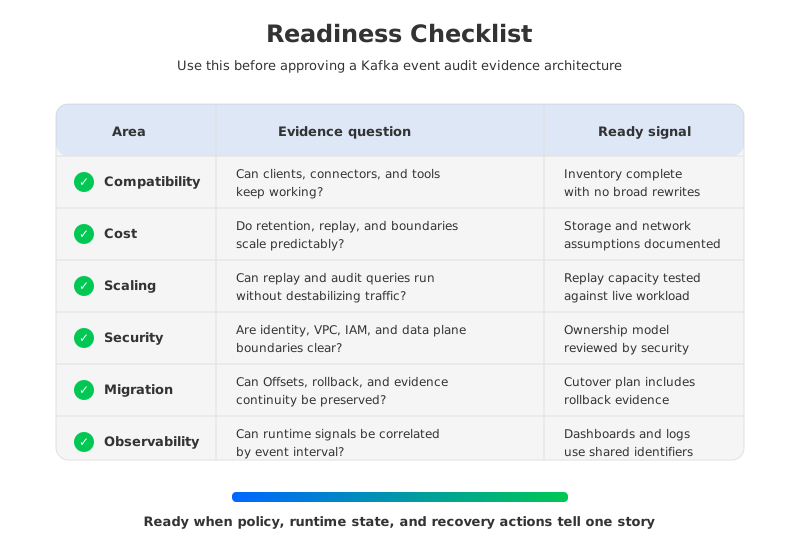
The scorecard should lead to a working backlog. If the weak signal is compatibility, start with client and connector inventory. If the weak signal is runtime evidence, define the correlation model before buying another logging tool. If the weak signal is storage, model retention and replay as first-class workloads. The audit question that began as event audit evidence kafka ends as a platform design question: can the system prove what happened without becoming harder to operate each time the policy gets stricter?
If you are evaluating a Kafka-compatible platform for governed streaming, review AutoMQ's deployment and architecture model through your own evidence checklist: start with AutoMQ BYOC or Software and test the controls that matter for your audit trail.
7FAQ
7.1Is Kafka enough for event audit evidence?
Kafka provides important primitives such as ordered partitions, Offsets, Consumer groups, transactions, and a broad client ecosystem. Event audit evidence also needs identity records, contract enforcement, access trails, retention policy, observability, and recovery procedures around Kafka.
7.2What is the difference between audit logs and event audit evidence?
Audit logs are one source of evidence. Event audit evidence connects application events, platform state, access records, schema or contract decisions, network boundaries, and replay capability so a team can explain what happened for a specific stream interval.
7.3Do data contracts replace audit evidence?
No. Data contracts define expectations for event shape, meaning, compatibility, and ownership. Audit evidence proves how those expectations behaved at runtime and whether exceptions, failures, or downstream effects were handled correctly.
7.4Where should AutoMQ appear in an evaluation?
Evaluate the neutral requirements first: compatibility, evidence durability, cost model, governance boundary, recovery, and migration risk. AutoMQ becomes relevant when the team wants Kafka compatibility with Shared Storage architecture, stateless brokers, object-storage-backed durability, and customer-controlled deployment boundaries.
8References
- Apache Kafka official documentation
- Apache Kafka Tiered Storage
- Apache Kafka transactions
- Apache Kafka Connect
- Apache Kafka KRaft
- AutoMQ compatibility with Apache Kafka
- AutoMQ Shared Storage architecture overview
- AutoMQ WAL storage
- AutoMQ zero cross-AZ traffic
- AutoMQ Table Topic overview
- AWS S3 pricing
- AWS PrivateLink pricing


