
Table of Contents
Table of Contents
Teams search for multi tenant governance kafka when the streaming platform has crossed a threshold. A single Kafka estate is no longer serving one application team with a few event streams. It is serving product analytics, fraud detection, lakehouse ingestion, machine learning features, operational dashboards, audit trails, and customer-facing services that all want different guarantees from the same runtime.
That is where governance stops being a policy document and becomes an operating problem. The question is no longer "who owns this topic?" in a catalog. It is whether the platform can prove, during production traffic, that each tenant has the right access, the right isolation, the right retention window, the right recovery path, and the right evidence for review. The hard part is that Kafka makes sharing useful before it makes sharing governable.
Multi-tenant governance for Kafka should therefore be evaluated as a runtime control loop: declare policy, enforce it close to the stream, observe tenant-specific signals, and adjust capacity or access before one tenant's behavior becomes another tenant's incident.
1Why teams search for multi tenant governance kafka
A platform team usually starts with a practical goal: reduce cluster sprawl. Instead of every domain running its own Kafka cluster, the organization wants a shared platform with consistent security, monitoring, schema practice, and cost reporting. That move is rational. Kafka is a platform dependency, and platform dependencies benefit from standardization.
The trouble appears when "shared" is mistaken for "undifferentiated." One tenant needs low-latency operational events. Another needs long retention for compliance replay. A third runs periodic backfills that create catch-up reads. A fourth owns sensitive customer attributes and needs tighter access review. If those workloads land on the same cluster without tenant-aware operating signals, the shared platform turns into a negotiation surface.
The most common symptoms are familiar to Kafka operators:
- Noisy tenants become infrastructure incidents. A producer burst, consumer replay, or connector backlog consumes broker, disk, network, or quota headroom that other tenants assumed was available.
- Governance is enforced too late. Ownership, schema compatibility, data classification, and access reviews are recorded in external systems, while the runtime path keeps accepting unsafe or poorly understood traffic.
- Cost attribution is too coarse. Teams can see cluster spend, but they cannot connect it cleanly to topic retention, replay behavior, broker-local storage growth, or cross-zone traffic.
- Recovery plans are written at cluster level. Tenant-specific rollback, replay, and migration plans are harder when data placement and capacity are tied to broker-local state.
None of these problems means Kafka is the wrong abstraction. The opposite is true: Kafka became important enough that many teams now depend on it as shared infrastructure. The governance model has to mature from static approval to tenant-aware runtime evidence.
2The production constraint behind the problem
Apache Kafka's core model is intentionally simple for clients: producers write to topics, consumers read ordered records by Partition and Offset, and Consumer groups coordinate parallel consumption. Those semantics are part of why Kafka became the default backbone for event-driven systems. Governance teams should respect that model instead of trying to wrap it in a separate control plane that application teams never use.
The constraint sits lower in the stack. Traditional Kafka uses a Shared Nothing architecture: each broker owns local storage, partitions are placed on brokers, and durability is maintained through replica placement and ISR (In-Sync Replicas). This design works well when the operating model is cluster-centric. Multi-tenancy pushes it harder because tenant policy starts to depend on where data lives, how much broker-local capacity is reserved, how rebalancing works, and how quickly the platform can isolate a tenant that changes behavior.
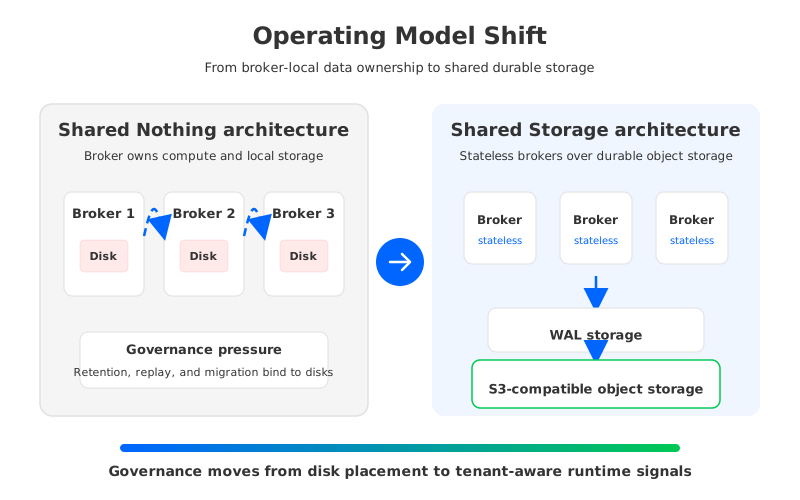
Broker-local storage turns several governance questions into operational chores. Retention policy becomes a disk reservation problem. Tenant migration becomes a partition movement problem. Noisy tenant isolation becomes a capacity and placement problem. Recovery after broker failure involves leadership movement, replica health, and local data catch-up. Even when the policy is clear, the runtime system may need expensive data movement before the policy can be enforced cleanly.
Cloud deployment adds another layer. Multi-AZ Kafka is often required for resilience, but cross-zone replication and client traffic must be understood as part of the operating cost model. Private networking, VPC (Virtual Private Cloud) boundaries, IAM policy, object storage policy, audit logs, and regional controls all become part of the compliance review. A governance program that ignores cloud primitives will miss the actual enforcement points.
3Architecture options and trade-offs
There is no single architecture that fits every multi-tenant Kafka estate. A team serving a handful of internal services has a different problem from a regulated platform serving hundreds of tenants across regions. The evaluation should start with the control objectives, then map each objective to runtime signals and operational mechanisms.
| Option | When it fits | Governance strength | Operational trade-off |
|---|---|---|---|
| Dedicated cluster per tenant | Strict isolation, clear blast-radius boundaries, separate compliance regimes | Strong separation and simpler tenant attribution | More clusters to patch, monitor, scale, and migrate |
| Shared cluster with quotas and ACLs | Teams share platform standards and have similar workloads | Centralized policy, lower platform sprawl | Noisy workloads still compete for broker, disk, and network headroom |
| Domain-based shared clusters | Tenants are grouped by business domain, sensitivity, or SLO | Better ownership alignment than one global cluster | Requires clear placement rules and ongoing capacity governance |
| Kafka-compatible cloud-native platform | Teams want Kafka APIs with a different storage and scaling model | Governance can align with cloud resource boundaries and elastic operations | Requires architecture validation, migration planning, and compatibility testing |
This table is less about picking a winner than making the hidden choices visible. Dedicated clusters can be the right answer for hard isolation. Shared clusters can be the right answer when tenants have similar SLOs and a strong platform team. Domain-based clusters often work as an intermediate state. A cloud-native Kafka-compatible platform becomes relevant when the limiting factor is no longer the Kafka API, but the cost and operational coupling created by broker-local storage.
The key is to define what the platform must prove. For a multi-tenant governance program, the answer usually includes five types of runtime evidence: identity, access, data contract health, resource consumption, and recovery readiness. If any of those signals exist only in a spreadsheet, the platform is not governing the live system; it is documenting intent.
4Evaluation checklist for platform teams
Start with a neutral checklist before comparing products or deployment models. It prevents the discussion from collapsing into a feature list and gives security, data governance, SRE, FinOps, and application owners a shared review language.
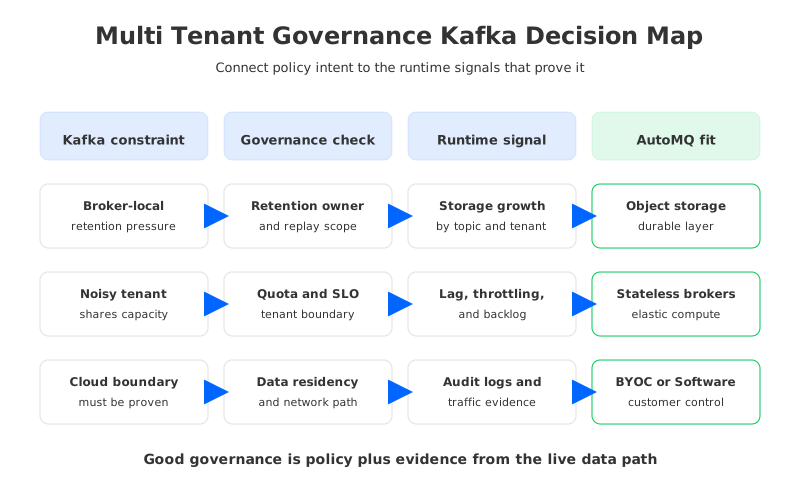
| Review area | Questions to answer | Runtime signals to collect |
|---|---|---|
| Compatibility | Can existing producers, consumers, Kafka Connect workers, Schema Registry integrations, and client libraries continue to work? | Client version inventory, protocol errors, consumer rebalance behavior, transactional producer usage |
| Tenant identity | Which teams, services, and machine identities can create, write, read, replay, or delete resources? | ACL changes, service account usage, authentication failures, privileged operation logs |
| Data contracts | Which topics require schema compatibility, owner approval, sensitive-field review, or reject handling? | Schema change history, incompatible writes, dead-letter topics, contract violation rate |
| Resource isolation | How are tenant quotas, replay windows, connector load, retention, and burst behavior bounded? | Produce and fetch throughput, Consumer lag, storage growth, quota throttling, connector backlog |
| Cost attribution | Can teams explain which tenants drive storage, network, compute, and object storage requests? | Topic-level retention, read fan-out, cross-AZ traffic, object storage usage, compute utilization |
| Recovery and rollback | Can a tenant replay, roll back, or migrate without disrupting other tenants? | Offset checkpoints, lag recovery time, backup status, migration sync status, rollback runbooks |
| Audit evidence | Can reviewers reconstruct who changed policy, who accessed sensitive streams, and what happened during an incident? | Control-plane audit logs, broker logs, schema history, metric snapshots, incident annotations |
The checklist should produce decisions, not paperwork. If tenant A needs 30 days of replay while tenant B needs 24 hours, the platform should expose that difference in retention, cost, and recovery testing. If a sensitive topic is allowed only to specific consumers, the runtime should show access attempts and policy changes. If one tenant triggers a large replay, SREs should see the effect on lag, fetch throughput, cache pressure, and other tenants before the shared cluster becomes a shared outage.
5How AutoMQ changes the operating model
Once the evaluation reaches storage, elasticity, and customer-controlled deployment boundaries, AutoMQ becomes relevant as a Kafka-compatible, cloud-native streaming platform. It keeps Kafka protocol and API compatibility while changing the storage layer from broker-local logs to a Shared Storage architecture backed by S3-compatible object storage.
That architectural change matters for multi-tenant governance because it separates two concerns that traditional Kafka tends to bind together: compute capacity and durable stream data. AutoMQ Brokers are stateless brokers. Durable data is stored through S3Stream, with WAL (Write-Ahead Log) storage used for write durability and recovery. Broker replacement, scaling, and partition reassignment no longer require the same kind of large broker-local data movement that a Shared Nothing architecture creates.
For governance teams, the practical effect is not "governance becomes automatic." It does not. Teams still need tenant ownership, ACLs, schemas, data contracts, monitoring, incident process, and access review. The difference is that the platform's operating model has fewer hidden dependencies between a tenant's data history and a specific broker's disk. That makes several controls easier to reason about.
- Retention can be reviewed as a storage policy, not only a broker disk budget. Object-storage-backed durability lets teams discuss tenant replay windows with cloud storage controls and cost attribution in view.
- Scaling can respond to tenant load without turning every change into a data relocation project. Stateless brokers and metadata-driven reassignment reduce the operational penalty of adding or replacing compute capacity.
- Deployment boundaries can align with customer controls. AutoMQ BYOC runs control plane and data plane components in the customer's cloud account and VPC, while AutoMQ Software targets customer-managed private environments.
- Network and regional decisions stay visible. When evaluating zero cross-AZ traffic, PrivateLink-style access patterns, regional buckets, and audit controls, teams can map Kafka runtime behavior to cloud-native boundaries.
AutoMQ also fits the compatibility side of the checklist. Existing Kafka clients, topic concepts, Consumer groups, offsets, transactions, Kafka Connect integrations, and ecosystem tools remain central to the evaluation. That is important for governance because the most expensive migration is often not broker replacement; it is rewriting the operational knowledge encoded in producers, consumers, dashboards, runbooks, and data contracts.
6A readiness scorecard for migration and rollout
A multi-tenant governance rollout should move tenant groups in a controlled order. Start with tenants that have clear ownership, moderate throughput, clean schemas, and rollback paths. Avoid using the most sensitive or highest-throughput tenant as the first proof point unless the organization is prepared to run a deeper parallel validation.
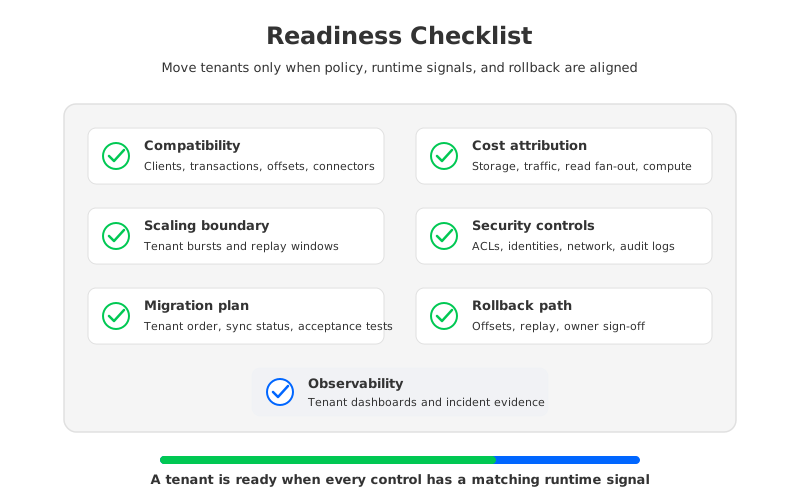
Use a scorecard like this before changing cluster boundaries or storage architecture:
| Dimension | Ready signal | Risk signal |
|---|---|---|
| Ownership | Every topic has an owning team and escalation path | Shared topics exist without a named runtime owner |
| Compatibility | Client versions, transactions, connectors, and offset behavior are inventoried | Unknown clients depend on undocumented broker behavior |
| Security | ACLs, service accounts, network paths, and audit logs are reviewed | Access policy is managed through tickets without runtime verification |
| Data contracts | Schema compatibility and sensitive-field review are enforced for critical streams | Contract violations are found after downstream fan-out |
| Cost | Retention, read fan-out, and traffic are attributable by tenant | Cluster spend is allocated by guesswork |
| Recovery | Tenant replay and rollback are tested before migration | Recovery exists only as a cluster-level runbook |
| Observability | Tenant dashboards show lag, throughput, errors, storage growth, and policy events | SREs see broker health but not tenant impact |
The scorecard creates a better migration conversation. Instead of asking whether the organization is "ready for multi-tenancy," it asks which tenant is ready, which control is missing, and which runtime signal must be added before the next step. That framing keeps governance tied to production behavior.
If your Kafka estate is moving from cluster sprawl toward a governed shared platform, evaluate the storage model, tenant signals, and deployment boundary together. The next step is to test the operating model with real workloads, not slides. You can explore AutoMQ's Kafka-compatible architecture and BYOC deployment path here: start with AutoMQ.
7FAQ
7.1Is multi-tenant Kafka governance the same as Kafka security?
No. Security is a core part of it, especially authentication, authorization, network isolation, encryption, and audit logs. Multi-tenant governance also includes ownership, schema and data contract policy, tenant-level observability, cost attribution, replay control, migration readiness, and recovery evidence.
7.2Should every tenant get a dedicated Kafka cluster?
Not always. Dedicated clusters provide strong blast-radius boundaries, but they increase platform operations. Many teams use a mix: dedicated clusters for strict isolation, domain-based shared clusters for related tenants, and shared platform services where workloads have compatible SLOs and governance needs.
7.3How do data contracts fit into multi-tenant governance?
Data contracts define what a stream is allowed to mean at runtime: schema, compatibility rules, ownership, sensitive fields, reject handling, and downstream expectations. In a multi-tenant platform, contracts help prevent one producer's change from becoming many consumers' incident.
7.4Does a Shared Storage architecture remove the need for quotas?
No. Shared Storage architecture changes data placement and scaling mechanics, but quotas remain important. Tenants still need limits on produce rate, fetch behavior, connector load, replay windows, and administrative operations.
7.5What should teams validate before migrating from traditional Kafka?
Validate client compatibility, transactional behavior, Consumer group and Offset handling, connector behavior, topic configuration, schema workflows, network paths, observability, rollback, and tenant-level cost attribution. Migration should be measured by workload behavior, not only by broker health.


