
Table of Contents
Table of Contents
Teams usually search for connector migration self managed kafka after the easy part has already worked. A source connector is moving database changes, SaaS events, files, or application records into Kafka. The pipeline has consumers, dashboards, alerts, and downstream jobs that expect those topics to behave in a familiar way. Then the platform team starts asking a harder question: can we move the connector estate without turning every source system and every consumer into a migration project?
That question is different from "which connector should we use?" The risky part is the contract around the connector: the Kafka API, internal Connect topics, offsets, consumer progress, schemas, security rules, network path, retry behavior, and rollback evidence. Connector migration becomes a platform problem because the connector often exposes a Kafka cluster sized for yesterday's retention, traffic, and failure model.
The practical goal is boring continuity. Producers from source systems should keep writing. Consumers should keep reading predictable records. Platform engineers should get a cleaner operating model without asking application teams to relearn Kafka semantics. That is the lens for evaluating a move from self-managed clusters to a Kafka-compatible streaming platform.
1Why Teams Search for connector migration self managed kafka
Self-managed Kafka and Kafka Connect often enter a company through a clear local need: move data from source systems into streams with a framework engineers understand. Kafka Connect gives the team a standard way to run connectors, split work into tasks, and store connector configuration, offsets, and status in Kafka.
The same design raises the stakes during migration. A connector is not a stateless batch job. It has upstream permissions, task assignment, plugin dependencies, converter behavior, schema assumptions, and offsets that determine where it resumes. The Kafka cluster also has topics, partitions, retention, compaction, ACLs, quotas, Consumer group progress, and broker metrics. Moving only the worker process leaves the harder part untouched.
The search term usually hides several production worries:
- Will source systems be read twice or skipped? CDC connectors, file readers, and queue readers all depend on position tracking. The migration plan must prove how connector offsets and upstream positions are preserved or intentionally reset.
- Will downstream consumers see a different stream? Topic names, record keys, serialization, timestamps, headers, and ordering assumptions need explicit validation before traffic moves.
- Will worker operations improve, or only move? A replacement runtime that keeps the same plugin drift, restart patterns, and opaque task failures may reduce one burden while preserving another.
- Will the Kafka platform absorb replay and catch-up traffic? Connector migration often creates bursts: snapshots, backfills, dual-running, lag catch-up, and validation reads.
That last point is where connector migration stops being only a Connect worker project. The destination platform must handle migration storage and scaling behavior.
2The Production Constraint Behind the Problem
Traditional Kafka runs as a Shared Nothing architecture. Each broker owns local or broker-attached storage, and each Partition has replicas distributed across brokers. This familiar model couples serving capacity, persistent storage, and data movement. When the connector estate grows, that coupling shows up in plain operational work: expand disks, rebalance partitions, tune retention, manage cross-Availability Zone replication, and reserve broker headroom for catch-up reads.
Connector workloads make this coupling more visible because their traffic pattern is uneven. A CDC connector may sit quietly for hours and then replay a backlog after a database failover. A sink connector may retry batches when the target system throttles. A source connector may run a snapshot that creates traffic unlike normal incremental updates. Kafka Connect can coordinate tasks, but it cannot remove the broker-local storage responsibilities of the Kafka cluster beneath it.
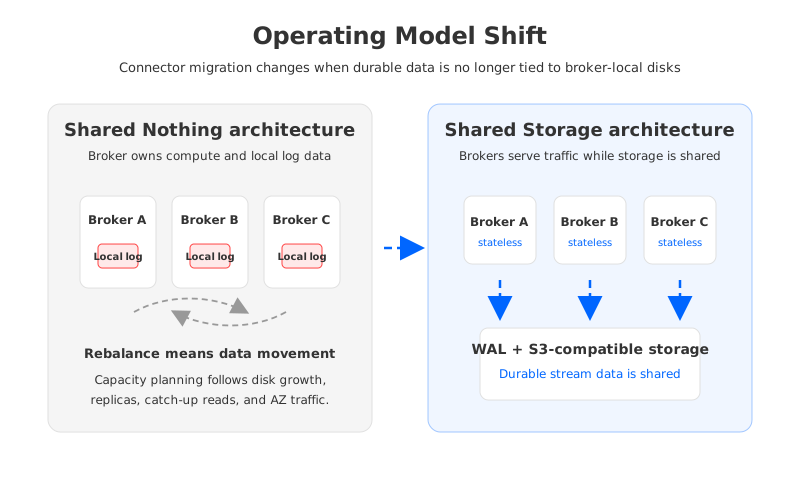
This is why platform teams should avoid treating connector migration as a worker replacement exercise. Worker placement matters, but the root constraint is usually lower in the stack. If durable data is tied to broker disks, connector retention or replay growth becomes broker storage growth. If Partition movement requires copying log data, resizing competes with live connector traffic. If replicas cross zones, the migration may carry a network cost and failure-domain model that the connector team does not own.
The point is not that self-managed Kafka is wrong. It gives teams control and a large ecosystem. The issue is an operating model that no longer matches the workload. The evaluation should ask what must remain Kafka-compatible and what can change underneath that contract.
3Architecture Options and Trade-offs
There are three common paths for connector migration from self-managed Kafka. They overlap in practice, but separating them helps the team avoid mixing unrelated decisions.
| Path | What changes | What stays hard |
|---|---|---|
| Keep self-managed Kafka, move Connect workers | Worker deployment, plugin packaging, and runtime ownership can improve. | Broker storage, retention growth, Partition movement, and platform capacity planning remain largely the same. |
| Move to managed Kafka Connect only | Task scheduling, worker lifecycle, and connector operations can move into a managed layer. | Kafka topic design, offsets, replay, data governance, and destination cluster economics still need review. |
| Move to a Kafka-compatible cloud-native platform | Kafka clients and Connect patterns can stay familiar while the storage and scaling model changes. | The team must validate compatibility, security boundaries, migration order, and rollback behavior. |
The right answer depends on where the pressure is coming from. If the main pain is plugin packaging and worker restarts, a managed Connect layer may be enough. If the pain is broker disk growth, long retention, replay cost, and slow capacity changes, the Kafka platform deserves the same attention as the connector runtime.
A useful architecture review starts with compatibility, not product names. Kafka Connect stores connector configuration, offsets, and status in Kafka topics in distributed mode. Consumers depend on Consumer group coordination and committed offsets. Transactional or idempotent producer behavior may matter. Security controls need to map across authentication, authorization, encryption, and audit requirements. A migration that breaks these surfaces is an application rewrite wearing a platform label.
The cloud dimension adds another trade-off. Connector workers need network access to source and sink systems. Some sources sit inside private VPCs. Some sinks require private connectivity, static egress, or strict IAM boundaries. Some connectors need access to object storage, databases, queues, or SaaS endpoints. The platform choice should make these paths explicit, because the wrong network location can create more risk than the Kafka cluster it replaced.
4Evaluation Checklist for Platform Teams
The decision map below is a compact way to structure the review. Start with the current constraint, choose the platform change that actually addresses it, and then test the migration risk before introducing AutoMQ or any other destination into the plan.
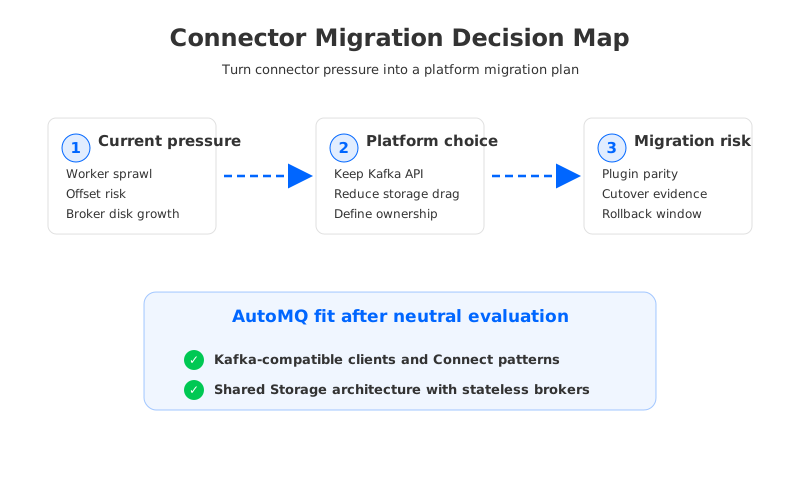
The checklist should be evidence-based. A green row means the team has a test result, inventory, or runbook, not a verbal agreement.
- Compatibility inventory: Record connector class names, plugin versions, converters, Single Message Transforms, topic naming, key format, schema dependencies, internal Connect topics, and any custom code. Include the Kafka client and broker versions used by applications that read from migrated topics.
- Offset and resume plan: Decide whether each connector resumes from existing offsets, starts from a fresh position, or runs a controlled snapshot. For consumers, prove where each Consumer group resumes after cutover.
- Topic and retention review: Map topic partitions, compaction, retention, replication expectations, and replay windows. Connector migration often exposes topics that were created for a proof of concept and never revisited.
- Security and network boundary: Document source credentials, secret storage, ACLs, TLS or mTLS requirements, IAM roles, private routes, egress policy, and audit evidence.
- Failure and rollback criteria: Define lag thresholds, duplicate-read checks, stop conditions, and a rollback window before traffic moves. A rollback plan written after the cutover is usually an incident report.
- Observability baseline: Capture connector task status, error rate, retry count, source lag, Kafka lag, broker storage, fetch latency, and downstream consumer health before and after migration.
The evaluation should also include cost, but not as a vague "lower cost" promise. Break it into observable parts: broker compute, broker storage, retained data, inter-zone replication, Connect worker compute, network egress, operational time, and failure recovery effort. If no one owns a cost line, no one will notice when the migration moves it to another team.
5How AutoMQ Changes the Operating Model
After the neutral checklist is complete, AutoMQ becomes relevant for teams that want Kafka compatibility while changing the storage and scaling model underneath connector workloads. AutoMQ is a Kafka-compatible cloud-native streaming platform built around Shared Storage architecture. It keeps the Kafka protocol surface familiar while moving durable stream storage from broker-local disks into S3-compatible object storage through S3Stream and WAL (Write-Ahead Log) storage.
For connector migration, that architecture changes the operating model in three ways. Stateless brokers reduce durable data tied to a specific broker, so capacity changes and broker replacement are less dominated by copying local log segments. Object-storage-backed durability makes retention and replay planning less dependent on preallocated broker disks. AutoMQ BYOC keeps the control plane and data plane inside the customer's cloud environment, which matters when connectors need private access to databases, queues, object storage, or internal services.
AutoMQ BYOC also provides Managed Connector capability for teams that want Kafka Connect task management through the AutoMQ Console while keeping workers in their own network boundary. This does not remove compatibility testing. It changes who operates the workers, how the connector lifecycle is managed, and how the connector estate fits into the same Kafka-compatible platform as the topics it reads from or writes to.
The important distinction is that AutoMQ is not a replacement for every connector framework. Kafka Connect still provides the execution model, and source-specific connectors still determine how each upstream system is read. AutoMQ changes the Kafka platform below those connectors: Shared Storage architecture, stateless brokers, object-storage-backed durability, Self-Balancing, and customer-controlled BYOC deployment boundaries.
For a migration plan, the AutoMQ-specific review should answer these questions:
| Area | Question to answer |
|---|---|
| Kafka compatibility | Do producers, consumers, admin tools, and Connect workers behave as expected against the destination cluster? |
| Worker boundary | Should connectors run as self-managed workers, AutoMQ Managed Connector tasks, or a staged mix during migration? |
| Storage model | Which retention and replay workloads benefit from durable data being stored in shared object storage rather than broker-local disks? |
| Network control | Do BYOC placement, private routing, IAM, secrets, and audit requirements match the source and sink systems? |
| Cutover evidence | Can the team prove offset behavior, consumer progress, task health, and rollback criteria before moving production traffic? |
This is also where migration tooling matters. For open-source Kafka migrations, teams often evaluate MirrorMaker2 and application-level dual writes or dual reads. For AutoMQ commercial editions, Kafka Linking can be part of a broader migration plan when the goal is to preserve message positions and Consumer group progress while moving traffic. The tool choice should follow the workload requirement: byte-level continuity, consumer resume behavior, acceptable downtime, and rollback confidence.
6A Readiness Scorecard for Connector Migration
A migration is ready when the team can point to evidence for each row, not when the destination cluster has been created. The scorecard below keeps the review concrete.
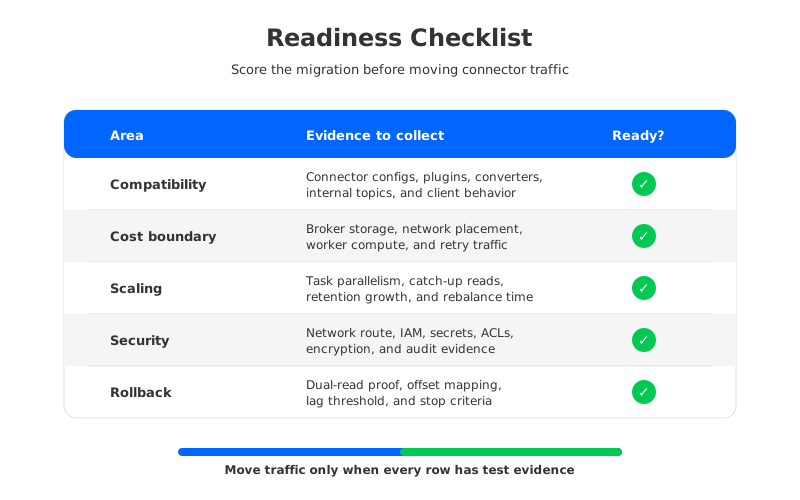
Use a simple scoring model. Score each row from 0 to 2: 0 means unknown, 1 means documented but not tested, and 2 means tested in an environment that represents production risk. A connector estate with any 0 should not move production traffic. Many 1s may be enough for a pilot, but not a broad cutover. The value is not mathematical precision; it forces the team to admit where the migration is still based on belief.
The strongest migration plans start small. Pick one connector whose upstream system, downstream consumers, and rollback path are well understood. Run it through the same worker deployment, security boundary, topic mapping, offset plan, and observability model that the larger estate will use. Then migrate a connector with a different shape: CDC, sink, high-throughput source, long-retention topic, or strict private-network dependency. The second pilot usually reveals whether the plan is a framework or a one-off script.
Back to the original search. connector migration self managed kafka is not a request for a generic checklist. It signals a team that wants to keep the Kafka integration contract while reducing platform drag. Treat the migration as a contract test across source systems, Connect workers, Kafka topics, consumers, storage, network, and rollback. If the evidence points to a storage and scaling problem, evaluate AutoMQ's Kafka-compatible Shared Storage architecture and Managed Connector model as part of that platform decision. A practical next step is to review the AutoMQ BYOC path against your own connector inventory and migration scorecard.
7FAQ
7.1Is connector migration the same as Kafka migration?
No. Connector migration may include Kafka migration, but it has extra state around plugins, worker tasks, connector offsets, source-system positions, converters, schemas, and task status. Kafka migration focuses on topics, records, offsets, brokers, clients, and cluster behavior. A production connector migration needs both views.
7.2Can Kafka Connect workers move before the Kafka cluster?
Yes, if the goal is worker operational improvement and the existing Kafka cluster remains healthy. The team still needs to validate internal Connect topics, worker group behavior, plugin versions, network routes, and restart behavior. Moving workers first does not solve broker storage growth or long-retention pressure.
7.3Where should AutoMQ appear in the decision process?
AutoMQ should appear after the team has identified a Kafka platform operating-model problem. If the main issue is plugin packaging, Managed Connector may be enough. If the issue includes broker-local storage, elastic scaling, replay windows, and data-plane ownership, AutoMQ's Shared Storage architecture and BYOC model become relevant.
7.4What is the most common rollback mistake?
The most common mistake is treating rollback as a DNS or bootstrap-server switch. Connector rollback also needs upstream position handling, duplicate-read or missed-read checks, Consumer group progress, task status, and downstream validation. Without those checks, the team may return traffic to the old cluster while carrying corrupted assumptions forward.


