
Table of Contents
Table of Contents
Searches for mainframe event modernization kafka rarely come from teams that are curious about streaming in the abstract. They usually come from teams that already have source systems feeding nightly files, MQ bridges, ETL jobs, or database replication pipelines, and the business is asking for fresher data without putting core transaction systems at risk. The question is not whether Apache Kafka can move events. The harder question is whether the whole operating model around those events can survive production pressure.
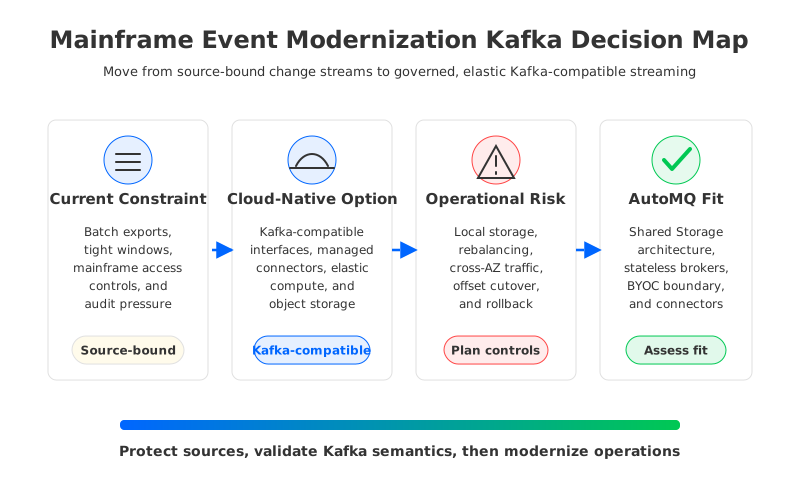
That pressure shows up in familiar places. A payments team wants authorization events in a fraud model within seconds. A customer data platform wants account changes before an agent refreshes the screen. A risk team wants immutable event history, while the mainframe team wants strict control over extraction windows, access methods, and rollback. Kafka-compatible streaming can connect these worlds, but it also turns batch integration into a platform problem: capacity planning, governance, offsets, schema evolution, recovery, and cloud cost.
The useful way to approach mainframe event modernization with Kafka is to avoid treating it as connector selection. Connector choice matters, but it is only the first boundary. Once events leave the source system, the streaming platform becomes the durable system of movement for operational data. If that platform inherits too much stateful infrastructure complexity, the program can trade source-system bottlenecks for Kafka operations bottlenecks.
1Why teams search for mainframe event modernization kafka
Mainframe modernization programs tend to start with a simple aspiration: make core business events available to downstream systems without forcing every consumer to integrate directly with the source. Kafka is attractive because it gives teams a shared commit log, consumer groups, offsets, and a large ecosystem around Kafka Connect, stream processing, monitoring, and governance. Those primitives match the integration pattern well: one extraction path from the source, many controlled consumers downstream.
The catch is that mainframe data is rarely a single clean event stream. Some feeds come from change data capture, some from logs, some from files, and some from application exits or middleware. Each source has its own ordering guarantees, failure modes, and operational owner. The Kafka side must normalize those differences without pretending they disappear. A robust design makes source constraints explicit: which records are replayable, which require deduplication, which need strict ordering, and which consumers can tolerate delay.
That is why the first design review should focus on semantics before infrastructure. Kafka offsets help consumers track progress, but they do not automatically define business correctness. Transactions can help atomic writes across partitions, but they still require a deliberate producer and consumer design. Consumer groups make fan-out efficient, but they also introduce rebalance behavior and lag signals that operations teams must understand. For mainframe event modernization, Kafka is the coordination layer, not a magic adapter.
2The production constraint behind the problem
The biggest mistake is to evaluate the target platform as if it only has to ingest the average event rate. Mainframe feeds often have burst patterns: end-of-day batch windows, catch-up after source maintenance, replay after a connector failure, or a sudden downstream demand for historical reconstruction. The platform has to absorb those bursts while protecting source systems and keeping consumer recovery predictable.
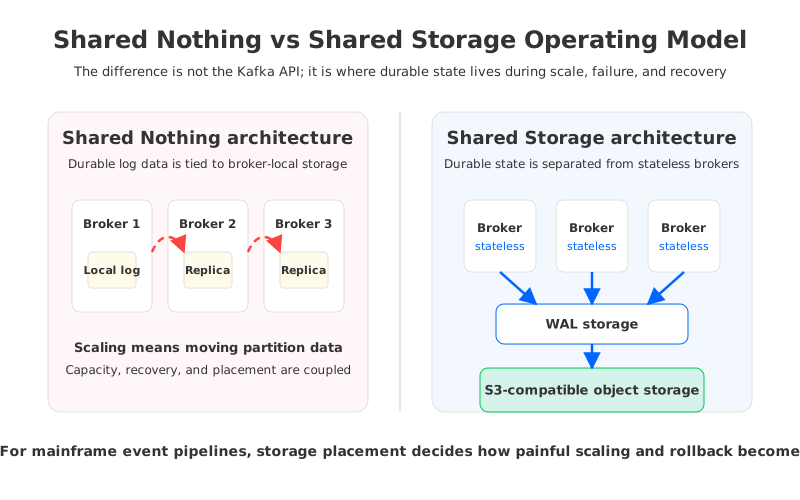
Traditional Kafka deployments solve durability through Shared Nothing architecture. Each broker owns local storage, partition replicas are placed on different brokers, and the cluster moves data when partitions are reassigned. This model is proven, but it couples compute, storage, and recovery behavior. When throughput grows, teams add brokers and storage. When a node fails, recovery depends on replicas and leader movement. When placement changes, data movement can become the slow part of the operation.
In a mainframe modernization project, that coupling matters because the stream is not an isolated analytics pipeline. It becomes a dependency for many operational systems. A slow rebalance can delay a capacity change. Broker-local storage can turn retention decisions into disk planning. Cross-Availability Zone replication and inter-zone traffic can become a recurring cost line in cloud deployments. None of these issues invalidate Kafka, but they change the real budget and risk profile behind the architecture.
3Architecture options and trade-offs
A realistic architecture discussion usually lands on three options. The right answer depends on team boundaries, latency targets, regulatory requirements, and how much platform ownership the organization wants to carry.
| Option | Where it fits | Main trade-off |
|---|---|---|
| Self-managed Kafka | Teams with deep Kafka operations skills and strict control over every broker, disk, and network path. | Maximum control, but storage, scaling, upgrades, and incident response remain internal responsibilities. |
| Managed Kafka service | Teams that want to reduce infrastructure ownership while staying within a vendor-managed operating model. | Less broker management, but cost, networking, connector boundaries, and migration controls still need careful review. |
| Kafka-compatible cloud-native platform | Teams that want Kafka APIs with a different storage and scaling model. | Requires architecture validation, but can reduce the amount of broker-local state the team has to operate. |
The table is deliberately neutral. Mainframe event modernization is not a contest of feature checklists; it is a question of where operational state should live. If local disks remain the center of durability, partition placement, replication traffic, and storage growth remain core concerns. If durable state moves to shared object storage, the platform changes the relationship between brokers, storage, and recovery, but the team must validate latency, WAL behavior, security boundaries, and compatibility.
Kafka Tiered Storage deserves a separate mention because it is often confused with a full storage redesign. Tiered Storage can move older log segments to remote storage while brokers still keep recent data locally. That helps retention economics for many workloads, but it does not make brokers stateless. A diskless Shared Storage architecture changes a different layer: persistent stream data is designed around shared object storage, with brokers focused on protocol handling, caching, and coordination.
4Evaluation checklist for platform teams
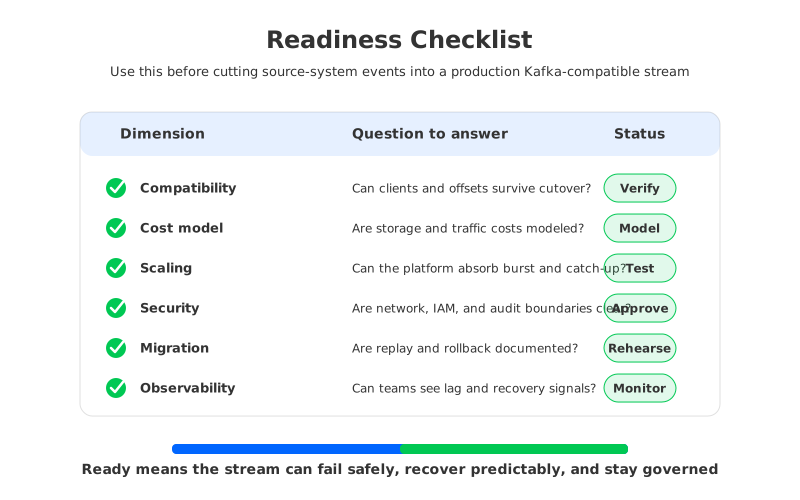
The practical evaluation starts with a scorecard, not a demo. A demo can show that events move. A scorecard shows whether the architecture can become a production dependency without surprising the source-system, platform, security, and application teams later.
Use these questions before committing to a target design:
- Compatibility: Which Kafka client versions, protocol features, serializers, Schema Registry workflows, Kafka Connect plugins, transactions, ACLs, and admin operations must work without application rewrites? Compatibility should be tested against the actual client mix, not inferred from broad marketing language.
- Source protection: How will extraction throttle, pause, resume, and replay without overloading the mainframe or violating maintenance windows? The source team needs a control surface, not a downstream promise.
- Cost model: What are the compute, storage, object storage request, network, PrivateLink, cross-AZ, connector, and observability cost drivers? Avoid using storage price alone as the proxy for Total Cost of Ownership.
- Elasticity: What happens during catch-up reads, bursty change streams, and consumer lag recovery? The platform should scale for the burst path, not only for steady-state ingestion.
- Governance: Where are schemas, lineage, encryption, access control, audit logs, and retention policies enforced? Mainframe events often carry sensitive business data, so governance cannot be postponed until after ingestion.
- Migration and rollback: Can you rehearse dual-run, offset validation, consumer cutover, and rollback without inventing a new process during an incident? A migration plan that cannot be rehearsed is a risk register, not a plan.
- Observability: Can operators correlate connector health, producer errors, consumer lag, broker health, storage behavior, and downstream SLOs? The first production incident will cross at least two team boundaries.
The key pattern is that every item connects a Kafka mechanism to an operating responsibility. Offsets are not only a consumer API concept; they are part of cutover and rollback. Retention is not only a topic configuration; it affects audit, replay, and storage spend. Connectors are not only data movers; they define backpressure behavior and source-system risk.
5How AutoMQ changes the operating model
Once the evaluation framework is clear, AutoMQ becomes relevant as a specific architectural answer: it is a Kafka-compatible, cloud-native streaming platform that keeps Kafka protocol semantics while changing the storage layer underneath. Instead of binding durable stream data to broker-local disks, AutoMQ uses Shared Storage architecture with S3-compatible object storage and stateless brokers. The point is not to make Kafka applications learn a new protocol. The point is to change what the platform team has to operate when capacity, recovery, and placement change.
In this model, brokers remain responsible for Kafka protocol handling, request routing, leadership, caching, and scheduling, while durable data is stored through S3Stream. WAL (Write-Ahead Log) storage handles the low-latency durability path before data is organized into object storage. Because persistent data is not tied to a specific broker disk, broker replacement and partition reassignment no longer mean bulk data movement. Operational changes can focus more on traffic ownership and metadata, and less on relocating local logs.
AutoMQ BYOC is also relevant for teams that need strong deployment boundaries. In BYOC, the control plane and data plane run in the customer cloud account and VPC, so Kafka traffic and business data stay inside the customer-controlled environment. That matters when mainframe events include regulated customer, payment, or operational data. The security review still has to cover IAM, network routing, encryption, audit, and operational access, but the deployment model gives platform and security teams a concrete boundary to evaluate.
For data integration teams, Managed Connector support changes another part of the operating model. Kafka Connect is useful because it standardizes source and sink integration, but production Connect clusters create their own lifecycle: plugin management, task placement, failure handling, scaling, and monitoring. A managed connector layer can reduce that operational burden while keeping the Kafka-compatible pipeline model. The evaluation still has to test the exact connector, source behavior, and failure handling, but the ownership model becomes clearer.
AutoMQ is not a shortcut around design work. A mainframe event stream still needs schema discipline, source throttling, replay boundaries, offset validation, and a migration plan. The difference is that Shared Storage architecture can remove a set of broker-local storage constraints from the critical path. For teams whose Kafka program is blocked by rebalancing windows, storage over-provisioning, or cross-AZ replication cost, that is the part worth testing early.
6A migration pattern that reduces surprise
The safest migration pattern is incremental. Start with one event family that is valuable enough to matter but narrow enough to reason about. Define the source extraction contract, expected ordering, schema rules, retention target, consumers, and rollback path before picking throughput numbers. Then run the stream in parallel with the existing integration path long enough to compare record counts, lag, error categories, and downstream outcomes.
A practical sequence looks like this:
- Classify the source event. Identify whether the feed is CDC, log-derived, file-derived, middleware-derived, or application-emitted. This determines ordering, replay, and deduplication rules.
- Define the Kafka contract. Set topic naming, key strategy, partitioning, schema compatibility, retention, access control, and consumer ownership. Avoid changing all of these during cutover.
- Run a controlled parallel path. Let the Kafka-compatible stream carry the same business event while downstream systems still rely on the existing path. Compare outputs before moving consumers.
- Validate offsets and replay. Prove that consumers can restart, catch up, and replay within the allowed window. Use real failure drills, not happy-path dashboards.
- Cut over by consumer group. Move one downstream use case at a time, and preserve a rollback route until the operating team has enough production evidence.
This pattern prevents the platform from becoming a black box. It also creates a shared language between source-system owners and streaming platform owners. The mainframe team can ask whether extraction is safe. The Kafka team can ask whether offsets and retention are correct. The application team can ask whether business outcomes match.
7The decision point
Mainframe event modernization with Kafka succeeds when the stream becomes a controlled operating surface, not another integration side channel. The platform should protect the source, preserve Kafka semantics, give consumers a clear contract, and keep recovery behavior visible. If the target architecture makes every scaling event, retention change, or broker failure feel like a storage migration, the project will inherit a different kind of legacy.
The useful decision question is direct: where do you want durable state, operational responsibility, and failure recovery to live? Traditional Kafka keeps those concerns close to broker-local storage. A Kafka-compatible Shared Storage architecture moves the center of gravity toward object storage, stateless brokers, and cloud-native resource management. That does not remove the need for engineering discipline, but it changes the set of constraints the team has to manage.
If your team is evaluating Kafka-compatible streaming for source-system modernization, use the checklist above as the first workshop agenda. Then test the architecture with a real event family, a real rollback plan, and a real cost model. To explore how AutoMQ BYOC can fit that evaluation, start with the AutoMQ console and deployment path here: try AutoMQ for your environment.
8FAQ
8.1Is Kafka a good fit for mainframe event modernization?
Kafka can be a strong fit when the goal is to publish source-system events to many downstream consumers with clear offsets, retention, and consumer-group behavior. It is less useful if the organization has not defined extraction contracts, schema ownership, replay rules, and operating responsibilities.
8.2Does Kafka compatibility mean no migration risk?
No. Kafka compatibility reduces application and ecosystem friction, but migration risk still depends on client versions, connector behavior, schema evolution, offset validation, security controls, and rollback planning. Test the actual workload before treating compatibility as complete.
8.3How is Shared Storage architecture different from Tiered Storage?
Tiered Storage moves older log segments to remote storage while brokers still keep recent data locally. Shared Storage architecture is designed so durable stream data lives in shared object storage and brokers are stateless from the perspective of persistent data ownership.
8.4Where should AutoMQ be evaluated in the architecture?
Evaluate AutoMQ after the team has defined compatibility, governance, source protection, migration, and cost requirements. Its fit is strongest when the program needs Kafka-compatible APIs plus a cloud-native operating model based on stateless brokers and shared object storage.


