
Table of Contents
Table of Contents
When teams search for source connector backpressure kafka, they are usually past the tutorial phase. The connector is already in production, the source database or SaaS API is under load, and Kafka is no longer a passive destination. It has become part of the control loop that decides how fast source systems are polled, how long tasks buffer data, how quickly offsets are committed, and how much operational risk the data integration team carries during a traffic spike.
Source connector backpressure is rarely solved by one tuning knob. A source connector sits between systems with different capacity models: a change stream, binlog, REST API, or query interface on one side, and Kafka topics, partitions, and consumers on the other. When rates diverge, the connector worker shows pressure first, but the root cause may live in the source, runtime, Kafka cluster, or cloud network.
The useful question is not "How do I make the connector faster?" It is "Which layer is applying pressure, and what will break if I remove that limit?" A production answer needs to cover connector task parallelism, source protection, Kafka write capacity, offset safety, observability, rollback, and whether the platform can absorb bursty ingestion without turning every spike into broker-local storage expansion or cross-zone traffic.
1Why Teams Search For source connector backpressure kafka
Backpressure becomes visible when a source connector cannot move records into Kafka at the rate source-side change is accumulating. For CDC, that may look like growing replication lag behind a database log. For a polling connector, it may look like longer query windows, missed freshness targets, or API throttling. For event ingestion, it may show up as task restarts, producer retries, or uneven throughput across partitions.
Kafka Connect gives you a clean abstraction: connectors define the integration, tasks perform the work, and workers run the task processes. Apache Kafka's source connector API describes SourceConnector implementations that pull data from external systems and send it to Kafka, while SourceTask instances produce records. That abstraction separates connector logic from worker operations, but it does not remove pipeline physics.
Three symptoms tend to be confused with one another:
- Source-side backlog is the distance between what the source has produced and what the connector has read. Scaling Kafka brokers does not fix a connector that is throttled by a database replica, API quota, or single-threaded source partition.
- Connector-runtime congestion is pressure inside the worker process: task count, producer settings, converters, transforms, memory, CPU, and offset commit behavior. Adding broker capacity may hide it for a short period, but the worker remains the bottleneck.
- Kafka-ingestion pressure is what happens when the destination cluster cannot accept, persist, or replicate records at the rate the connector produces them. This is where broker storage, partition placement, network paths, and durability settings start to matter.
The mistake is treating all three as a Kafka Connect tuning problem. Backpressure is a pipeline signal. Interpreted correctly, it protects the source and keeps offsets recoverable. Interpreted poorly, it overloads the source or turns Kafka into the next backlog store.
2The Production Constraint Behind The Problem
A source connector is allowed to be slower than the source. In many systems, that is a feature: you do not want a connector to drain a database change log so aggressively that it starves transactional workloads or ignores upstream rate limits. The challenge is deciding where "slower" becomes "unsafe."
That boundary usually depends on four clocks. The source has its own retention or replay window. The connector has a poll, batch, transform, produce, and offset commit loop. Kafka has broker-side persistence, replication, and partition leadership. Downstream consumers have their own processing rate and lag budget. Backpressure becomes dangerous when these clocks lose alignment and no team owns the full path.
Offset handling is the part that deserves extra attention. Kafka Connect stores connector progress separately from the source system in most deployments, and source connectors use source partitions and source offsets to represent what has already been read. If records have been pulled from the source but not durably written to Kafka, committing progress too early creates loss risk. If progress is committed too late, recovery may replay records. That trade-off is acceptable only when the team knows which side of the boundary each connector chooses.
The platform team should turn discussion from throughput toward failure shape:
| Question | Why it matters for backpressure |
|---|---|
| What is the source replay window? | It defines how long the connector can fall behind before recovery becomes a source-side incident. |
| Can the connector split work into independent tasks? | Task parallelism only helps when the source and connector plugin can divide the workload safely. |
| Where are offsets stored and when are they committed? | Offset timing controls the duplicate-versus-loss boundary during restarts. |
| What happens when Kafka slows down writes? | Producer retries, task buffers, and source polling behavior determine whether pressure moves upstream cleanly. |
| Who owns rollback? | Connector owners, Kafka platform teams, and source-system owners need a shared recovery runbook. |
Connector backpressure often exposes organizational boundaries before it exposes a software bug. The source team wants protection, the integration team wants freshness, the platform team wants stable brokers, and analytics teams want downstream lag to disappear. A good architecture gives each group a control surface without letting one group silently push risk onto another.
3Architecture Options And Trade-Offs
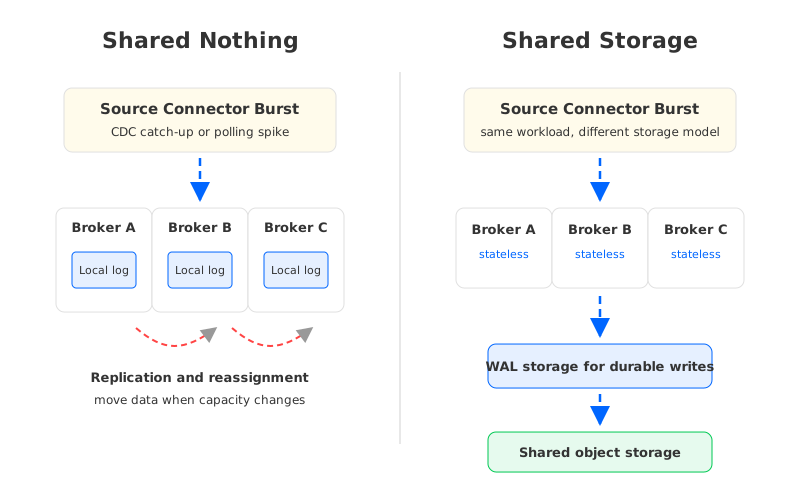
Traditional Kafka runs as a Shared Nothing architecture. Each broker owns local storage for the partitions it hosts, and durability is achieved through replicas across brokers. That model is proven and widely understood. It also means that ingestion pressure from source connectors eventually lands on broker-local disks, replica traffic, and partition placement decisions.
In a steady state, this is manageable. The platform team sizes brokers for write throughput, storage retention, replication factor, and failure recovery. The difficult case is bursty source ingestion. A connector that catches up after a source outage may produce far above its normal rate. A CDC connector that is backfilled may turn historical rows into a temporary write storm. A newly deployed set of source connectors may concentrate writes into a small set of topics before the platform team has adjusted capacity.
With broker-local storage, every capacity decision has a data-movement shadow. Expanding the cluster may require partition reassignment, rebalancing can move data between brokers, and Multi-AZ durability can add inter-zone replication traffic. Kafka tiered storage can move older segments to object storage, but the hot log and replication model still depend on broker-local state.
The practical options look like this:
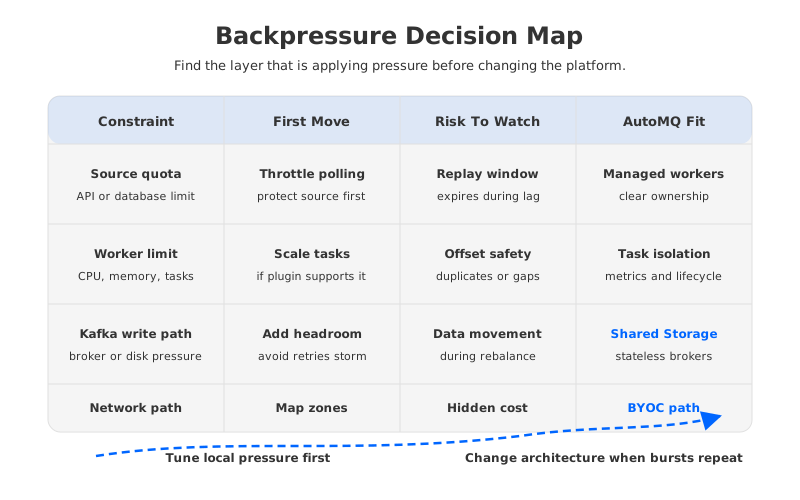
- Tune the connector first when the bottleneck is source polling, task parallelism, batch sizing, transforms, or producer configuration. This is the lowest-risk path, but it cannot solve a destination cluster that lacks write or storage headroom.
- Add Kafka capacity when broker CPU, request latency, partition leadership, or local disk pressure is the limiting factor. This keeps the familiar operating model, but it can increase data movement and capacity planning overhead.
- Split pipelines when one source connector class has a different failure or cost profile from the rest of the platform. Dedicated topics, workers, or clusters reduce blast radius, but they add governance and migration work.
- Move to a cloud-native Kafka-compatible platform when the recurring problem is that ingestion bursts force stateful broker operations. The point is not raw throughput alone; it is changing how the platform absorbs bursts, scale events, and storage growth.
The last option is where architecture matters more than a single benchmark. If source connector backpressure is occasional, local tuning is enough. If it is recurring, the Kafka platform has become part of the integration control plane.
4Evaluation Checklist For Platform Teams
A platform that receives source connector traffic must preserve Kafka semantics, protect source systems, keep recovery understandable, and give operators enough observability to make good decisions under pressure. The right choice depends on workload shape and team boundaries.
Use this checklist before changing the platform:
| Area | What to verify | Healthy signal |
|---|---|---|
| Compatibility | Existing Kafka clients, connectors, converters, transforms, and ACL patterns work without application rewrites. | The connector plugin and worker configuration can move with minimal changes. |
| Source protection | Rate limits, query windows, database load, and CDC retention are documented. | Backpressure slows polling before it overloads the source. |
| Kafka write path | Broker request latency, producer retries, partition skew, and storage headroom are observable. | A catch-up event does not force emergency broker resizing. |
| Offset safety | Restart, replay, and duplicate behavior are tested for each connector class. | The team can explain the recovery boundary without guessing. |
| Cost model | Compute, storage, cross-AZ traffic, PrivateLink, and observability costs are modeled together. | The cost of a backlog catch-up is visible before it happens. |
| Governance | Network, IAM, secrets, plugin lifecycle, and metrics export are owned. | Connector deployment is repeatable and auditable. |
| Migration | Cutover, rollback, and topic compatibility are part of the plan. | The old path can be resumed before source replay windows expire. |
This table intentionally puts compatibility first. Kafka Connect teams often rely on existing plugins, source offset formats, custom transforms, and runbooks. A platform that improves storage economics but breaks connector behavior creates a different kind of backpressure: organizational friction. The cost row also deserves a broader view than broker count because source, worker, broker, object storage, and monitoring paths may cross different zones or accounts.
5How AutoMQ Changes The Operating Model
Once the evaluation makes the pressure points visible, AutoMQ becomes relevant as an architecture category: a Kafka-compatible streaming platform that separates compute from storage. It keeps the Kafka API surface that connector teams depend on, while replacing broker-local persistent storage with a Shared Storage architecture backed by object storage and WAL storage.
This matters for source connector backpressure because the destination platform no longer treats every burst as a broker-local storage event. AutoMQ Brokers are stateless brokers. Durable data is stored through S3Stream in shared storage, while brokers handle protocol, routing, caching, and leadership work. Scaling brokers is closer to scaling an application tier than moving local log data between machines.
That does not make source systems infinitely fast or remove connector tuning. It changes the destination-side failure and scaling model. A connector catch-up event still has to respect source limits and topic design, but the platform team has less reason to over-provision local broker disks for rare spikes.
AutoMQ Managed Connector extends that operating model to Kafka Connect in AutoMQ BYOC. Connect workers run inside the customer's cloud account and VPC, so data flows stay within the customer's network boundary. The service can deploy and manage connector tasks through the AutoMQ Console or Terraform, while teams still use the Kafka Connect ecosystem. For integration teams, the important point is not that connectors disappear; it is that worker lifecycle, metrics, resource isolation, and Kafka platform elasticity can be managed through one operational surface.
There is a useful way to think about the boundary:
- Source-side backpressure remains a connector and source-system responsibility. AutoMQ does not change database retention windows, API quotas, or connector plugin semantics.
- Connector-runtime backpressure becomes easier to operate when worker capacity, task lifecycle, metrics export, and plugin isolation are managed consistently.
- Kafka-ingestion pressure changes because the platform does not bind durable data to broker-local disks. That is where Shared Storage architecture reduces the operational coupling between bursty connector traffic and stateful broker operations.
For teams evaluating Kafka-compatible streaming platforms, this is the practical difference. The platform is part of the control loop that determines whether a source-side spike becomes a manageable catch-up, an emergency capacity event, or a governance problem.
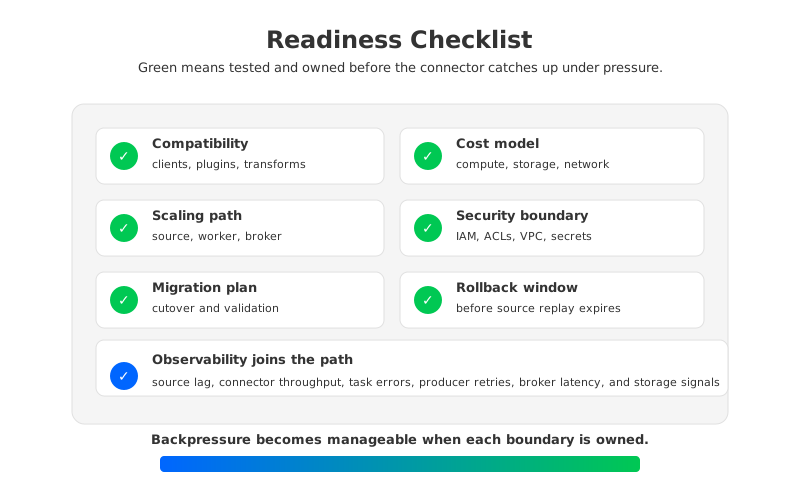
Backpressure is not a theoretical property of Kafka Connect; it is what the team sees when a source backlog is growing and every dashboard points to a different owner. A good platform shows where pressure is building, preserves the offset boundary, and gives operators a scaling path that does not turn a connector incident into a storage migration.
If source connector backpressure is becoming a recurring production event, use the checklist above to separate source limits from platform limits. To see how a Kafka-compatible Shared Storage architecture changes the destination-side operating model, visit AutoMQ through the BYOC path.
6FAQ
6.1What is source connector backpressure in Kafka?
Source connector backpressure is the condition where a Kafka Connect source connector cannot move records from the source system into Kafka at the same rate that the source produces or exposes them. It may be caused by source limits, connector worker capacity, producer retries, Kafka broker pressure, or downstream governance constraints.
6.2Should I increase tasks.max to fix source connector backpressure?
Only if the connector plugin and source system can safely split work across tasks. Some sources divide cleanly by table, shard, partition, or stream. Others remain limited by a single change log, API quota, or source-side lock. Increasing tasks without checking the source model can add load without increasing throughput.
6.3Is connector lag the same as consumer lag?
No. Consumer lag measures how far a consumer group is behind records already written to Kafka. Source connector lag measures how far the connector is behind the external source. A pipeline can have low consumer lag and still be at risk if the source connector is falling behind a database log retention window.
6.4How does a Shared Storage architecture help with connector bursts?
Shared Storage architecture helps on the Kafka destination side. By keeping durable data in shared object storage and making brokers stateless, the platform can scale compute and replace brokers without tying every scale event to broker-local data movement. Source and connector limits still need separate controls.
6.5Where should teams start?
Start with ownership and observability. Map the source replay window, connector task behavior, Kafka write path, network boundary, and rollback procedure. Once those are visible, tuning and platform changes become engineering decisions.
7References
- Apache Kafka documentation: Kafka Connect
- Apache Kafka documentation: Kafka Connect worker configuration
- Apache Kafka API: SourceConnector
- Apache Kafka API: SourceTask
- AutoMQ documentation: Shared Storage architecture
- AutoMQ documentation: Stateless Broker
- AutoMQ documentation: Kafka Connect overview
- AutoMQ documentation: Manage Connectors
- AWS PrivateLink pricing


