
Table of Contents
Table of Contents
fsync durability kafka is the kind of search query that usually appears after a risk review, not during a greenfield design session. Someone has asked a precise question: when a producer receives an acknowledgement, is the data durable on media, durable on another broker, durable in object storage, or mostly protected by the operating system page cache until a later flush? The question cuts through comfortable labels like “replicated” and “persistent.” It asks what would actually survive a host failure, a power loss, a storage stall, or a zone event.
Kafka operators already know the first answer: do not treat fsync as a magic durability switch. Forcing every append to wait for a physical flush can make write latency and throughput behave differently from a normal Kafka deployment. Ignoring flush behavior is not a strategy either. The useful path is to define the loss window the business can tolerate, the acknowledgement semantics clients depend on, and the failure modes the platform has tested.
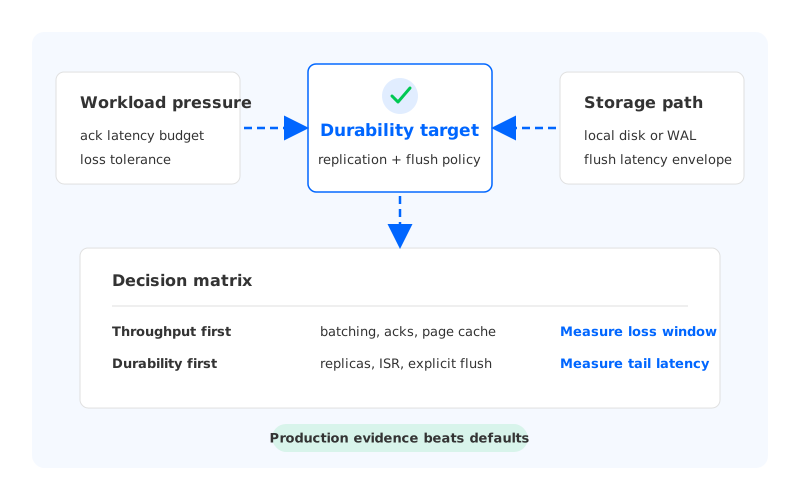
Durability is a path, not a single configuration value. Producer acks, min.insync.replicas, leader election policy, broker flush settings, disk behavior, filesystem semantics, and recovery runbooks all participate in the final answer. In a Kafka-compatible platform, the architecture underneath the protocol matters as much as the protocol itself. A broker-local log, a replicated local disk design, and a shared-storage design can all expose familiar Kafka APIs while making different durability and operations trade-offs.
1Why teams search for fsync durability kafka
The search intent is usually practical. A payment event, order update, fraud signal, entitlement change, or operational audit record cannot be treated like a cache entry. Teams want to know whether Kafka can acknowledge writes before data reaches stable media, how much data could be lost if a broker or node disappears, and whether stronger flush settings are worth the latency cost. That is a fair question, especially when Kafka is used as the commit path between application services and downstream state.
Kafka’s default operating model is built around high-throughput append, replication, and the operating system page cache. A broker can append records efficiently, replicate them to followers, and let the operating system flush dirty pages according to its own policy. That design is one reason Kafka can sustain large streaming workloads. It also means that “written to the broker” and “physically flushed to durable media on that broker” are not always the same moment.
The risk is often overstated in one direction and understated in the other. A process crash is not the same as a machine losing power; the operating system page cache may still exist after the broker process exits. A single broker failure is not the same as simultaneous loss of every replica that has acknowledged the write. At the same time, replicated but unflushed data is still exposed to correlated failures if storage and power failure domains are not independent enough.
Three questions usually decide whether fsync tuning belongs in the critical path:
- What is the acknowledged write contract? A topic using
acks=allwith an appropriatemin.insync.replicassetting has a different risk profile from a topic accepting leader-only acknowledgements. - What failure is being mitigated? Broker process restart, host power loss, disk controller failure, zone failure, and operator error produce different recovery paths.
- What latency budget is available? A flush policy that is acceptable for a compliance audit topic may be unusable for a high-throughput clickstream.
Those questions prevent a common mistake: changing a broker-wide flush setting to solve a topic-specific risk. Fsync forces the storage path into the foreground. Once it sits in the acknowledgement path, a slow disk, noisy neighbor, or cloud volume tail-latency event can become application-visible write latency.
2The production constraint behind the problem
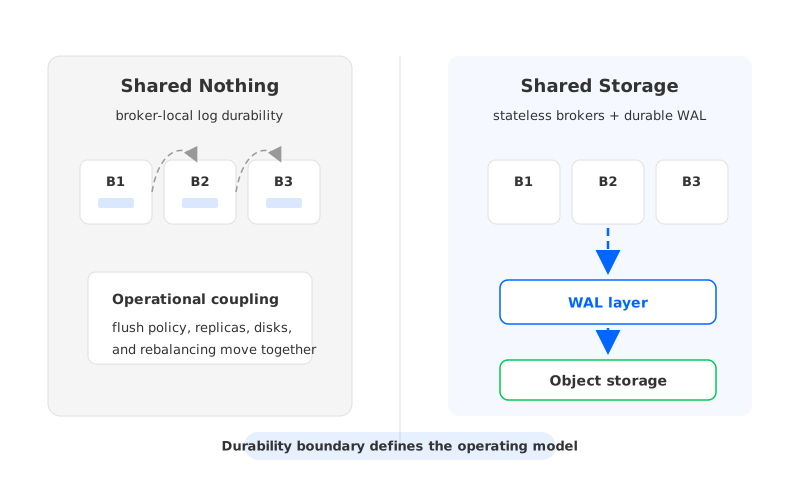
Traditional Kafka uses a shared-nothing storage model. Each broker owns local log segments for its partitions, and replication copies records across brokers for availability and durability. This model is clear and operationally familiar. Its trade-off is that durability, capacity, and placement are tied to the broker fleet. When the durability target changes, the platform team may need to revisit broker sizing, disk throughput, replication policy, reassignment behavior, and failure drills together.
The page cache is part of that trade-off. It lets Kafka batch writes efficiently and keep the hot append path fast, but the flush boundary is influenced by kernel and storage behavior. Kafka exposes broker and topic-level log flush controls, yet those controls should be treated as production policy, not local performance knobs.
A useful mental model is to separate acknowledgement durability from recovery evidence. Acknowledgement durability asks what must happen before the producer receives success. Recovery evidence asks what the team has proven through failure drills. Many incidents happen in the gap between the two. The configuration says writes should be protected by replicas, but a recovery drill reveals that one replica was lagging, disk IO was saturated, or an operator runbook moved leadership faster than followers could catch up.
This is where fsync discussions become governance discussions. A platform team may decide that most topics should use replicated Kafka defaults, while a small set of audit or financial topics should accept higher write latency for tighter flush boundaries. Application teams need to know which contract they are using; SREs need alerts that match the contract; security and compliance teams need evidence that the contract has been tested.
3Architecture options and trade-offs
There are several defensible ways to approach fsync durability in Kafka-compatible systems. None removes trade-offs; each moves risk to a place where the team can measure and govern it. A blanket rule that says every topic should fsync every message, or that no topic should ever care about flush policy, misses the point.
| Option | What it optimizes | Main trade-off |
|---|---|---|
| Replication-first Kafka defaults | Throughput and operational familiarity | Durability relies on replica placement and storage failure independence. |
| Explicit flush policy for selected topics | Narrower local loss window | Higher write latency and stronger dependence on storage tail behavior. |
| Stronger ISR and acknowledgement rules | Protection against broker failure before success is returned | Requires capacity for follower catch-up and careful monitoring of under-replicated partitions. |
| Shared-storage architecture | Durability boundary moves away from broker-local disks | Requires understanding the WAL path, object storage semantics, and platform implementation. |
Different workloads deserve different answers. A telemetry topic that can tolerate replay from devices should not inherit the same fsync policy as a ledger event. A low-volume audit stream can afford a stricter write path if the business value is clear. A high-volume event stream may get better end-to-end durability from replication health, producer idempotence where appropriate, and verified recovery drills than from pushing every broker into synchronous local flush.
There is also a cloud cost angle. Stronger durability settings can increase IO pressure, extend broker lifetimes during rebalancing, and force more conservative capacity planning. In a shared-nothing Kafka deployment, adding replicas or keeping more disk headroom may be correct, but it should be a conscious cost decision rather than an accidental side effect of fear.
The same discipline applies to cloud storage durability claims. Object storage services such as Amazon S3 are designed for extremely high durability, and AWS publicly states that S3 is designed for 99.999999999% durability across multiple availability zones. That fact is useful, but it does not by itself prove the durability of a Kafka-compatible write. The complete path still includes the platform’s WAL implementation, acknowledgement timing, metadata consistency, and recovery behavior. Architecture claims become credible only when they map to the exact point at which a producer receives success.
4Evaluation checklist for platform teams
Before changing fsync settings, write down the production contract in language that an application owner can understand. “We use Kafka with replication factor 3” is not enough. The contract should say what acknowledgement setting is required, how many in-sync replicas must accept the write, what failure the team expects to survive, and what recovery test proves the claim. Without that contract, a config review turns into folklore.
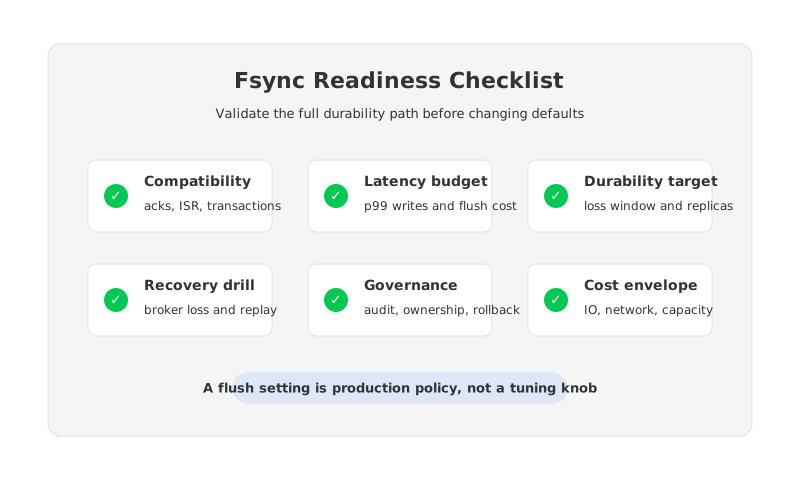
Use this checklist as a practical review gate:
- Compatibility. Confirm that the client libraries, producer settings, transactions, idempotence, and topic policies still behave as expected under the durability setting being proposed.
- Latency. Measure p50, p95, and p99 produce latency with the storage path under pressure, not during an empty-cluster benchmark.
- Replica health. Alert on ISR shrink, under-replicated partitions, follower lag, and controller events that could weaken the acknowledgement contract.
- Failure drills. Test broker process crash, host loss, disk failure, and zone impairment separately. Each failure should have an observed recovery result.
- Rollback. Define how to back out a stricter flush policy if write latency becomes unacceptable, including which topics are allowed to change first.
- Cost. Account for IO throughput, disk capacity, network replication, and extra headroom required to keep followers caught up during peak load.
This checklist also helps governance teams ask better questions of managed Kafka or Kafka-compatible vendors. Instead of asking whether the service is “durable,” ask where the write is durable at acknowledgement time. Ask whether the service depends on broker-local disks, cloud block volumes, a separate WAL, or object storage. Ask how the provider tests host failure and zone failure.
For application architects, the most important habit is to classify topics by consequence. Many organizations run every topic under one durability posture because that is how the cluster was created. A better model is to group topics by loss tolerance, replayability, ordering requirements, and latency budget, then choose policies that match each group.
5How AutoMQ changes the operating model
If broker-local disks carry too much durability and scaling responsibility, the architecture alternative is to separate the Kafka-compatible compute path from the durable storage boundary. AutoMQ is a Kafka-compatible cloud-native streaming platform that does this with stateless brokers, shared storage, and a write-ahead log layer designed for the cloud. The goal is not to make fsync irrelevant; the goal is to move durability reasoning from per-broker local disks into a storage architecture that can be evaluated independently.
In a shared-storage design, brokers no longer have to be treated as the long-term home of partition data. They serve Kafka-compatible protocol traffic and coordinate writes, while durable data is written through the platform’s storage path. Broker replacement has less local data gravity. Compute and storage can scale more independently. Failure recovery is less dominated by copying large local log segments from one broker to another.
For fsync durability discussions, the key question becomes more precise: what does the WAL guarantee before acknowledgement, and how does it hand data to object storage? AutoMQ’s public documentation describes its shared-storage architecture and WAL storage options, which is where teams should start when mapping durability requirements to deployment choices. The evaluation point is the full write path from producer acknowledgement to WAL persistence, object storage placement, metadata update, and recovery.
This shift can reduce the pressure to use broker-wide flush settings as a substitute for architecture. In a broker-local model, a stricter fsync policy is one of the few direct levers available to narrow the local loss window. In a shared-storage model, the platform can offer a different durability boundary while keeping Kafka protocol compatibility for clients.
AutoMQ should still be evaluated with the same checklist as any other platform. Verify Kafka client compatibility, test failure recovery, inspect operational metrics, and confirm deployment boundaries such as BYOC or private networking when governance requires them. Durable systems earn trust through observed behavior under failure.
6Decision framework for production changes
The safest way to handle fsync durability is to avoid both extremes. Do not dismiss the question as paranoia; data loss windows matter. Do not answer it by forcing the most conservative flush behavior everywhere; latency and availability also matter. Treat durability as a workload contract, then select the architecture and configuration that make it measurable.
A production decision can follow a simple order. Start with the business consequence of loss. Convert that consequence into Kafka semantics: producer acknowledgement, ISR requirement, replication factor, topic policy, and recovery expectation. Measure the write path under load. Run failure drills. Then decide whether broker-local storage with replication is sufficient, whether selected topics need stricter flush behavior, or whether a shared-storage architecture better fits the operating model.
That order keeps the team from turning fsync into a superstition. A flush setting is useful when it closes a named risk inside an acceptable latency budget. It is harmful when it hides a weak replication policy, missing recovery drill, or storage architecture that no longer fits the cloud environment. The right question is not “should Kafka fsync more often?” The right question is “what has to be durable before we tell the producer the write succeeded, and can we prove it under failure?”
If your team is revisiting Kafka durability because broker-local storage, replication cost, and recovery operations are becoming harder to govern, review AutoMQ’s Kafka-compatible shared-storage model and talk through the write path with an engineer: contact AutoMQ. The useful conversation starts with your durability contract, not with a product feature list.
7References
- Apache Kafka broker configuration: https://kafka.apache.org/40/configuration/broker-configs/
- Apache Kafka topic-level configuration: https://kafka.apache.org/40/configuration/topic-level-configs/
- Apache Kafka producer configuration: https://kafka.apache.org/40/configuration/producer-configs/
- AutoMQ compatibility with Apache Kafka: https://docs.automq.com/automq/what-is-automq/compatibility-with-apache-kafka?utm_source=blog&utm_medium=reference&utm_campaign=rpb-0162
- AutoMQ architecture overview: https://docs.automq.com/automq/architecture/overview?utm_source=blog&utm_medium=reference&utm_campaign=rpb-0162
- AutoMQ WAL storage documentation: https://docs.automq.com/automq/architecture/s3stream-shared-streaming-storage/wal-storage?utm_source=blog&utm_medium=reference&utm_campaign=rpb-0162
- Amazon S3 FAQ: https://aws.amazon.com/s3/faqs/
8FAQ
8.1Does Kafka fsync every message by default?
Kafka is designed around append throughput, replication, and operating system buffering rather than forcing every message through a synchronous physical flush by default. Broker and topic-level flush settings exist, but changing them should be treated as a production durability policy because they can affect write latency and throughput.
8.2Is acks=all the same as fsync?
No. acks=all means the leader waits for the configured in-sync replicas before acknowledging a write. Fsync is about flushing data to stable storage. Both can contribute to durability, but they protect against different failure modes and have different latency costs.
8.3When should a team consider stricter flush settings?
Consider stricter flush behavior for narrow classes of topics where the business consequence of loss is high, throughput is manageable, and the latency impact has been measured. Apply it as a workload-specific policy, not as a reflexive cluster-wide rule.
8.4How does shared storage change the fsync discussion?
Shared storage changes the durability boundary. Instead of relying primarily on broker-local disks as the long-term data home, a platform can use a WAL and object storage path behind Kafka-compatible APIs. Teams still need to verify acknowledgement timing, recovery behavior, and governance requirements, but the operating model is different from broker-local log ownership.


