
Table of Contents
Table of Contents
A team choosing between fully managed Kafka and self-managed Kafka is rarely choosing between "convenient but expensive" and "hard but lower cost." Kafka is a durable distributed log with brokers, controllers, replicas, partitions, disks, network paths, client semantics, access controls, and recovery behavior that show up during incidents.
The question is not whether a Kafka managed service is good or whether self hosted Kafka is bad. Both can be correct. The question is which model gives your platform team the right boundary for risk, cost, data control, compliance, and migration. A CTO may care about procurement; an SRE may care about broker replacement; a data engineering lead may care about Kafka Connect, retention, and replay.
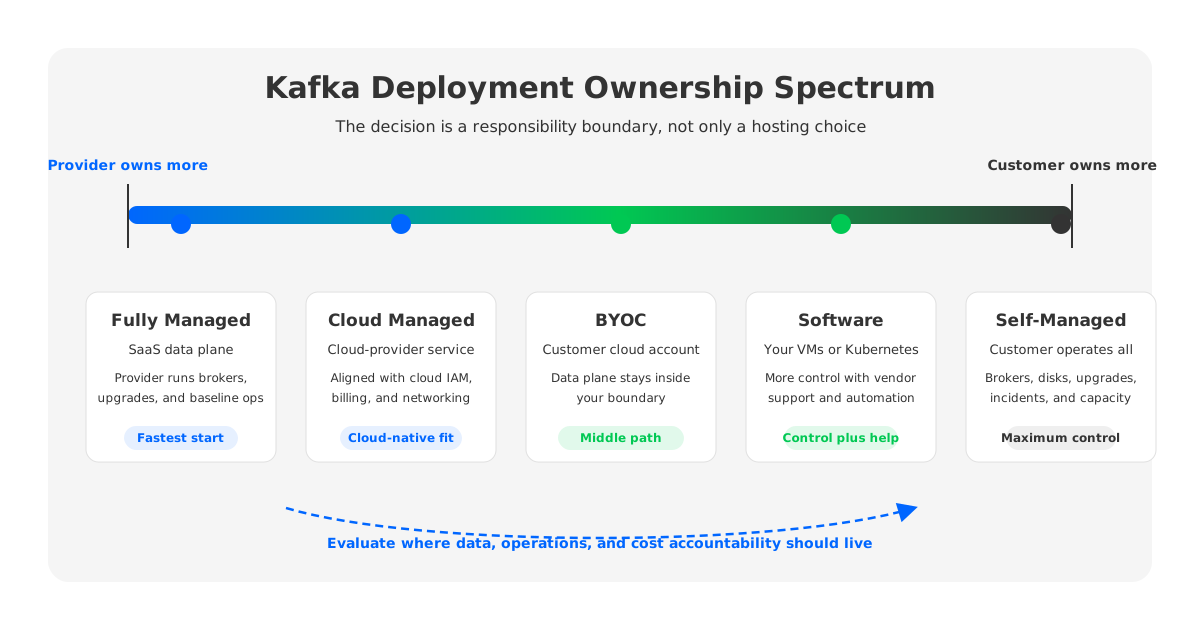
The most useful comparison starts with ownership. Fully managed Apache Kafka transfers many infrastructure tasks to a provider. Self-managed Kafka keeps the control surface with your team. BYOC and software models sit between those poles: the data plane can remain in your environment while a vendor, automation layer, or new storage architecture reduces local-disk work.
1The real difference is operational ownership
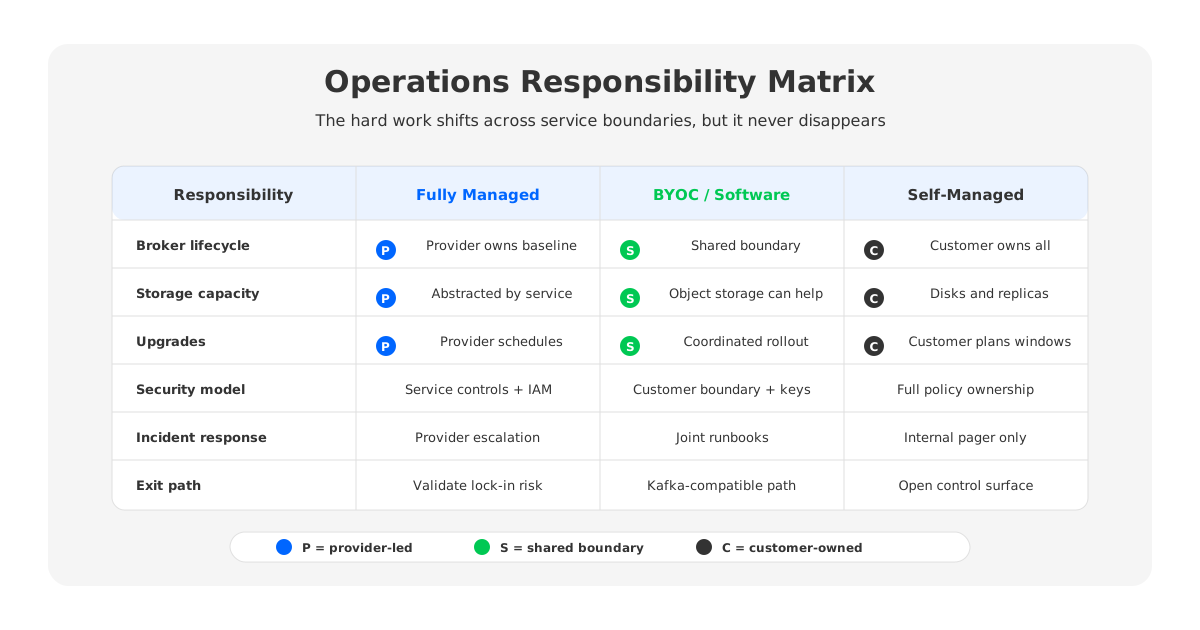
Apache Kafka's operational burden comes from the fact that the cluster is both a serving layer and a durable storage system. Brokers accept writes, serve reads, maintain replicas, write log segments, participate in metadata operations, and handle leader changes. Kafka documentation covers these responsibilities across operations, storage, security, and upgrades because they are the machinery that keeps a production log alive.
In a self-managed cluster, your team owns that machinery end to end:
- Broker provisioning, JVM and OS tuning, storage sizing, and network throughput.
- Controller quorum health, metadata operations, and cluster configuration.
- Topic and partition design, leader distribution, replica placement, and under-replicated partition response.
- Rolling upgrades, client compatibility checks, security configuration, certificates, authentication, and authorization.
- Incident response for disk saturation, broker loss, network partitions, hot partitions, consumer lag, and cross-zone cost surprises.
Fully managed Kafka changes the owner of many of those tasks. A provider typically provisions infrastructure, automates patching, exposes monitoring, handles failed broker replacement, and offers support commitments. But architecture remains yours: partition counts, producer durability, retention, schema discipline, client behavior, private connectivity, disaster recovery, and application backpressure.
This is where buying discussions get distorted. A managed service may remove infrastructure pager load while adding constraints in the data path, pricing model, networking, quotas, or exit path. A self-managed deployment may look lower cost while hiding skilled engineers, automation, standby capacity, disks, rebalancing windows, and incident fatigue.
2Fully managed Kafka: what you gain
The strongest case for fully managed Kafka is speed to production with a smaller operating team. If your organization already trusts a provider's cloud control plane, a managed Kafka service can reduce setup work around clusters, certificates, patching, monitoring, and hardware failure. It also gives procurement a cleaner purchase motion than staffing an internal Kafka platform team from scratch.
For SREs, the biggest gain is not "no operations." It is a narrower set of operations. The provider usually absorbs work below the service boundary:
| Area | What fully managed Kafka can reduce | What your team still owns |
|---|---|---|
| Infrastructure | Broker provisioning, patching, replacement, baseline monitoring | Capacity requests, quotas, private access, regional design |
| Kafka operations | Some upgrade and failover workflows | Topic design, partition count, retention, client behavior |
| Security | Managed encryption options, IAM or service account integrations | Identity model, ACL design, secrets lifecycle, compliance evidence |
| Reliability | Provider SLA, operational runbooks, support escalation | Application retries, producer acks, DR plan, recovery objectives |
| Cost | Less internal labor and automation buildout | Usage model, idle capacity, traffic fees, retention growth |
Managed Kafka is especially attractive when the workload is important but not strategically differentiating. If the cluster backs internal analytics, event ingestion, or product telemetry, the business may prefer buying operational maturity from a provider over turning Kafka into a platform engineering project. A managed service can also help teams that need production Kafka quickly while they are still building deeper streaming expertise.
Provider ecosystems matter too. Confluent Cloud documents private networking options, security controls, and cluster types. Amazon MSK documents security, multi-VPC private connectivity, broker operations, and an SLA aligned with AWS procurement. These official surfaces are valuable because they turn some operational ambiguity into documented responsibility.
3Fully managed Kafka: the limits that matter later
The hidden work starts after the first cluster is live. Managed Kafka can make day-one easier while leaving day-two architecture decisions unresolved. The important limits usually appear in capacity planning, governance, and incident review.
First, cost is still workload-shaped. Kafka cost is driven by writes, reads, partitions, retention, replication, private networking, inter-zone traffic, support, and idle headroom. A managed service can reduce people cost, but it cannot repeal durable replication and network movement. With months of replay data, storage and replication can dominate the bill even when the provider handles operations.
Second, control moves to the service boundary. You may not control every broker-level setting, plugin, version timing, storage layout, or maintenance window. Platform teams that need custom authorization flows, unusual networking, strict upgrade sequencing, or deep tuning should test those requirements before signing a long contract.
Third, the data path may affect compliance. Some SaaS models run the data plane in a vendor-controlled environment. Regulated teams often need to prove where data resides, how keys are managed, what network path traffic follows, and who can operate infrastructure. Private networking helps, but it is not the same as keeping the data plane inside your own cloud account or VPC.
Finally, exit risk is real. Kafka compatibility at the protocol layer does not guarantee that every connector, quota model, observability surface, schema workflow, and automation script will move cleanly. Teams should evaluate departure before they are forced to depart.
4Self-managed Kafka: what you gain
Self-managed Kafka gives platform teams maximum control. You choose the cloud, regions, instance types, disks, Kubernetes or VM layout, broker configuration, network routes, version cadence, security model, and operational tooling. For organizations with mature Kafka expertise, that control can be a strategic asset.
There are good reasons to self-manage:
- You need a private or on-premises deployment that a SaaS provider cannot support.
- You have strict data residency, encryption, key management, or inspection requirements.
- You operate at a scale where internal platform economics beat a vendor margin.
- You need deep customization around networking, compliance, observability, or security controls.
- You want to avoid provider lock-in and keep a direct path to open Apache Kafka behavior.
Self-managed Kafka also keeps architectural knowledge close to dependent applications. Engineers see how partitions, producers, brokers, consumers, disks, and networks interact. During tuning or incident response, that knowledge can shorten diagnosis because the team controls the full stack.
For some companies, this is the right answer. A platform organization with 24/7 SRE coverage, strong automation, Kafka specialists, FinOps discipline, and a steady workload may treat Kafka as shared infrastructure rather than a liability.
5Self-managed Kafka: what you really own
The hard part is that self-management makes your team the provider. You own the uncomfortable edge cases: disks filling faster than forecast, hot leaders, controller instability, certificate expiration, uneven replica catch-up, upgrades that expose client assumptions, and recovery after zone-level impairment.
Local broker storage is the center of much of this complexity. In traditional Kafka, durable data is tied to broker-local disks. When capacity changes, replicas move. When a broker fails, data may need to be copied. When retention grows, disks and replication traffic grow. When partitions are imbalanced, reassignment can become an operational project rather than a metadata change.
That storage coupling affects several operational loops:
- Scaling is not only adding brokers; it is redistributing partitions and data.
- Recovery is not only replacing compute; it is restoring replica health.
- Retention is not only a policy; it is disk capacity, replication, and network cost.
- Upgrades are not only binary rollout; they must respect broker state, clients, controllers, and operational windows.
The labor cost is often underestimated because it is spread across teams. One group builds Terraform, another writes runbooks, SREs carry the pager, data engineers tune clients, security reviews certificates and ACLs, and FinOps explains why storage and cross-zone traffic grew. Procurement sees "VMs and disks" but not the time spent avoiding an outage.
6BYOC Kafka as a middle path
Between fully managed Kafka and self-managed Kafka sits an important category: BYOC and customer-environment software. The idea is straightforward. Keep the data plane in the customer's cloud account, VPC, VNet, Kubernetes cluster, or private environment, while reducing the Kafka infrastructure work the customer must own directly.
This model is attractive when a pure SaaS data path is difficult but a fully self-managed cluster would be too much operational drag. It can support requirements such as:
- Data remains in the customer's cloud account or controlled network boundary.
- Cloud bills, object storage, private networking, and identity can stay aligned with the customer's governance model.
- The platform team can avoid building every broker lifecycle, monitoring, and storage automation primitive from scratch.
- Procurement can evaluate a vendor-supported product without moving all operational risk to an external account.
BYOC is not magic. The responsibility boundary must be inspected carefully. Who can access the environment? Where does the control plane run? What telemetry leaves the account? Who applies upgrades? Who responds during incidents? Which components are customer-operated, and which are vendor-operated?
AutoMQ belongs in this middle-path discussion because its architecture changes one of the hardest parts of self-managed Kafka: the tight coupling between broker compute and durable local storage. AutoMQ is Kafka-compatible, but it uses shared storage on object storage with stateless brokers. In BYOC or Software deployments, teams can keep data and infrastructure within their chosen environment while reducing the storage operations that make self hosted Kafka difficult at scale.
7How AutoMQ changes the self-managed Kafka economics
The meaningful point is architectural. If brokers are no longer the long-term owner of local durable data, several Kafka operations change shape.
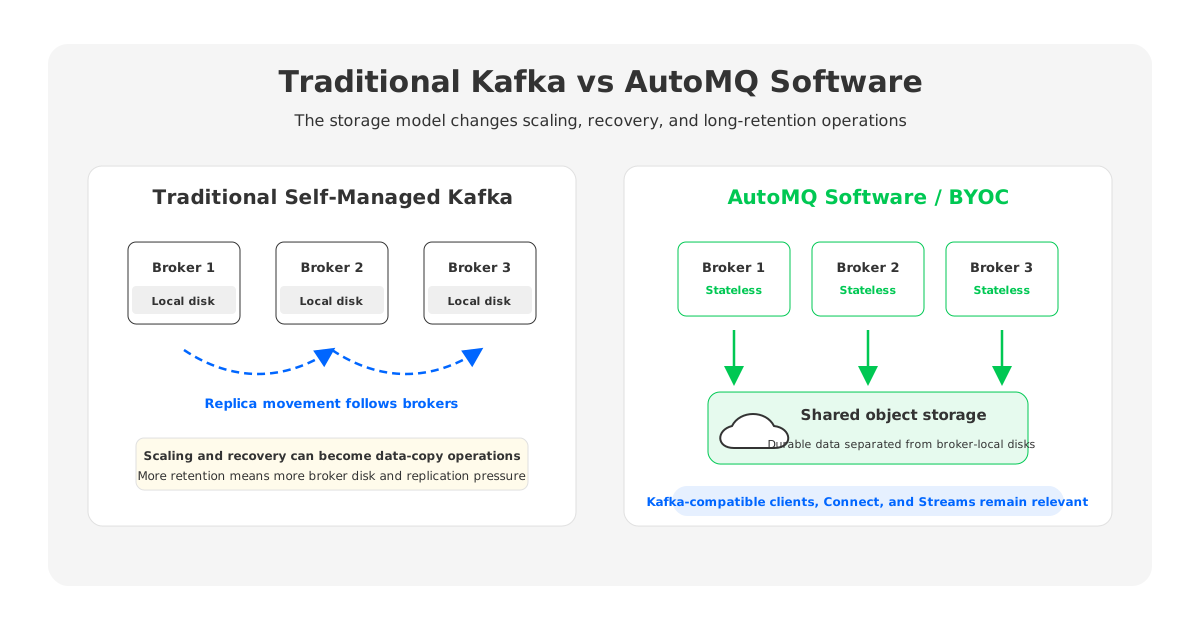
In traditional self-managed Kafka, brokers are stateful. Compute, serving, and local log storage are bound together. Scaling often implies data movement. Long retention increases disk pressure. Recovery can involve copying data back into replica placement. Teams can mitigate this with automation, but the pattern remains storage-heavy.
In an AutoMQ-style design, durable data is placed in shared object storage and brokers become more stateless. The platform still speaks Kafka protocol to clients, so producers, consumers, Kafka Connect, and Kafka Streams can remain part of the architecture. The economics shift because storage capacity, broker replacement, and elasticity are not governed by the same local-disk constraints.
For platform teams, this creates a third evaluation path:
| Decision dimension | Fully managed Kafka | Traditional self-managed Kafka | BYOC or Software with shared storage |
|---|---|---|---|
| Data control | Depends on provider model | High | High when deployed in customer environment |
| Broker operations | Provider-owned | Customer-owned | Reduced, but boundary depends on deployment |
| Storage scaling | Provider abstraction | Broker disk and replica planning | Object storage and stateless broker model |
| Customization | Limited by service | Highest | More control than SaaS, less toil than classic self-management |
| Exit path | Must test surrounding ecosystem | Strong open-source familiarity | Kafka-compatible path, product-specific architecture |
This is a natural fit for teams that rejected SaaS because of data control, but also know that operating classic Kafka is not where they want scarce SRE time to go. It is also useful for organizations that need a software deployment for private environments but want the storage layer to behave more like cloud infrastructure than a fleet of hand-managed disks.
8Decision checklist
The best choice depends less on company size than on operating maturity and constraints. A small team with strict residency requirements may need BYOC sooner than a large company, while a large company with commodity event streams may prefer fully managed Kafka to free engineers for product work.
Use this checklist before deciding:
| Question | If the answer is yes, watch for |
|---|---|
| Do you need data to stay in your own cloud account or private network? | SaaS data-plane constraints, key management, audit evidence |
| Do you have Kafka specialists on call? | If not, classic self-management may create hidden reliability risk |
| Is long retention or replay central to the workload? | Broker disk growth, replication traffic, object-storage architecture |
| Will you need custom broker settings or strict upgrade timing? | Managed-service configuration limits and maintenance windows |
| Are cross-zone or private networking costs material? | Data path design, replication topology, ingress and egress charges |
| Could you leave the platform in two years? | Client compatibility, connectors, observability, schema workflows |
| Does procurement evaluate people cost and incident cost? | Self-managed spreadsheets often omit engineering time |
For many teams, the answer is staged. Start with fully managed Kafka when speed matters and constraints are moderate. Use self-managed Kafka when deep control is mandatory and maturity is proven. Evaluate BYOC or software when data control matters but you want to reduce the storage-heavy burden of self hosted Kafka.
The expensive mistake is choosing a model whose failure mode you cannot absorb. A managed service can be wrong if it blocks compliance, exit, or cost visibility. Self-managed Kafka can be wrong if it turns your SRE team into a 24/7 storage operations group. The right platform is the one whose responsibility boundary matches how your business owns risk.
9References
- Apache Kafka Documentation
- Confluent Cloud Networking Overview
- Confluent Cloud Security Overview
- Confluent Cloud Cluster Types
- Amazon MSK Service Level Agreement
- Amazon MSK Security
- Amazon MSK Multi-VPC Private Connectivity
- AutoMQ Cloud Environment Overview
- What Is AutoMQ Cloud?
- AutoMQ on GitHub
10FAQ
10.1Is fully managed Kafka always more expensive than self-managed Kafka?
Not always. Fully managed Kafka may have a higher visible service bill, but self-managed Kafka includes engineering labor, automation, monitoring, incident response, standby capacity, storage planning, and upgrade work. A fair comparison should include people cost, reliability risk, retention, replication, networking, and exit cost.
10.2When should a team choose self-managed Kafka?
Self-managed Kafka fits teams that need deep control over infrastructure, networking, broker configuration, security policy, version cadence, or private deployment. It works best with Kafka expertise, strong automation, 24/7 coverage, and a clear reason to own the full stack.
10.3What does BYOC Kafka solve?
BYOC Kafka can keep the data plane in the customer's cloud or network boundary while reducing some operational burden through vendor automation or a different architecture. It is useful when SaaS data placement is difficult but classic self-management creates too much operational risk.
10.4How is AutoMQ different from traditional self-managed Kafka?
AutoMQ keeps Kafka protocol compatibility but separates durable storage from broker-local disks by using shared object storage and stateless brokers. In BYOC or Software deployments, that can preserve customer data control while reducing storage-heavy operations such as broker disk scaling, data movement, and recovery tied to local replicas.
10.5Can fully managed Kafka remove all Kafka operations?
No. A managed service can reduce infrastructure operations, but application teams still own topic design, partition strategy, producer and consumer behavior, retention decisions, security model, disaster recovery objectives, and cost governance. Managed Kafka narrows the responsibility boundary; it does not remove architecture.


