
Table of Contents
Table of Contents
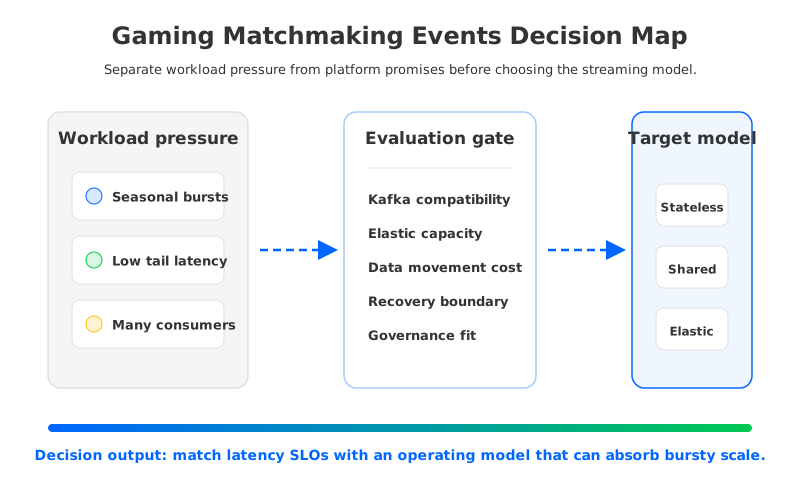
Searches for gaming matchmaking events kafka usually come from teams that already know event streaming is the right abstraction. The harder question is whether the platform can survive the shape of the workload. Matchmaking traffic is not a smooth analytics stream; it arrives when a tournament opens, a content drop lands, a ranked season resets, or a regional queue suddenly becomes popular. A few quiet hours can turn into a burst of party formation, lobby updates, queue assignments, and risk signals.
Kafka fits the first-order requirement because matchmaking is a sequence of events that multiple systems need to observe without coupling themselves to the game server. The matchmaker needs current state. The analytics team wants funnel data. Trust and safety may inspect suspicious patterns. Live operations wants dashboards that show where queues are stuck. The risk is that each additional consumer and retention requirement increases pressure on a cluster that was originally sized for a narrower path.
That is why platform evaluation has to start with constraints, not vendor adjectives. A game studio can accept complexity when traffic is predictable, but matchmaking systems punish slow capacity changes and ambiguous failure modes. If a broker drains too slowly during a spike, the user-facing symptom is not "storage rebalancing"; it is a player staring at a queue screen while their friends start another game.
1Why teams search for gaming matchmaking events kafka
The search phrase is specific because the problem is specific. A generic Kafka architecture guide explains producers, topics, partitions, and consumer groups. A matchmaking team needs to know whether the same mechanics can handle queue surges, strict latency budgets, and fan-out to several operational systems. They also need to know where Kafka's familiar guarantees stop being enough.
In practice, the matchmaking stream often carries several event categories:
- Player intent events, such as join queue, leave queue, party ready, region preference, and mode selection.
- State transition events, such as candidate match found, lobby allocated, roster locked, and backfill requested.
- Operational signals, such as queue depth, wait-time buckets, placement failures, and service health markers.
- Governance and safety events, such as abuse reports, risk scores, identity attributes, and audit trails.
Those categories do not share one latency and retention profile. Queue transitions may need low latency and short retention. Audit events may tolerate a slower path but need stronger access controls. Analytics events may be consumed by batch and streaming systems. Treating all of them as one "game events" stream usually creates a cluster that is expensive during quiet hours and fragile during busy ones.
The design question is not whether Kafka can carry matchmaking events. It can. The design question is whether the chosen Kafka-compatible platform lets each event class keep the right cost, latency, durability, and operational boundary as traffic changes.
2The production constraint behind the problem
Matchmaking traffic has a feedback loop that many backend event streams do not have. When a player waits longer, the application often emits more events: retry, status refresh, timeout, party update, and perhaps a region expansion. If the stream slows down, the game can create more stream work while trying to recover. That loop is manageable when the platform has headroom, but it is brutal when capacity expansion depends on moving large amounts of broker-local data.
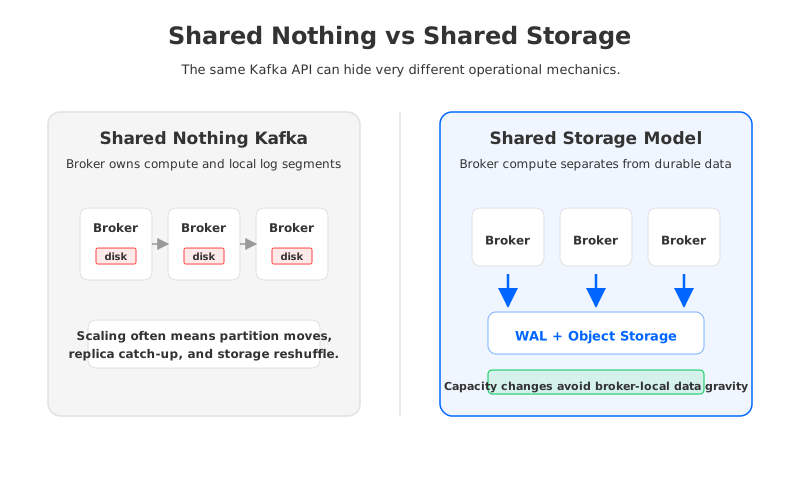
Traditional Kafka was designed around partitions stored on broker-local disks. Replication gives durability and availability, and consumer groups give independent readers their own progress through the log. Apache Kafka documentation describes consumers, offsets, transactions, KRaft metadata management, and Kafka Connect because those mechanics are the contract most teams build around. For matchmaking, the challenge is that this contract does not automatically solve the cloud operating model around the brokers.
A bursty game workload exposes four infrastructure tensions:
- Capacity has to arrive before the event storm is over. If scaling requires partition reassignment and replica catch-up across local disks, the cluster may technically scale but miss the window that mattered.
- Fan-out changes the cost curve. Matchmaking events rarely feed only one service. Each additional consumer group adds read pressure, lag management, and observability work.
- Multi-AZ resilience can become a network bill problem. Replication, client placement, and follower reads all interact with cloud availability-zone boundaries. The cloud bill reflects those paths even when the application team thinks only in topic names.
- Retention is not one number. Short-lived queue transitions, moderation evidence, and operational metrics have different lifetimes. A single retention policy can overpay for hot storage or under-serve audit needs.
These tensions matter because games change their traffic profile deliberately. A studio can plan a live event, but it cannot predict every regional surge, influencer stream, attack pattern, or platform outage that reshapes demand. The streaming layer has to handle both planned and unplanned bursts without turning every release calendar into an infrastructure reservation exercise.
3Architecture options and trade-offs
There are several reasonable ways to run matchmaking streams. The right choice depends on Kafka surface area, operational control, and traffic volatility. A self-managed Kafka cluster gives direct control over broker sizing, storage, configuration, and network placement. That control is valuable for teams with deep Kafka experience, but it also means the team owns partition planning, rebalancing, upgrade windows, disk pressure, and cloud cost modeling.
Managed Kafka reduces some operational load, especially around provisioning and patching. It does not remove the need to understand how storage, broker capacity, cross-zone traffic, and consumer lag behave under a queue surge. It can fit when the workload is steady enough or when the platform team prefers a familiar model with fewer infrastructure responsibilities.
Kafka-compatible cloud-native platforms take a different route: they keep the Kafka protocol and ecosystem surface while changing the storage and scaling model underneath. The label matters less than whether the platform separates fast-changing compute from durable, low-cost retention.
| Option | Strong fit | Watch carefully |
|---|---|---|
| Self-managed Kafka | Deep control, custom tuning, existing Kafka expertise | Broker-local data movement, operational staffing, cloud network cost |
| Managed Kafka | Familiar Kafka workflow with less platform maintenance | Elasticity boundaries, retention cost, service-specific limits |
| Kafka-compatible shared storage | Bursty workloads, independent compute and storage scaling, lower data gravity | Compatibility validation, migration runbook, provider-specific deployment model |
| Event bus without Kafka semantics | Simple routing and lightweight integration | Consumer offset control, log replay, ecosystem tooling, stateful stream processing |
The table is not a ranking. A matchmaking platform that runs one region with predictable concurrency may do well on a conventional Kafka deployment. A global title with seasonal spikes, many downstream consumers, and strict cloud governance will feel the pain sooner. What matters is whether the platform's failure and scaling behavior matches the game team's reality.
4Evaluation checklist for platform teams
A useful evaluation starts by separating application semantics from infrastructure mechanics. The application team cares about match assignment latency, queue fairness, player experience, and service isolation. The platform team cares about partitions, replication, storage, zones, identity, observability, and recovery. Both groups need a shared checklist.
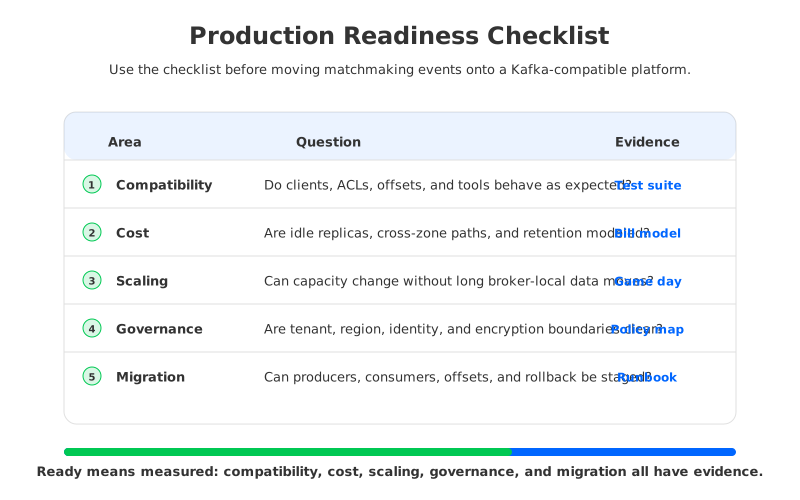
Start with compatibility. Kafka compatibility is not a slogan; it is a test plan. Verify producer configuration, consumer group behavior, offset management, ACLs, TLS or SASL settings, connector integrations, and observability tools. If a game service depends on idempotent producers, transactions, or a specific client library version, test that path before planning migration.
Then model burst elasticity. Do not ask only whether the platform can add nodes. Ask what happens to the data when nodes are added, removed, or replaced. If scaling triggers long partition reassignment, catch-up reads, or hot broker recovery, the cluster may be technically elastic but operationally slow.
Cost modeling needs the same discipline. The bill is not only broker instances. It includes storage, retention, replication traffic, cross-AZ data movement, private connectivity, monitoring, connector infrastructure, and the human time spent babysitting rebalances. Cloud provider documentation and price pages should be part of the design review, especially when multi-AZ traffic or PrivateLink-style connectivity is involved.
Governance is not an afterthought for gaming. Matchmaking events can carry identity-adjacent metadata, fraud signals, region preference, and moderation context. The platform should make it clear where data is stored, which cloud account or VPC controls it, how encryption works, and how service accounts are scoped. For global games, region boundaries and data residency are architecture inputs, not legal paperwork after launch.
Migration risk deserves its own scorecard:
- Can the team mirror existing topics without changing game-server code first?
- Can consumers be moved by service group rather than all at once?
- Can offsets and lag be observed during parallel run?
- Can the old path remain available during rollback?
- Can a load test reproduce launch-day queue pressure before the cutover?
If the answers are vague, the platform is not ready for matchmaking production, even if a small proof of concept looks healthy. The proof of concept should include burst shape, fan-out, failure injection, and rollback.
5How AutoMQ changes the operating model
Once the evaluation framework is clear, AutoMQ becomes relevant as a specific example of a Kafka-compatible cloud-native streaming platform. AutoMQ keeps Kafka protocol compatibility while using a Shared Storage architecture that separates broker compute from durable log storage on object storage. The broker is no longer the long-term owner of the data in the same way a traditional broker-local Kafka node is.
That shift changes the operating model for matchmaking streams. If the bottleneck is compute during a queue surge, the platform should add compute capacity without forcing the team to wait for broker-local data migration. If retention grows because analytics, trust, and live-ops teams want the same event history, storage should scale independently from broker count. If a broker fails, recovery should avoid treating that broker's local disks as the center of the world.
AutoMQ's architecture documentation describes stateless brokers, S3Stream shared storage, WAL storage options, Kafka API compatibility, and self-balancing. For gaming teams, compute-storage separation lets platform teams reason about latency, durability, retention, and scaling as separate dimensions instead of bundling them into one broker size.
This also matters for cross-zone traffic. Traditional Kafka deployments often replicate data across brokers in different availability zones for resilience. That design is valid, but it can create recurring inter-zone data transfer paths in the cloud. AutoMQ documentation describes reducing inter-zone traffic through object storage-backed architecture and zone-aware configuration. For gaming teams with high fan-out, network topology becomes an explicit architecture choice.
AutoMQ is not a reason to skip due diligence. A serious evaluation should still run client compatibility tests, load tests, observability checks, failure drills, and migration rehearsal. The value is that those tests are applied to a platform whose underlying data model is designed for cloud elasticity rather than broker-local storage gravity.
For teams that want to test the fit, the useful next step is not a brochure. Build a small matchmaking-event benchmark with your own producer burst pattern, consumer fan-out, retention mix, and rollback plan. AutoMQ's documentation is a practical starting point: review AutoMQ Cloud and deployment options.
6Decision matrix for a production rollout
The final architecture decision should be made in stages. A platform that passes a synthetic throughput test may still fail a live-ops test if the wrong team owns rollback or if cost ownership is unclear. A platform that looks expensive on steady-state broker pricing may be more cost-effective when it avoids over-provisioned idle capacity and operational labor. The decision matrix should include both technical and organizational signals.
| Decision area | Green signal | Red signal |
|---|---|---|
| Latency | P95 and P99 stay within target during burst and fan-out tests | Tail latency rises during broker replacement or consumer catch-up |
| Elasticity | Capacity can change during a simulated event window | Scaling depends on long data movement or manual partition planning |
| Cost | Storage, compute, cross-zone traffic, and connectivity are modeled separately | Team evaluates only broker instance cost |
| Governance | Region, identity, encryption, and audit boundaries are documented | Event payloads include sensitive fields with unclear retention policy |
| Migration | Parallel run, offset tracking, and rollback are rehearsed | Cutover depends on one big switch with no replay plan |
| Operations | SREs have dashboards for lag, throughput, errors, and saturation | Alerts describe broker symptoms but not player-impacting conditions |
The decision matrix should be owned jointly by application and platform teams. Matchmaking is too close to player experience for the platform team to decide alone, and too infrastructure-heavy for game-service engineers to treat the stream as a black box. The strongest architecture is the one whose trade-offs are visible before the season launch, not discovered during it.
7References
- Apache Kafka Documentation: https://kafka.apache.org/documentation/
- Apache Kafka Consumer Configuration: https://kafka.apache.org/documentation/#consumerconfigs
- Apache Kafka Streams Developer Guide: https://kafka.apache.org/documentation/streams/
- AutoMQ Cloud overview: https://docs.automq.com/automq-cloud/overview/what-is-automq-cloud?utm_source=blog&utm_medium=reference&utm_campaign=gaming-matchmaking-events-kafka
- AutoMQ architecture overview: https://docs.automq.com/automq/architecture/overview?utm_source=blog&utm_medium=reference&utm_campaign=gaming-matchmaking-events-kafka
- AutoMQ S3Stream shared storage overview: https://docs.automq.com/automq/architecture/s3stream-shared-streaming-storage/overview?utm_source=blog&utm_medium=reference&utm_campaign=gaming-matchmaking-events-kafka
- AutoMQ Kafka compatibility: https://docs.automq.com/automq/what-is-automq/compatibility-with-apache-kafka?utm_source=blog&utm_medium=reference&utm_campaign=gaming-matchmaking-events-kafka
- AutoMQ inter-zone traffic overview: https://docs.automq.com/automq/eliminate-inter-zone-traffics/overview?utm_source=blog&utm_medium=reference&utm_campaign=gaming-matchmaking-events-kafka
- AWS PrivateLink documentation: https://docs.aws.amazon.com/vpc/latest/privatelink/what-is-privatelink.html
- AWS EC2 On-Demand Pricing and data transfer notes: https://aws.amazon.com/ec2/pricing/on-demand/
8FAQ
8.1Is Kafka a good fit for gaming matchmaking events?
Kafka is a strong fit when matchmaking events need ordered logs, replay, consumer-group isolation, and integration with analytics or stream processing systems. It is less useful as a direct substitute for in-memory matchmaking state. Most teams use Kafka-compatible streaming for event capture, coordination signals, audit trails, analytics, and fan-out, while the matchmaker keeps latency-critical state close to the service.
8.2How many topics should a matchmaking architecture use?
There is no universal number. A practical starting point is to separate event classes with different latency, retention, access-control, and consumer needs. Queue transition events, operational metrics, moderation signals, and analytics exports often deserve different topic design because they age differently and are owned by different teams.
8.3What is the biggest Kafka risk for bursty matchmaking workloads?
The largest risk is assuming that broker capacity can be changed as quickly as game traffic changes. In broker-local storage architectures, scaling and recovery can involve data movement, replica catch-up, and partition reassignment. Those operations may be acceptable for steady workloads but painful during a tournament or season launch.
8.4Does Kafka compatibility remove migration risk?
No. Kafka compatibility reduces application rewrite risk, but migration still needs testing around client behavior, offsets, ACLs, observability, connector dependencies, and rollback. A production migration should include a parallel run and a load test that matches the burst pattern of the game, not only a steady throughput benchmark.
8.5Where does AutoMQ fit in this architecture?
AutoMQ fits when a team wants Kafka protocol compatibility but needs a cloud-native operating model with separated compute and storage. For matchmaking events, that can help platform teams reason about burst elasticity, retention, broker replacement, and cross-zone traffic without treating every capacity change as a broker-local storage event.


