
Table of Contents
Table of Contents
Search for gaming telemetry streams kafka and the real question is rarely "Can Kafka move events?" Most gaming teams already know the answer. The harder question is whether the platform can absorb live gameplay spikes, fraud signals, matchmaking events, economy updates, and crash reports without forcing permanent over-provisioning.
Gaming telemetry has a strange shape. A quiet region may run at a predictable baseline for hours, then a content drop, esports event, streamer campaign, or bot attack can change the traffic profile in minutes. The data is valuable while it is fresh because it drives live operations, player support, anti-cheat workflows, and incident response. It is also valuable later because product, data science, finance, and compliance teams want retained history for warehouses, lakehouses, and feature pipelines.
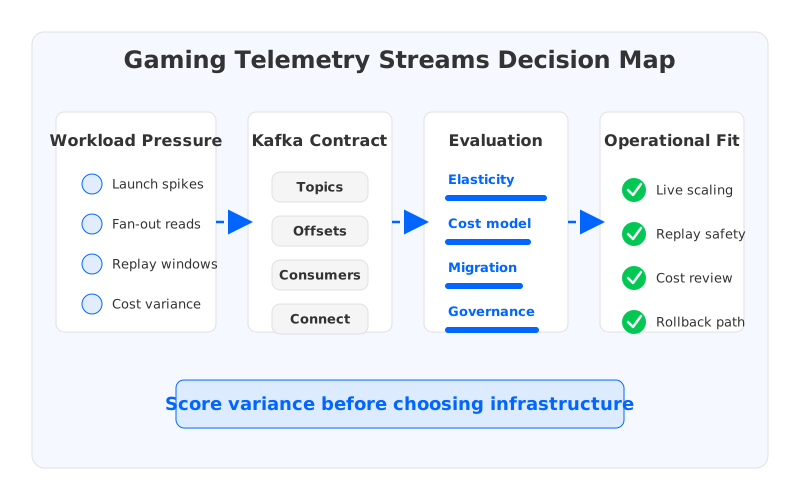
That combination turns Kafka from a transport layer into a production operating model. The platform has to protect latency during spikes, retain data for replay, feed downstream systems, and keep costs explainable. Gaming telemetry architecture should be evaluated by how it handles variance, not by how clean the happy-path diagram looks.
1Why Gaming Telemetry Stresses Kafka Differently
Traditional web analytics traffic is often bursty, but gaming telemetry adds tighter coupling between event freshness and player experience. A delayed purchase event can break entitlement workflows. A delayed anti-cheat event can let suspicious sessions continue. A delayed matchmaking or session-quality signal can hide a regional failure until players leave. These streams are operational inputs, not passive logs for an overnight batch job.
The pressure usually comes from four directions at once:
- Ingest variance. Producers include game servers, clients, edge services, payment systems, and live-ops tools. Their traffic can move independently, so aggregate throughput hides the topic-level hotspots that actually hurt brokers.
- Fan-out pressure. The same telemetry may be consumed by fraud detection, player segmentation, customer support dashboards, real-time experimentation, and lake ingestion. Consumer lag becomes a product and operations signal.
- Retention tension. Teams want longer replay windows for incident analysis and model training, but local broker disks turn retention into a capacity-planning argument.
- Governance drift. Gaming event schemas change quickly. Without ownership rules, telemetry topics become a mix of stable contracts, debug exhaust, and undocumented fields.
Kafka is a strong fit for the event model because it gives producers and consumers a shared log with topics, partitions, offsets, and consumer groups. The platform problem starts when those semantics are tied to infrastructure assumptions that are awkward in cloud gaming operations. The expensive moment is not the steady state. It is when the game needs capacity before the team has time to rebalance storage, move partitions, or explain a network bill.
2The Production Constraint Behind the Architecture
Kafka's Shared Nothing architecture made sense in the environment where Kafka grew up. Each broker owns local storage, partitions have leaders and followers, and replication protects durability by copying data between brokers. That model is still powerful, but it makes storage locality part of every operational decision. Add a broker and the cluster still needs to move partition data before the new capacity is useful. Replace a broker and the cluster still has to heal local replicas. Extend retention and the broker fleet still needs enough disk headroom.
Gaming telemetry makes those mechanics visible. Imagine a launch-week cluster sized for peak write throughput. If the game is quiet for most of the week, the team pays for spare compute and disk anyway. If a tournament doubles write traffic, the team can add brokers, but local data placement determines how fast that capacity helps. If analytics falls behind, catch-up reads compete with hot-path traffic because the same broker fleet serves recent and historical data.
The constraint is not only cost. It is the coupling of operational actions:
| Decision | What platform teams want | What local broker storage can force |
|---|---|---|
| Scale out | Add compute for a spike | Rebalance partitions and data before capacity is fully useful |
| Extend retention | Keep more replay history | Buy more broker-local disk or reduce headroom |
| Replace a node | Treat compute as disposable | Wait for replica recovery and data movement |
| Serve more consumers | Add read fan-out | Protect broker CPU, cache, network, and disk together |
| Control cloud cost | Attribute cost to workloads | Separate compute, storage, and cross-AZ transfer line items manually |
Tiered Storage helps one part of this problem by moving older segments to remote storage while recent data remains on local disks. That can improve long-retention economics, and Apache Kafka documents Tiered Storage as a feature for keeping older log segments in remote storage. It does not fully remove the broker-local storage model from the hot path. For gaming telemetry, that distinction matters because spikes, leader movement, and hot reads are usually about the latest data.
3Architecture Options and Trade-Offs
A practical evaluation starts by separating the event contract from the infrastructure model. The event contract covers Kafka producer and consumer APIs, topic naming, partitioning, offsets, consumer groups, delivery behavior, transactions where needed, Connect integration, and schema governance. The infrastructure model covers broker storage, durability, scaling, network placement, observability, and upgrades.
Most teams end up comparing four options.
- Self-managed Kafka on cloud instances. This gives maximum control and maximum operational responsibility. It fits teams with deep Kafka skills, strict customization needs, and tolerance for managing brokers, disks, upgrades, balancing, and disaster recovery.
- Managed Kafka. This reduces some operational work, but the buyer still needs to inspect how retention, partitions, networking, scaling, and connector operations map to cost and SLOs.
- Kafka with Tiered Storage. This can reduce pressure from long retention, especially for cold reads and replay windows. It should be evaluated separately from spike handling because it does not make brokers stateless.
- Kafka-compatible shared storage systems. These keep Kafka-facing semantics while changing the storage model underneath. The evaluation question becomes whether the system preserves compatibility while making compute replacement, scaling, and storage growth less coupled.
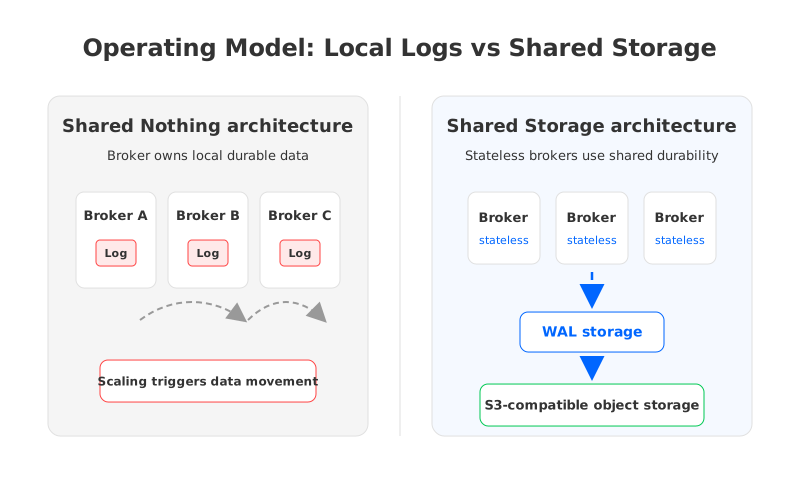
The right option depends on workload shape. A game with predictable telemetry, short retention, and a small number of consumers may not need an architectural shift. A game with global launch spikes, long replay requirements, multiple real-time consumers, and cost pressure should look harder at storage separation. The more variance a workload has, the more damaging it is when compute and storage scale as one unit.
4A Neutral Evaluation Checklist for Platform Teams
The cleanest way to evaluate gaming telemetry streams kafka infrastructure is to score the platform against production questions instead of vendor categories. A system that looks attractive in a benchmark can still be a poor fit if it breaks consumer compatibility, hides network costs, or makes rollback difficult. Gaming teams rarely get to redesign telemetry when a season launch is already on the calendar.
| Evaluation area | Questions to ask before choosing |
|---|---|
| Compatibility | Do existing Kafka clients, consumer groups, offsets, transactions, and Connect-based integrations continue to work with limited changes? |
| Elasticity | Can the platform add compute capacity quickly during an event spike without waiting for large data movement? |
| Cost model | Are compute, storage, requests, and cross-AZ traffic visible enough for FinOps review? |
| Retention | Can the team keep replay windows for incidents, model training, and analytics without turning every broker into a storage purchase? |
| Isolation | Can hot gameplay telemetry, fraud streams, and lake ingestion be isolated by topic, quota, consumer group, and observability boundary? |
| Migration | Is there a tested path to mirror topics, preserve offsets, validate consumers, and roll back? |
| Operations | Are broker replacement, upgrades, partition reassignment, and failure recovery routine operations rather than launch-week risks? |
This table also exposes a common mistake. Teams often treat telemetry streaming as a pure throughput problem, then discover that the more expensive problems are recovery, replay, and change management. Throughput is necessary, but it is not sufficient. A gaming platform owner needs to know how the system behaves when a region is hot, when a consumer group is behind, when a bad client build emits noisy events, and when finance asks why the data-transfer line changed after a release.
5How AutoMQ Changes the Operating Model
Once the requirements are framed this way, AutoMQ fits into a specific architectural category: a Kafka-compatible cloud-native streaming platform that keeps Kafka protocol semantics while moving persistent storage to shared object storage. AutoMQ uses a Shared Storage architecture with stateless brokers, S3Stream, WAL (Write-Ahead Log) storage, data caching, and S3-compatible object storage. The product point is not "Kafka, but with a different label." The architecture changes which operations require data movement.
In traditional Kafka, a broker is both compute and a storage owner. In AutoMQ, AutoMQ Brokers handle Kafka protocol work, request routing, partition leadership, caching, and scheduling, while durable stream data is stored through S3Stream and object storage. WAL storage sits in the write path for durability and recovery, and S3 storage acts as the main storage layer. That separation means broker replacement and scaling are less tied to moving partition data from one local disk to another.
For gaming telemetry, the operational consequences are concrete:
- Spike response becomes a compute problem first. When brokers are stateless, adding or replacing compute does not require the same local-log migration pattern that dominates traditional rebalancing.
- Retention planning moves closer to object storage economics. Long replay windows no longer require every broker to carry proportional local disk capacity.
- Cross-AZ design can be reviewed explicitly. AutoMQ's architecture is designed around shared object storage and Zero cross-AZ traffic patterns, which matters when multi-AZ Kafka replication traffic becomes a visible cloud cost.
- Migration can be staged around Kafka compatibility. Existing producer and consumer semantics remain central, so platform teams can evaluate topic mirroring, offset behavior, and consumer validation without asking application teams to adopt a new event API.
This does not remove the need for engineering discipline. Teams still need clear topic ownership, partitioning rules, schema evolution, quota policy, consumer lag alerts, and failure drills. It also does not mean every game needs the same WAL type or deployment model. AutoMQ Open Source uses S3 WAL, while AutoMQ commercial editions can use WAL storage options such as Regional EBS WAL or NFS WAL depending on the environment and latency requirements. The practical evaluation is to match the WAL and deployment model to the game workload instead of treating all telemetry as one class.
6A Readiness Scorecard for Gaming Telemetry
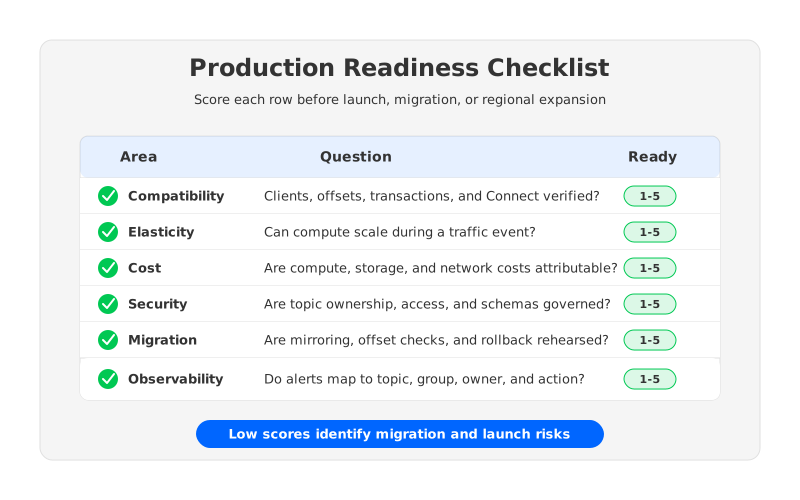
The fastest way to find risk is to score the system that exists today. Give each row a score from 1 to 5. A score of 1 means the team depends on manual coordination or unclear ownership. A score of 5 means the behavior is tested, observable, and repeatable under load. The exact number matters less than the conversation it forces between game services, data engineering, SRE, security, and finance.
| Capability | 1 looks like | 5 looks like |
|---|---|---|
| Launch scaling | Capacity is guessed weeks ahead | Capacity can be added and verified during a controlled load test |
| Consumer recovery | Lag response depends on tribal knowledge | Lag alerts map to owners, runbooks, and replay windows |
| Retention policy | Defaults vary by topic | Retention is tied to product, compliance, and analytics requirements |
| Cost attribution | Kafka cost is one shared bucket | Compute, storage, network, and connector costs are reviewed by workload |
| Migration safety | Cutover is a one-time event | Mirroring, offset validation, rollback, and consumer tests are rehearsed |
| Governance | Event fields change without review | Schema ownership and compatibility checks are part of release flow |
The scorecard is deliberately cross-functional. A platform team can make brokers healthier, but it cannot decide whether a telemetry field belongs in a long-retention topic. Data engineering can build lake ingestion, but it cannot absorb a gameplay spike if the broker fleet is undersized. FinOps can flag cost anomalies, but it needs enough platform detail to distinguish normal event growth from inefficient replication or fan-out.
7CTA: Validate the Architecture Before the Next Launch
If your team is planning a content launch, regional expansion, or telemetry platform refresh, do not start with a vendor feature list. Start with the variance: peak write rate, fan-out, replay windows, cross-AZ topology, migration tolerance, and the operational actions your team must perform while the game is live.
AutoMQ is worth evaluating when Kafka compatibility matters but broker-local storage is the part of the system slowing down scaling, retention, or recovery. Review the architecture overview and deployment model here: AutoMQ documentation.
8References
- Apache Kafka Documentation: Consumers and consumer groups
- Apache Kafka Documentation: Kafka Connect
- Apache Kafka Documentation: KRaft
- Apache Kafka Documentation: Tiered Storage
- AutoMQ Documentation: What is AutoMQ
- AutoMQ Documentation: Architecture overview
- AutoMQ Documentation: Manage environments overview
- Amazon S3 User Guide
- Amazon S3 Pricing
- Google Cloud Storage documentation
- Azure Blob Storage introduction
9FAQ
9.1Is Kafka a good fit for gaming telemetry streams?
Kafka is a strong fit when the game needs ordered partitions, replayable event logs, consumer groups, and broad ecosystem integration. The harder decision is not whether Kafka can carry events. It is whether the chosen Kafka-compatible platform can handle launch spikes, retention, fan-out, recovery, and cloud cost without excessive manual operations.
9.2What is the main scaling risk in gaming telemetry Kafka architecture?
The main risk is coupling compute scaling to broker-local storage movement. If adding capacity also requires large partition rebalancing and local data movement, the platform may react too slowly during live events. Shared Storage architecture changes that operating model by making brokers less dependent on local persistent data.
9.3Does Tiered Storage solve gaming telemetry retention?
Tiered Storage can help with long retention by moving older log segments to remote storage. It is not the same as a fully diskless or stateless broker architecture because recent data and broker operations can still depend on local storage. Teams should evaluate Tiered Storage for retention and shared storage for elasticity as related but different decisions.
9.4What should be tested before migrating gaming telemetry streams?
Test producer compatibility, consumer group behavior, offset preservation, topic mirroring, schema compatibility, lag recovery, rollback, observability, and cost attribution. A migration plan that only verifies write throughput is incomplete because most telemetry incidents happen around consumers, replay, or operational recovery.


