
Table of Contents
Table of Contents
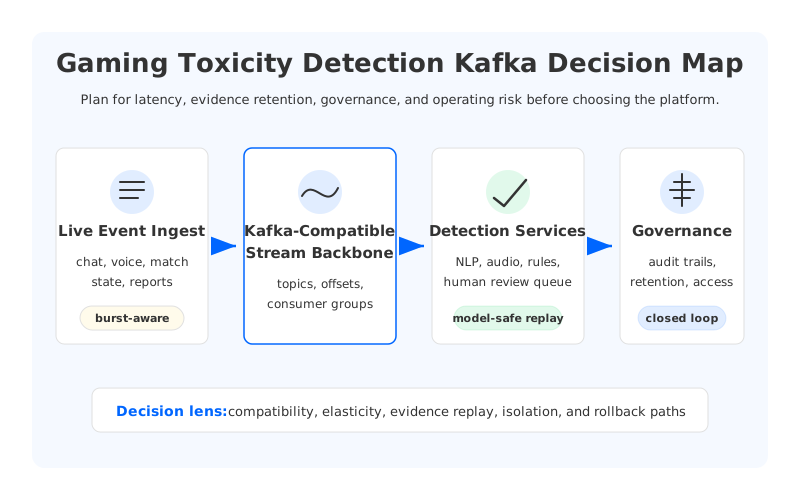
A team searching for gaming toxicity detection kafka is usually past the proof-of-concept stage. The hard question is no longer whether chat text, voice transcripts, player reports, and moderation decisions can move through an event stream. The hard question is whether that stream still behaves predictably during a tournament launch, a content patch, a viral streamer event, or a coordinated abuse wave, when product teams want faster detection and trust teams want stronger evidence retention.
That mix makes toxicity detection different from a generic event pipeline. Moderation systems combine low-latency serving, replayable evidence, model iteration, human review, regional policy boundaries, and player-facing actions. A Kafka-compatible platform can be the right backbone because teams already understand topics, partitions, offsets, consumer groups, Kafka Connect, and the surrounding ecosystem. But the platform choice should be driven by operating constraints, not by the fact that Kafka is familiar.
The useful framing is this: a gaming toxicity detection Kafka architecture is a control system. It observes player behavior, classifies risk, routes decisions, preserves evidence, and feeds model improvements. If the stream backbone becomes expensive to scale, slow to rebalance, or difficult to govern, the detection system inherits those limits.
1Why Teams Search for gaming toxicity detection kafka
Gaming teams usually reach this search from one of three directions. Trust and safety teams want to detect harassment, hate speech, grooming, spam, cheating coordination, or voice abuse closer to the moment it happens. Data teams want a streaming substrate for detection, analytics, and offline training without duplicating every integration. Platform teams want the system to survive uneven traffic, because game usage rarely follows smooth capacity curves.
Kafka fits the mental model because moderation events are ordered, partitionable, replayable records. A text message can be keyed by match, party, player, region, or conversation. A voice transcript can be joined with session metadata and player reports. A moderation decision can be written back as another event, consumed by enforcement services, player support tooling, and audit storage.
The first design mistake is treating those topics as an application detail. They are the product's evidence trail. Once a player appeals a ban, a regulator asks about data handling, or a model team needs to reconstruct a bad decision, offsets and retention stop being plumbing. They become the boundary between "we think this happened" and "we can show the exact sequence of events that led to the action."
2The Production Constraint Behind the Problem
A toxicity detection stream is pulled in two directions at once. The online path wants low latency: capture the event, enrich it, score it, and route an action while the match is still live. The offline and governance paths want durability: keep enough history for model evaluation, appeals, abuse pattern analysis, and policy review. Those requirements are compatible on paper, but they put pressure on different parts of the streaming platform.
In a typical design, events flow through a few durable stages:
- Raw ingest topics keep minimally transformed chat, voice transcript, report, and match-state records. These topics need clear retention and access rules because they may contain sensitive player communication.
- Feature and enrichment topics attach language, region, player history, trust signals, and context windows. These topics often have higher fan-out because several detection services need the same context.
- Decision topics record model scores, rule matches, human review outcomes, enforcement actions, and appeal state. These streams need stable offsets because downstream systems may use them to reconcile player-visible actions.
- Audit and training exports preserve selected records for review, evaluation, and future model development. This path may tolerate more latency, but it cannot tolerate ambiguous lineage.
This is where the architecture stops being a pure ML question. The streaming layer must handle bursty writes, fan-out reads, long or selective retention, replay, and strict access boundaries. It must also keep operational risk low enough that trust and safety teams can change detection rules without waiting for a storage migration or a broker rebalance.
3Shared Nothing Turns Workload Spikes Into Storage Work
Traditional Kafka follows a Shared Nothing architecture: each broker owns local storage, and partitions are replicated between brokers through leader and follower replicas. That model is well understood and battle-tested. It also couples compute capacity with local persistent data, which matters when the workload is shaped by game events rather than steady enterprise traffic.
When a seasonal launch doubles chat volume, a platform team may need more broker capacity. In broker-local storage designs, adding capacity does not only mean adding compute. Partitions must move, local disks must absorb retention, replicas must catch up, and cross-zone replication paths may grow with the workload. For toxicity detection, the timing is awkward: the team needs more detection throughput precisely when the evidence stream is hottest.
The same issue appears during replay. A model rollback, a false-positive investigation, or a revised policy rule may require consumers to scan historical data. That read pattern competes with live detection traffic unless the cluster is designed for both tailing reads and catch-up reads. Retention is no longer a static compliance value; it becomes an operational input into how quickly a team can explain and correct moderation behavior.
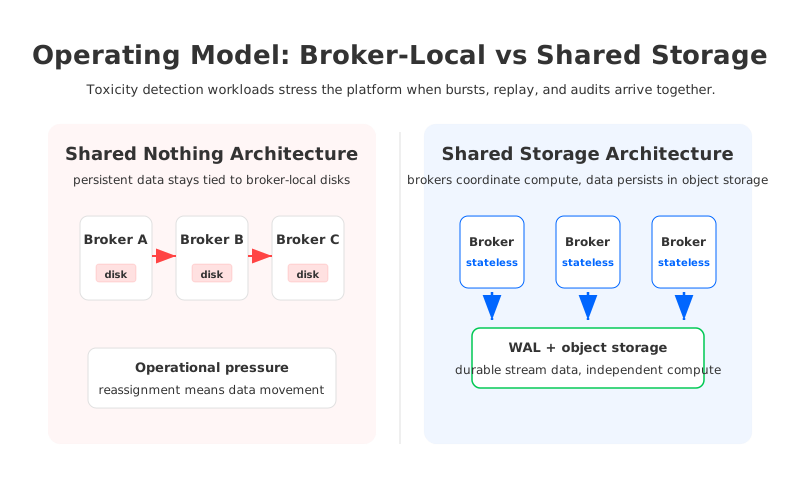
The point is not that broker-local Kafka cannot run this workload. It can. The point is that platform teams must plan for the hidden coupling between traffic growth, storage growth, data movement, and operational recovery. Once that coupling is visible, the evaluation criteria become more concrete.
4Architecture Options and Trade-Offs
A reasonable platform evaluation should compare at least four approaches. None is universally right. The strongest fit depends on latency targets, cloud boundaries, operational ownership, retention policy, and migration tolerance.
| Option | Where it fits | Main trade-off for toxicity detection |
|---|---|---|
| Self-managed Kafka | Teams with deep Kafka operations expertise and strong infrastructure control | Maximum control, but teams own broker sizing, disk planning, partition movement, upgrades, and failure drills. |
| Managed Kafka service | Teams that want to offload routine cluster operations | Lower operational burden, but platform limits, pricing dimensions, and migration paths must be checked against retention and replay needs. |
| Stream processing service plus storage lake | Teams that prioritize offline analytics and model training | Good for analytics, but online moderation still needs a low-latency event backbone with stable offsets and clear replay semantics. |
| Kafka-compatible cloud-native streaming | Teams that want Kafka protocol compatibility with a different storage operating model | Promising when existing clients and tools matter, but compatibility and migration behavior must be verified with real workloads. |
The evaluation should start with compatibility. Apache Kafka's own documentation defines the concepts teams depend on, including producers, consumers, consumer groups, offsets, transactions, Kafka Connect, and KRaft-based operations. A platform that claims Kafka compatibility should be tested against the behaviors your applications use, not only against a hello-world producer and consumer.
After compatibility, cost modeling should include more than broker hours. Toxicity detection creates cost through retention, read fan-out, replay, inter-zone networking, audit exports, and over-provisioned capacity for bursts. A platform that looks inexpensive for steady writes may become costly when model teams replay weeks of historical reports or when human review tools add another consumer group to high-volume topics.
Governance is the next filter. Player communication can be sensitive. The platform should make it clear where data lives, which account or VPC owns it, how encryption and access policies are enforced, and whether operational telemetry is separated from message data. For global games, regional policy can shape topic layout, retention, replication, and review workflows.
5Evaluation Checklist for Platform Teams
The practical checklist is shorter than most architecture reviews. If a candidate platform cannot answer these questions cleanly, the risk will surface later in migration, incident response, or trust and safety operations.
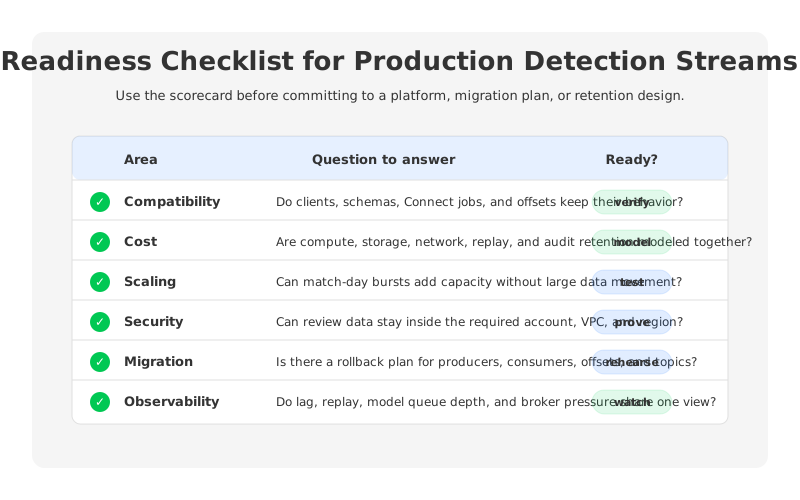
Use this scorecard before choosing a platform:
- Protocol and client behavior: Can existing Kafka clients, serializers, schema tools, Kafka Connect jobs, consumer groups, and offset management patterns move without application rewrites?
- Latency under burst: What happens to produce latency and consumer lag during match-day spikes, replay jobs, and detection service deploys?
- Retention and replay: Can the platform retain the required evidence window without forcing brokers to carry long-term storage as local operational burden?
- Data movement during scaling: Does adding or replacing capacity require large partition data movement, or is the operation mostly metadata and leadership coordination?
- Security boundary: Does player communication stay inside the required cloud account, VPC, region, and access-control model?
- Migration and rollback: Can producers, consumers, topics, ACLs, and offsets be moved in phases, with a clear fallback if the cutover exposes an application assumption?
- Observability: Can platform teams correlate broker pressure, object storage behavior, consumer lag, detection queue depth, model errors, and review backlog in one incident timeline?
This checklist also prevents a common organizational failure. Trust and safety, data science, platform engineering, and SRE teams often evaluate different parts of the system. The stream backbone is where their assumptions meet. A decision that satisfies only one group usually creates work for another.
6How AutoMQ Changes the Operating Model
Once the evaluation framework is explicit, AutoMQ becomes relevant as a Kafka-compatible cloud-native streaming platform with a Shared Storage architecture. It keeps the Kafka protocol and ecosystem surface that application teams expect, while changing the storage model beneath the broker layer. Instead of binding persistent stream data to broker-local disks, AutoMQ uses stateless brokers and S3-compatible object storage as the durable storage foundation.
That storage shift matters for toxicity detection because the workload's pain is operational coupling. When brokers are stateless, scaling compute does not have to mean moving the full body of retained evidence between local disks. Partition reassignment can become a coordination and ownership problem rather than a large data-copy problem. For a gaming platform, that is useful during live events, when capacity has to follow traffic without turning the evidence trail into a moving target.
AutoMQ's S3Stream layer uses WAL (Write-Ahead Log) storage on the write path before data is uploaded to object storage. The WAL is the durable buffer for acknowledgments and failure recovery, while object storage holds the main stream data. This design separates the hot write path from long-term retention more cleanly than broker-local storage.
The deployment boundary is also part of the architecture. AutoMQ BYOC runs in the customer's cloud account and VPC, and AutoMQ Software is designed for private environments. For teams handling sensitive player communication, that boundary can be as important as throughput. The control plane can manage lifecycle and operations, while the data plane that carries Kafka traffic remains in the customer's environment.
AutoMQ is not a reason to skip testing. A serious migration still needs workload validation: client versions, topic configs, consumer group behavior, Connect integrations, schema compatibility, retention rules, and rollback plans. AutoMQ Linking for Kafka can help with staged migration and offset-preserving cutover patterns, but the team still needs to rehearse the path with representative topics.
7Reference Architecture for a Production Rollout
A production gaming toxicity detection architecture should separate online decisions from evidence governance without splitting the authoritative event record. The event stream should remain where ordered behavior, classifications, and actions are recorded. Derived stores can serve search, analytics, model training, and support tooling, but should be rebuildable from durable streams where practical.
A clean rollout often looks like this:
- Define topic contracts by workflow, not team ownership. Raw events, enrichments, decisions, review outcomes, and appeals should each have clear schemas, retention, and access rules.
- Partition for the operational question you must answer. Player, conversation, match, and region keys each create different ordering and hot-partition behavior. Choose based on the moderation decision path, not the easiest producer implementation.
- Separate online and replay consumers. Detection services need predictable tailing reads. Model evaluation and policy audits need catch-up reads. Treat them as different capacity profiles.
- Make governance observable. Retention, delete requests, appeal lookups, human review queues, and model output drift should have metrics that can be read alongside Kafka lag and broker pressure.
- Rehearse migration as an incident drill. Cutover plans should include producer routing, consumer offsets, duplicate handling, rollback triggers, and who owns the decision when a policy service disagrees with the stream state.
This pattern keeps the Kafka-compatible event backbone central without making every downstream team depend on the same operational path. The detection service can optimize for fast decisions. The review tooling can optimize for context. The data science team can replay safely. The platform team can scale the backbone with fewer storage-side surprises.
8FAQ
8.1Is Kafka a good fit for gaming toxicity detection?
Kafka is a good fit when the system needs ordered, replayable, high-throughput event streams across multiple consumers. Toxicity detection often has those requirements because chat, voice transcripts, reports, model scores, enforcement actions, and appeal outcomes all need consistent lineage. Kafka is less helpful if the workload is only occasional batch review with no need for live routing or replay.
8.2What topics should a gaming toxicity detection Kafka design include?
Most teams start with raw event topics, enrichment topics, model-score topics, human-review topics, enforcement-action topics, and audit/export topics. The exact split should follow access control and retention boundaries. Sensitive raw communication may need stricter controls than derived scores or aggregate metrics.
8.3How should teams think about retention?
Retention should be tied to product and policy needs: live detection, appeals, abuse pattern investigation, model evaluation, and legal requirements. Keeping everything forever is rarely the right answer. Keeping too little makes incidents and appeals hard to reconstruct. The platform choice should make the chosen retention window operationally affordable.
8.4Where does AutoMQ fit in this architecture?
AutoMQ fits when teams want Kafka-compatible APIs and ecosystem behavior, but they also want a Shared Storage architecture with stateless brokers and object-storage-backed durability. That combination is relevant for workloads where burst scaling, replay, retention, and cloud operating cost all matter.
If your next architecture review is about gaming toxicity detection, start by modeling the evidence stream, not the model endpoint. Then test whether the platform can keep offsets, replay, retention, and scaling boring during the busiest hour of the game. To evaluate AutoMQ for a Kafka-compatible deployment in your own environment, visit AutoMQ Cloud.


