
Table of Contents
Table of Contents
Kafka high availability on Google Cloud looks straightforward until the first serious capacity or failure exercise. You spread brokers across zones, set a replication factor of 3, require enough in-sync replicas, and keep clients away from single-zone assumptions. That gets the cluster out of the obvious danger zone, but it does not answer the harder architecture question: how much data must move every time the system protects itself?
That question is where many GCP Kafka designs become expensive or operationally heavy. Traditional Kafka protects data by keeping partition replicas on broker-local storage. On GCP, those brokers live in zones, and replica traffic crosses zone boundaries whenever leaders replicate to followers in other zones. Google Cloud's own network pricing distinguishes same-zone traffic from traffic to a different zone in the same region, and Managed Service for Apache Kafka pricing calls inter-zone transfer a major cost component for active clusters. The availability design is doing its job, but the bill and the recovery path are telling you what the design costs.
1What Multi-Zone Kafka Must Protect Against
A production GCP Kafka architecture has to survive more than a VM restart. It has to handle a broker failure, zonal capacity pressure, rolling maintenance, disk pressure, leader movement, and the possibility that an entire zone becomes temporarily unusable. Google Cloud regions are divided into zones, and common GKE and Compute Engine designs use those zones to reduce correlated failure risk. Kafka can fit that model, but only if broker placement, replication, client routing, and storage behavior are treated as one system.
The usual checklist starts with the right primitives:
- Replica placement across zones keeps a partition available when one broker or zone is lost, assuming the remaining replicas stay in sync and the topic's durability settings allow progress.
min.insync.replicaswith producer acknowledgments decides whether a write can be acknowledged when the cluster has already lost redundancy.- Rack awareness helps Kafka avoid placing all replicas for a partition in the same failure domain.
- Client locality reduces unnecessary cross-zone reads when consumers can fetch from a nearby replica.
- Capacity headroom gives the cluster room to absorb leader concentration after a failure.
These controls are necessary, but they are not the whole architecture. A cluster can be configured correctly and still spend a surprising amount of time moving bytes. Every retained segment on local broker storage is part of the failure domain. Every new replica, broker replacement, and partition reassignment is an operation that has to reconcile placement with data location.
2Traditional Kafka Replication on GCP
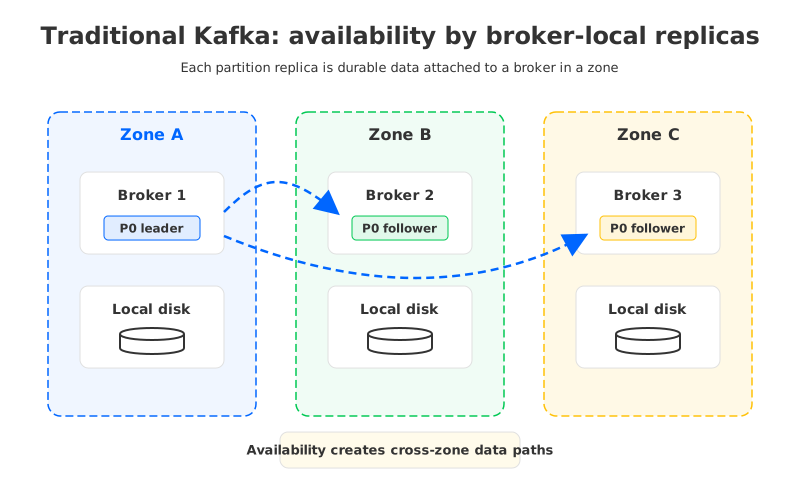
Traditional Kafka's durability model is elegant in a data-center world: a leader appends records to its log, followers fetch from the leader, and replicas stay in the in-sync replica set if they keep up. With a replication factor of 3 across three zones, a write to a leader in Zone A is typically copied to followers in Zone B and Zone C. That is the right shape for availability because a single-zone outage should not erase every copy of the data.
On GCP, the physical meaning of that design is more explicit. The leader's write path and the follower replication path use network links between zones. If the producer writes 10 GiB into a leader in one zone and two followers sit in other zones, the replication path transfers 20 GiB across zones before consumer traffic is considered. Google uses exactly this kind of example in Managed Service for Apache Kafka pricing: with replication factor 3, 10 GiB written in a single zone creates 20 GiB of inter-zone transfer for the two copied replicas at the listed \$0.01/GiB rate in that pricing page's example.
| Design element | What it protects | What it moves |
|---|---|---|
| Replication factor 3 across zones | Broker and zone failure | Each write is copied to follower zones |
| Partition reassignment | Placement correction and scaling | Retained segments copied to new replicas |
| Broker replacement | Hardware or VM failure | Data must catch up on replacement replicas |
| Consumer locality | Cross-zone read reduction | Requires clients and replicas to align |
The table is not an argument against Kafka replication. It is a reminder that Kafka's replication model makes availability visible as network traffic. If your workload has high ingest, long retention, many partitions, or frequent scale events, that visibility becomes part of the architecture, not a footnote in the pricing model.
3Network and Storage Cost Implications
Google Cloud's VPC network pricing states that traffic to the same zone using internal addresses has no charge, while traffic to a different zone in the same region is charged per GiB. Managed Service for Apache Kafka pricing goes further for Kafka specifically: it lists networking as a component covering inter-zone transfer for replication within a cluster, and notes that for clusters above a utilization threshold, inter-zone transfer can become the largest component of total cost. The operational lesson is blunt: zone diversity is valuable, but cross-zone byte paths deserve architectural attention.
There are three main byte paths to separate when estimating Kafka on GCP:
- Write replication traffic is driven by producer ingest, replication factor, compression, and leader placement. It is usually the first number to calculate because it is predictable.
- Read traffic depends on whether consumers fetch from leaders or local followers. Kafka supports follower fetching, but the client, broker, and placement model must make it useful in practice.
- Recovery and reassignment traffic appears during cluster operations. It can be quieter day to day, then dominate the cluster during broker replacement, expansion, or partition movement.
Storage has a similar split. Persistent Disk or local broker-attached storage gives Kafka its familiar local log behavior, but it also binds durable data to the broker fleet. Cloud Storage has a different durability model: Google documents that regional buckets store data redundantly in at least two zones and that object writes are confirmed only after data has been redundantly stored across at least two zones. That does not automatically make an object-storage-backed Kafka design faster or simpler; the commit path, metadata path, and read path still matter. It does show why shared storage changes the fault boundary. Durable data no longer has to be reconstructed by copying every retained segment from one broker-local disk layout to another.
4Failure Recovery and Partition Movement
The uncomfortable moment in a traditional multi-zone Kafka design is not always the failure itself. Kafka is good at electing leaders from in-sync replicas when the cluster has enough healthy replicas. The heavier part can come after the immediate failover, when the platform has to restore balance, replace capacity, and return to the intended placement model.
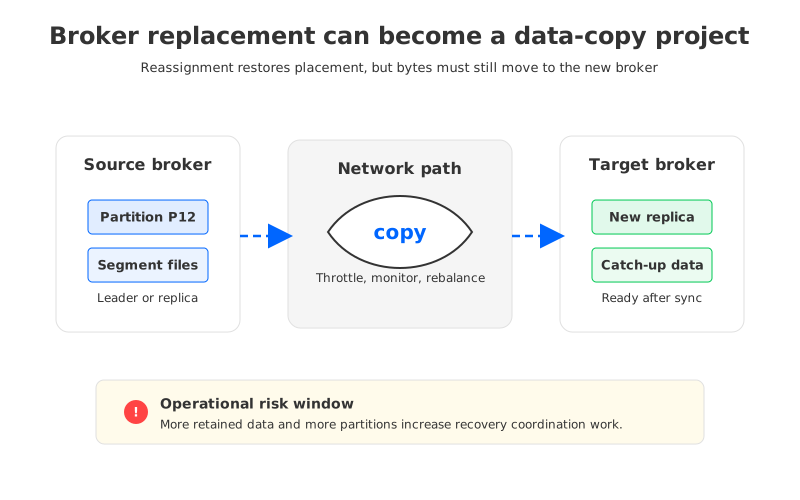
Partition reassignment is the classic example. Adding brokers or replacing failed brokers does not magically teleport old log segments. New replicas have to copy data from existing replicas until they catch up. Operators can throttle reassignment, schedule it during quiet periods, and monitor lag, but the core mechanism still moves bytes. When retention is long, partitions are numerous, and broker disks are large, the recovery plan becomes a network and time-management exercise.
This is why a serious GCP Kafka architecture review should ask operational questions before tool questions:
- If one zone is unavailable, which partitions lose leaders, and where do new leaders concentrate?
- How much spare CPU, memory, network, and disk throughput remains after that concentration?
- How many GiB or TiB must move to restore the desired replica layout?
- Can reassignment traffic be throttled without extending risk too long?
- Which dashboards distinguish client lag from replica catch-up and disk saturation?
Managed Kafka services can automate parts of broker lifecycle management. Google Managed Service for Apache Kafka, for example, states that broker management including storage is automated, and that failed brokers are replaced automatically when possible. That is useful operationally, especially for teams that do not want to run every Kafka maintenance workflow themselves. It does not remove the architectural fact that open source Kafka stores replicas on brokers and uses replication between brokers to maintain availability.
5Shared-Storage Kafka Architecture With AutoMQ
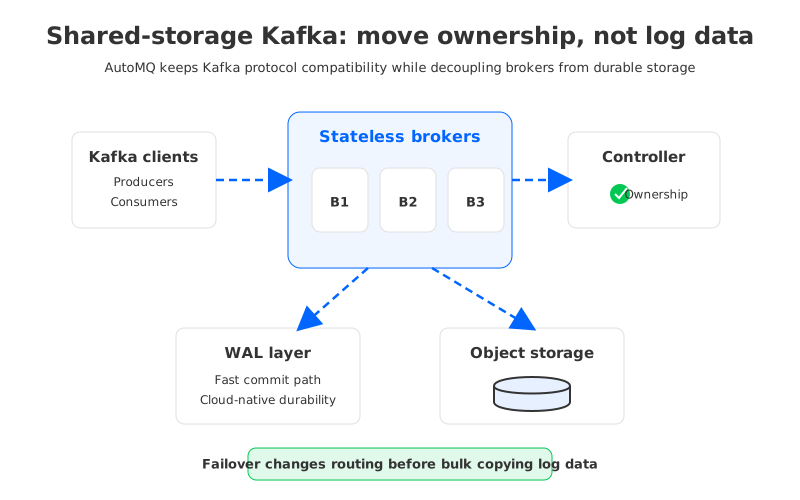
Once the problem is framed as data movement rather than only broker placement, another design becomes visible. A Kafka-compatible system can keep the Kafka protocol and client semantics while changing where durable log data lives. Instead of treating each broker as both compute and long-term storage, the architecture can make brokers more stateless and place durable data in shared cloud storage, with a write-ahead log layer handling the fast commit path.
That is the architectural category AutoMQ fits into. AutoMQ is a Kafka-compatible cloud-native streaming system that decouples brokers from durable storage, using shared object storage and a WAL-based write path so broker failure or scaling does not require the same volume of broker-local log copying. The product point matters less than the design principle: if durable data is no longer owned by one broker's disk, recovery can focus more on metadata, ownership, and traffic routing.
This model changes several GCP architecture decisions:
- Broker replacement becomes lighter because a replacement broker does not need to rebuild a large local log before it can participate in serving the cluster.
- Scaling becomes less coupled to retained data because compute capacity and storage footprint are separated.
- Multi-zone durability can lean on cloud storage primitives rather than relying only on application-level copies across broker disks.
- Cost analysis shifts from "how many full broker replicas and cross-zone copies do we maintain" to "which data path needs low latency, which path needs durable storage, and which path should avoid repeated movement."
There are tradeoffs, and they should be evaluated directly. Shared storage introduces a dependency on the storage service, the WAL design, request patterns, and metadata correctness. It also changes what you monitor: object storage request behavior, WAL health, broker ownership, and cache efficiency become first-class signals. For many GCP teams, that is a good trade when Kafka operations are dominated by reassignment, disk sizing, and over-provisioned brokers. For workloads with extremely tight local-disk assumptions or unusual plugin dependencies, the compatibility and performance test plan matters as much as the architecture diagram.
6Architecture Checklist
A good GCP Kafka architecture review should be specific enough to catch the hidden data movement. Generic statements like "three zones" and "replication factor 3" are not enough. The review should produce numbers, failure paths, and owner decisions.
| Architecture question | Traditional Kafka focus | Shared-storage focus |
|---|---|---|
| Where is durable log data stored? | Broker-attached disk | Shared object storage plus WAL |
| What happens after broker loss? | Elect leaders, then rebuild replicas | Reassign ownership and restore compute capacity |
| What drives cross-zone transfer? | Replication, reads, reassignment | Commit path, storage access, client routing |
| What limits scale-out speed? | Data copy and partition balance | Broker startup, metadata, workload routing |
| What should SREs watch? | ISR, under-replicated partitions, disk, reassignment | WAL, storage latency, ownership, broker health |
Use this checklist before choosing self-managed Kafka on Compute Engine, Kafka on GKE, Google Managed Service for Apache Kafka, or a Kafka-compatible shared-storage system:
- Define the failure target: broker failure, zone failure, regional disaster recovery, or all three. Each target has a different data-placement answer.
- Calculate write replication traffic from ingest rate and replication factor. Then calculate consumer traffic separately.
- Model a broker replacement with retained data size, partition count, reassignment throttle, and acceptable time in a degraded state.
- Decide whether clients need local reads. If yes, validate placement and client configuration rather than assuming locality happens automatically.
- Test rolling maintenance and forced broker loss in a staging cluster with production-like retention. Synthetic small topics hide the very thing you need to measure.
- Compare the operational model, not only the service label. Managed Kafka reduces operational ownership; shared-storage Kafka changes the storage and recovery mechanics.
The strongest architecture is usually the one that makes the expensive paths explicit. Traditional Kafka can be a solid choice when the team accepts broker-local replicas and has mature operations around reassignment. Google Managed Service for Apache Kafka is a strong fit when teams want open source Kafka behavior with Google-managed broker operations and GCP-native integration. AutoMQ becomes interesting when the main pain is not Kafka API compatibility, but the amount of durable data tied to broker movement.
If your current GCP Kafka design starts with three zones but never quantifies the data paths between them, the next review should start there. Map the write path, read path, and recovery path, then decide whether broker-local storage is still the right boundary. To explore the shared-storage option, review the AutoMQ architecture overview and the deployment overview with your GCP failure model beside it.
7References
- Google Cloud: Managed Service for Apache Kafka overview
- Google Cloud: Managed Service for Apache Kafka pricing
- Google Cloud: VPC network pricing
- Google Cloud: Compute Engine regions and zones
- Google Cloud: GKE cluster configuration choices
- Google Cloud: Cloud Storage availability and durability
- Google Cloud: Cloud Storage bucket locations
- Apache Kafka documentation: replication
- Apache Kafka documentation:
min.insync.replicas - Apache Kafka documentation: cluster expansion and partition reassignment
- Apache Kafka documentation: KRaft
- AutoMQ documentation: architecture overview
- AutoMQ documentation: deployment overview
8FAQ
8.1Is three-zone Kafka on GCP enough for high availability?
Three zones are a strong starting point, but they are not the complete design. You still need replica placement, in-sync replica policy, client routing, capacity headroom, monitoring, and a recovery plan for replacing brokers and restoring balanced placement.
8.2Why does multi-zone Kafka create network cost?
With traditional Kafka replication, followers fetch data from leaders. When leaders and followers are in different zones, replication traffic crosses zones. Consumer traffic can also cross zones if clients fetch from brokers outside their local zone.
8.3Does Google Managed Service for Apache Kafka remove reassignment concerns?
It automates broker management and simplifies many operational tasks, which is valuable. The service still runs open source Apache Kafka, so the core architecture remains broker-local replicas and inter-zone replication for availability.
8.4How does shared-storage Kafka reduce data movement?
Shared-storage Kafka separates durable log storage from broker-local disks. When brokers fail or scale, the system can move ownership and routing instead of rebuilding every durable log segment on a replacement broker before it is useful.
8.5Should every GCP Kafka workload move to shared storage?
No. The right answer depends on workload latency, retention, partition count, operational maturity, compliance boundaries, and compatibility requirements. Shared storage is most compelling when broker replacement, partition reassignment, disk sizing, or cross-zone data movement dominate the Kafka operating model.


