
Table of Contents
Table of Contents
A Kafka audit review often begins with a reassuring statement: “The logs are enabled.” That statement leaves several questions unanswered. Which identity changed a Topic configuration? Which service account accessed a cluster? Can an investigator reconstruct a data access event, and will the evidence still exist when the review starts?
A usable GCP Kafka audit plan ties each control objective to an event source, an owner, a retention rule, and a review action. Google Cloud’s Cloud Audit Logs overview describes the platform audit model, while the Managed Service for Apache Kafka documentation defines the provider-managed service boundary. The practical work is to connect those sources to Kafka behavior and to record the gaps that the platform does not fill by itself.
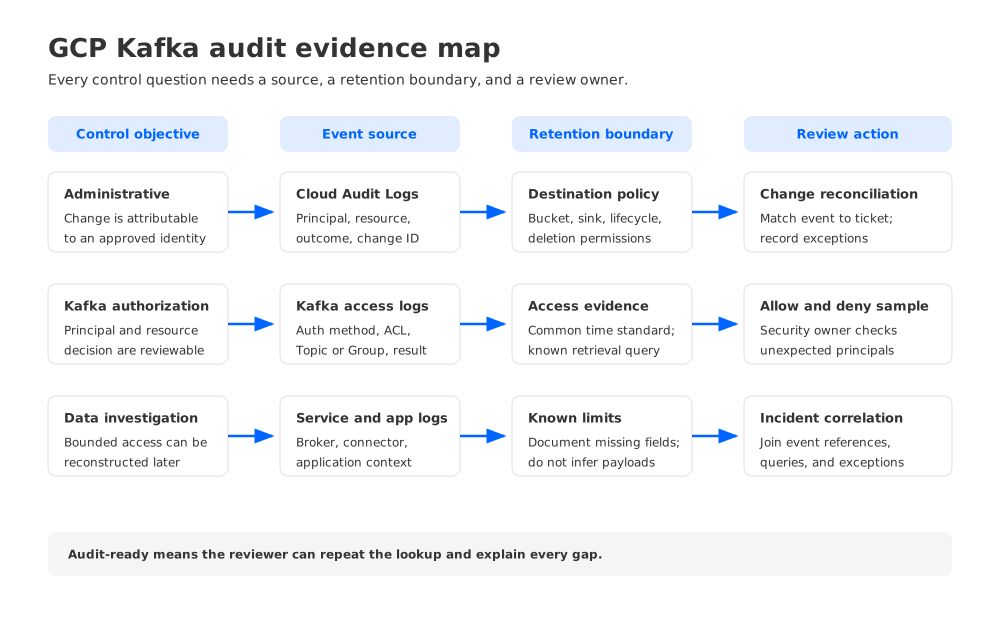
1Start with the control objective, not the log product
An auditor does not usually ask for “all logs.” They ask whether a control can be demonstrated. Turn each request into a statement that can be tested, such as “privileged changes to Topic configuration are attributable to an approved identity” or “access to retained records is reviewed within the organization’s stated window.”
A control statement becomes useful when it names the decision and the evidence that supports it:
| Control objective | Evidence to collect | Owner and review action |
|---|---|---|
| Prove administrative change | Cloud control-plane audit event, request identity, resource, outcome, and change ticket | Platform owner reconciles the event to an approved change |
| Prove Kafka authorization | Authentication context, Kafka ACL decision, principal, Topic or Group, and client result | Security owner samples allow and deny outcomes |
| Investigate data access | Provider data-access event where available, client or broker log, request context, and time range | Incident owner correlates the event with application activity |
| Demonstrate retention | Log bucket or sink destination, retention policy, deletion controls, and export health | Compliance owner checks policy and a retrieval sample |
| Show review execution | Review timestamp, reviewer, query or report identifier, and exception record | Control owner closes findings or assigns remediation |
This table forces a distinction between an event being emitted and an event being reviewable. A log line without a principal, resource, or time context may help with debugging but cannot answer an access review. A retention policy without a retrieval test proves configuration, not evidence availability.
The same distinction helps when a control spans managed and self-managed components. Google Cloud can record a resource change through Cloud Audit Logs, while the Kafka layer may record a client authentication failure or an ACL decision in a different stream. The review must preserve both views and a way to correlate them.
2Separate administrative, access, and data events
The audit trail becomes easier to reason about when the data path is split into three event classes. Administrative events describe changes to cloud resources, cluster settings, IAM bindings, or logging configuration. Access events describe authentication and authorization decisions at the Kafka boundary. Data events describe reads and writes, or the application actions that stand in for them when record-level logging is not available.
The classes have different volumes and different evidence risks:
- Administrative events are relatively sparse and should carry a change owner, resource name, request outcome, and a link to the approval record.
- Access events need the principal, authentication method, client identity, network context, and the resource decision. An allow event without the requested Topic or Group is hard to review.
- Data events can be high volume. Capture enough context to investigate a bounded incident, and document where record-level visibility ends. Do not imply that a platform audit log contains message payloads unless the service documentation explicitly says so.
Cloud Audit Logs uses categories such as Admin Activity and Data Access. Google Cloud documents that Admin Activity logs are collected by default, while Data Access logging generally requires explicit configuration and can have service-specific behavior. Treat that as a configuration checkpoint, not a blanket assumption. Verify which services and methods are covered in the target project, which identities are exempt, and whether the selected Kafka deployment emits a corresponding event.
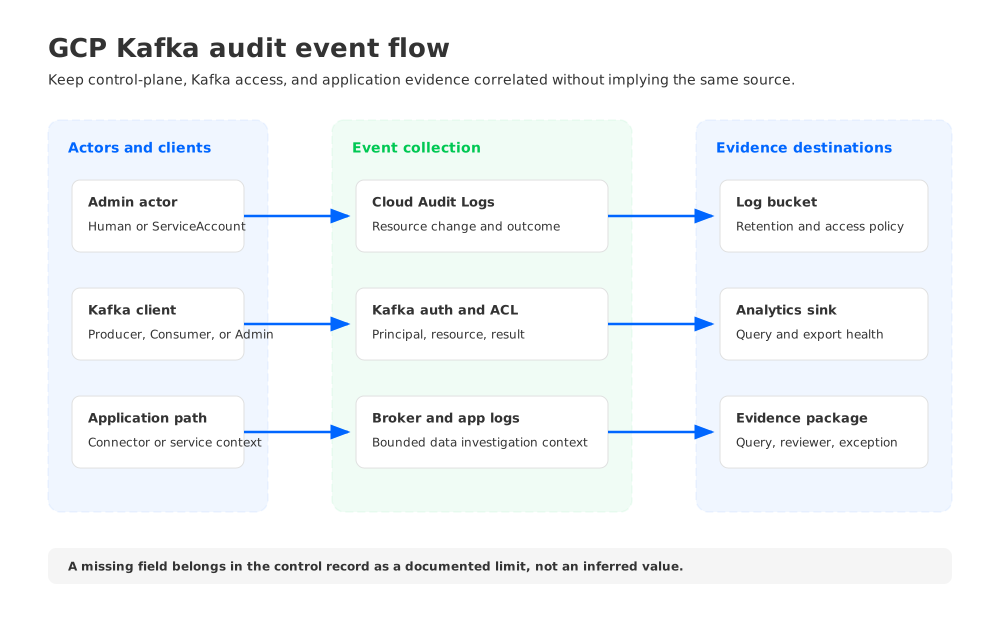
Correlation is the part that usually fails during an incident. Keep a common time standard and preserve fields that can join records across systems: project or organization, cluster or instance, Topic and Partition where relevant, principal, request or trace identifier, source network, and outcome. If a field is unavailable, record that limitation in the control evidence rather than filling it with an inferred value.
For self-managed Kafka on GKE, the event map may include Kubernetes audit records, node or workload logs, Kafka broker logs, and Google Cloud IAM activity. The deployment pattern in Kafka on Google Cloud with GKE is a useful reminder that ownership moves with the deployment model. A managed service and a customer-operated cluster can expose different evidence surfaces even when clients use the same Kafka protocol.
3Design retention as an evidence contract
Retention is more than choosing a number of days. It is a contract between the control owner, the log producer, the storage destination, and the investigator who must retrieve a record later. Write down which evidence is authoritative, where it is copied, who can delete it, and how a reviewer verifies that retrieval still works.
A retention review should cover four boundaries:
- Collection boundary: Which log categories, Kafka components, and request methods are collected? Confirm whether the event source is enabled and whether exclusions or filters remove relevant records.
- Routing boundary: Where do records go after collection? A log bucket, an analytics sink, and an archive can have different access policies and failure modes. Record the sink identity and the health signal used to detect export failure.
- Retention boundary: Which policy applies at each destination? Google Cloud allows configurable retention for log buckets, but the value, location, and organization policy must be checked in the target environment. If a separate archive is used, document its lifecycle and deletion controls as well.
- Retrieval boundary: Can a reviewer find one known event using the fields in the control statement? Run a retrieval test after policy changes, and preserve the query, time range, and result reference in the evidence package.
Do not mix Kafka record retention with audit-log retention. Kafka retention determines how long a Topic keeps records for consumers and replay. Audit retention determines how long an investigator can reconstruct administrative or access activity. They may support the same incident, but they answer different questions and can expire at different times.
The Google Cloud log retention documentation should be treated as the source for the selected project and organization policy. Defaults and available controls can change by service and location, so the runbook should record the verification date and the exact destination rather than copying a default into a permanent checklist.
4Review cadence turns logs into evidence
A control is not operating because a sink is healthy. Someone must inspect the right slice of events, record the outcome, and escalate exceptions. Match the cadence to the event class and the risk of delayed discovery.
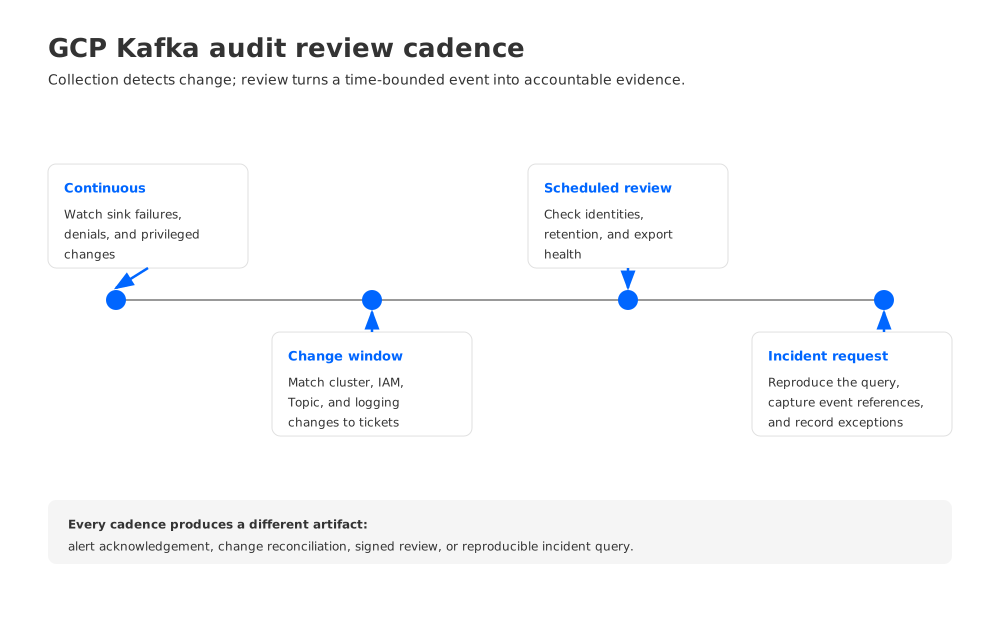
Use a cadence that separates detection from formal evidence collection:
| Cadence | Review focus | Evidence artifact |
|---|---|---|
| Continuous or alert-driven | Export failures, denied access spikes, logging configuration changes, and unexpected privileged actions | Alert record with event query, owner, and acknowledgement |
| Each change window | Cluster, IAM, Topic, connector, or logging changes | Change ticket matched to audit events and post-change verification |
| Scheduled control review | Privileged identities, allowlist changes, retention policy, and sink health | Signed review record with exceptions and remediation owner |
| Incident or audit request | Bounded timeline across control-plane, Kafka, and application evidence | Reproducible query set, event references, and chain-of-custody notes |
The review query should be reproducible. Save the time range, filters, project or organization scope, and the identifier of the exported result. Avoid relying on screenshots as sole evidence because they hide query context and make later verification difficult. If a reviewer finds a missing field or an unexplained gap, open an exception with a reason, impact, compensating control, and target date.
5Where AutoMQ fits in an audit evidence plan
The evidence framework should survive a change in Kafka deployment. When the data plane runs in a customer-owned environment, the team can draw a clearer boundary around which logs stay in the customer cloud account and which management events belong to the control plane.
AutoMQ is a Kafka-compatible cloud-native streaming platform built on a Shared Storage architecture. In AutoMQ BYOC, the control plane and data plane run in the customer cloud account, so the audit plan can assign ownership to the customer’s logging, IAM, network, and storage controls. The AutoMQ architecture overview describes the separation between Kafka-facing compute and durable object storage. The deployment boundary does not remove audit work; it makes the boundary explicit.
Evaluate AutoMQ with the same evidence questions used for a managed GCP Kafka service:
- Which control-plane actions are attributable to a human or ServiceAccount?
- Which broker, Controller, Kafka ACL, and storage events are available in the target release?
- Where do logs and metrics reside, and which customer identity can retrieve them?
- How are retention, export failure, and deletion permissions tested?
- Can an investigator correlate a cluster change with client access and application behavior?
The GCP deployment guide for AutoMQ on GKE is a starting point for the infrastructure boundary. Confirm release-specific audit surfaces and logging integrations before making a compliance claim.
6FAQ
6.1Are Cloud Audit Logs enough for Kafka compliance on GCP?
They cover Google Cloud resource activity within their documented scope. Kafka authentication, ACL decisions, broker behavior, connector actions, and application evidence may live elsewhere. Build a joined evidence map and record the boundary for each event class.
6.2Are Admin Activity and Data Access logs configured the same way?
No. Google Cloud documents different collection behavior for these categories, and service-specific coverage can vary. Check the target project, service, method, and exclusion settings before relying on a category in a control.
6.3How long should GCP Kafka audit logs be retained?
The right period comes from your regulatory, contractual, and incident-response requirements. Apply it separately to audit logs and Kafka records, verify the destination policy, and run a retrieval test. This article does not prescribe a universal duration.
6.4What should a review package contain?
Include the control statement, source systems, query or report, time range, event references, reviewer, outcome, exceptions, and retention evidence. A package should let another reviewer repeat the lookup without guessing which project or filter was used.
A GCP Kafka audit program becomes credible when every control question has a named event source, a retention boundary, and a person who reviews the result. Start by testing one privileged change from request to evidence, then extend the map to access and data events. If you are evaluating a customer-owned Kafka data plane, start an AutoMQ evaluation with the same audit worksheet, retrieval test, and exception process.


