
Table of Contents
Table of Contents
An Apache Kafka deployment on GCP rarely produces a bill in the shape your platform users recognize. A team owns a topic, a product owns a connector, and an analytics group owns the replay job, yet the bill may show compute, storage, network, and service line items that cross all three. If finance sends the whole amount to the platform team, the number is easy to post and hard to act on. If every line is forced into a project label, shared infrastructure disappears from the model.
A useful GCP Kafka cost allocation model keeps two ideas together: assign direct usage to the workload that caused it, and make shared spend visible with an allocation rule that someone can audit. That approach turns a monthly total into an operating conversation about retention, replay, throughput, and ownership. It also gives FinOps a way to compare deployment choices without promising savings before the current SKU export and workload measurements are known.
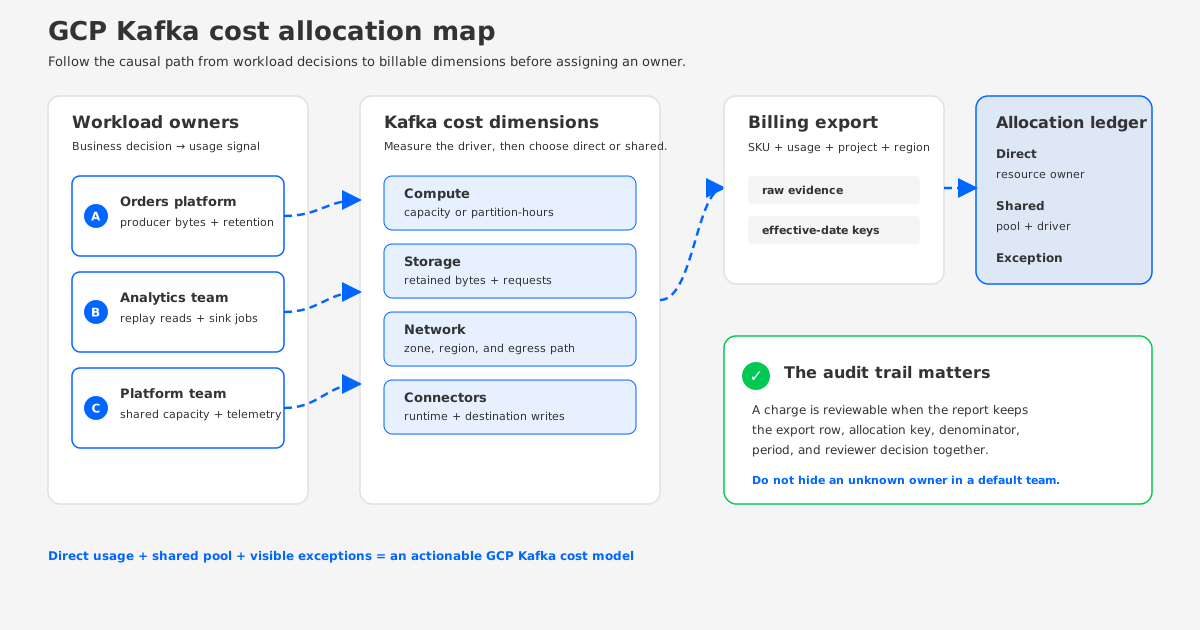
1Start with cost dimensions, not team names
Team names are the last field in an allocation model, not the first. Begin by listing the cost dimensions that can move when a Kafka workload changes. Google Cloud’s Managed Service for Apache Kafka pricing separates several dimensions, but the exact billable SKUs and usage units must be checked in the project’s current export.
For a GCP Kafka platform, the working inventory usually includes:
- Compute: broker or service capacity that stays provisioned for the cluster or instance.
- Local or attached storage: capacity and operations tied to the selected storage path.
- Remote or durable storage: retained bytes, requests, and any tier or lifecycle behavior exposed by the service.
- Network: inter-zone, inter-region, or egress traffic created by replication, clients, connectors, and replay jobs.
- Connectors and downstream services: connector runtime, destination writes, BigQuery or Dataflow consumption, and related processing.
- Operations: monitoring, logging, backup, and control-plane resources that support more than one workload.
This list is a review frame rather than a price sheet. A service can combine, rename, or expose these dimensions differently, and a customer-managed cluster has a different boundary from a managed service. Record the SKU description, service, project, region, usage unit, and billing account directly from the current export before assigning an owner.
A useful test is to ask what would happen if one workload stopped producing records. Compute may remain unchanged, while network, connector writes, or retained bytes change later. That delay is why a single “Kafka cost per team” number can conceal the causal path.
2Make ownership explicit in the billing export
Google Cloud Billing export to BigQuery gives FinOps a durable place to join usage and ownership metadata. The export is evidence, not an automatic chargeback model. You still need a stable mapping between a billable resource and the workload that uses it.
Use labels or an equivalent inventory key where the service supports them. Keep the key vocabulary small enough to enforce:
| Field | Example value | Why it matters |
|---|---|---|
environment | prod | Separates production commitments from testing and migration work. |
region | us-central1 | Preserves the location that shapes storage and network charges. |
owner_team | orders-platform | Names the accountable service owner, not a temporary project alias. |
workload | order-events | Connects topics, connectors, and replay jobs to one business flow. |
cost_class | direct or shared | Prevents shared platform lines from vanishing into a default team. |
A label is useful only if it survives the path from resource inventory to export. Test that path with a small set of known resources, then record exceptions. Some service-generated resources, network flows, or managed control-plane lines may not carry the same labels as the resource that initiated them. Treat those lines as an explicit reconciliation queue instead of silently assigning them to the first team that notices.
The ownership key should also be versioned. When a topic changes team, preserve the effective date so a month-end report can explain why the same workload appears under two owners. This is more reliable than editing last month’s allocation after the fact.
3Separate direct spend from shared platform work
Direct attribution is strongest when one workload creates a measurable line. A dedicated connector runtime, an isolated project, or a workload-specific downstream job can often be charged directly. Shared costs need a different rule because the platform exists even when one workload is quiet.
Use a ledger with three buckets:
- Direct: assign the exported cost to the resource or workload key that generated it.
- Shared platform: place common brokers, observability, shared connectors, and common network paths in a named pool.
- Unallocated or exception: hold lines whose owner or usage signal is not yet trustworthy.
Do not force the third bucket to zero. An exception balance is a control that tells the platform team where telemetry or inventory is incomplete. Once the evidence is fixed, the line can move to direct or shared allocation in the next close.
For a shared pool, choose an allocation key that reflects the cost driver. Retained bytes can allocate durable storage; partition-hours or provisioned capacity can allocate a standing compute service; measured bytes or request counts can allocate network and connector work. If a billable line has no defensible driver, allocate it as a platform charge and document the decision instead of inventing precision.
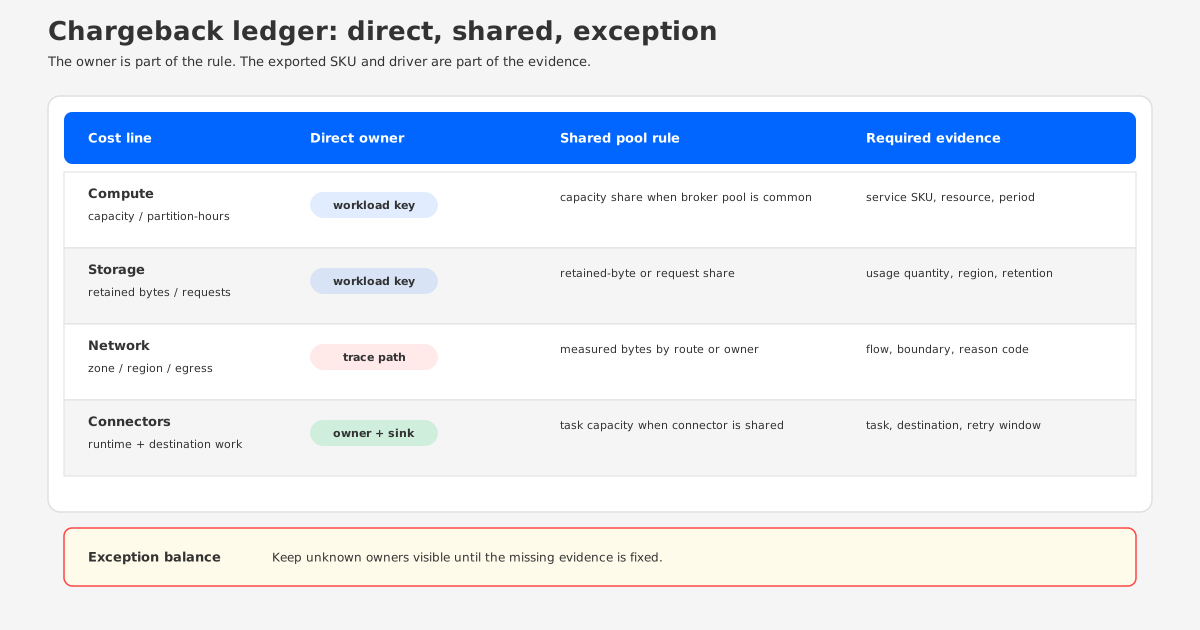
A simple formula is enough to make the rule reviewable:
workload charge = direct usage cost + (shared pool × workload allocation key / total allocation keys)
The formula does not make the result correct by itself. The review must show the exported cost, the denominator, the period, and the version of the allocation key. If a replay job temporarily increases reads, the report should make that change visible rather than spreading it across unrelated producers.
4Treat network and connectors as causality problems
Network is where allocation models most often lose the plot. A producer team may create the records, a shared cluster may replicate them, and a separate analytics team may read them across a zone or region. Charging all traffic to the producer rewards the wrong behavior; charging it to the platform hides the downstream decision that created the bytes.
Trace the path before assigning a line:
- Which client or connector produced the bytes?
- Which boundary did the traffic cross: zone, region, VPC, or public egress?
- Was the traffic normal tailing, replication, backfill, or retry traffic?
- Does the destination team control the retention or replay policy that increased the reads?
Connectors deserve the same treatment. Charge their runtime directly when it is dedicated. For a shared connector cluster, allocate by task capacity or measured records only if those signals are stable and documented. Destination writes belong in the destination service’s own cost model; otherwise the Kafka report becomes a proxy for a larger pipeline bill.
This path-based view also helps resolve disputes. When an analytics owner sees a replay line tied to a historical offset and a cross-region route, the conversation can focus on the decision and its evidence. The team can defend the line with evidence. For a broader inventory of Kafka cost drivers, compare it with Google Cloud Kafka cost optimization.
5Set a monthly review loop that can change the model
Chargeback is useful only when it changes behavior before the next invoice. Keep the close process small and repeatable:
- Export: freeze the billing period and the source usage tables.
- Normalize: map SKU, project, region, resource, and ownership keys to a stable schema.
- Allocate: apply direct mappings, shared-pool rules, and exception handling.
- Review: compare changes with retention, traffic, connector, and replay events.
- Adjust: update the inventory or rule with an effective date, then preserve the previous result.
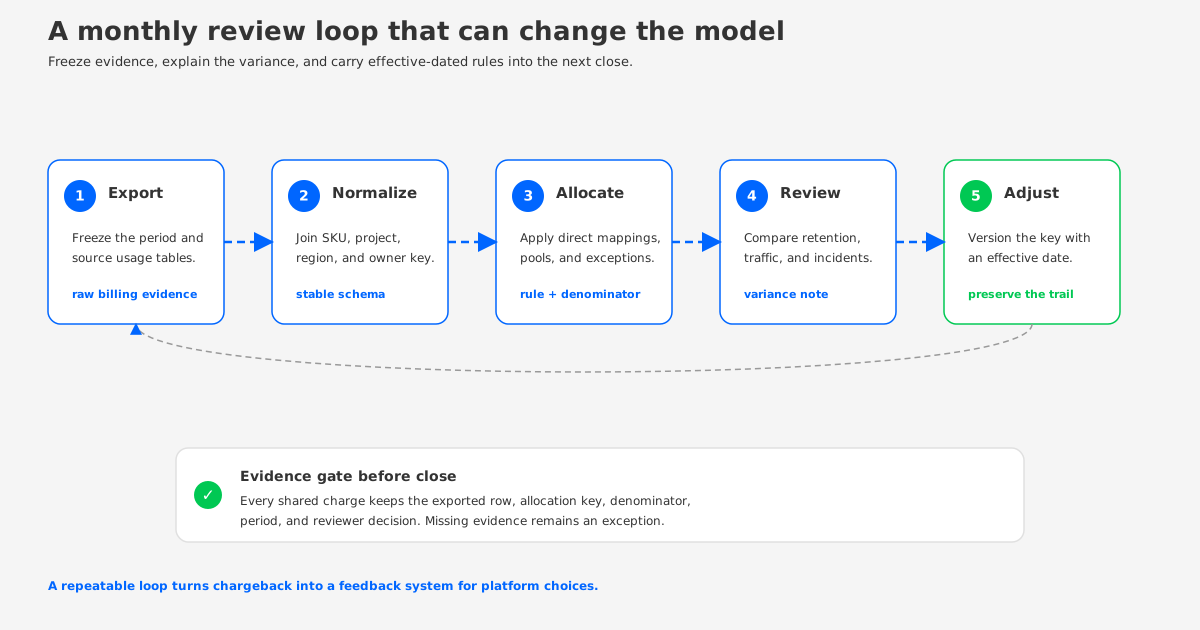
A review should answer four questions without opening a spreadsheet archaeology project:
- Which workload changed the most, and which measurable dimension explains the change?
- Which shared pool grew without a corresponding owner or usage signal?
- Which exception lines are still unallocated, and what evidence is missing?
- Which allocation rule should be tested against next month’s export?
Keep a variance note beside the report. A change in topic retention, a migration rehearsal, a connector retry storm, or a region move can all change the shape of spend without indicating a steady-state trend. The note gives engineering and finance a common explanation while the raw export remains the source of truth. See the companion FinOps reporting guide for that handoff.
6Where a Shared Storage architecture changes the comparison
Once the cost dimensions and ownership rules are explicit, you can compare a managed GCP Kafka service, a self-managed deployment, and a Kafka-compatible Shared Storage architecture on the same ledger. That is the point at which AutoMQ becomes relevant: it is a Kafka-compatible cloud-native streaming platform that separates broker compute from durable object storage in customer-controlled deployment models.
The architecture does not remove the need for allocation. It changes which assumptions must be measured. A customer-owned deployment can expose compute capacity, WAL type, object-storage bytes, requests, network paths, and control-plane resources as separate review dimensions. The architecture overview is useful when mapping those paths, but current product capabilities and storage options should be rechecked for the target release and GCP design.
Use the same questions for every architecture:
| Question | Evidence to collect |
|---|---|
| What stays provisioned when traffic is quiet? | Capacity configuration, instance inventory, and idle-period usage. |
| Which bytes are durable, cached, replicated, or replayed? | Storage metrics, object requests, WAL metrics, and consumer offsets. |
| Which team controls the cost driver? | Ownership key, change record, and service-level decision. |
| Can a shared line be explained at month end? | Export row, allocation rule, denominator, and reviewer sign-off. |
This keeps the comparison honest. A different storage architecture may make cost drivers easier to see or allow compute and storage decisions to evolve independently, but the result still depends on measured workload shape, retention, network topology, and the current GCP bill.
7FAQ
7.1Should every Kafka topic have its own GCP project?
No. Separate projects can simplify ownership, but they also add administration and may not isolate every shared service. A stable workload key plus an explicit shared-pool rule can be sufficient when the export preserves the required evidence.
7.2How should teams split a shared Kafka cluster?
Use a driver that follows the cost dimension: provisioned capacity for standing compute, retained bytes for storage, and measured traffic for network or connector work. Publish the driver and denominator with the report so teams can challenge the rule with evidence.
7.3Can cost allocation prove that one Kafka architecture has lower cost?
It can make the comparison measurable; it cannot prove a universal outcome. Recalculate with the current GCP SKUs, measured traffic, retention, replay behavior, and operational resources for the workload under review.
7.4What should happen to unallocated spend?
Keep it visible as an exception balance, assign an owner to resolve the missing evidence, and carry the line forward until the mapping is trustworthy. Hiding it inside a default team removes the incentive to fix the data.
A useful allocation model ends where it started: with a bill that explains who made which streaming decision. If your team is comparing a managed service, self-managed Kafka, and customer-owned shared storage on GCP, start an AutoMQ evaluation with the same workload ledger and the same evidence rules.


