
Table of Contents
Table of Contents
Choosing a Kafka path on Google Cloud is rarely a single product comparison. It is a commitment about application semantics, operating model, data-plane ownership, procurement boundaries, and the cost shape your platform can sustain. The wrong decision may pass a proof of concept and fail later, when retention grows, consumer lag creates bursty reads, partitions need to move, or procurement asks why a managed service still needs a large platform team around it.
The realistic options are not limited to "run Kafka" or "use Pub/Sub." Most GCP teams evaluate five paths: self-managed Apache Kafka on Compute Engine or GKE, Google Cloud Managed Service for Apache Kafka, Pub/Sub, Confluent Cloud on Google Cloud, and a Kafka-compatible shared-storage system such as AutoMQ. Each path can be rational. The decision depends on which constraints are hard requirements and which are preferences.
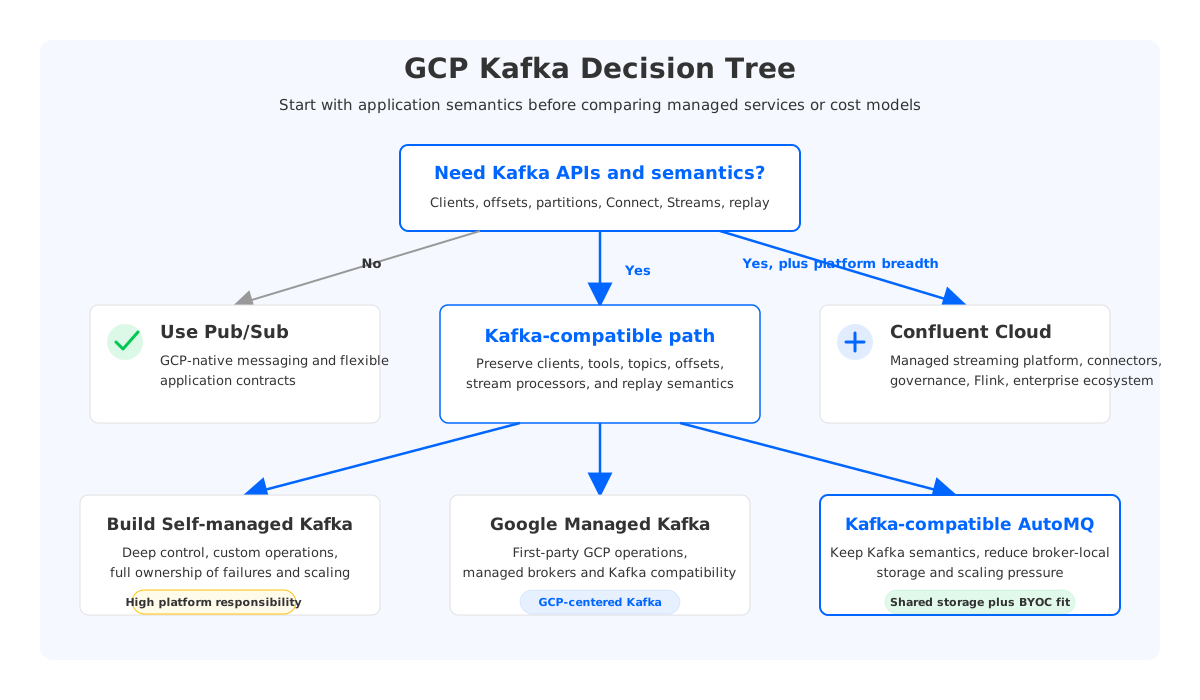
The useful way to decide is to start from questions that are difficult to change later: Do your applications require Kafka APIs and Kafka semantics? Do you want GCP-native messaging more than Kafka ecosystem portability? What cost model can you defend under long retention and uneven traffic? How much control do you need over the data plane? How much migration work can your organization absorb?
1The Five GCP Kafka Paths
Self-managed Kafka gives teams the highest implementation control: broker sizing, disk type, network layout, monitoring, upgrade windows, partition strategy, security model, and automation. It fits mature Kafka operators or platform teams that treat Kafka as a core internal product. The cost is full ownership of broker failures, disk pressure, reassignment, upgrades, capacity forecasting, and incidents.
Google Cloud Managed Service for Apache Kafka reduces that burden while preserving Apache Kafka compatibility. It runs open source Apache Kafka, works with existing Kafka applications, and integrates provisioning, storage management, patching, logging, and metrics with Google Cloud operations tooling.
Pub/Sub is a different category: a fully managed real-time messaging service for decoupling applications, event ingestion, and Google Cloud integrations. It can be a strong default when applications do not require Kafka clients, partition semantics, Kafka Connect, Kafka Streams, or Kafka-specific operations.
Confluent Cloud is a managed data streaming platform available on Google Cloud, with managed Kafka, connectors, stream governance, Flink, enterprise security features, and the broader Confluent ecosystem. It can make sense when an organization wants a commercial streaming platform and accepts the vendor control plane, pricing model, and data-plane architecture.
AutoMQ fits a narrower branch: teams that need Kafka compatibility and ecosystem continuity but do not want broker-local storage and scaling behavior to dictate cost and operations. It keeps Kafka-compatible access while using object-storage-backed shared storage, so brokers can behave more like elastic compute than durable data holders.
2Decision Question 1: Do You Need Kafka API Compatibility?
Kafka compatibility is not a checkbox if your platform already has application code, connector pipelines, stream processing jobs, dashboards, and incident playbooks built around Kafka. Replacing Kafka with a different messaging abstraction can be worthwhile, but it becomes an application migration rather than an infrastructure migration.
Ask this question before comparing prices:
- Are producers and consumers already using Kafka clients directly?
- Do teams depend on partitions for ordering, scaling, or workload isolation?
- Do applications use Kafka Connect, Kafka Streams, Flink Kafka connectors, or ecosystem tools that assume Kafka protocols?
- Are offset management, replay, compaction, transactional writes, or topic-level retention part of the application contract?
- Would changing the messaging system require coordinated releases across many teams?
If the answer is yes across several of these points, Pub/Sub may still be valuable for specific pipelines, but it is unlikely to be a drop-in replacement. Managed Kafka, Confluent Cloud, self-managed Kafka, and AutoMQ stay closer to the existing contract.
If the answer is no, Pub/Sub deserves serious attention. Teams building new GCP-native services, event ingestion flows, or loosely coupled application messaging may prefer the operational simplicity of Pub/Sub over carrying Kafka semantics they do not need.
3Decision Question 2: GCP-Native Messaging or Kafka Ecosystem Portability?
GCP-native messaging and Kafka portability optimize for different futures. Pub/Sub integrates naturally with Google Cloud services and removes broker thinking from the application team, which is attractive when the strategy is to standardize on Google Cloud primitives.
Kafka portability matters when the streaming layer must outlive a single cloud, connect many data platforms, or preserve a familiar interface across environments. In CDC, lakehouse ingestion, observability, fraud detection, personalization, feature stores, and stream processing, the value is the ecosystem contract as much as the broker.
A practical rule is this: choose Pub/Sub when the application boundary is cloud-native and the messaging contract is flexible. Choose a Kafka-compatible path when the application boundary is Kafka-shaped and portability is a real requirement.
Many mature GCP architectures use both: Pub/Sub for GCP-native notifications and ingestion, Kafka-compatible infrastructure for streams that require partitioned replay, ecosystem tooling, or multi-cloud portability.
4Decision Question 3: What Cost Model Can You Sustain?
Kafka cost on GCP is not only broker price. It includes compute, storage, retained data, inter-zone traffic, replication overhead, operational labor, monitoring, incident handling, and migration cost. Proofs of concept often hide long retention, fan-out reads, uneven partitions, and recovery objectives.
Self-managed Kafka can be cost-effective with experienced operators and predictable workloads, but expensive when teams over-provision disks, keep extra brokers for failover, or spend engineering cycles on rebalancing and recovery. Managed Kafka shifts some work to Google, while Confluent Cloud bundles more platform services into a commercial offering.
Pub/Sub has a different pricing and scaling shape. It may be attractive when the workload maps cleanly to Pub/Sub and the team avoids Kafka-specific infrastructure, but a Kafka-to-Pub/Sub rewrite carries engineering, semantic, testing, and retraining cost.
AutoMQ's cost argument is architectural rather than a generic discount claim. Traditional Kafka binds durable log storage to brokers. When data grows, brokers and disks often grow together, and partition movement can become a data-copying operation. A shared-storage design moves durable data into object storage and lets brokers focus on serving compute and cache. That can relieve storage and scaling pressure for workloads with long retention, large replay windows, or elastic traffic. The right evaluation is not "which option has the lowest list price," but "which cost model remains stable when data volume and operational complexity grow."
5Decision Question 4: How Much Control Do You Need Over the Data Plane?
Control means different things to different teams: logs and incident procedures for SRE, encryption and IAM boundaries for security, billing and accountability for procurement, and data location for governance.
Self-managed Kafka provides the most direct control and responsibility. Google Cloud Managed Service for Apache Kafka provides first-party Google Cloud IAM, networking, Cloud Monitoring, Cloud Logging, and managed patching. Confluent Cloud provides strong ecosystem services, with a control model defined by Confluent's platform.
BYOC is worth evaluating when the organization wants managed lifecycle benefits while keeping the data plane in its own cloud account or network boundary. AutoMQ's BYOC and shared-storage positioning is relevant here because the decision is not only about Kafka compatibility. It is also about who controls infrastructure, where data resides, and whether the architecture can use object storage without giving up Kafka-shaped application behavior.
This question is often decisive for regulated industries, large enterprises, and platform teams serving many business units. A technically elegant service may still be a poor fit if the security, residency, or procurement model creates friction.
6Decision Question 5: How Much Migration Effort Can You Afford?
Migration effort has two layers. The visible layer is infrastructure: clusters, networking, topics, data movement, bootstrap endpoints, and throughput validation. The deeper layer is semantics: ordering, consumer groups, retries, dead-letter patterns, schemas, observability, and runbooks.
A Kafka-to-Kafka migration is not free, but it preserves more of the application contract. Moving to Google managed Kafka, Confluent Cloud, or AutoMQ usually keeps Kafka clients and many ecosystem integrations, while still requiring tests for auth, quotas, monitoring, and topic settings.
A Kafka-to-Pub/Sub migration can be strategically correct when the team wants GCP-native messaging, but it should be planned as application modernization: map topics and subscriptions, rethink ordering and replay, update clients, and validate downstream processing.
The lower the migration budget, the more valuable Kafka compatibility becomes. The higher the appetite for redesign, the more room there is to choose Pub/Sub for workloads that no longer need Kafka semantics.
7Where AutoMQ Fits in a Neutral Decision Framework
AutoMQ should not be treated as a generic answer to every GCP messaging problem. If your application is cloud-native, does not use Kafka APIs, and benefits from direct Google Cloud integration, Pub/Sub may be the cleaner path. If your organization wants a broad commercial data streaming platform with governance, managed connectors, and Flink services, Confluent Cloud may be a strong fit. If you require first-party Google Cloud management and standard Apache Kafka, Google Cloud Managed Service for Apache Kafka is the obvious candidate to evaluate.
AutoMQ becomes relevant when four conditions show up together:
- Kafka APIs and Kafka semantics must be preserved.
- Storage growth, retention, or replay workloads are becoming a major cost driver.
- Partition reassignment, broker scaling, or recovery creates operational drag.
- The organization cares about data-plane control, cloud account boundaries, or BYOC-style deployment.
In that branch, the architectural distinction matters. AutoMQ is Kafka-compatible, but its durable storage model is not the traditional broker-local disk model. By using shared object storage with a write-ahead log and broker cache, it separates durable data from broker compute. For GCP teams, the practical question is whether Google Cloud Storage-backed economics and elasticity can reduce the operational pressure that made Kafka difficult in the first place.
8Final Decision Matrix
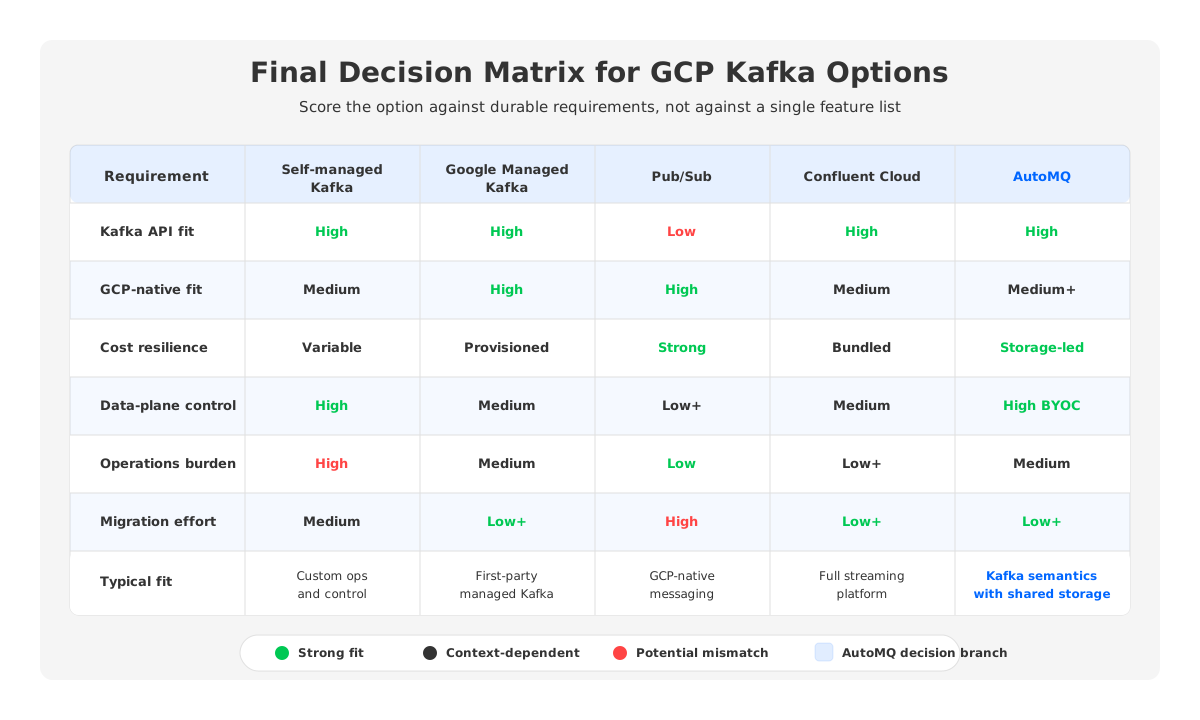
Use the matrix as a starting point, not a substitute for workload testing.
| Requirement | Self-managed Kafka | Google managed Kafka | Pub/Sub | Confluent Cloud | AutoMQ |
|---|---|---|---|---|---|
| Kafka API compatibility | High | High | Low | High | High |
| GCP-native operations | Medium | High | High | Medium | Medium to high |
| Operational ownership | High | Medium | Low | Low to medium | Medium |
| Data-plane control | High | Medium | Low to medium | Medium | High in BYOC scenarios |
| Kafka ecosystem portability | High | High | Low | High | High |
| Storage and scaling pressure relief | Low to medium | Medium | High for non-Kafka workloads | Medium to high | High for Kafka-compatible workloads |
| Migration effort from Kafka | Medium | Low to medium | High | Low to medium | Low to medium |
The table usually leads to three conclusions: Pub/Sub is strongest when Kafka compatibility is not required; managed Kafka services are strongest when teams want Kafka with fewer broker operations; AutoMQ is most relevant when teams want Kafka semantics but a different storage and elasticity model.
9A Practical Next-Step Workflow
Do not start with a vendor shortlist. Start with workload facts: traffic, retention, fan-out, replay, and migration constraints.
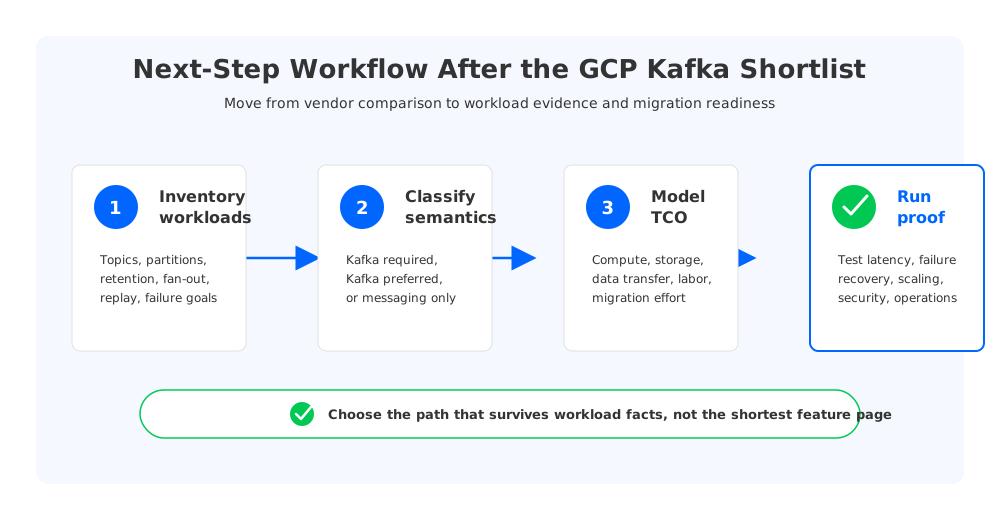
Inventory producers, consumers, topics, partitions, retention, compaction, throughput, fan-out, replay behavior, and failure tolerance. Then classify each workload by compatibility requirement.
Build a cost model under realistic conditions: retained data, replication, inter-zone traffic, burst reads, staffing, and migration time. Then test the two or three surviving options for throughput, latency, failure recovery, scaling, observability, security review, and day-two operations.
The decision is not about finding a universally superior GCP Kafka option. It is about matching the messaging architecture to the constraints your organization cannot escape.
10References
- Google Cloud Managed Service for Apache Kafka overview
- Google Cloud Managed Service for Apache Kafka pricing
- Google Cloud Pub/Sub documentation
- Google Cloud Pub/Sub service overview
- Confluent Cloud documentation
- Apache Kafka APIs documentation
- AutoMQ compatibility with Apache Kafka
- AutoMQ S3Stream shared storage overview
- AutoMQ S3 storage architecture
11FAQ
11.1Is Pub/Sub a replacement for Kafka on GCP?
Pub/Sub can replace Kafka for workloads that only need managed messaging and can adopt Pub/Sub's APIs and semantics. It is not a transparent replacement for Kafka clients, Kafka Connect, Kafka Streams, topic configuration, partition-based design, or Kafka offset behavior. Treat Kafka-to-Pub/Sub as an application migration, not a broker migration.
11.2When should a team choose Google Cloud Managed Service for Apache Kafka?
It is a strong candidate when the team wants first-party Google Cloud operations while preserving Apache Kafka compatibility. It is especially relevant for organizations standardizing on Google Cloud IAM, networking, monitoring, logging, and managed infrastructure.
11.3When does self-managed Kafka still make sense on GCP?
Self-managed Kafka can make sense when a platform team needs deep configuration control, already has mature Kafka automation, or has requirements that managed services cannot support. The tradeoff is full ownership of upgrades, failures, disk pressure, partition movement, and capacity planning.
11.4Where does AutoMQ fit among GCP Kafka alternatives?
AutoMQ fits when Kafka compatibility is required but traditional Kafka storage and scaling mechanics are the pain point. Its shared-storage design uses object storage for durable data and keeps brokers closer to elastic compute, which can help teams evaluating Kafka-compatible BYOC and storage-efficient architectures.
11.5What should FinOps teams compare before approving a GCP Kafka option?
Compare provisioned compute, persistent storage, retained data, data transfer, replication overhead, operations staffing, incident cost, migration effort, and growth scenarios. A realistic model should include long retention and replay behavior, not only steady-state ingest throughput.


